Opinion: AI Bubble Bursts, Bitcoin and Other Risky Assets Are the First to Be Impacted

marsbit2026-06-30 tarihinde yayınlandı2026-06-30 tarihinde güncellendi

Özet

BIS Warns AI Investment Boom Could Trigger Market Stress, Impacting Bitcoin First The Bank for International Settlements (BIS) warns that a potential bursting of the "AI bubble" could tighten liquidity and severely impact risk assets like Bitcoin in the near term. Major tech firms are projected to spend over $1 trillion on AI infrastructure in 2025-2026. The BIS cautions that if returns fail to meet expectations, a sudden withdrawal of financing could turn this investment boom into a prolonged bust, creating ripple effects across financial markets. While AI holds long-term economic promise, the current scale and speed of investment, coupled with intense competition and physical bottlenecks (e.g., semiconductors, power grids), mirror historical bubbles. The report highlights that the AI funding web—spanning corporate debt, private credit, and complex vendor agreements—makes systemic risks harder to see. A disappointment in AI adoption could transmit stress through this chain, widening credit spreads and pressuring weaker borrowers. For Bitcoin, the initial reaction to such a market shock would likely be defensive. As liquidity tightens, investors typically sell liquid assets first, and Bitcoin often trades in line with other risk assets during portfolio de-risking. Recent correlations, like Bitcoin's drop following a sharp decline in South Korea's stock market, support this view. However, the longer-term outcome for Bitcoin depends on the policy response. If an AI-driven c...

Author: CryptoSlate

Compilation: Deep Tide TechFlow

Deep Tide Introduction: The Bank for International Settlements warns that the five tech giants will invest $1 trillion in AI infrastructure from 2025 to 2026. If the return on investment falls short of expectations, a funding squeeze could first impact risky assets like Bitcoin. While loose monetary policy may benefit Bitcoin in the long run, traders must first survive this round of sell-offs.

Over the past year, AI trading has become one of the main pillars supporting global risk appetite.

However, the Bank for International Settlements (BIS) is now warning: if expected returns fail to materialize, this spending frenzy could become a source of financial stress.

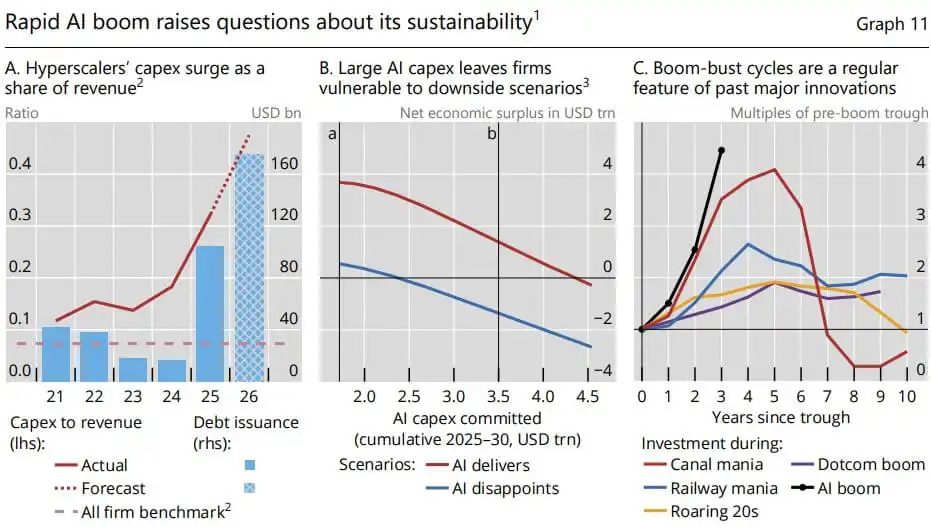
In its annual economic report, the Basel-based institution that advises central banks noted that the five largest cloud computing giants will have AI-related capital expenditures exceeding $1 trillion in 2025 and 2026.

The BIS stated that such massive investment raises the question of whether companies are committing too much capital before their business models are fully validated.

The BIS said:

"Disappointing returns could trigger a sudden withdrawal of financing, turning the capital expenditure boom into a prolonged investment slump, with knock-on effects on financial conditions."

For Bitcoin traders, the implications of this warning extend far beyond the chip and data center race in Silicon Valley.

A sharp reversal in AI spending could tighten liquidity in equity and credit markets, forcing cryptocurrencies to face a tough test: in a sell-off, will Bitcoin initially behave like another risky asset, or will its long-term monetary narrative regain strength after the shock?

AI Spending Boom Draws Central Bank Attention

The Bank for International Settlements (BIS), a forum for central banks, warned in its annual economic report that the race for AI dominance may be pushing investment to levels that future returns cannot sustain.

The BIS stated:

"If supply bottlenecks limit production, the current capital expenditure surge may not be sustainable. Fierce competition for market leadership could further fuel overinvestment, as seen in previous innovation waves, increasing the risk of a sharp reversal if AI returns disappoint."

The issue is not a lack of economic potential for AI. The BIS indicated that this technology could ultimately boost productivity in ways different from earlier waves of automation and software development. If AI systems can self-improve and help generate new ideas, the long-term macroeconomic impact could be significant.

But the near-term financial risks are different. Companies like Google, OpenAI, and Anthropic are pouring huge sums of money without clarity on how much revenue the spending will generate, how long that revenue will last, or how quickly the infrastructure behind AI will become obsolete.

In practice, the largest tech companies are splurging on chips, cloud capacity, data centers, power supplies, and networking equipment, competing for users and market share.
The scale of this race has helped solidify investor confidence in tech stocks while boosting demand for suppliers and infrastructure companies linked to AI construction.

However, the BIS warned that intense competition itself creates fragility. If every major player spends heavily to avoid falling behind, the entire industry could end up with overcapacity, lower returns, and financing structures difficult to maintain once optimism fades.

This dynamic has occurred before. The BIS pointed to earlier investment booms associated with canals, railways, electrification, and the internet.

While each technology later transformed the economy, they also produced periods where investors financed too much, too fast, ultimately leading to painful reversals.

With this in mind, the BIS concluded:

"The scale and speed of the current AI investment boom, coupled with expectations of a significant productivity boost, resemble these precedents and highlight the potential near-term downside risks."

Compounding the issue are severe physical bottlenecks. The insatiable demand for computing power is straining supplies of advanced semiconductors, grid equipment, and raw electricity.

According to the BIS, this surging demand is already pushing up electricity prices, potentially feeding into broader inflation measures—at a time when geopolitical conflicts in the Middle East are independently straining global supply chains.

Credit Risks Build Beneath Equity Rally

Meanwhile, the BIS's concerns extend far beyond a simple stock market correction to how an AI shock could affect the broader financial system.

While the early stages of AI development were funded largely by the massive cash reserves of Silicon Valley giants, the current trillion-dollar scale of investment relies more on debt and increasingly opaque financing structures.

The BIS noted that AI infrastructure now spans corporate debt markets, private credit, lease financing, data center construction, energy contracts, and supplier agreements.

Chipmakers, cloud providers, AI labs, and data center operators are becoming increasingly interconnected through equity investments, procurement commitments, and long-term capacity trades.

Indeed, Bitcoin-focused financial services firm Onramp Bitcoin recently pointed out:

"A web of overlapping commitments now binds AI construction into roughly a $1 trillion loop: Nvidia invests in AI labs like OpenAI, the labs lease cloud capacity from Oracle and CoreWeave, and those cloud services buy Nvidia chips. The same dollar can be booked simultaneously as investment, funding, revenue, and sales, so headline numbers are no longer as meaningful as they appear."
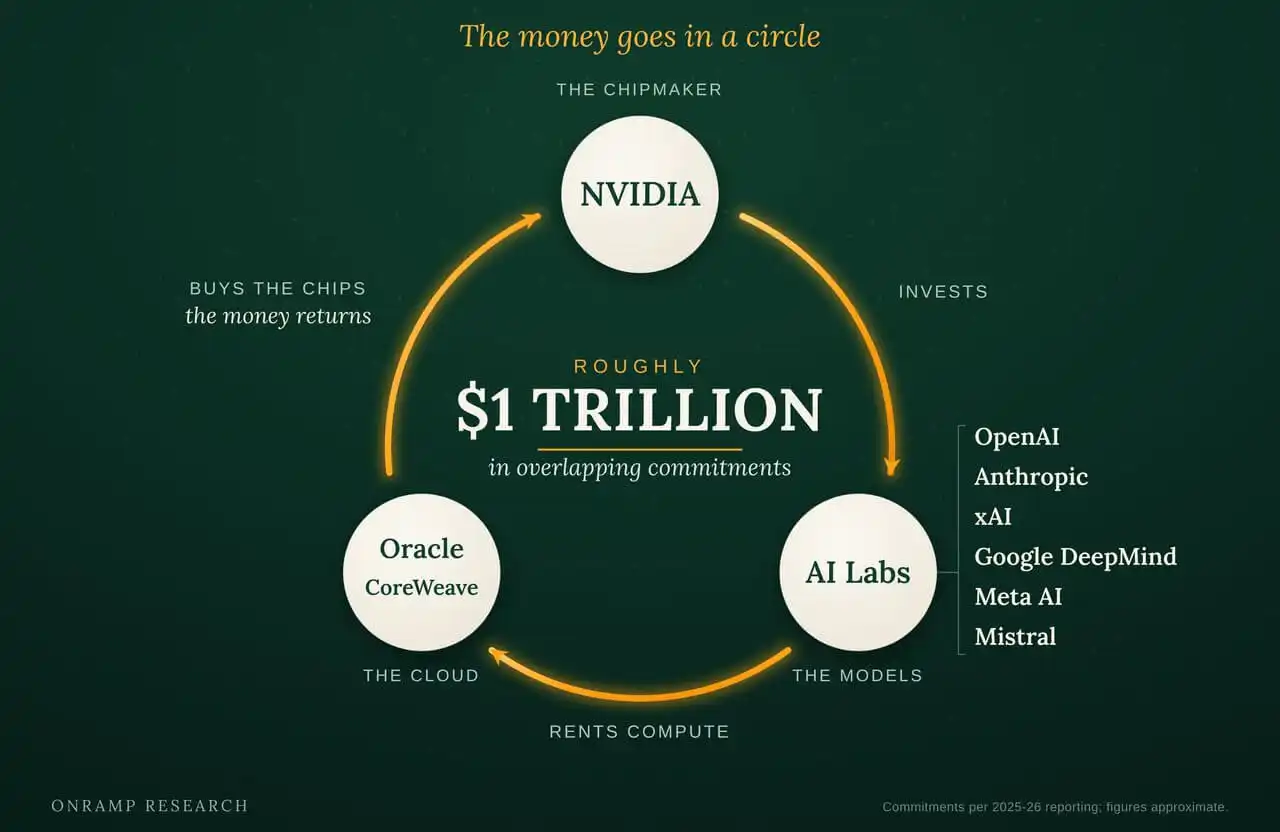
The BIS warned that these arrangements can make risks harder to see, noting that this network of claims is built on expectations of future demand. If AI adoption continues to accelerate, this structure can be self-reinforcing.

But if demand disappoints, stress could reverberate back through the chain.

This could lead to a scenario where suppliers might lose orders, and data center developers might struggle to fill capacity.

Meanwhile, private credit funds could face stress on loans linked to software, infrastructure, or tech borrowers. Banks might find their exposure to private credit and non-bank finance more complex than surface numbers suggest.

This is why the BIS's warning extends beyond tech stocks. A decline in AI-related stocks directly hurts investors. A broader reassessment of AI financing could tighten credit conditions for companies relying on the same funding environment.

Credit spreads have remained relatively narrow, reflecting investor belief that borrowers can continue servicing debt.

A sharp repricing of equity risk could quickly change that. Once lenders demand more risk compensation, weaker borrowers face higher refinancing costs, reduced access to capital, and pressure to cut investment.

This is the path through which AI disappointment could evolve into a macro event.

Bitcoin's Initial Reaction May Be Defensive

In such an economic shock, Bitcoin's role would be complex. Proponents of the asset often describe it as a hedge against currency debasement, fiscal stress, and financial system fragility. Its supply is fixed, it has no corporate issuer, and it does not rely on corporate profits or debt repayment schedules.

These properties could become more attractive if an AI credit crunch ultimately forces policymakers to ease financial conditions. But in the early stages of a broad sell-off, Bitcoin would likely face the same pressure as other risk assets.

When liquidity tightens, investors typically sell liquid positions first. Bitcoin trades continuously, can be sold quickly, and is held by many investors who also own stocks, exchange-traded products, derivatives, and other high-beta assets. This makes it vulnerable during portfolio de-risking.

Recent market behavior supports this concern. CryptoSlate recently reported that Bitcoin fell below $63,000 after South Korea's benchmark KOSPI stock index plunged nearly 10% last week.

This decline suggests that liquidity conditions, leverage, and risk appetite can overwhelm the scarcity narrative for extended periods.

A market shock triggered by AI could follow a similar sequence. Tech stocks linked to construction might fall first. As investors reassess debt linked to data centers, suppliers, and private financing vehicles, credit spreads could widen. Funds facing losses or margin pressure might subsequently cut positions in cryptocurrencies and other liquid assets.

At that stage, Bitcoin wouldn't need a direct link to AI infrastructure to be affected. It just needs to be part of the same risk budget.

Liquidity Questions Follow

But the second stage depends on the government's response to the ensuing market distress.

If a reversal in AI investment remains confined to a small group of tech companies, the damage could be limited. Stocks would reprice, suppliers would adjust, investors would reassess valuations, without forcing a major shift in monetary policy.

But the risk flagged by the BIS is that the spending boom is already large enough to affect the broader financial system.

This suggests that a significant pullback in AI capital expenditure could simultaneously hit corporate investment, employment, household wealth, and credit availability. If inflation remains high and central banks feel unable to cut rates quickly, these pressures could become more severe.

This creates a difficult scenario for risk assets. Higher inflation could keep policy tight even as investment weakens. Tighter credit could expose leverage in private markets. Falling stock prices could reduce household wealth and slow consumption. Each channel could reinforce the others.

For Bitcoin, the policy path is crucial. This asset typically performs best when liquidity is expanding, real rates are falling, and investors anticipate central bank support for markets. A credit shock that ultimately brings looser money could restart that trade.

BitMEX co-founder Arthur Hayes believes that an AI crash could help propel Bitcoin significantly higher if authorities respond by re-creating liquidity, and investors shift away from debt-laden financial structures.

This view remains speculative, but it captures why some crypto traders see AI capital expenditure and credit markets as potential drivers for the next Bitcoin cycle.

But the timing is uncertain. Therefore, traders betting on an eventual liquidity response may still have to endure the preceding drawdown.

Bitcoin rose 2.28% in the past 24 hours and is currently ranked first by market capitalization.

Broader Market Status

Currently, the total cryptocurrency market capitalization is $2.09 trillion, with a 24-hour trading volume of $81.45 billion. Bitcoin's dominance is 57.97%.

For two years, buying more Bitcoin was enough to push up treasury stock prices. Strategy's BTC Yield is now declining, Metaplanet's market capitalization is below the value of its Bitcoin holdings, and new entrants in Europe are asking investors to fund them at terms no one is pricing.


Trend Kriptolar

İlgili Sorular

QAccording to the BIS's warning, what could be the initial impact on Bitcoin and other risk assets if the trillion-dollar AI investment boom fails to deliver expected returns?

AThe initial impact would likely be a sharp sell-off. Liquidity could tighten across equity and credit markets, forcing investors to de-risk their portfolios. As a highly liquid asset held by many of the same investors exposed to tech stocks and high-beta assets, Bitcoin would be vulnerable to these initial waves of selling pressure and would likely behave like another risk asset.

QWhat specific financial system vulnerabilities does the BIS highlight regarding the current AI infrastructure investment boom?

AThe BIS highlights vulnerabilities in the complex and opaque financing web binding the AI ecosystem. This includes corporate debt, private credit, leasing, and long-term capacity contracts between chipmakers, cloud providers, AI labs, and data center operators. This structure, built on expectations of future demand, could transmit stress throughout the chain if demand disappoints, potentially impacting banks with indirect exposure and tightening credit conditions more broadly.

QWhy might Bitcoin's price action be complex in the scenario of an AI-induced market shock, according to the article?

ABitcoin's price action would be complex due to a potential two-phase reaction. In the initial phase, it would likely fall alongside other risk assets as investors sell liquid holdings. However, if the shock is severe enough to force central banks to ease monetary policy and inject liquidity to prevent a broader crisis, Bitcoin's long-term narrative as a hedge against monetary debasement could reassert itself, potentially leading to a significant rally in a subsequent phase.

QWhat historical precedents does the BIS cite to support its concern about the current AI investment surge?

AThe BIS cites historical investment booms associated with major technological innovations like canals, railroads, electrification, and the internet. While these technologies ultimately transformed economies, they also led to periods where investment and financing raced ahead of sustainable returns, resulting in painful reversals and downturns.

QApart from financial risks, what other challenge does the BIS identify that could hinder the AI investment boom?

AThe BIS identifies severe physical bottlenecks as a major challenge. The insatiable demand for computing power is straining supplies of advanced semiconductors, grid equipment, and raw electricity. This is already pushing up electricity prices and could contribute to broader inflationary pressures, adding another layer of economic complexity.

İlgili Okumalar

In the AI Era, What's Left for Bitcoin?

As Bitcoin falls below $60,000, the author reflects on the relationship between AI and Bitcoin, seeing them as two sides of the same coin. In the AI era, the cost of generating content has plummeted, making fake text, images, and videos increasingly easy and cheap to produce. This has led to a fundamental shift: while AI dramatically lowers the cost of information production, it also undermines trust and authenticity online. What becomes truly valuable is not more content, but the ability to verify what is real—"verifiability." This perspective offers a new lens for Bitcoin. Its massive energy consumption, often criticized as wasteful, is reinterpreted. While AI burns energy to enhance "capability" and efficiency, Bitcoin burns energy to produce "verifiability." Its purpose is not to be trusted but to enable a system where no trust in intermediaries—banks, platforms, or developers—is needed. Every transaction and the entire ledger's history is secured by cryptography and a decentralized network of nodes, making it independently verifiable. AI cannot forge a transaction on the Bitcoin network because the system is designed for proof, not generation. The author draws a historical parallel to the Renaissance: the printing press drastically reduced the cost of copying knowledge, while double-entry bookkeeping reduced the cost of trust in commerce. Today, AI is the new printing press, reducing content creation costs to near zero. Blockchain, and Bitcoin as its pioneer, may be the modern equivalent of double-entry bookkeeping—a foundational technology for verifying digital asset ownership and historical records without centralized authorities. Thus, AI and blockchain are not competitors. AI lowers the cost of creation; blockchain lowers the cost of verification. In an age where AI can generate anything, true scarcity may lie not in more content, but in independently verifiable facts. Whether the market will reprice Bitcoin accordingly remains uncertain, but its core value proposition as a "machine for producing verifiability" becomes strikingly relevant.

marsbit17 dk önce

In the AI Era, What's Left for Bitcoin?

marsbit17 dk önce

In the Age of AI, What's Left for Bitcoin?

Author: Sevclub, Seven Research Amid Bitcoin's recent drop below $60k, the author reflects on a growing sense that AI and Bitcoin are two sides of the same coin. Today, encountering any content triggers a new default question: "Was this made by AI?" The cost of generating convincing text, images, and video is now negligible. While the internet lowered information *distribution* costs, AI is crashing information *production* costs to near zero. The consequence is a flood of content where truth and falsehood are increasingly indistinguishable. In this environment, what becomes truly valuable is not more information, but the ability to verify what is real—"verifiability." This reframes the common criticism that Bitcoin "wastes electricity." AI consumes power to produce "capability" (e.g., more powerful models). Bitcoin consumes power to produce something else: "verifiability." Bitcoin's core purpose isn't about belief or trust in any institution, developer, or even its creator. It's about enabling independent verification. Every bitcoin's origin, every transaction, and the integrity of the entire ledger are secured by mathematics, cryptography, and a global network of nodes. AI can fabricate convincing media, but it cannot falsify a transaction on the Bitcoin network. The expended energy makes篡改历史 (tampering with history) prohibitively expensive, purchasing a globally verifiable ledger. The author draws a historical parallel to the Renaissance. The printing press drastically reduced the cost of copying knowledge, while double-entry bookkeeping reduced the cost of trust in commerce—one enabled creation, the other verification. Today, AI is the new printing press, driving content production costs toward zero. The question becomes: what is this era's "double-entry bookkeeping"? Blockchain appears to be the leading candidate. It doesn't verify which news is true or which image is real, but it provides a foundational layer for independently verifying asset ownership and historical records in the digital realm without centralized authorities. Therefore, AI and blockchain are not in competition. AI lowers the cost of *generation*. Blockchain (and Bitcoin as a prime example) lowers the cost of *verification*. One creates, the other proves. Whether Bitcoin ultimately succeeds remains uncertain, facing potential challenges from quantum computing, regulation, and technical evolution. However, the author now sees it less as a "machine for making bitcoin" and more as a "machine for making verifiability." In an age where AI can generate anything, true scarcity may no longer be "more content," but "more independently verifiable facts." Whether the market will price this accordingly is a separate question.

链捕手26 dk önce

In the Age of AI, What's Left for Bitcoin?

链捕手26 dk önce

İşlemler

Spot

Popüler Makaleler

BITCOIN Nedir

HarryPotterObamaSonic10Inu (ERC-20)'yu ve Kripto Alanındaki Yerini Anlamak Son yıllarda, kripto para piyasası, hem ticaret yapanların hem de topluluk etkileşimi ve eğlence değeri arayanların ilgisini çeken meme coin'lerin popülaritesinde bir artış gördü. Bu benzersiz token'lar arasında, kripto para dokusuna kültürel referansları harmanlayan ilginç bir proje olan HarryPotterObamaSonic10Inu (ERC-20) bulunmaktadır. Bu makale, HarryPotterObamaSonic10Inu'nun temel yönlerini, mekanizmalarını, topluluk odaklı ethosunu ve daha geniş kripto manzarasıyla etkileşimini incelemektedir. HarryPotterObamaSonic10Inu (ERC-20) Nedir? Adından da anlaşılacağı gibi, HarryPotterObamaSonic10Inu, Ethereum blok zinciri üzerinde inşa edilen bir meme coin'dir ve ERC-20 standardı altında sınıflandırılmaktadır. Geleneksel kripto paraların pratik kullanılabilirlik veya yatırım potansiyeline odaklandığı durumların aksine, bu token eğlence değeri ve topluluğunun gücü üzerine kuruludur. Proje, bağlı kullanıcıların bir araya gelebileceği, fikirlerini paylaşabileceği ve çeşitli kültürel fenomenlerden ilham alan etkinliklere katılabileceği bir ortam yaratmayı hedeflemektedir. HarryPotterObamaSonic10Inu'nun dikkate değer özelliklerinden biri işlemlerde sıfır vergi olmasıdır. Bu çekici unsur, küçük ölçekli yatırımcıları caydırabilecek ek ücretlerden yoksun olarak ticareti ve topluluk katılımını teşvik etmeyi amaçlamaktadır. Coin'in toplam arzı bir milyar token olarak belirlenmiştir; bu, topluluk içinde önemli bir dolaşım sağlama niyetini göstermektedir. HarryPotterObamaSonic10Inu (ERC-20) Yaratıcısı HarryPotterObamaSonic10Inu'nun kökenleri bir miktar gizemlidir; yaratıcısı hakkında spesifik bilgilerin ne olduğu bilinmemektedir. Bu token'ın geliştirilmesi, belirli bir ekip veya açık bir plan eksikliği ile gerçekleşmiştir; bu durum, meme coin sektöründe oldukça yaygındır. Proje, topluluğunun heyecanı ve katılımına dayalı olarak organik bir şekilde ortaya çıkmıştır. HarryPotterObamaSonic10Inu (ERC-20) Yatırımcıları Dış yatırımlar ve destekler söz konusu olduğunda, HarryPotterObamaSonic10Inu da belirsiz kalmaktadır. Token, bilinen herhangi bir yatırım fonunu veya önemli bir kurumsal desteği listelememektedir. Bunun yerine, projenin can damarı, kolektif eylem ve kripto alanındaki katılım yoluyla büyüme ve sürdürülebilirlik sağlayan temel topluluğudur. HarryPotterObamaSonic10Inu (ERC-20) Nasıl Çalışır? Bir meme coin olarak, HarryPotterObamaSonic10Inu, genellikle varlık değerini yöneten geleneksel çerçevelerin dışında çalışmaktadır. Projenin nasıl çalıştığını tanımlayan birkaç özelliği vardır: Sıfır Vergi İşlemleri: İşlemlerde vergi ücreti olmadan, kullanıcılar gizli maliyet endişesi olmadan token'ı serbestçe alıp satabilirler. Topluluk Etkileşimi: Proje, topluluk etkileşimi üzerine kuruludur ve sosyal medya platformlarını kullanarak heyecan yaratarak katılımı kolaylaştırır. Tartışmalar, içerik paylaşımı ve katılım, projenin erişimini genişletmeye ve destekleyiciler arasında sadakat oluşturmaya yardımcı olan kritik unsurlardır. Pratik Kullanılabilirlik Yok: HarryPotterObamaSonic10Inu'nun mali ekosistem içinde somut bir kullanılabilirlik sunmadığı belirtilmelidir. Daha ziyade, eğlence ve topluluk etkinlikleri için bir token olarak sınıflandırılmaktadır. Kültürel Referans: Token, popüler kültürden unsurları zekice harmanlayarak ilgi çekmektedir ve hem meme meraklıları hem de kripto takipçileriyle bağlantı kurmaktadır. HarryPotterObamaSonic10Inu, meme coin'lerin, daha geleneksel kripto para projelerinden nasıl farklı çalıştığını örneklendirmektedir; bu projeler, utilitarist varlıklar yerine yenilikçi sosyal yapıların bir parçası olarak piyasaya girmektedir. HarryPotterObamaSonic10Inu (ERC-20) Zaman Çizelgesi HarryPotterObamaSonic10Inu'nun tarihi, birkaç dikkate değer kilometre taşı ile işaretlenmiştir: Oluşum: Token, birçok kripto meraklısının hayal gücünü yakalayan bir viral meme'den ortaya çıkmıştır. Spesifik yaratım tarihleri mevcut değildir ve bu onun organik yükselişini vurgulamaktadır. Borsa Listelemeleri: HarryPotterObamaSonic10Inu, topluluğun daha kolay erişim ve ticaret yapabilmesini sağlamak için çeşitli borsalarda yer bulmuştur. Topluluk Katılım İnisiyatifleri: Yarışmalar, sosyal medya kampanyaları ve hayranlar ile destekçilerden içerik üretimini içeren topluluk etkileşimini artırmayı amaçlayan devam eden etkinlikler. Gelecek Genişleme Planları: Projenin yol haritası, kültürel temalarına ilişkin bir NFT koleksiyonu, ticari ürünler ve bir e-ticaret sitesi başlatılmasını içermektedir; bu da topluluğun daha fazla katılımını sağlamayı ve ekosistemine daha fazla boyut kazandırmayı hedeflemektedir. HarryPotterObamaSonic10Inu (ERC-20) Hakkında Kilit Noktalar Topluluk Odaklı Doğası: Proje, kullanıcı katılımını geliştirme önceliği taşır ve böylece kullanıcıların sürecin en önünde yer almasını sağlar. Meme Coin Sınıflandırması: Eğlenceye dayalı kripto paranın doruk noktasıdır ve geleneksel yatırım araçlarından ayrılmaktadır. Bitcoin ile Doğrudan İlişki Yok: Ticker ismindeki benzeliğe rağmen, HarryPotterObamaSonic10Inu ayırt edicidir ve Bitcoin veya diğer yerleşik kripto paralarla herhangi bir ilişkisi yoktur. İşbirliğine Odaklanma: HarryPotterObamaSonic10Inu, sahipleri arasında işbirliği ve hikaye paylaşımı için bir alan oluşturmak üzere tasarlanmıştır ve bu da yaratıcılık ve topluluk bağlarını sağlamaktadır. Gelecek Beklentileri: Başlangıçta belirlendiği temalardan NFTs ve ticari ürünlere genişleme arzusu, projenin dijital kültürde daha ana akıma girebilmesi için bir yol haritası çizmektedir. Meme coin'ler, kripto para topluluğunun hayal gücünü çalmaya devam ederken, HarryPotterObamaSonic10Inu (ERC-20), kültürel bağları ve topluluk merkezli yaklaşımıyla öne çıkmaktadır. Geleneksel bir hizmet odaklı token modeliyle uyumlu olmasa da, özünde destekçileri arasında sağlanan neşe ve dostluğu vurgulayarak, giderek dijitalleşen bir çağda kripto paraların evrilen doğasını göstermektedir. Proje gelişmeye devam ettikçe, topluluk dinamiklerinin blockchain teknolojisi dünyasındaki seyrini nasıl etkilediğini izlemek önemli olacaktır.

2.1k Toplam GörüntülenmeYayınlanma 2024.04.01Güncellenme 2024.12.03

BITCOIN Nedir

BTC Nasıl Satın Alınır

HTX.com’a hoş geldiniz! Bitcoin (BTC) satın alma işlemlerini basit ve kullanışlı bir hâle getirdik. Adım adım açıkladığımız rehberimizi takip ederek kripto yolculuğunuza başlayın. 1. Adım: HTX Hesabınızı OluşturunHTX'te ücretsiz bir hesap açmak için e-posta adresinizi veya telefon numaranızı kullanın. Sorunsuzca kaydolun ve tüm özelliklerin kilidini açın. Hesabımı Aç2. Adım: Kripto Satın Al Bölümüne Gidin ve Ödeme Yönteminizi SeçinKredi/Banka Kartı: Visa veya Mastercard'ınızı kullanarak anında Bitcoin (BTC) satın alın.Bakiye: Sorunsuz bir şekilde işlem yapmak için HTX hesap bakiyenizdeki fonları kullanın.Üçüncü Taraflar: Kullanımı kolaylaştırmak için Google Pay ve Apple Pay gibi popüler ödeme yöntemlerini ekledik.P2P: HTX'teki diğer kullanıcılarla doğrudan işlem yapın.Borsa Dışı (OTC): Yatırımcılar için kişiye özel hizmetler ve rekabetçi döviz kurları sunuyoruz.3. Adım: Bitcoin (BTC) Varlıklarınızı SaklayınBitcoin (BTC) satın aldıktan sonra HTX hesabınızda saklayın. Alternatif olarak, blok zinciri transferi yoluyla başka bir yere gönderebilir veya diğer kripto para birimlerini takas etmek için kullanabilirsiniz.4. Adım: Bitcoin (BTC) Varlıklarınızla İşlem YapınHTX'in spot piyasasında Bitcoin (BTC) ile kolayca işlemler yapın.Hesabınıza erişin, işlem çiftinizi seçin, işlemlerinizi gerçekleştirin ve gerçek zamanlı olarak izleyin. Hem yeni başlayanlar hem de deneyimli yatırımcılar için kullanıcı dostu bir deneyim sunuyoruz.

8.0k Toplam GörüntülenmeYayınlanma 2024.12.12Güncellenme 2026.06.02

BTC Nasıl Satın Alınır

$BITCOIN Nedir

DİJİTAL ALTIN ($BITCOIN): Kapsamlı Bir Analiz DİJİTAL ALTIN ($BITCOIN) Tanıtımı DİJİTAL ALTIN ($BITCOIN), geleneksel değerli metallerin özelliklerini merkeziyetsiz teknolojilerin yeniliği ile birleştirmeyi amaçlayan Solana ağı üzerinde çalışan blockchain tabanlı bir projedir. Bitcoin ile aynı isme sahip olmasına rağmen, genellikle bir değer saklama aracı olarak algılandığı için “dijital altın” olarak anılmaktadır; DİJİTAL ALTIN, Web3 ortamında benzersiz bir ekosistem yaratmak için tasarlanmış ayrı bir tokendir. Hedefi, uygulanabilir bir alternatif dijital varlık olarak kendini konumlandırmaktır, ancak uygulamaları ve işlevleri ile ilgili ayrıntılar hala gelişmektedir. DİJİTAL ALTIN ($BITCOIN) Nedir? DİJİTAL ALTIN ($BITCOIN), Solana blockchain'inde kullanılmak üzere açıkça tasarlanmış bir kripto para tokenidir. Bitcoin'in yaygın olarak tanınan bir değer saklama rolü sağlamasının aksine, bu token daha geniş uygulamalara ve özelliklere odaklanıyor gibi görünmektedir. Dikkate değer yönler şunlardır: Blockchain Altyapısı: Token, yüksek hızlı ve düşük maliyetli işlemleri yönetme kapasitesi ile bilinen Solana blockchain'inde inşa edilmiştir. Arz Dinamikleri: DİJİTAL ALTIN'ın maksimum arzı 100 katrilyon token (100P $BITCOIN) ile sınırlıdır, ancak dolaşımdaki arzı ile ilgili ayrıntılar şu anda açıklanmamıştır. Kullanım Alanı: Kesin işlevler açıkça belirtilmemiş olsa da, token'ın merkeziyetsiz uygulamalar (dApps) veya varlık tokenizasyon stratejileri ile ilgili çeşitli uygulamalar için kullanılabileceğine dair işaretler bulunmaktadır. DİJİTAL ALTIN ($BITCOIN) Yaratıcısı Kimdir? Şu anda, DİJİTAL ALTIN ($BITCOIN) arkasındaki yaratıcıların ve geliştirme ekibinin kimliği bilinmemektedir. Bu durum, merkeziyetsiz finans ve meme coin fenomenleriyle uyumlu olan birçok yenilikçi proje arasında yaygındır. Böyle bir anonimlik, topluluk odaklı bir kültürü teşvik edebilirken, yönetişim ve hesap verebilirlik konusundaki endişeleri artırmaktadır. DİJİTAL ALTIN ($BITCOIN) Yatırımcıları Kimlerdir? Mevcut bilgiler, DİJİTAL ALTIN ($BITCOIN) için bilinen herhangi bir kurumsal destekçi veya önde gelen risk sermayesi yatırımı olmadığını göstermektedir. Proje, geleneksel finansman yolları yerine topluluk desteği ve benimsemeye odaklanan bir eşler arası modelde çalışıyor gibi görünmektedir. Faaliyetleri ve likiditesi esas olarak PumpSwap gibi merkeziyetsiz borsalarda (DEX'ler) yer almakta olup, bu da onun taban hareketine vurgu yapmaktadır. DİJİTAL ALTIN ($BITCOIN) Nasıl Çalışır DİJİTAL ALTIN ($BITCOIN) 'ın operasyonel mekanikleri, blockchain tasarımı ve ağ özellikleri temelinde açıklanabilir: Konsensüs Mekanizması: Solana'nın benzersiz tarih kanıtı (PoH) ile bir hisse kanıtı (PoS) modelini birleştirerek, proje ağın yüksek performansına katkıda bulunan verimli işlem doğrulamasını sağlar. Tokenomik: Belirli deflasyonist mekanizmalar kapsamlı bir şekilde detaylandırılmamış olsa da, geniş maksimum token arzı, henüz tanımlanmamış mikro işlemler veya niş kullanım durumlarına hitap edebileceğini ima etmektedir. Etkileşim: Solana'nın daha geniş ekosistemi ile entegrasyon potansiyeli bulunmaktadır; bu, çeşitli merkeziyetsiz finans (DeFi) platformlarını içermektedir. Ancak, belirli entegrasyonlarla ilgili ayrıntılar belirtilmemiştir. Önemli Olayların Zaman Çizelgesi DİJİTAL ALTIN ($BITCOIN) ile ilgili önemli kilometre taşlarını vurgulayan bir zaman çizelgesi: 2023: Token'ın Solana blockchain'inde ilk dağıtımı, sözleşme adresi ile işaretlenmiştir. 2024: DİJİTAL ALTIN, PumpSwap gibi merkeziyetsiz borsalarda işlem görmeye başladıkça görünürlük kazanır ve kullanıcıların bunu SOL karşısında ticaret yapmasına olanak tanır. 2025: Proje, topluluk odaklı etkileşimlere yönelik potansiyel ilgi ve ara sıra ticaret faaliyetleri görür, ancak şu ana kadar dikkate değer ortaklıklar veya teknik ilerlemeler belgelenmemiştir. Kritik Analiz Güçlü Yönler Ölçeklenebilirlik: Temel Solana altyapısı, yüksek işlem hacimlerini destekleyerek $BITCOIN'in çeşitli işlem senaryolarındaki faydasını artırabilir. Erişilebilirlik: Token başına potansiyel düşük ticaret fiyatı, perakende yatırımcıları çekebilir ve parçalı mülkiyet fırsatları sayesinde daha geniş katılımı kolaylaştırabilir. Riskler Şeffaflık Eksikliği: Kamuya açık olarak bilinen destekçilerin, geliştiricilerin veya bir denetim sürecinin olmaması, projenin sürdürülebilirliği ve güvenilirliği konusunda şüpheler doğurabilir. Piyasa Volatilitesi: Ticaret faaliyeti büyük ölçüde spekülatif davranışa dayanmakta olup, bu da yatırımcılar için önemli fiyat dalgalanmalarına ve belirsizliklere yol açabilir. Sonuç DİJİTAL ALTIN ($BITCOIN), hızla gelişen Solana ekosisteminde ilginç ama belirsiz bir proje olarak ortaya çıkmaktadır. “Dijital altın” anlatısını kullanmaya çalışırken, Bitcoin'in değer saklama rolünden ayrılması, amaçlanan faydasının ve yönetişim yapısının daha net bir şekilde tanımlanması gerekliliğini vurgulamaktadır. Gelecekteki kabul ve benimseme, mevcut belirsizliklerin giderilmesine ve operasyonel ile ekonomik stratejilerinin daha açık bir şekilde tanımlanmasına bağlı olacaktır. Not: Bu rapor, Ekim 2023 itibarıyla mevcut olan sentezlenmiş bilgileri kapsamaktadır ve araştırma döneminin ötesinde gelişmeler yaşanmış olabilir.

153 Toplam GörüntülenmeYayınlanma 2025.05.13Güncellenme 2025.05.13

$BITCOIN Nedir

Tartışmalar

HTX Topluluğuna hoş geldiniz. Burada, en son platform gelişmeleri hakkında bilgi sahibi olabilir ve profesyonel piyasa görüşlerine erişebilirsiniz. Kullanıcıların BTC (BTC) fiyatı hakkındaki görüşleri aşağıda sunulmaktadır.

活动图片