TradFi和传统股票,到底什么关系?

火币成长学院2026-06-18 tarihinde yayınlandı2026-06-18 tarihinde güncellendi

Özet

用最通俗的方式,把TradFi和传统股票的关系讲清楚。

先讲个故事:老李的困惑

老李是个在币圈玩了两年多的投资者。有一天,他在HTX的合约页面看到了一个叫“TradFi”的专区,点进去发现里面能交易黄金(XAU)、原油(USOIL)、还有苹果、英伟达、特斯拉的标的。

老李有点懵:“苹果不是股票吗?怎么跑到币圈平台来了?TradFi到底是什么?它跟股票是一回事吗?”

这个问题并不奇怪。对于习惯了Crypto世界的用户来说,“TradFi”是一个相对陌生的概念。这篇文章就用最通俗的方式,把TradFi和传统股票的关系讲清楚。

一个比喻,秒懂两者关系

想象你在盖一栋房子:

传统股票,是房子里的一块砖头。它是一样具体的东西——买苹果股票,就代表你拥有苹果公司的一小块所有权,苹果赚钱了你可以分红,苹果股价涨了你卖掉能获利。

TradFi(传统金融),是整栋房子。这栋房子里除了股票这块砖,还有别的砖:债券、黄金、原油、外汇、国债……所有在区块链诞生之前就存在的金融资产,全都属于TradFi这个大范畴。

所以答案很清楚了:

TradFi是一个大类,传统股票是它里面最重要、最常见的组成部分之一。

你可以用下面这张表快速理解:

那为什么在币圈总听人说“TradFi”?

这是一个很好的问题。

以前在Crypto世界,大家聊的都是比特币、以太坊、各种山寨币,跟传统金融没啥关系。但近一两年情况变了:

- 2024年比特币现货ETF在美国获批,华尔街开始大规模买入比特币

- 越来越多传统资产被“代币化”,搬到了链上

- 像HTX这样的加密交易平台,直接上线了TradFi专区,让用户用USDT就能交易黄金、美股等传统资产的价格

所以现在在币圈语境下,“TradFi”通常指的是那些通过技术手段被引入加密世界、让Crypto用户也能接触到的传统金融资产。

在HTX的TradFi专区里,股票扮演了什么角色?

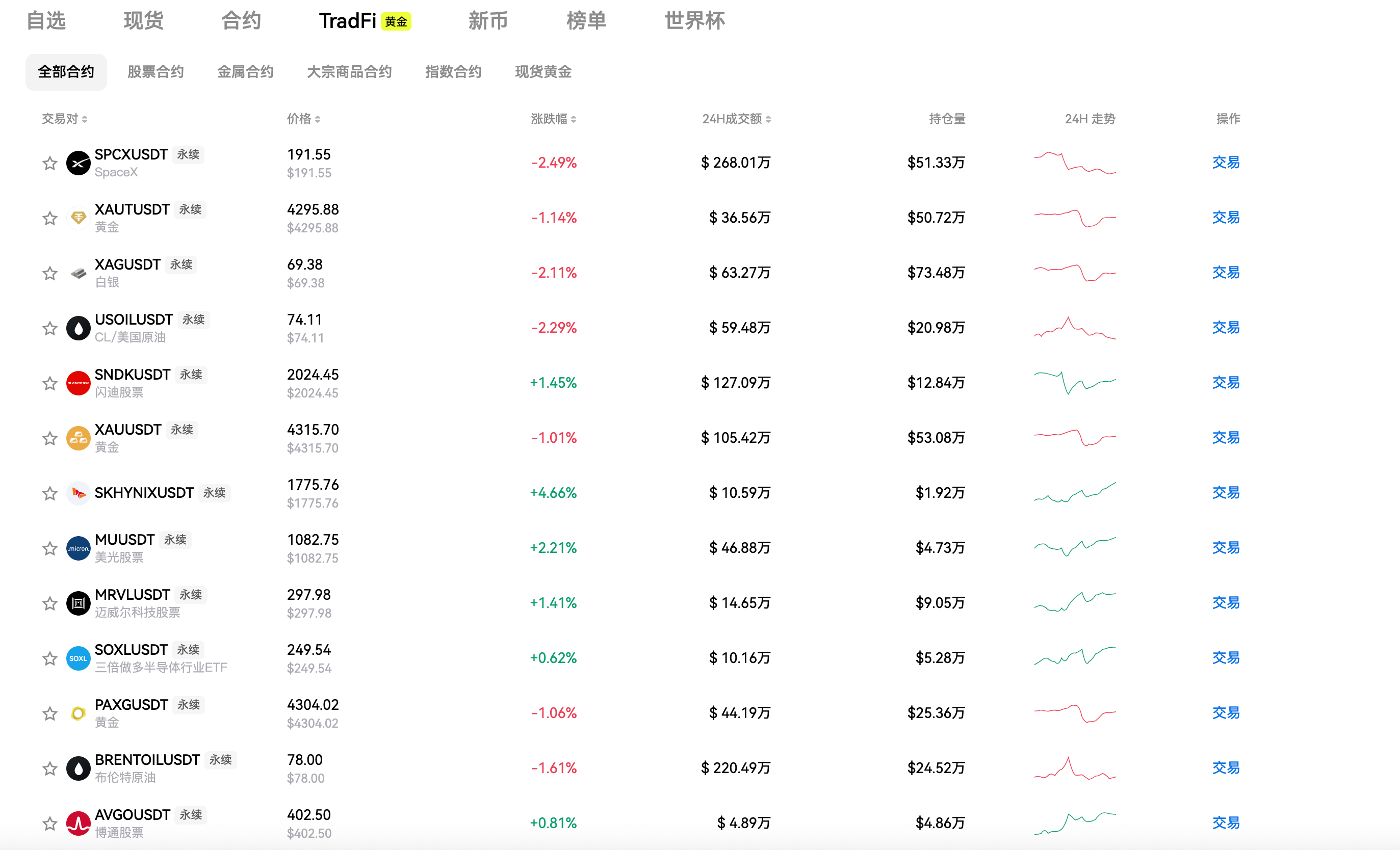
打开HTX的TradFi专区,你会发现里面有两类资产:

第一类:大宗商品和避险资产

- 黄金(XAU)——避险之王

- 白银(XAG)——贵金属兄弟

- 原油(USOIL)——工业血液

第二类:股票和股指

- 美股指数(SPX500)——追踪标普500整体走势

- 科技龙头(NVDA、TSLAX等)——追踪英伟达、特斯拉等个股价格

第二类就是“股票类TradFi资产”。也就是说,股票是TradFi专区里的重要组成部分,但TradFi不止有股票,还有黄金、原油等其他资产。
在HTX交易股票类TradFi,和买真正的股票一样吗?

不完全一样,但有相似之处。

相似的地方:价格走势一致

NVDA的TradFi合约价格紧跟英伟达真实股价。英伟达财报好、股价涨,这里的合约价格也会跟着涨。

不同的地方:交易方式不同
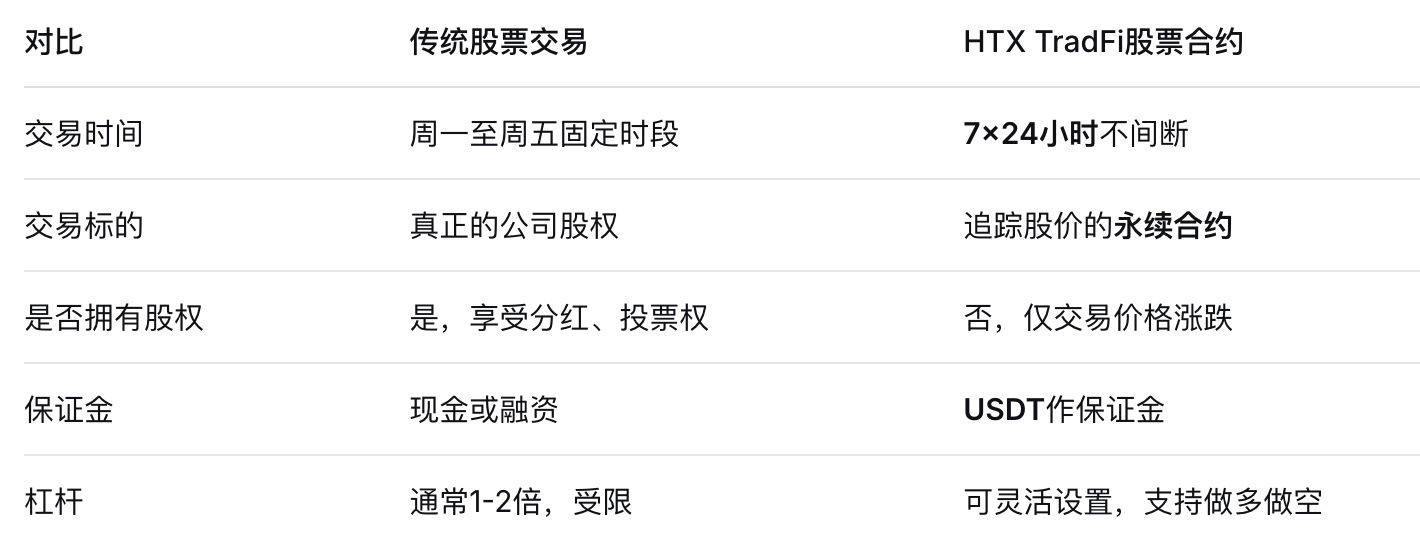
简单说:你用习惯的加密交易方式,去交易一个追踪传统股票价格的标的。

为什么要在币圈平台交易股票?直接买股票不就行了吗?

这是个很现实的问题。直接买股票确实可以,但有三个门槛:

门槛一:开户麻烦。传统券商开户需要各种身份认证,流程繁琐。

门槛二:交易时间受限。美股只在北京时间晚上开盘,白天想操作没门。

门槛三:做空工具少。下跌行情中想做空获利,传统账户操作复杂、限制多。

而在HTX的TradFi专区:

- 有USDT就能交易,不需要再去传统券商开户

- 7×24小时,随时可以买卖

- 做多做空一键切换,方向选对就能操作

四个要点,帮你快速记住TradFi和股票的关系

1. TradFi是大房子,股票是里面的砖头

2. 在币圈谈TradFi,特指“上链”了的传统资产,股票是其中重要一类

3. TradFi不只有股票,还包括黄金、原油、债券等

4. 在HTX交易股票类TradFi,体验类似加密合约,价格锚定真实股票,但底层逻辑是合约而非股权

写在最后

TradFi和传统股票的关系,不是什么高深理论,而是一把钥匙——帮你打开从Crypto走向更广阔金融世界的那扇门。

İlgili Okumalar

WeChat AI Card Hands-On Guide: Has the AI Shopping Era Arrived?

**"WeChat AI Card" Practical Test Guide: Has the Era of AI Shopping Arrived?** WeChat has officially launched the "AI Exclusive Card," a feature integrated into its Workbuddy AI assistant. This card is designed to handle payments for AI-initiated purchases. Our hands-on test reveals it's not yet a tool for fully autonomous AI shopping, but rather a controlled payment layer for AI agents. The AI Card functions as an isolated sub-wallet within WeChat Pay. Users must bind the card and transfer funds into it from their main wallet. Crucially, every transaction requires explicit user confirmation via smartphone scan; AI cannot spend autonomously. Currently accessible through the Workbuddy agent, the card targets specific digital consumption scenarios: purchasing paid content (reports, data), calling paid APIs/tools, and subscribing to services. Its design prioritizes security and control by separating funds and mandating approval for each payment. We tested a real-world scenario: ordering bubble tea via Workbuddy using a "Meituan Life Assistant" skill. The process encountered multiple hurdles: high "skill" usage costs (exceeding daily free credits), and most importantly, while a payment was successfully initiated, the AI purchased an incorrect product (a mismatched group-buy coupon instead of the desired drink). This highlights the current limitation: the **AI Card only solves the payment step**. The broader challenge lies in the **AI agent's execution chain**—accurately understanding intent, navigating third-party platforms, selecting the right product, and ensuring proper fulfillment. The payment succeeded, but the purchase failed to meet the user's need. In conclusion, the WeChat AI Exclusive Card is a cautious, early-step experiment in AI commerce. It provides a secure, user-controlled payment method for agent interactions but is not yet capable of reliable, end-to-end complex purchases. For now, it's best used for low-value, low-risk digital services with careful user verification at each step. The vision of AI handling complete shopping tasks remains a work in progress.

marsbit1 saat önce

WeChat AI Card Hands-On Guide: Has the AI Shopping Era Arrived?

marsbit1 saat önce

Deconstructing Notion's Growth: From a Note-taking Tool to 100 Million Users—How Notion Built a Triple Growth Flywheel Through Product, Templates, and Community

Notion's growth from a niche note-taking tool to a platform with 100 million users is powered by three interconnected flywheels: Product-Led Growth (PLG), a Template Economy, and Community-Driven Growth. First, Notion's PLG strategy relies on a highly flexible, "plastic" product that users can adapt to countless personal and team workflows. Its freemium model lowers the barrier to entry, while features like page sharing and collaboration drive organic, usage-based viral growth as users naturally invite others. Second, the Template Economy solves the "blank page" problem. Templates, created by both Notion and its community, transform abstract product capabilities into concrete, copyable solutions for specific scenarios (e.g., project management, content calendars). This dramatically lowers activation costs for new users and fuels SEO-driven discovery. Third, a vibrant Community acts as a distributed growth engine. Users and official Ambassadors create tutorials, share use cases, and host local events. This community not only educates users but also fosters a sense of identity around pursuing "better ways of working," strengthening loyalty and enabling global, low-cost expansion. Together, these flywheels create a self-reinforcing ecosystem: a great product attracts users who create templates and community content, which in turn attracts more users and deepens engagement. This system allowed Notion to scale from individuals to teams and enterprises through a bottom-up adoption path. Looking ahead, AI integration promises to accelerate these flywheels further by making templates smarter and the platform a potential AI-native work operating system. Ultimately, Notion's defensible advantage is not just its features, but this deeply entrenched network of user assets, creators, and community trust.

marsbit1 saat önce

Deconstructing Notion's Growth: From a Note-taking Tool to 100 Million Users—How Notion Built a Triple Growth Flywheel Through Product, Templates, and Community

marsbit1 saat önce

$10 Billion, Qualcomm to Acquire Chip Legend Jim Keller's Company

Global mobile chip giant Qualcomm is in advanced talks to acquire AI chip startup Tenstorrent in a deal valued between $8-10 billion, according to media reports. This potential acquisition would be one of the largest in the AI chip sector in recent years. Tenstorrent, led by legendary chip architect Jim Keller, has gained prominence for its RISC-V architecture and AI accelerator designs. The move highlights Qualcomm's strategic push to diversify beyond its core smartphone chip business. As the smartphone market matures, Qualcomm is aggressively targeting growth in automotive, data center, and cloud AI. Acquiring Tenstorrent would allow Qualcomm to rapidly enter the high-end AI computing market, bypassing lengthy in-house development cycles. Tenstorrent's cost-effective system architecture, which avoids expensive HBM memory and relies on standard Ethernet for clustering, offers a potential alternative to Nvidia's costly solutions. Furthermore, Tenstorrent's high-performance RISC-V CPU technology and its focus on the automotive and edge computing segments align with Qualcomm's strategic goals, including its "Snapdragon Digital Chassis" platform. Despite the strategic rationale, the high valuation has sparked some investor caution. The successful integration of Tenstorrent's open-source culture and independent team into Qualcomm's organization, along with the commercialization of its technology, remains a key challenge.

marsbit2 saat önce

$10 Billion, Qualcomm to Acquire Chip Legend Jim Keller's Company

marsbit2 saat önce

CARDS' Brutal Truth of $535M FDV: Only $43M Net Revenue, Profit Margin Halved

The article deconstructs Collector Crypt (CC), a blockchain-based platform for trading tokenized collectible cards, revealing a significant disparity between its high volume and actual business fundamentals. Key findings include: * CC's cumulative revenue of $635M is misleading; 90.6% is instantly returned to users via card buybacks, leaving only $43M in net revenue (6.7% retention). * Trading activity is minimal, with real secondary market trading below $5M. eBay sales as a percentage of volume have declined for six consecutive quarters. * The platform's user base is highly concentrated, with a few dozen high-frequency wallets driving most of the volume, resembling a "casino" with ~420 daily active players. * As volume shifts to higher-priced card packs, the net profit margin has halved from 11.2% to 5.8%. * Token value capture (via burns and buybacks) totals only $1.4M, just 3.4% of net revenue. Meanwhile, operational wallets have off-ramped $45.7M in USDC. * With a Fully Diluted Valuation (FDV) of ~$535M, the token trades at 7.3x net revenue. The float is only 20.5%, with 72% of the supply allocated to insiders and locked until November 2027. The analysis concludes that while CC has found product-market fit as a high-speed gacha machine, it shows little evidence of evolving into a sustainable collector's marketplace, with minimal value accruing to its CARDS token.

marsbit2 saat önce

CARDS' Brutal Truth of $535M FDV: Only $43M Net Revenue, Profit Margin Halved

marsbit2 saat önce

İşlemler

Spot
Futures
活动图片