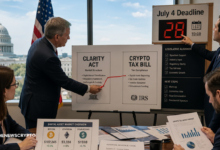
El Congreso Aplaza la Prohibición de la CBDC hasta 2030 mediante una Importante Ley de Reforma de Vivienda

TheNewsCrypto2026-06-17 tarihinde yayınlandı2026-06-17 tarihinde güncellendi

Özet

Los legisladores han aprobado un proyecto de ley de reforma de vivienda, la "Ley del Camino a la Vivienda del Siglo XXI", que incluye una prohibición temporal hasta el 31 de diciembre de 2030 para que la Reserva Federal emita un dólar digital (CBDC). La medida, integrada en esta legislación bipartidista más amplia, define el CBDC como un activo digital denominado en dólares y accesible para todos los estadounidenses. Sus defensores argumentan que esta pausa permite más tiempo para evaluar los impactos potenciales, reflejando preocupaciones sobre privacidad, vigilancia financiera y el papel del gobierno en los pagos digitales. La prohibición se aplicaría a cualquier CBDC minorista, ya sea emitida directamente por la Fed o a través de intermediarios, aunque se contemplan excepciones para dólares digitales privados que mantengan un nivel de privacidad comparable al efectivo físico. Aunque el foco del proyecto de ley son las reformas para mejorar la vivienda asequible y la oferta, la cláusula sobre el CBDC ha captado una atención significativa en la comunidad cripto, ya que podría influir en el futuro de los pagos digitales y en el debate sobre el lugar de los activos digitales en el sistema financiero del país. El desarrollo del proceso legislativo determinará si la prohibición entra en vigor durante la próxima década.

Los legisladores han aprobado un proyecto de ley destinado a impulsar reformas en materia de vivienda que incluyen una prohibición temporal de una CBDC de la Reserva Federal. La prohibición es una de las muchas propuestas incluidas en el proyecto de ley bipartidista, la Ley del Camino a la Vivienda del Siglo XXI. El proyecto de ley busca mejorar la vivienda asequible, aumentar la oferta de viviendas y llevar a cabo diversas reformas.

Una propuesta en el proyecto de ley prohíbe a la Reserva Federal crear un dólar digital antes del 31 de diciembre de 2030. Los legisladores insertaron esta disposición en el proyecto de ley más amplio sobre vivienda, en lugar de presentarla como una medida independiente relacionada con las criptomonedas. Según la propuesta, los legisladores clasifican una CBDC como un activo digital denominado en dólares. Esto constituye un pasivo directo de la Reserva Federal y permanece accesible para todos los estadounidenses.
Los partidarios de la disposición argumentan que otorga a los responsables de políticas tiempo adicional para evaluar los impactos potenciales de un dólar digital. La prohibición también refleja las preocupaciones que algunos legisladores han planteado sobre privacidad, vigilancia financiera y la participación del gobierno en los sistemas de pago digitales. Por otro lado, esta propuesta no impone restricciones a las redes blockchain sin permisos.

Enfoque en la Política de Cripto en la Legislación de Vivienda

Los legisladores diseñaron la legislación de vivienda para abordar los desafíos de oferta de vivienda a través de reformas en permisos, cambios regulatorios y oportunidades de financiación ampliadas. Sin embargo, es el lenguaje sobre la política de CBDC el que ha acaparado gran atención en la comunidad de criptomonedas, ya que impacta la posible emisión del dólar digital en el futuro. Este lenguaje fue adoptado en el Congreso a la luz de discusiones más amplias sobre el lugar de los activos digitales en el sistema financiero del país.

De acuerdo con el texto, la prohibición se aplica a los esfuerzos de la Reserva Federal para emitir una CBDC minorista, ya sea que se emita directamente por la institución o a través de intermediarios. Además, algunos borradores del proyecto de ley contienen una excepción en el caso de que los dólares digitales privados conserven características de privacidad comparables a las de los dólares físicos.

Los analistas del mercado continúan observando los desarrollos, ya que la legislación podría afectar futuras discusiones sobre pagos digitales y criptomonedas. Aunque el proyecto de ley de vivienda es en lo que los legisladores se están concentrando, la cláusula sobre las CBDC puede verse como un factor importante para el sector de las criptomonedas. Los próximos pasos en el proceso legislativo decidirán si la prohibición se hará efectiva durante la próxima década.

Noticias Destacadas de Criptomonedas:

Ethereum Avanza con la Actualización Glamsterdam Previo a su Lanzamiento Previsto para 2026

EtiquetasBlockchainCBDCcrypto legislaciónReserva FederalCongreso de EE.UU.

Trend Kriptolar

İlgili Sorular

Q¿Qué prohibe específicamente la propuesta incluida en el proyecto de ley de reforma de vivienda?

ALa propuesta prohíbe a la Reserva Federal crear un dólar digital (CBDC) antes del 31 de diciembre de 2030.

Q¿En qué proyecto de ley más amplio se insertó esta disposición sobre el dólar digital?

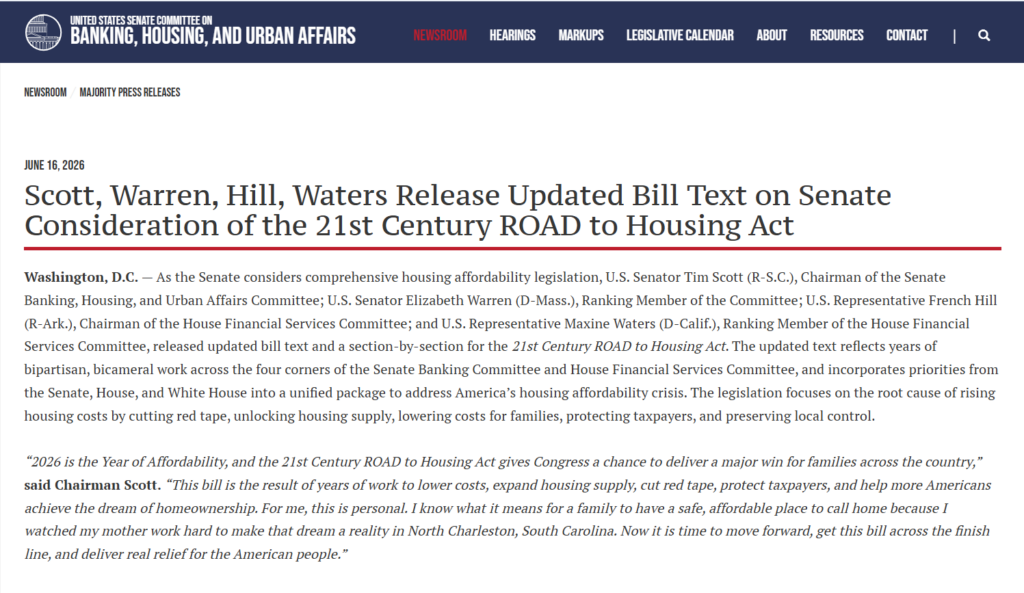
ALa disposición se insertó en el proyecto de ley bipartidista llamado '21st Century Road to Housing Act' (Ley del Camino a la Vivienda del Siglo XXI), enfocado en reformas de vivienda.

Q¿Cuáles son algunas de las preocupaciones que motivan esta prohibición temporal de un CBDC?

AAlgunos legisladores tienen preocupaciones sobre la privacidad, la vigilancia financiera y la participación del gobierno en los sistemas de pago digitales.

Q¿Aplica esta prohibición a las redes blockchain sin permiso (permissionless)?

ANo, la propuesta no impone restricciones a las redes blockchain sin permiso (permissionless).

Q¿Qué tipo de excepción se contempla en algunos borradores del proyecto de ley respecto a los dólares digitales?

AAlgunos borradores contemplan una excepción para los dólares digitales privados que mantengan características de privacidad comparables a las de los dólares físicos.

İlgili Okumalar

From Corning to Ciena: The 10x Opportunity in the AI Optical Communication Chain

The transition from copper to optical communication in AI data centers is creating significant investment opportunities beyond just chipmakers. The entire photonics supply chain, from glass and fiber to connectors and test equipment, is critical. Corning, a key fiber supplier, has locked in multi-billion dollar, multi-year contracts with major cloud providers (Meta, Amazon, Google, Microsoft, OpenAI, NVIDIA), demonstrating pricing power and scale. Its profit growth is outpacing revenue growth. In the interconnect layer, Amphenol benefits from high growth in AI data centers, driven by strategic acquisitions and operational efficiency, while Credo Technology acts as a bridge between copper and optical solutions, though with high customer concentration risk. At the systems level, Ciena enables higher data capacity on existing fiber lines, with a strong backlog and cloud customer adoption. Further upstream, AXT is a bottleneck supplier of key indium phosphide wafers for lasers but faces geopolitical supply chain risks. VEO Solutions provides essential testing equipment for the entire photonics industry. A new pure-play photonics ETF (FOTO) offers a consolidated investment approach. The core thesis is that the physical limits of copper are driving an inevitable shift to optical technologies, with wealth flowing to essential, often overlooked, suppliers across the photonics value chain.

marsbit13 dk önce

From Corning to Ciena: The 10x Opportunity in the AI Optical Communication Chain

marsbit13 dk önce

Collector Crypt's DAU Is Only 800, Yet It's Already One of Crypto's Most Profitable Projects?

"Collector Crypt: A Highly Profitable Crypto Project with Only 800 Daily Active Users?" Collector Crypt (CARDS) is a crypto project tokenizing physical graded trading cards (primarily Pokémon) on Solana, achieving significant real-world profitability and growth. According to a Maelstrom Fund analysis, it generated approximately $53M in annualized profit in May, with a June run-rate nearing $109M, against a $550M FDV. Its core revenue driver is a digital pack-opening 'Gacha' system. The platform bulk-buys cards at a 5-15% discount. Users can open digital packs and choose to keep cards or sell them back to the platform at a 7-15% discount to market price. Most users sell back common cards, creating an efficient model: users get packs with a ~2% positive expected value, while Collector Crypt captures ~4.5% profit. The project aims to disrupt the inefficient $22.2B GMV (Q1 2026) eBay trading card market, which charges sellers 16-20% in total fees. Collector Crypt offers 2% fees, instant settlement, insured custody, and one-click trading. Beyond Gacha, future revenue streams include secondary market trading fees, infrastructure partnerships, and an eBay "snipe" tool. It holds ~$23M in card inventory and ~$10M in cash, and has already begun token buybacks. With a total supply of 2B tokens, effective circulation post-2027 unlocks is estimated at ~1.3B. Trading primarily on DEXs has so far limited large institutional entry. The project is expanding into sports cards and attracting Web2 users. Maelstrom Fund's price target is $4 by summer's end, positioning Collector Crypt at the forefront of migrating collectibles on-chain.

Foresight News25 dk önce

Collector Crypt's DAU Is Only 800, Yet It's Already One of Crypto's Most Profitable Projects?

Foresight News25 dk önce

New Chair, Old Inflation, Better-Than-Expected Jobs: How Are Global Assets Repriced After Wash's Debut?

New Fed Chairman Kevin Wash's first FOMC meeting delivered a "hold" decision, keeping rates at 3.50%-3.75%. The key signal was a major shift in communication: the policy statement was shortened, and forward guidance was removed. Wash emphasized the Fed will no longer pre-commit to future actions, instead refocusing markets on economic data itself. The updated "dot plot" revealed a hawkish tilt, with the median forecast for the policy rate rising to 3.8% by year-end, suggesting a potential 25-basis-point hike in 2026. PCE inflation forecasts were also significantly raised. This reflects the Fed's current dilemma: a resilient job market (May nonfarm payrolls beat expectations) coupled with persistent inflation (PCE remains well above 2%) makes rate cuts unlikely and hikes a possibility. Wash inherits a deeply divided committee and a challenging macro environment reminiscent of 1994—strong growth with latent stagflation risks. His primary test is balancing inflation control against economic stability. Markets are repricing assets accordingly. The dollar strengthened on higher rate expectations. Treasury ETFs face pressure from potential hikes but may attract haven flows if growth fears emerge. Gold's role is more as a hedge amid conflicting forces. AI infrastructure stocks face valuation compression from higher rates, but the sector's fundamental demand logic remains intact if cloud CapEx holds. Defense stocks offer some resilience due to long-term government contracts. Looking ahead, key data points will drive market moves: the June nonfarm payrolls (July 2) and CPI (mid-July) will be critical for setting the tone of the July FOMC meeting (July 28-29), where Wash may face his first real policy decision. Political pressure from the White House for rate cuts will also be a persistent theme testing Fed independence.

marsbit38 dk önce

New Chair, Old Inflation, Better-Than-Expected Jobs: How Are Global Assets Repriced After Wash's Debut?

marsbit38 dk önce

Stablecoin Salaries: Why Are They Becoming the First Choice for Cross-Border Workers?

Stablecoin Salaries: Why They're Becoming the Top Choice for Global Remote Workers The traditional global salary system carries hidden exchange rate risks for freelancers in countries like India, Argentina, and Turkey who earn in USD but spend in local currencies. When salaries are instantly converted to local currency, workers lose purchasing power if that currency depreciates against the dollar. For instance, an Indian designer converting a $2000 monthly salary to rupees lost over 10% in purchasing power last year due to the rupee's decline. Holding even a portion of income in USD or USD-pegged stablecoins can preserve value. Stablecoins offer a solution by breaking down barriers to holding dollars. Opening foreign USD bank accounts is difficult, and international wire transfers incur high fees (averaging 6.5%) and delays. In contrast, stablecoin transfers are fast and low-cost. Furthermore, many countries with high inflation and depreciating currencies restrict citizens' access to foreign currency. Self-custody stablecoin wallets enable workers to hold dollar-equivalent assets without needing bank approval, bypassing these limits. These wallets integrate multiple functions: they allow users to convert only what's needed for daily expenses into local currency, keep the remainder in stablecoins, connect to on-chain lending or yield products, and even link to payment cards for direct spending. While challenges remain—such as the lack of deposit insurance and evolving regulatory frameworks—the trend is clear. Reports indicate a growing preference for USD or stablecoin payments among freelancers in high-inflation countries. This shift represents a fundamental restructuring of salary functions: payment currency, asset storage, yield generation, spending, and cross-border flow. It offers the freedom and flexibility that are core to money's purpose, signaling a profound change in the global financial landscape.

Foresight News53 dk önce

Stablecoin Salaries: Why Are They Becoming the First Choice for Cross-Border Workers?

Foresight News53 dk önce

İşlemler

Spot
Futures

Popüler Makaleler

BAN Nasıl Satın Alınır

HTX.com’a hoş geldiniz! Comedian (BAN) satın alma işlemlerini basit ve kullanışlı bir hâle getirdik. Adım adım açıkladığımız rehberimizi takip ederek kripto yolculuğunuza başlayın. 1. Adım: HTX Hesabınızı OluşturunHTX'te ücretsiz bir hesap açmak için e-posta adresinizi veya telefon numaranızı kullanın. Sorunsuzca kaydolun ve tüm özelliklerin kilidini açın. Hesabımı Aç2. Adım: Kripto Satın Al Bölümüne Gidin ve Ödeme Yönteminizi SeçinKredi/Banka Kartı: Visa veya Mastercard'ınızı kullanarak anında Comedian (BAN) satın alın.Bakiye: Sorunsuz bir şekilde işlem yapmak için HTX hesap bakiyenizdeki fonları kullanın.Üçüncü Taraflar: Kullanımı kolaylaştırmak için Google Pay ve Apple Pay gibi popüler ödeme yöntemlerini ekledik.P2P: HTX'teki diğer kullanıcılarla doğrudan işlem yapın.Borsa Dışı (OTC): Yatırımcılar için kişiye özel hizmetler ve rekabetçi döviz kurları sunuyoruz.3. Adım: Comedian (BAN) Varlıklarınızı SaklayınComedian (BAN) satın aldıktan sonra HTX hesabınızda saklayın. Alternatif olarak, blok zinciri transferi yoluyla başka bir yere gönderebilir veya diğer kripto para birimlerini takas etmek için kullanabilirsiniz.4. Adım: Comedian (BAN) Varlıklarınızla İşlem YapınHTX'in spot piyasasında Comedian (BAN) ile kolayca işlemler yapın.Hesabınıza erişin, işlem çiftinizi seçin, işlemlerinizi gerçekleştirin ve gerçek zamanlı olarak izleyin. Hem yeni başlayanlar hem de deneyimli yatırımcılar için kullanıcı dostu bir deneyim sunuyoruz.

485 Toplam GörüntülenmeYayınlanma 2024.12.11Güncellenme 2026.06.02

BAN Nasıl Satın Alınır

Tartışmalar

HTX Topluluğuna hoş geldiniz. Burada, en son platform gelişmeleri hakkında bilgi sahibi olabilir ve profesyonel piyasa görüşlerine erişebilirsiniz. Kullanıcıların BAN (BAN) fiyatı hakkındaki görüşleri aşağıda sunulmaktadır.

活动图片