Author: Gu Yu, ChainCatcher
A rare signal is emerging in the crypto primary market: the proportion of M&A deals is approaching half that of financing rounds.
According to RootData statistics, this month alone, the number of M&A cases in the crypto industry has reached 10, while the number of financing rounds is only 14. Calculated as a proportion of total primary market deals, M&A now accounts for approximately 42%, the highest level in history.
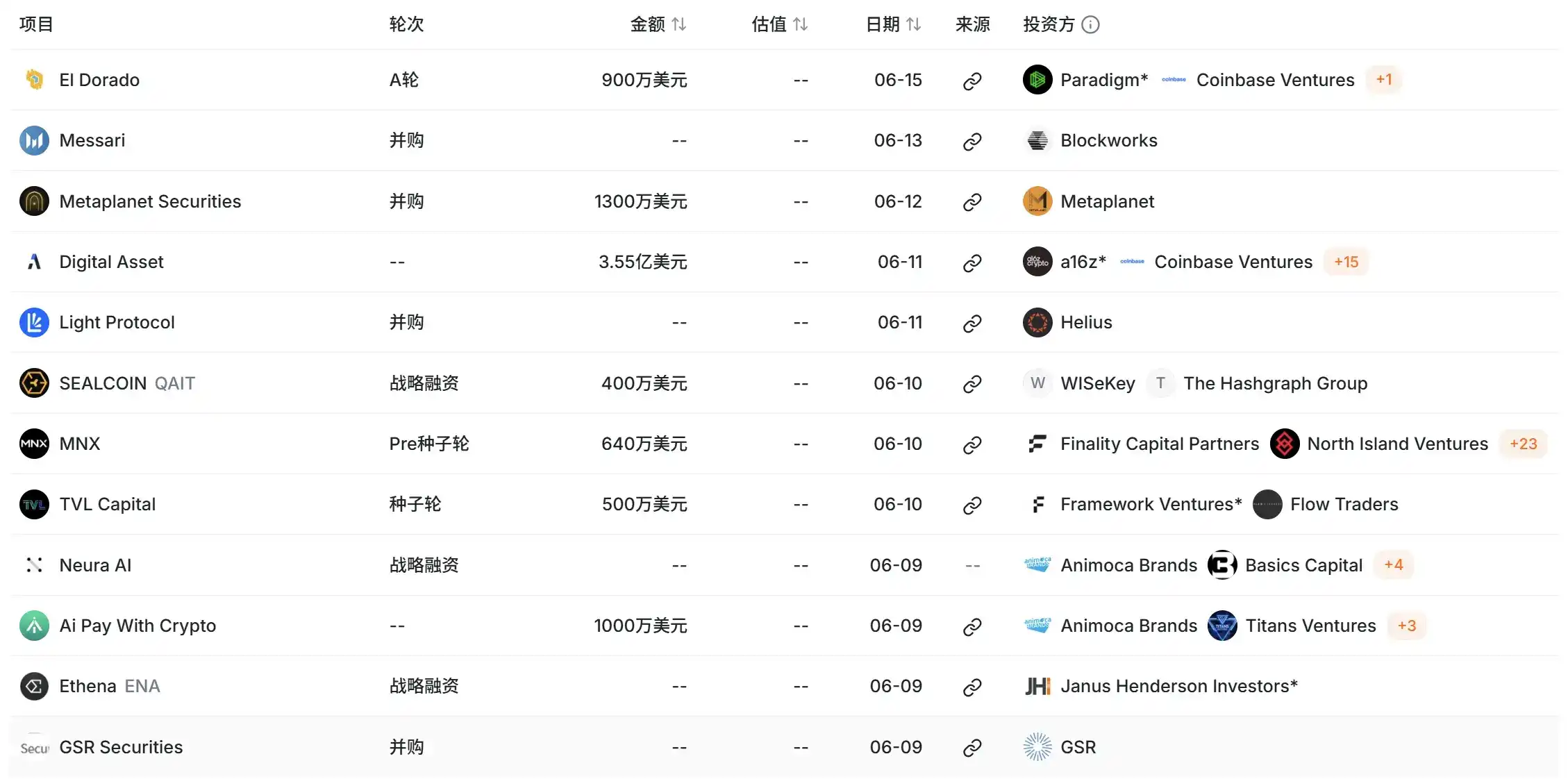
The meaning of this data is not complicated: in the past, the protagonist of the crypto primary market was fundraising; now, more and more deals are becoming acquisitions.
This does not mean the industry has suddenly entered a boom cycle. On the contrary, the rapid rise in the proportion of M&A primarily reflects the continued downturn in the financing market. Since November 2024, the monthly number of M&A transactions in the crypto industry has remained basically in the range of 10-20 deals, while the number of financing transactions has dropped significantly from around 100 to around 50, potentially setting a new low this month.
In other words, M&A transactions have not truly replaced the heat of the financing market; rather, they have become the most stable form of transaction in the primary market after the financing market contracted.
For project teams, this means the path of relying on narratives for fundraising, token expectations, and ecosystem subsidies to maintain valuations is narrowing. For leading companies, however, this means a rare window: to acquire teams, licenses, technology, liquidity, and market entry points at lower prices, with less competition, and stronger bargaining power.
After the ebb of fundraising, the crypto primary market has not stopped functioning; it's just that pricing power is shifting from VCs to buyer giants.
I. Why M&A Activity Remains High
Over the past year, frequent buyers have included Coinbase, Kraken, Ripple, MoonPay, Polymarket, Kaiko, Sol Strategies, GSR, Keyrock, Jupiter, Paxos, Ondo Finance, etc.
These companies operate in different sectors, including exchanges, payment companies, market makers, data service providers, prediction markets, RWA platforms, Solana treasury companies, as well as stablecoin and financial infrastructure firms. However, their M&A logic is highly consistent: to complement key capabilities at lower cost during the industry downturn.
First, valuations are cheap enough.
When the financing environment tightens, many projects cannot continue to raise funds at their previous round's valuation. For buyers, this means better acquisition prices, fewer competitors in bidding, and stronger bargaining power. For sellers, even if the price isn't ideal, being acquired by a leading company may offer more certainty than further dilution, layoffs, or pivots.
Take the recently acquired Messari as an example. The project's highest valuation once reached $300 million, with cumulative funding exceeding $70 million. However, as its core investment research business was severely impacted by AI and competitors, leading to repeated layoffs and business contraction, Blockworks' acquisition price was only a little over ten million dollars.
Second, saving time and trial-and-error costs.
Windows of opportunity in the crypto industry are often very short. When a regulatory gap opens, a new product model proves successful, or an asset class heats up, the market won't give companies two or three years to build a team from scratch. Acquiring a mature team is often faster than internal incubation and avoids unnecessary trial-and-error costs.
Coinbase's acquisition of Deribit for $2.9 billion is a typical case. Deribit is one of the world's major crypto options platforms, with trading volume reaching approximately $1.2 trillion in 2024. Through this transaction, Coinbase directly entered the core global crypto derivatives market, rather than building an options trading platform from scratch.
Third, acquiring licenses and compliance resources.
As regulatory frameworks in the US, EU, Hong Kong, Singapore, and other regions gradually become clearer, licenses are becoming core assets for crypto companies. Trading, custody, payment, stablecoins, brokerage, clearing, derivatives—every link requires a compliant entry point.
Kraken's acquisition of NinjaTrader follows this logic. NinjaTrader is a futures trading platform for retail users, with trading volume of $15 billion; this deal helps Kraken expand into multi-asset trading and regulated derivatives businesses.
Fourth, integrating industry chain upstream and downstream.
Crypto giants are moving from single-point products towards financial conglomerates. Exchanges are not just matching orders; they also want to offer derivatives, wallets, custody, payments, RWA, token issuance, data, and institutional services. Stablecoin companies don't just issue tokens; they want to build payment networks, AI agents, and financial infrastructure. RWA platforms don't just issue assets; they want to master compliance, distribution, liquidity, and data entry points.
The M&A path of crypto payment giant MoonPay is typical. In 2025, MoonPay acquired crypto payment startup Helio for approximately $175 million; later, it announced the acquisition of stablecoin infrastructure platform Iron to expand its enterprise payment and stablecoin capabilities.
II. Which Areas Are the Focus of M&A?
Judging from recent M&A directions, areas crypto giants are most willing to spend money on are mainly concentrated in four categories: trading infrastructure, payments & stablecoins, compliance licenses, and asset issuance & distribution.
Trading infrastructure remains the biggest battleground.
Coinbase's acquisition of Deribit and Kraken's acquisition of NinjaTrader are driven by the same judgment: spot trading growth is limited, while derivatives, options, futures, multi-asset trading, and institutional services are higher-value profit pools. Especially with the gradual rise of ETFs, RWA, tokenized stocks, and prediction markets, the boundaries of trading platforms are expanding from "crypto-to-crypto exchanges" to "global asset trading gateways."
Payments and stablecoins form the second main line.
MoonPay, Ripple, Paxos, Tether, and other companies are expanding around payment, stablecoin clearing, merchant acquiring, enterprise settlement, and cross-border transfers. Ripple's acquisition moves in recent years have been particularly aggressive, including the $250 million acquisition of custody company Metaco in 2023, followed by expansions focusing on stablecoin payments, prime brokerage, and enterprise treasury management.
This indicates that the stablecoin war is no longer just about issuance scale; it's about payment networks, compliance channels, institutional clients, and scenario access.
RWA and asset issuance are also becoming new M&A hotspots.
Companies like Ondo Finance, Jupiter, Polymarket, and Coinbase are expanding their asset issuance, liquidity distribution, and trading gateway capabilities through acquisitions or integrations. Coinbase's acquisitions of Liquifi and Echo are precisely focused on token issuance and on-chain financing capabilities. The Echo deal, valued at $375 million, helps Coinbase expand into an on-chain capital formation platform; Liquifi provides token distribution and management tools, aligning with Coinbase's bet on compliant token issuance pathways.
The strategic significance of such M&A lies in the fact that whoever controls asset issuance controls the source of trading. In the past, exchanges mainly profited from trading fees on existing assets; in the future, leading platforms prefer to profit from the entire chain encompassing asset creation, financing, listing, distribution, market making, custody, and trading. M&A is the fastest way to integrate this chain.
III. M&A Is Rewriting the Primary Market Exit Logic
The warming of M&A is not necessarily bad for entrepreneurs.
In the past, the exit path for crypto projects was overly reliant on tokens. A project's success often depended on whether it could issue a token, list it on exchanges, maintain market cap, and create liquidity. However, this mechanism created numerous problems over the past few years: founders exiting early, VC unlocking sell pressure, retail investors left holding the bag, high valuations with low circulation, and real business being held hostage by token prices.
M&A offers an alternative path. Even if a team cannot independently grow into a giant, as long as it can develop genuine capabilities in a certain area—such as licenses, technology, liquidity, compliance, users, data, risk control, market making, payment networks—it has the potential to be acquired by a larger platform.
This will change entrepreneurs' behavior. In the past, many projects issued tokens for the sake of issuing tokens and packaged narratives for fundraising; in the future, more teams might refocus on product, revenue, customers, and strategic value that can be integrated.
This is also why the M&A boom can, to some extent, give the primary market a shot in the arm. It shows that there are still asset buyers in the crypto industry, there is still value revaluation, and exit possibilities still exist.
It's just that the market is screening value in a more demanding way. What can be bought is no longer grand narratives on PowerPoint slides, but real capabilities that can be directly integrated into business blueprints.
IV. The Crypto Industry Is Becoming More Centralized
Behind the M&A boom lies the downturn in the financing market, declining project valuations, and increasing exit pressure on startup teams. But it also indicates that the crypto industry has not lost its capital vitality; it is simply completing resource reorganization in a different way.
Another issue that must be recognized is: the crypto industry is becoming more centralized.
As asset issuance, trading, market making, custody, payments, and data gradually concentrate in the hands of a few companies, the openness and anti-monopoly emphasis of the crypto industry's early days may be reshaped by realistic business logic.
Especially as compliance becomes a core barrier, the difficulty for new entrepreneurs to enter the market will increase further. The future crypto industry may develop a landscape similar to traditional finance: a few large platforms hold licenses, customers, and liquidity, while small and medium-sized teams can only become technology suppliers, ecosystem plugins, or potential acquisition targets.
Therefore, another implication of the rising proportion of M&A is: the crypto industry is bidding farewell to the era of low-barrier entrepreneurship.
Future entrepreneurs will not only face market competition but also the ecosystem boundaries and regulatory barriers of giants.