From Identity Protocol to AI Gateway: How Ambitious Is World?

marsbit2026-06-16 tarihinde yayınlandı2026-06-16 tarihinde güncellendi

Özet

The article discusses Worldcoin's (WLD) evolution from a "proof of personhood" network to a potential identity infrastructure for the AI era. Initially focused on unique digital identities via iris scans, Worldcoin faced skepticism over real-world use cases. However, entering "The Simple Plan" Phase 3, it's shifting from token incentives to utility-driven growth. Key applications are emerging: enterprise solutions (e.g., deepfake verification with Zoom, Okta), consumer use cases (e.g., reducing bots on Tinder or in ticket sales), and notably, the AI Agent sector via AgentKit, which aims to establish trusted authorization between humans and AI agents. The author argues AI's proliferation makes authentic human identity a scarce and valuable resource. Worldcoin's strategy is now focused on key markets for network effects and developing self-service Orb hardware to scale sustainably. The launch of World ID 4.0 introduces a fee model for issuers/protocols, creating a potential revenue stream. In conclusion, WLD's rise reflects a market reassessment. Worldcoin's ambition is to become the foundational identity layer and crucial entry point for the coming AI Agent economy, moving crypto narratives beyond finance into verifiable human identity.

Author:Flora,CryptoPulse Labs

Recently, in the cryptocurrency market, WLD has become one of the focal points of market attention. Market data shows that WLD has continued to rise, breaking through $0.6, with a total market capitalization exceeding $3 billion.

The main driver behind the warming market sentiment is World's announcement that it has officially entered the third stage of "The Simple Plan," shifting its growth logic from early-stage token incentives to utility-driven mechanisms. Therefore, the question worth considering now is: is World truly evolving into a critical piece of infrastructure for the AI era?

一、From Iris Scanning to Real-World Application: World Enters a New Phase

From its inception, World's core objective has been unequivocally clear: to build a global "proof-of-personhood" network.

Simply put, it aims to address an increasingly critical problem in the internet world: how to prove you are a real human being, not a bot, script, or AI-generated identity.
In the past few years, this problem seemed distant. However, with the explosion of generative AI, it is rapidly becoming a real-world necessity. Today, AI can generate highly realistic images, videos, and audio, even operate social media accounts in bulk and execute complex tasks autonomously.

In the future, a significant portion of active users on the internet may not be real people but rather AI Agents. Against this backdrop, verifying that the entity on the other end is human is becoming a fundamental issue for the internet.

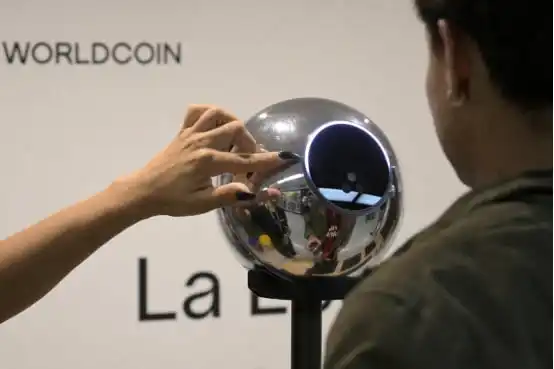
This is precisely the market World aims to capture. Its core product, World ID, uses the Orb device to scan a user's iris, generating a unique digital identity credential for each individual. This system attempts to achieve a "one person, one ID" principle, verifying authenticity while protecting user privacy as much as possible, and supporting on-chain calls.

Previously, the biggest market skepticism towards World was that, while the identity system held great imaginative potential, it consistently lacked real-world use cases. However, as it enters the third stage, this is changing. World has explicitly stated it will promote adoption across three main directions: enterprise, individual users, and AI Agents.

On the enterprise front, World is collaborating with companies like Zoom, Okta, and DocuSign to launch identity verification products targeting deepfake issues. As AI scams and deepfake attacks become more common, the demand for real-person verification is rising rapidly. Whether for video conferencing, remote work, or electronic signing, verifying identity authenticity is becoming crucial.

On the individual user front, World is targeting higher-frequency pain points on the internet. For example, Tinder could use World ID to verify if a user is a real person, and the Concert Kit for ticket purchases could reduce bot scalping and ticket touting.

This means World is attempting to solve the long-standing internet industry problems of fake accounts and bot traffic.

The most noteworthy aspect is the AI Agent front. World has launched AgentKit, aiming to establish a trusted authorization relationship between humans and AI. In the future, if everyone has their own AI assistant, these Agents might help users manage assets, execute transactions, sign agreements, or even participate in on-chain governance.

But before that, the system must be able to verify whom an AI represents and whether it has obtained authorization from a real human. The value of AgentKit lies in establishing a foundational trust framework for the future AI economy.

二、The AI Era: "Real Human Identity" is Becoming Scarce

The core reason for WLD's price increase isn't merely news-driven hype but the market beginning to reprice the scarcity value of "real human identity."

Over the past few years, numerous identity-focused projects have emerged in the crypto market, but most struggled to sustain themselves, fundamentally due to insufficient demand. While traditional internet had identity verification needs, it wasn't enough to support a massive, independent sector. However, the arrival of the AI era has completely changed this logic.

When the cost of generating AI content approaches zero, the truly scarce resource becomes human beings themselves. In the past, the internet's most important resources were traffic, content, and attention. In the future, scarcer resources might be real human identity, real human behavior, and real human authorization.

The reason is simple. AI can infinitely replicate text, images, audio, and even video, but it cannot naturally possess an independent human identity. This means that in the future internet, real humans could become an increasingly scarce resource. Whoever can verify a "real person" holds the key gateway.

This is also why the market is beginning to reassess World's long-term value. It is no longer betting on just a crypto narrative but on a crucial infrastructure need for the AI era.

Simultaneously, World's operational strategy has undergone a significant shift. The team announced it will concentrate resources on a few high-density, high-value cities, including San Francisco, New York, as well as regions like the UK, Germany, Japan, and South Korea, while scaling back operations in non-priority areas. This indicates the team is no longer pursuing widespread expansion but prioritizing establishing network effects in high-value markets first.

The business logic behind this strategy is clear. The value of an identity system inherently comes from network effects. Only when a region has enough users, enterprises, and application scenarios can the true value of World ID be realized. Otherwise, even with user growth, it's difficult to form a stable value loop.

Another key change is hardware upgrades. The next-generation Orb will move towards self-service, aiming to achieve 95% autonomous operation by the end of 2026. This is crucial.

Previously, the bottleneck in Orb expansion was the high labor cost, requiring offline operational support for each additional user. Once the device can achieve large-scale self-service operation, customer acquisition and expansion costs will significantly decrease, making the business model healthier.

三、The AI Agent Era: World Could Become a Key Gateway

From a broader perspective, World's advancement could have profound implications for the crypto industry.

First, it could drive the crypto narrative further from finance into identity. In the past, market discussions about Crypto primarily revolved around DeFi, stablecoins, ETFs, and RWA, essentially financial logic. But World represents another path: identity infrastructure.
In the future, identity itself could become a composable asset. Users with a trusted identity might gain access to airdrops, credit scores, governance rights, and even AI usage permissions.

Around the identity layer, new market sectors could emerge, such as identity protocols, human credit protocols, and AI authorization protocols.

Second, World could become important infrastructure for the AI Agent economy. If AI Agents truly become the next generation of productivity tools, the entire industry must solve three problems: who does the Agent belong to, is the Agent trustworthy, and is the Agent verifiable. World is addressing these three core needs.

From this angle, World's ambition isn't merely to be a crypto project but to become the identity gateway for the AI era. Just as Google became the gateway for information and Meta for social interaction, World aims to become the gateway for identity. If this positioning holds, the valuation logic for WLD would be fundamentally reconstructed.

Finally, the market's most pressing concern remains: how does WLD capture value? This is also a significant change brought by World ID 4.0. The new protocol introduces a fee mechanism, allowing credential issuers and the protocol to charge users (the service consumers), while end-users can still use it for free.

The significance of this model is that it gives World a real source of revenue. Users use the protocol for free, while ecosystem participants pay, which is highly similar to the business model of internet platforms.

As the number of identity verifications increases, enterprise adoption scales up, and protocol call frequency rises, the entire network has the potential to generate sustainable cash flow.

For the market, this might be the most crucial change, as it means World is no longer just telling a future story but beginning to establish a verifiable business model and value capture path.

Conclusion

WLD's price rise appears, on the surface, to be a recovery in market sentiment. At a deeper level, it reflects a shift in market perception. World's true bet isn't on short-term token price, but on the most fundamental question of the AI era: how to prove you are human.

As AI becomes more human-like, the value of a real human's identity will likely continue to appreciate. And whoever masters the proof-of-personhood network might control a key gateway to the next-generation internet. For World, this might just be the beginning.


Trend Kriptolar

İlgili Sorular

QWhat is the core goal of World, according to the article?

AAccording to the article, World's core goal is to build a global 'proof of personhood' network, aimed at solving the critical internet problem of verifying that a user is a real human and not a bot, script, or AI-generated identity.

QWhat are the three key directions World is pushing for adoption in its third stage 'The Simple Plan'?

AIn the third stage of 'The Simple Plan,' World is pushing for adoption in three key directions: the enterprise side (e.g., partnerships with Zoom, Okta for deepfake verification), the individual user side (e.g., verifying real users on Tinder, preventing bots in ticket sales), and the AI Agent side (providing a trusted authorization framework between humans and AI via AgentKit).

QWhy does the article suggest that 'real human identity' is becoming a scarce resource in the AI era?

AThe article suggests that as the cost of AI-generated content approaches zero, what becomes truly scarce are genuine human identity, human behavior, and human authorization. AI can replicate content infinitely but cannot inherently possess an independent human identity, making verified human presence a critical and increasingly scarce resource on the future internet.

QWhat significant change does the introduction of World ID 4.0 protocol bring regarding value capture?

AThe introduction of the World ID 4.0 protocol brings a fee mechanism that allows credential issuers and the protocol to charge usage fees from parties utilizing the service, while end-users can still use it for free. This change provides World with a potential real revenue stream, moving towards a verifiable business model similar to internet platforms.

QWhat broader impact might World's development have on the cryptocurrency industry, as mentioned in the article?

AThe article mentions that World's development could expand the crypto narrative from primarily finance to include identity infrastructure. It could make identity a composable asset and establish itself as crucial infrastructure for the AI Agent economy. Furthermore, by aiming to become the 'identity gateway' for the AI era, it could fundamentally reshape valuation logic for projects like WLD.

İlgili Okumalar

UNI Doubles in Two Months Against the Trend: A 5-Year-Overdue Value Realization

Amidst a generally stagnant crypto market in June and July, UNI, the governance token of Uniswap, saw a significant surge, nearly doubling in price from around $2.3 to $4.6. This rally represents a delayed but significant value reassessment, triggered by the practical implementation of its long-debated "fee switch" mechanism. The key turning point was the on-chain execution of the UNIfication proposal in December 2025. It activated a protocol fee on select pools, directed Unichain sequencer revenue (net of costs) to a communal treasury, executed a one-time burn of 100 million UNI, and established a system where all protocol revenue flows into a "TokenJar" contract. This treasury has a single exit: purchasing and permanently burning UNI via a "Firepit" contract. Initially, the market reacted tepidly as the generated revenue and corresponding burn rate were modest. The narrative shifted dramatically in July 2025 with two major developments. First, the launch of Robinhood Chain, tailored for tokenized stocks, rapidly became a primary source of volume and fees for Uniswap, at one point contributing nearly half of its weekly fees. Second, governance votes successfully expanded the fee mechanism to v4 pools and initiated a temperature check for fees on Robinhood Chain. The activation of v4 fees caused the protocol's daily revenue earmarked for UNI burns to nearly triple. The core of UNI's recent price action is the transition from a pure governance token to a cash-flow asset with a permanent, protocol-funded buyer. Its effectiveness is amplified by UNI's mature and widely distributed supply, with no major impending unlocks to dilute the impact of the buybacks. The sustainability of this rally now hinges on whether the transaction volume, particularly on Robinhood Chain, persists after its initial gas subsidies expire, determining if this is a genuine value realization or a subsidy-fueled spike.

marsbit1 saat önce

UNI Doubles in Two Months Against the Trend: A 5-Year-Overdue Value Realization

marsbit1 saat önce

Breaking: Google Earth Urgently Pulls Back Nano Banana 2 Image Generation Feature!

Google Earth's newly launched "Create image" feature, powered by the Nano Banana 2 AI image generation model, was abruptly withdrawn shortly after its release due to being "played" by users. The feature allowed users to generate and overlay AI-created visuals directly onto real-world satellite and 3D maps in Google Earth. The tool enabled creative applications like historical recreations (e.g., visualizing ancient Pompeii), generating informational graphics for landmarks, and envisioning architectural projects or futuristic cityscapes on real terrain. It operated under "geospatial grounding," meaning the AI respected the underlying geography, topography, and perspective of the chosen map view. The model also integrated with Gemini to retrieve relevant factual information. However, upon release, users quickly tested its limits. A prominent example involved reimagining Philadelphia's historic Independence Hall as a post-apocalyptic ruin overrun by "happy" zombies, evil clowns, and giant alien mechs. This highlighted both the feature's playful potential and its risks regarding the generation of inappropriate or misleading content on realistic maps, leading to its swift temporary removal. Google stated it would re-release the feature after implementing "enhanced guardrails." Analysts note this move strategically leverages Google's vast proprietary geospatial data, positioning its AI not just for artistic generation but for spatially accurate world visualization—a unique advantage in the competitive AI image generation landscape.

marsbit3 saat önce

Breaking: Google Earth Urgently Pulls Back Nano Banana 2 Image Generation Feature!

marsbit3 saat önce

Altman Admits: Overestimated AI Snatching Jobs! Huang Renxun: The Unemployment Narrative Is Completely Backwards

Sam Altman has revised his earlier predictions about AI rapidly replacing jobs, admitting he overestimated the speed at which AI would eliminate entry-level white-collar roles. Speaking on the "Invest Like the Best" podcast, he stated that people do not truly want an AI CEO, as accountability and human connection remain critical. He found that individuals prefer interacting with people who can be held responsible for decisions. Similarly, NVIDIA's Jensen Huang argued that the narrative of AI destroying jobs is misguided. He distinguishes between tasks and jobs, noting that while AI can automate specific tasks, entire jobs—encompassing communication, judgment, coordination, and accountability—are not eliminated. He cited examples like radiologists and software engineers, where demand for these roles has increased as AI handles repetitive tasks, allowing for business expansion and the creation of more positions. Data from a University of Maryland and LinkUp study supports this, showing that U.S. job postings for new graduates have actually risen, countering the fear of vanishing entry-level roles. However, a significant shift is occurring: the traditional entry-level tasks that help newcomers gain experience are being automated, making initial career access more challenging. The key insight is that as AI takes over standardized tasks, the enduring value of human work shifts toward areas of responsibility, trust-building, and final decision-making—aspects that AI cannot replicate. The real "moat" for professionals lies in these irreplaceable human elements.

marsbit3 saat önce

Altman Admits: Overestimated AI Snatching Jobs! Huang Renxun: The Unemployment Narrative Is Completely Backwards

marsbit3 saat önce

İşlemler

Spot

Popüler Makaleler

WLD Nasıl Satın Alınır

HTX.com’a hoş geldiniz! Worldcoin (WLD) satın alma işlemlerini basit ve kullanışlı bir hâle getirdik. Adım adım açıkladığımız rehberimizi takip ederek kripto yolculuğunuza başlayın. 1. Adım: HTX Hesabınızı OluşturunHTX'te ücretsiz bir hesap açmak için e-posta adresinizi veya telefon numaranızı kullanın. Sorunsuzca kaydolun ve tüm özelliklerin kilidini açın. Hesabımı Aç2. Adım: Kripto Satın Al Bölümüne Gidin ve Ödeme Yönteminizi SeçinKredi/Banka Kartı: Visa veya Mastercard'ınızı kullanarak anında Worldcoin (WLD) satın alın.Bakiye: Sorunsuz bir şekilde işlem yapmak için HTX hesap bakiyenizdeki fonları kullanın.Üçüncü Taraflar: Kullanımı kolaylaştırmak için Google Pay ve Apple Pay gibi popüler ödeme yöntemlerini ekledik.P2P: HTX'teki diğer kullanıcılarla doğrudan işlem yapın.Borsa Dışı (OTC): Yatırımcılar için kişiye özel hizmetler ve rekabetçi döviz kurları sunuyoruz.3. Adım: Worldcoin (WLD) Varlıklarınızı SaklayınWorldcoin (WLD) satın aldıktan sonra HTX hesabınızda saklayın. Alternatif olarak, blok zinciri transferi yoluyla başka bir yere gönderebilir veya diğer kripto para birimlerini takas etmek için kullanabilirsiniz.4. Adım: Worldcoin (WLD) Varlıklarınızla İşlem YapınHTX'in spot piyasasında Worldcoin (WLD) ile kolayca işlemler yapın.Hesabınıza erişin, işlem çiftinizi seçin, işlemlerinizi gerçekleştirin ve gerçek zamanlı olarak izleyin. Hem yeni başlayanlar hem de deneyimli yatırımcılar için kullanıcı dostu bir deneyim sunuyoruz.

203 Toplam GörüntülenmeYayınlanma 2024.12.11Güncellenme 2026.06.02

WLD Nasıl Satın Alınır

Tartışmalar

HTX Topluluğuna hoş geldiniz. Burada, en son platform gelişmeleri hakkında bilgi sahibi olabilir ve profesyonel piyasa görüşlerine erişebilirsiniz. Kullanıcıların WLD (WLD) fiyatı hakkındaki görüşleri aşağıda sunulmaktadır.

活动图片