NEAR to Airdrop 330,000 Tokens, Betting on TVL Reaching $70 Million

Foresight News2026-06-12 tarihinde yayınlandı2026-06-12 tarihinde güncellendi

Özet

On June 11th, NEAR Protocol launched the Near@3.33 Milestone Incentive Program, targeting users of its Confidential Intents privacy cross-chain execution feature. The program will distribute 333,333 milestone tokens when the Confidential Intents Total Value Locked (TVL) reaches $70 million. Users must have conducted Confidential transactions on near.com and maintain a Confidential balance above $100 in any asset to qualify, with a single wallet capped at 2% of the current airdrop pool. The milestone tokens will be locked upon receipt and cannot be sold or transferred. They can only be converted 1:1 to NEAR tokens once NEAR's Volume Weighted Average Price (VWAP) maintains $3.33 or higher for three consecutive trading days. As of the report, Confidential Intents TVL exceeds $20.69 million, needing roughly a 3x increase to trigger the airdrop. Confidential Intents, launched in February 2026, is NEAR's privacy execution layer designed to prevent MEV, front-running, and strategy leaks by building confidentiality directly into the execution environment. Its TVL has grown from zero to approximately $15 million in about three months. NEAR token price, which surged from around $1 in April to a peak of $3.08, currently trades near $2. The program aims to boost user activity for Confidential Intents, with future incentive rounds planned as community engagement increases.


By: Ma He, Foresight News


On June 11th, NEAR Protocol officially launched the Near@3.33 Milestone Incentive Program. This program is designed for users of the Confidential Intents private cross-chain execution function. When the total TVL of Confidential Intents reaches $70 million, a snapshot will be triggered, and the first round of 333,333 milestone tokens will be distributed to eligible accounts.


With airdrops generally being shelved by project teams and token prices remaining low in the bear market, is NEAR making another big move in the privacy space?


Airdrop Details


According to the official announcement, the first round will distribute 333,333 milestone tokens. When the aggregated TVL of Confidential Intents reaches $70 million, the system will automatically take a snapshot and allocate tokens to eligible accounts. Users' past activities will continue to be counted towards the allocation weight until the snapshot occurs; newly joined users can still gain a higher share by increasing their activity on the platform.


The specific eligibility threshold requires users to have conducted Confidential transactions on near.com. The Confidential balance must remain above $100 (in any asset), and holdings and transaction activities exceeding the threshold will affect the final allocation ratio. A single wallet can receive a maximum of 2% of the current airdrop pool.


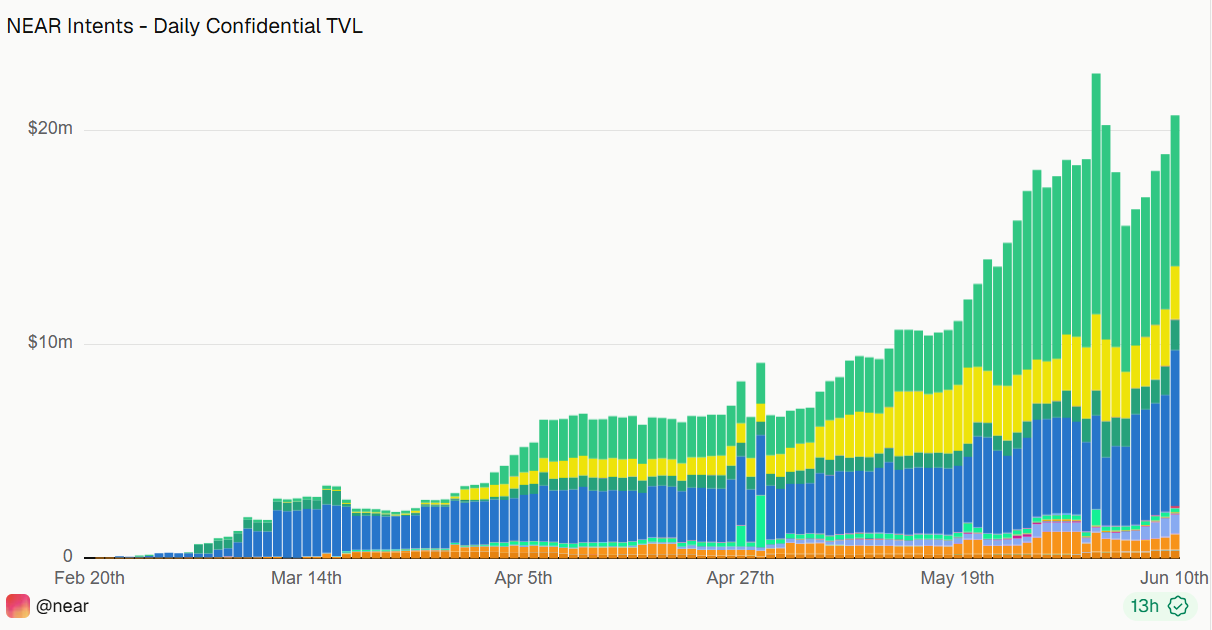
Currently, according to the latest data from Dune's dashboard, NEAR's Confidential Intents total TVL has exceeded $20.69 million, meaning it needs to grow another 3 times to reach the airdrop threshold.


The NEAR milestone tokens will be locked upon receipt and cannot be sold or transferred. They can only be converted into NEAR tokens at a 1:1 ratio when the volume-weighted average price (VWAP) of NEAR tokens remains at or above $3.33 for three consecutive trading days.


The official statement also indicates that subsequent rounds of incentive programs will be launched gradually. The trigger conditions for each round will increase correspondingly with the growth of community activity, continuously encouraging higher levels of participation.


Confidential Intents


Confidential Intents is the privacy execution layer of the NEAR Intents protocol, officially launched in late February 2026. It is not a simple coin mixer or post-hoc anonymization tool but builds confidentiality directly into the execution environment, allowing users to achieve limited visibility when conducting cross-chain transactions.


Confidential Intents is initially operated by decentralized permissioned validators and connects to the NEAR mainnet via a bridge based on Trusted Execution Environments (TEE).


Issues like MEV, front-running, strategy leaks, and forced liquidations have long plagued DeFi players on public chains. Confidential Intents avoids these risks from the source through sharded execution: retail users no longer lose value to sandwich attacks, large holders can execute substantial operations without exposing their intent, institutions can protect their positions and negotiation information while retaining selective disclosure capabilities to meet compliance and audit needs. Enterprise application scenarios include confidential handling of sensitive operations such as salary payments, treasury management, and supply chain payments.


Since its launch, according to official NEAR and community data, the TVL of Confidential Intents has grown from zero to approximately $15 million in about three months.


The product addresses real needs, and the incentives will also boost user participation and activity. For Confidential Intents to reach the $70 million target, perhaps under the ongoing wave of AI and privacy narratives, it might have a chance to achieve it in the second half of this year.
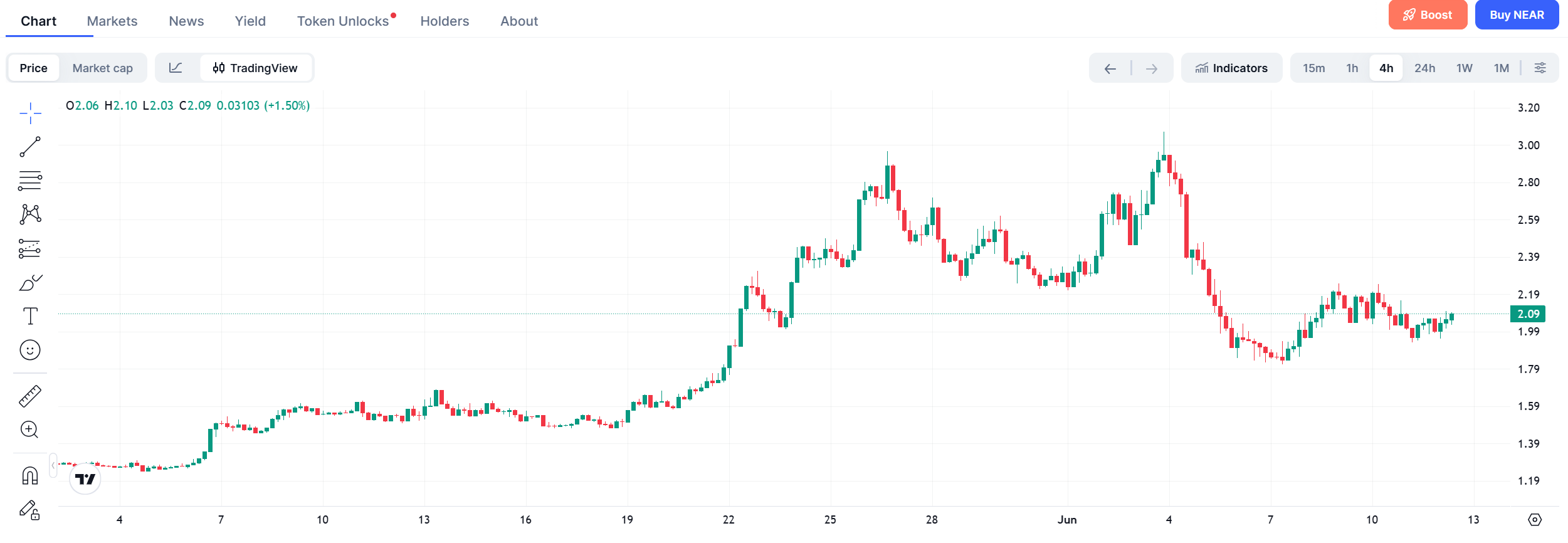


Previously, the NEAR token price surged under the AI narrative from around $1 in April this year to a high of $3.08, currently fluctuating around $2. When the crypto market conditions improve and liquidity becomes more abundant, the locked milestone tokens will convert into fully liquid NEAR tokens.


İlgili Sorular

QWhat is the trigger condition for NEAR Protocol's milestone token airdrop to begin distribution?

AThe first round of 333,333 milestone tokens will be distributed once the total TVL of Confidential Intents reaches $70 million.

QWhat are the eligibility criteria for users to participate in the NEAR@3.33 milestone incentive airdrop?

AUsers must have performed a Confidential transaction on near.com and maintain a Confidential balance above $100 (in any asset). Holdings and transaction activity beyond the threshold influence the final allocation share.

QWhat is Confidential Intents on the NEAR Protocol, and what problem does it aim to solve?

AConfidential Intents is the privacy execution layer for NEAR's Intents protocol. It builds confidentiality directly into the execution environment to provide users with limited visibility during cross-chain transactions, aiming to solve issues like MEV, front-running, strategy leakage, and forced liquidations.

QWhen do the milestone tokens received from the airdrop become convertible to NEAR tokens?

AThe milestone tokens are locked upon receipt and can only be converted to NEAR tokens at a 1:1 ratio when the volume-weighted average price (VWAP) of NEAR tokens remains at or above $3.33 for three consecutive trading days.

QAccording to the article, what is the current approximate TVL of NEAR's Confidential Intents and how close is it to the airdrop trigger target?

AAccording to the article, the current TVL of Confidential Intents is over $20.69 million. It needs to grow approximately 3.4 times from this level to reach the $70 million airdrop trigger target.

İlgili Okumalar

A Guide to Grayscale’s ‘Bottom Fishing’: Using Cash Flow to Assess Cryptocurrency Value

**Title:** Grayscale's Guide to Bottom-Fishing: Valuing Cryptoassets Using Cash Flows **Summary:** This report by Grayscale Research presents a fundamental valuation framework for cryptocurrency assets, moving beyond pure speculation to analyze those with underlying cash flows. It distinguishes between "commodity-like" assets (e.g., Bitcoin) and "cash-flow" assets, primarily within DeFi. Using the leading decentralized lending protocol Aave as a case study, the analysis applies traditional financial methodologies like Discounted Cash Flow (DCF) and Price-to-Earnings (P/E) multiples. Key findings indicate that AAVE tokens are currently undervalued. Despite recent challenges, the protocol's strong revenue growth, ~50% net profit margin, and diversified treasury support a fundamental valuation range of $80-$100 per token (compared to a ~$75 market price at the time of writing). In a base-case scenario driven by stablecoin adoption and regulatory clarity, the fair value could rise to around $175 within a year. The report emphasizes that protocol success does not automatically translate to token value. It critically examines the "value capture" mechanisms—such as buybacks, burns, and staking rewards—that channel protocol profits to token holders. Furthermore, it addresses the legal and governance complexities of Decentralized Autonomous Organizations (DAOs), noting their difference from traditional corporate equity but highlighting how robust, transparent governance can align protocol economics with holder interests. The conclusion is that the crypto market is maturing, with capital increasingly flowing towards projects with demonstrable fundamentals, real adoption, and disciplined capital allocation, creating opportunities for value-based investors.

marsbit42 dk önce

A Guide to Grayscale’s ‘Bottom Fishing’: Using Cash Flow to Assess Cryptocurrency Value

marsbit42 dk önce

After semiconductors lead the gains, are funds buying into AI orders or a macroeconomic rebound?

After US-Iran talks led to a temporary ceasefire and framework for reopening the strategic Strait of Hormuz, U.S. stocks rose on June 18, with the Nasdaq gaining 1.9%. The semiconductor and AI hardware sectors outperformed. This rally stemmed primarily from reduced geopolitical risk, which lowered oil prices and inflation expectations, easing discount rate pressure on high-valuation growth stocks like tech. The key question is not whether tech rebounded, but the nature of the rebound. The market appears to be selectively repricing AI infrastructure plays rather than broadly chasing AI narratives. Gains were concentrated in chips, optical interconnects, memory, and domestic manufacturing—segments tied to tangible data center build-outs and capital expenditure. Intel's ~10% surge, fueled by a Trump statement about potential Apple collaboration, exemplifies this mixed dynamic. It reflects policy catalysts and domestic manufacturing sentiment more than confirmed fundamentals. Meanwhile, strong earnings from companies like Astera Labs (revenue up 93% YoY) provided concrete evidence of AI-driven demand in hardware. In essence, the rally represents a risk-premium recalibration. Lower Middle East tensions opened a valuation repair window, and capital flowed first into AI infrastructure segments with visible near-term revenue streams. The sustainability of this move hinges on upcoming Q2 earnings, specifically continued strength in cloud provider capex, AI server orders, and hardware company guidance. Policy hopes alone are insufficient; the cycle needs validation from orders and financials.

marsbit47 dk önce

After semiconductors lead the gains, are funds buying into AI orders or a macroeconomic rebound?

marsbit47 dk önce

The Entire Internet Hails Noam's Joining, But OpenAI's Loss Bill Just Got Thicker

While the AI community celebrates Noam Shazeer, co-author of the "Attention Is All You Need" paper, joining OpenAI as Head of Architectural Research, the company's audited financials reveal a starkly different reality. In 2025, OpenAI reported $13.07 billion in revenue but a massive $20.92 billion operating loss. Even excluding a one-time accounting charge, the cash burn is severe, with $3.7 billion consumed in Q1 2026 alone. This high-profile hiring occurs against a backdrop of significant internal research talent drain, with key founders and researchers departing as the company's focus shifts from exploratory research to product iteration. Meanwhile, OpenAI's fundamental business model faces a deep crisis. It paid Microsoft $10.59 billion for compute in 2025, while its vast user base of 9 billion weekly actives includes only 50 million paying customers, making growth a direct driver of escalating costs. The article argues Shazeer's recruitment is less about technical necessity and more about crafting a compelling narrative for OpenAI's upcoming IPO, aiming to justify a rumored $1 trillion valuation to future public market investors. It contrasts OpenAI's strategy with Anthropic's reported path to profitability, which relies on a strong enterprise customer base and cost control, rather than star-powered narratives. Ultimately, the piece concludes that while Shazeer's architectural work may take 1-2 years to materialize, OpenAI's financial clock is ticking much faster, with its massive losses undercutting the celebratory headlines.

marsbit2 saat önce

The Entire Internet Hails Noam's Joining, But OpenAI's Loss Bill Just Got Thicker

marsbit2 saat önce

İşlemler

Spot
Futures
活动图片