a16z Crypto Partner: Cash Flow is the Moat

marsbit2026-06-12 tarihinde yayınlandı2026-06-12 tarihinde güncellendi

Özet

Cash Flow as the Moat: A Playbook for Crypto Founders Historically, the most enduring businesses have been built by positioning themselves within the "flow of funds"—facilitating the creation and transfer of value in a network and extracting a portion of it. Cryptocurrency is the first modern technology natively built for this purpose. For startups, failing to architect products and businesses to leverage these principles means missing a major opportunity. Blockchains are inherently network businesses. Each transaction settles on a shared ledger, and every new participant strengthens the underlying network for all. Well-designed network tokens amplify this by aligning users, developers, and validators around growing the network, with value flowing back to contributors in a transparent feedback loop. This model is not new; companies from railroads and Standard Oil to Google, Meta, and AWS have thrived by inserting themselves into critical flows of value (goods, attention, compute). Financial markets make it even clearer: firms like Visa and major market makers generate immense revenue not by predicting markets but by being in the path of transactions. The combination of fund flow and network effects creates one of the most durable business structures. The high margins in traditional finance (payments, custody, lending, FX) represent prime targets. Crypto founders have the opportunity to build the next version—programmable, instant, global, and natively in the flow of funds...

Author: Jason Rosenthal, a16z Operating Partner

Translation: Hu Tao, ChainCatcher Selection

Many of history's greatest businesses were built by positioning themselves in the "flow of funds"—facilitating the creation and transfer of value within a network and taking a cut of it. The more value that flows through the network, the larger the business typically becomes.

Cryptocurrency is the first modern technology natively built for this purpose. If your startup hasn't yet architected its product and business to benefit from these principles, you're missing an opportunity. Thanks to stablecoins, capital and value now flow at internet speed—settling globally, 24/7, with end-to-end programmability. Payment channels are unobstructed, unit economics are transparent, and every dollar flowing anywhere in the world is reachable.

The Model

Blockchains are network businesses by design. Every transaction settles on a shared ledger. Each new participant reinforces the same underlying network that the next builder can use. As more people use and build on it, the network becomes more valuable to all users.

Most companies spend years manufacturing network effects on top of traditional infrastructure. Crypto founders inherit them as a starting condition.

Network tokens amplify this. Well-designed tokens can align users, developers, suppliers, validators, and protocols around a single outcome—growing the network—and pay proportionally to each participant's contribution. But the protocol's revenue belongs to the people who use it. No partner rebates, no side deals. Just a feedback loop between value flowing through the system and value accruing to the hands of those building and growing it.

This isn't a new model. Cryptocurrency just makes it accessible and scalable for startups for the first time.

Railroads didn't make money from locomotives. They made money from every ton of grain, coal, and steel that crossed their tracks. Standard Oil, U.S. Steel, and AT&T were all companies in the flow of funds. Google and Meta displaced print and TV not because their ads were better, but because they sat at the chokepoint where attention converts to commerce, enabling them to take a cut of trillions in commercial intent. AWS is in the flow of computation.

The model is consistent: find where value flows, and position yourself in the middle of it.
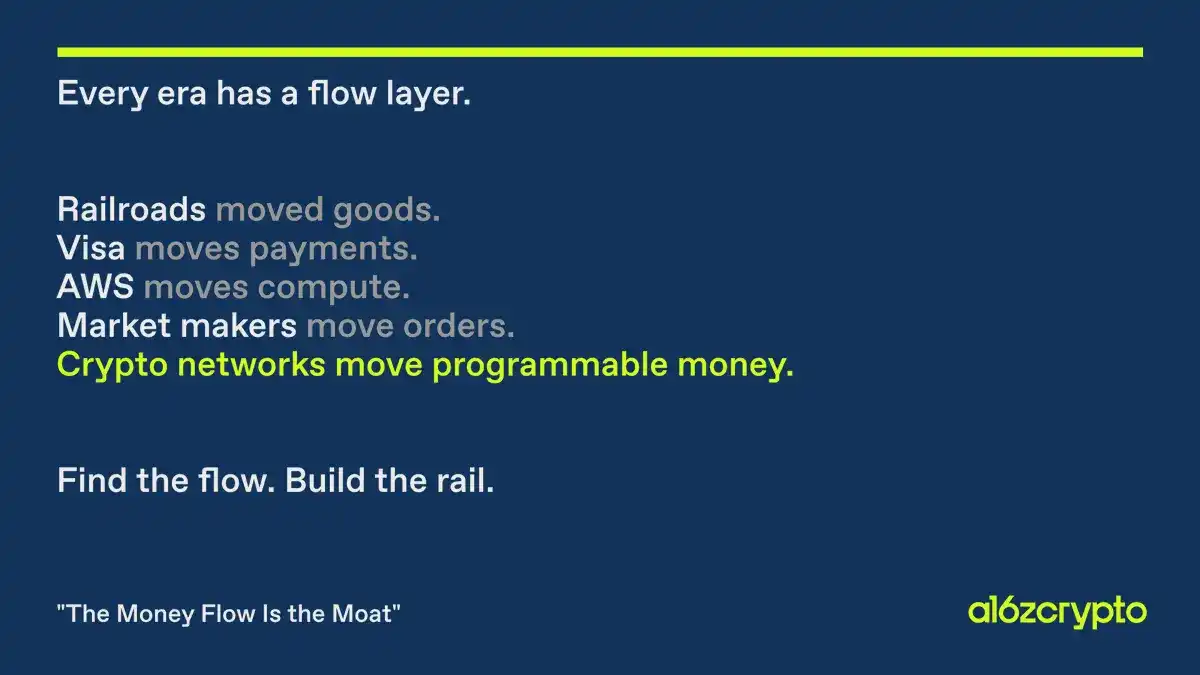
Financial markets make this model even clearer. Visa processed $15.7 trillion in payment volume in FY2024, reporting $35.9 billion in net revenue. Jane Street posted $20.5 billion in net trading revenue last year—more than Citigroup or Bank of America. The top five U.S. market makers handled 87% of order flow payment: they don't predict the market; they sit in the flow of every order and earn more as trading volume grows.

These businesses share another commonality: network effects. Visa is more useful to more merchants because there are more cards; more useful to more cardholders because more merchants accept it. It's the same with order flow—each additional broker narrows spreads, attracting more brokers, which attracts more flow.

The flow of funds plus network effects is one of the most durable business structures ever.

Your Margin is My Opportunity

Bezos called it "your margin is my opportunity." He was talking about retail, but it applies even more to traditional financial services—the world's largest pool of margin extraction. Payments, custody, lending, FX, securitization, settlement, market making—all of it. Visa and Mastercard charge 2-3% transaction fees on networks designed in the 1960s. Remittance corridors charge 6-9%. Prime brokers and custodians take a piece of every securities trade. Even after the U.S. shifted to T+1 settlement in 2024, money still sits idle overnight as a structural tax on every participant.

Each of these margins is a target. Compress cost, increase speed, and potentially expand the entire market. Stripe and Square proved this is possible in payments.

Crypto founders have the opportunity to build the next version—programmable, instant, global, and natively in the flow of funds.

And the frontier extends far beyond financial services. Compute and GPU markets. Memory chips. AI training data. Energy. Robotics. Space. Rare earth metals. Each category is an area where global value can begin to flow at volumes the existing rails were never designed to handle.

Each is an open field for building flow-of-funds businesses from the ground up on programmable infrastructure. These markets have no existing rails, no entrenched intermediaries, and nothing to defend.

As a founder, ask yourself:

1. Are you in the flow of funds today?

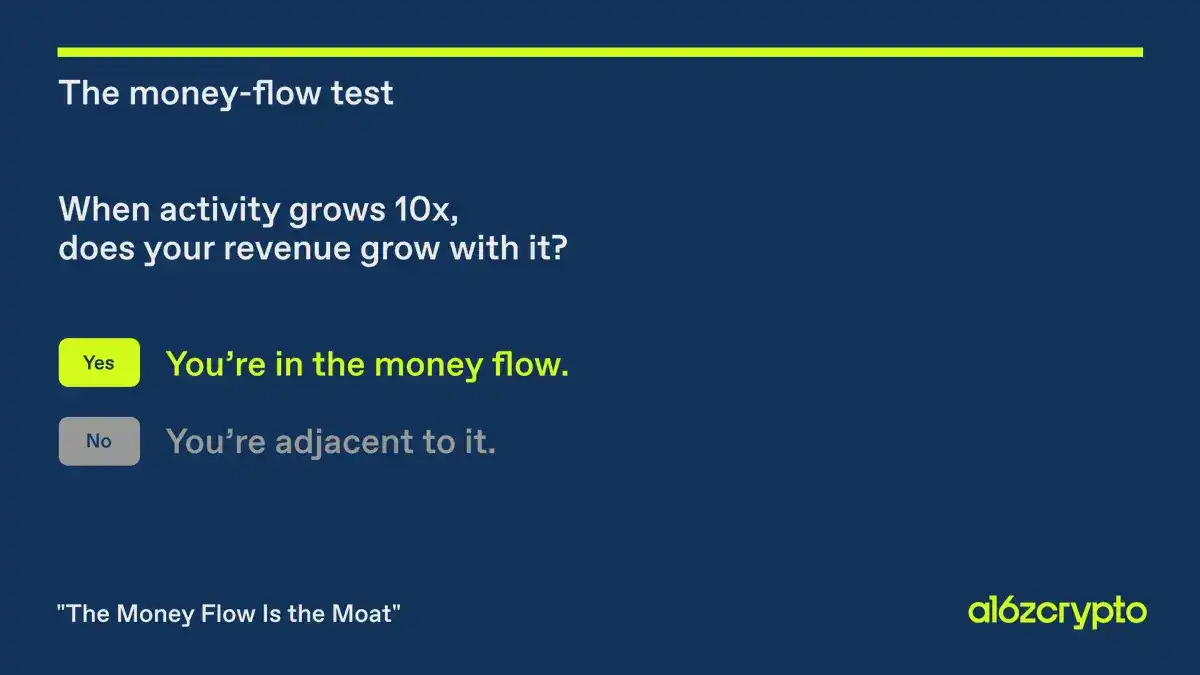
2. When the value of activity on your product grows 10x, does your revenue grow with it?

3. If you're building a new product, where in your target market is the margin extraction highest relative to the value being created?
The opportunity is there. Seize it, ride the new flow, and let the network compound from there.


Trend Kriptolar

İlgili Sorular

QAccording to the article, what are the core characteristics of successful business models historically?

AHistorically, many of the best businesses positioned themselves within 'cash flows'—facilitating the creation and transfer of value within a network and taking a cut of that flow. The more value that flows through the network, the larger the business typically becomes.

QHow does the article describe the fundamental advantage that cryptocurrency offers for startups?

ACryptocurrency is the first modern technology natively built for cash flow. It enables value to move at internet speed—24/7, global settlement, with end-to-end programmability—providing startups with accessible and scalable network effects and open unit economics from the start.

QWhat is the relationship between network tokens and business growth as explained in the text?

AWell-designed network tokens align users, developers, suppliers, validators, and the protocol around a single outcome: growing the network. Participants are paid proportionally to their contributions. This creates a feedback loop between the value flowing through the system and the value accumulating to those building it, without private deals or rebates.

QWhat does the phrase 'your margin is my opportunity' refer to in the context of the article?

AIt refers to the opportunity for new, often crypto-native, businesses to compete by targeting high-margin areas in traditional industries (especially financial services). By reducing costs, increasing speed, and building on programmable infrastructure, they can capture market share from established players with inefficient profit structures.

QWhat are the three key questions founders should ask themselves, according to the article's conclusion?

A1. Are you in the cash flow today? 2. When the value of activity on your product grows 10x, does your revenue grow with it? 3. If you're building a new product, where in your target market is the profit-taking highest relative to the value being created?

İlgili Okumalar

Low Investment Isn't Apple's Immunity Pass

While Meta and Google face investor scrutiny over ballooning AI capital expenditures, Apple's minimal AI investment has paradoxically become a strength. Its market cap recently reclaimed the global top spot, surpassing $5 trillion. The irony is deep: Apple's own AI efforts have lagged, with "Apple Intelligence" delayed and core talent lost, forcing reliance on partners like Google Gemini and Alibaba's Qianwen. Its Q3 FY2026 (Q2 CY) earnings initially seemed stellar. Revenue hit $109.4B (up 16% YoY), with iPhone and Mac sales, growing 22% and 29% respectively, driving most of the growth. However, the stock fell over 8% post-earnings. The primary concern was a weaker Q4 revenue growth forecast of 9-11%, below expectations, due to looming supply chain constraints. Apple is feeling the indirect cost of the AI boom. Soaring memory and chip prices, fueled by massive data center investments from Microsoft, Amazon, and others, are forcing Apple to raise Mac and iPad prices significantly. The upcoming iPhone launch is also expected to see substantial price hikes. Despite avoiding heavy AI infrastructure spending—its capital expenditures are actually down 28%—Apple cannot escape the industry-wide supply and cost pressures. While Apple's operating cash flow remains robust, its substantial R&D spending (up 32% YoY) has yet to yield major AI breakthroughs. As Tim Cook prepares to step down as CEO, Apple faces a challenging transition: balancing its premium hardware success against the strategic and cost pressures of the AI era it has so far cautiously navigated.

marsbit48 dk önce

Low Investment Isn't Apple's Immunity Pass

marsbit48 dk önce

PA Graphics Explanation | One Chart to Understand the Major Web3 Events in August 2026

**PANews Crypto Calendar: Key Web3 Events in August 2026** PANews introduces its revamped crypto calendar, featuring comprehensive coverage, flexible filtering, and easy export options. The market in August will be shaped by multiple key events across macroeconomics, regulation, tokenomics, and project developments: * **Macro & Policy:** Key US economic data releases (July Non-Farm Payrolls, CPI), the Federal Reserve meeting minutes, and the Jackson Hole Economic Symposium will be in focus. On the regulatory front, the US Senate plans to release a new draft of the *CLARITY Act*, while the EU's expanded crypto ban against Belarus comes into effect. * **Token Unlocks:** Significant token unlocks are scheduled for assets including ENA, AVAX, CONX, ZRO, and KAITO, which may influence market volatility. * **Project Updates & Shutdowns:** Several services, including Exchange Art, Ctrl Wallet, Zapper, NFTfi, and Summer.fi, are set to cease operations or undergo major adjustments. Users are advised to manage their assets accordingly. * **Corporate Activity:** Q2 earnings reports from companies like SpaceX, Circle, and Nvidia are due. Unitree Robotics will initiate its IPO subscription on the STAR Market, and Moonshot AI plans to begin a Pre-IPO financing round. * **Industry Events:** Major conferences such as Bitcoin Asia 2026 and the 2026 Digital Expo will take place. The overarching market narrative for August will revolve around macroeconomic expectations, regulatory developments, token unlock schedules, and ongoing industry consolidation.

marsbit59 dk önce

PA Graphics Explanation | One Chart to Understand the Major Web3 Events in August 2026

marsbit59 dk önce

Wall Street's Most Famous 'Cassandra' Now Has His Sights Set on Nvidia

Michael Burry, the famed "Big Short" investor, has once again captured Wall Street's attention with a series of short positions against major tech and semiconductor stocks, most notably Nvidia. In late June and July, through his "Cassandra Unchained" newsletter, Burry disclosed short bets against Nvidia, Tesla, Applied Materials, Caterpillar, the SOXX semiconductor ETF, and later, Micron Technology. His core thesis revolves around potential distortions in the AI infrastructure boom, specifically questioning whether extended depreciation schedules (e.g., 6 years vs. a realistic 2-3 years for AI chips) by cloud giants like Microsoft and Google artificially inflate profits. He also raises concerns about possible "off-balance-sheet circular financing," where chip demand might be propped up by vendor-backed funding to clients. Nvidia's stock experienced volatility following these disclosures, briefly dipping but largely holding near Burry's reported entry points, leaving his positions roughly flat or slightly underwater as of late July. This move is part of a pattern for Burry, whose track record since his legendary 2008 bet is mixed. He has faced notable losses, such as on Tesla in 2021, while scoring on broader market turns like the 2020 pandemic crash. His methodology focuses intensely on free cash flow and scrutinizing original financial documents to spot overvaluation and structural risks, but it often struggles with timing the market. The article contrasts Burry's stance with other prominent investors. Steve Eisman, another "Big Short" figure, is not shorting Nvidia, citing strong fundamentals but expressing nervousness about sustainability. Jim Chanos agrees with the broad "accounting mismatch" concern—comparing it to the dot-com bubble—but targets financial leverage in private equity firms rather than the chip stocks themselves. While Nvidia's short interest remains relatively low at 1.3-1.4% of float, the massive stock size means absolute short losses have been significant, exceeding $5 billion earlier this year. The piece concludes that for ordinary investors, the key takeaway is not replicating specific short bets but learning from the critical frameworks these investors use: questioning rosy accounting, identifying structural vulnerabilities, and maintaining skepticism during market euphoria, even if pinpointing the exact catalyst for a downturn remains elusive.

marsbit1 saat önce

Wall Street's Most Famous 'Cassandra' Now Has His Sights Set on Nvidia

marsbit1 saat önce

Weekly Selection丨Epic Stock Market Volatility, Changxin Tech's IPO Reshapes Storage Landscape, Saylor Aims to Re-Anchor STRC Around September 8th

PANews Weekly Digest: Market Turmoil, Tech Breakthroughs, and Crypto Developments. The week saw significant volatility across global markets. South Korea's KOSPI index experienced extreme turbulence, including multiple trading halts, largely driven by sharp declines in AI hardware stocks like SK Hynix. In contrast, China's Changxin Xinqiao (CXC) achieved a landmark IPO with a market cap surpassing 4 trillion yuan, marking a major success for the domestic DRAM industry after a decade of losses. In the crypto and Web3 space, several key narratives emerged. AI is driving demand for new infrastructure, with projects like AI agent wallets and programmable payments gaining traction, attracting interest from firms like Coinbase. The Bitcoin mining sector is pivoting, with companies like MARA focusing on energy management as electricity becomes a core AI-era asset. Meanwhile, the RWA (Real World Assets) sector faces a "utilization puzzle," with hundreds of billions in on-chain assets remaining dormant. Notable market movements included a historic single-day surge of over 17% for the KOSPI index and a significant migration of $16.5 billion in staked ETH within the Lido ecosystem. Michael Saylor announced a target to re-peg the STRC stablecoin around September 8th. Other highlights include discussions on Ethereum's ambitious 2030 roadmap for scaling and privacy, analysis showing high protocol revenues not always translating to token price gains, and warnings from Citi about potential extreme commodity price shocks by late 2026.

marsbit1 saat önce

Weekly Selection丨Epic Stock Market Volatility, Changxin Tech's IPO Reshapes Storage Landscape, Saylor Aims to Re-Anchor STRC Around September 8th

marsbit1 saat önce

When the Market Begins to Question AI Capex: A Full Analysis of Q2 Earnings Reports from Five Tech Giants

In late July 2026, five major US tech giants—Alphabet, Intel, Microsoft, Meta, and Apple—released their Q2 earnings reports. While all companies exceeded revenue and profit expectations, driven by strong AI-related business growth, investor reactions diverged sharply due to concerns over escalating AI capital expenditures (capex) and their impact on free cash flow. Alphabet reported strong revenue growth and a surging cloud business, but its stock fell after announcing a doubled year-on-year capex and negative quarterly free cash flow for the first time. Intel posted its strongest revenue growth in over 15 years, but its stock experienced volatile trading after significantly raising its full-year capex guidance. Microsoft saw its stock surge after beating estimates and, crucially, lowering its capex forecast while projecting positive free cash flow. Meta faced the most severe sell-off as its profits declined despite revenue beats, with free cash flow plunging over 90% and its capex guidance raised. Apple reported record June-quarter results, but its stock plummeted after providing Q4 revenue guidance that fell short of expectations, citing supply chain constraints and forex headwinds. The overall takeaway is that the market's focus has shifted from validating AI demand to scrutinizing the timeline for returns on massive AI investments. Companies demonstrating a clearer path to managing capex and preserving free cash flow, like Microsoft, were rewarded, while those signaling continued aggressive spending faced investor skepticism.

Odaily星球日报1 saat önce

When the Market Begins to Question AI Capex: A Full Analysis of Q2 Earnings Reports from Five Tech Giants

Odaily星球日报1 saat önce

İşlemler

Spot

Popüler Makaleler

FLOW Nasıl Satın Alınır

HTX.com’a hoş geldiniz! Flow (FLOW) satın alma işlemlerini basit ve kullanışlı bir hâle getirdik. Adım adım açıkladığımız rehberimizi takip ederek kripto yolculuğunuza başlayın. 1. Adım: HTX Hesabınızı OluşturunHTX'te ücretsiz bir hesap açmak için e-posta adresinizi veya telefon numaranızı kullanın. Sorunsuzca kaydolun ve tüm özelliklerin kilidini açın. Hesabımı Aç2. Adım: Kripto Satın Al Bölümüne Gidin ve Ödeme Yönteminizi SeçinKredi/Banka Kartı: Visa veya Mastercard'ınızı kullanarak anında Flow (FLOW) satın alın.Bakiye: Sorunsuz bir şekilde işlem yapmak için HTX hesap bakiyenizdeki fonları kullanın.Üçüncü Taraflar: Kullanımı kolaylaştırmak için Google Pay ve Apple Pay gibi popüler ödeme yöntemlerini ekledik.P2P: HTX'teki diğer kullanıcılarla doğrudan işlem yapın.Borsa Dışı (OTC): Yatırımcılar için kişiye özel hizmetler ve rekabetçi döviz kurları sunuyoruz.3. Adım: Flow (FLOW) Varlıklarınızı SaklayınFlow (FLOW) satın aldıktan sonra HTX hesabınızda saklayın. Alternatif olarak, blok zinciri transferi yoluyla başka bir yere gönderebilir veya diğer kripto para birimlerini takas etmek için kullanabilirsiniz.4. Adım: Flow (FLOW) Varlıklarınızla İşlem YapınHTX'in spot piyasasında Flow (FLOW) ile kolayca işlemler yapın.Hesabınıza erişin, işlem çiftinizi seçin, işlemlerinizi gerçekleştirin ve gerçek zamanlı olarak izleyin. Hem yeni başlayanlar hem de deneyimli yatırımcılar için kullanıcı dostu bir deneyim sunuyoruz.

315 Toplam GörüntülenmeYayınlanma 2024.12.10Güncellenme 2026.06.02

FLOW Nasıl Satın Alınır

Tartışmalar

HTX Topluluğuna hoş geldiniz. Burada, en son platform gelişmeleri hakkında bilgi sahibi olabilir ve profesyonel piyasa görüşlerine erişebilirsiniz. Kullanıcıların FLOW (FLOW) fiyatı hakkındaki görüşleri aşağıda sunulmaktadır.

活动图片