a16z Partner: Being in the Flow of Capital Is the True Moat

marsbit2026-06-11 tarihinde yayınlandı2026-06-11 tarihinde güncellendi

Özet

A16z Partner: Standing in the Cash Flow is the True Moat Historically, many of the strongest companies built their moats by positioning themselves within "cash flows"—facilitating value creation and transfer in a network and taking a cut. The more value flows, the larger they grow. Crypto is the first modern technology natively built for this. With open ledgers, programmable settlement, and stablecoins enabling internet-speed global value transfer, it allows startups to inherit network effects from day one. Well-designed tokens align users, developers, and the protocol towards network growth, distributing value to contributors. This model isn't new (e.g., railroads, Visa, Google, AWS) but Crypto democratizes it. It lets entrepreneurs target areas with high inefficiency and profit extraction—like traditional finance's payments, custody, FX, and settlement—to compress costs, increase speed, and redistribute value by standing in the new flow. The opportunity extends beyond finance to emerging markets like GPU/compute, AI training data, energy, and space, where new, programmable infrastructure can be built without legacy constraints. Key questions for founders: Are you already in the cash flow? Does your revenue scale 10x with network activity? Where is profit extraction highest relative to value created in your market? The strategy is clear: compress the old cost structure, position yourself in the new value stream, and let the network compound.

Editor's Note: The core judgment of this article is straightforward: the flow of capital itself is the moat. Looking back through business history, many of the most powerful companies didn't win by simply selling products; they positioned themselves in the middle of a "value flow," continuously taking a cut from every shipment, payment, transaction, ad conversion, compute call, or order flow. Railroads made money from the movement of goods, Visa charged fees from the payment network, Google and Meta captured the entry point where attention converts into commercial transactions, and AWS positioned itself at the center of compute flow. As long as value continues to flow through the network, the network itself becomes stronger.

Crypto natively gives this model to startups for the first time. Blockchains provide open ledgers and programmable settlement, stablecoins allow capital to flow globally at internet speed, and token mechanisms align users, developers, and network growth. For Crypto entrepreneurs, the real opportunity isn't just building a new application, but finding the most expensive, inefficient, and profit-extracting value channels in the old system, compressing them, reconstructing them, and positioning themselves in the new capital flow.

The article emphasizes that the most profit-extracting and inefficient parts of traditional financial services—payments, custody, lending, forex, clearing, market making, etc.—will become entry points for crypto entrepreneurs to reconstruct: compressing costs, increasing speed, and redistributing value. This type of "capital flow business" (taking a revenue share based on volume in the value flow channel) will not stop at finance; it could extend to future markets like GPU markets, AI training data, energy, robotics, space, and rare earth metals.

For founders, the most crucial questions are: Is your product already positioned in a value flow? When network activity scales 10x, does your revenue scale proportionally? Opportunities often hide where old infrastructure is least efficient but profit extraction is highest. Whoever compresses old costs and positions themselves in the new flow has the chance to turn the capital flow into their own moat.

Here is the original text:

Many of history's greatest businesses have been built by putting themselves in the "flow of capital"—they facilitate the creation and transfer of value in a network and take a portion of it. The more value that flows through the network, the larger such businesses tend to grow.

Crypto is the first modern technology that is native to this. If your startup isn't designing its product and business model around these principles, you're missing the opportunity. Especially with stablecoins, capital and value can now flow at internet speed: global settlement, running 24/7, with end-to-end programmability. The underlying rails are open, the unit economics are public, and the addressable market for capital flows is nearly every dollar moving globally.

This Model

Blockchains are network businesses by nature. Every transaction settles on a shared ledger; every new participant reinforces the same underlying infrastructure that later participants can use. As more people use and build on it, the network becomes more valuable for all its users.

Most companies spend years artificially manufacturing network effects on top of traditional infrastructure. Crypto entrepreneurs inherit this network effect from day one.

Network tokens amplify this further. A well-designed token can align users, developers, suppliers, validators, and the protocol itself to the same goal: growing the network and distributing rewards based on each participant's contribution. Protocol revenue belongs to the people actually using it. No co-op rebates, no side deals, just a positive feedback loop: value flows through the system while also flowing back to those who build and drive its growth.

This isn't a new model. Crypto just makes it easier and at a larger scale for startups to use it.

Railroads didn't make money selling locomotives; they made money on every ton of grain, coal, and steel that moved over their tracks. Standard Oil, U.S. Steel, and AT&T were companies in the flow of capital. Google and Meta didn't replace print and TV because the ads were better; they captured the crucial node where attention converts into commerce, taking a cut from trillions in commercial intent. AWS positioned itself at the center of compute flow.

The model is consistent: Find where value flows, then put yourself in the middle.
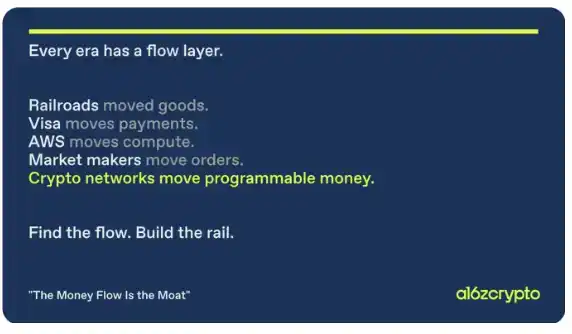
Financial markets make this pattern even clearer. Visa processed $15.7 trillion in payment volume in fiscal 2024, recording $35.9 billion in net revenue. Jane Street had $20.5 billion in net trading revenue last year, surpassing Citi and Bank of America. The top five U.S. market makers handle 87% of payment for order flow: they aren't predicting the market; they're in the middle of every order flow, earning more as trading volume grows.

These businesses share another trait: network effects. Visa becomes more useful to merchants as more cards are issued; more useful to cardholders as more merchants accept Visa. The same with order flow: each added broker narrows spreads, attracting more brokers, which attracts more order flow.

Capital flow plus network effects is one of the most durable structures in business history.

Your Margin is My Opportunity

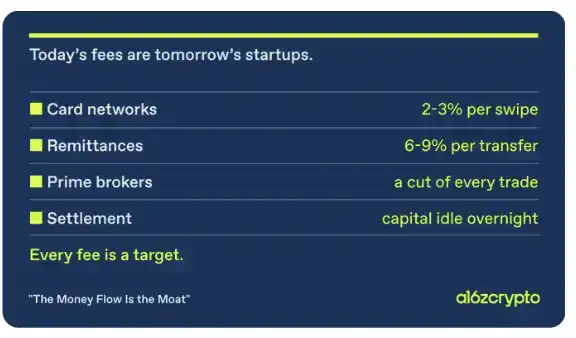
Jeff Bezos once said, "Your margin is my opportunity." He was talking about retail, but it applies even more to traditional financial services—the world's largest pool of profit extraction. Payments, custody, lending, forex, securitization, settlement, market making—it's all true. Visa and Mastercard charge 2% to 3% interchange on a network designed in the 1960s; cross-border remittance corridors charge 6% to 9%; prime brokers and custodians take a cut of every securities transaction. Even with the U.S. moving to T+1 settlement in 2024, capital still sits idle overnight, a structural cost borne by all participants.

These profit margins are targets. Compress costs, increase velocity, and potentially expand the entire market. Stripe and Square have proven this in payments.
Crypto entrepreneurs have the chance to build the next version: programmable, instant, global, and natively in the flow of capital.

And this frontier extends far beyond financial services. Compute and GPU markets, memory chips, AI training data, energy, robotics, space, rare earth metals—each could see massive global flows of value, and existing infrastructure isn't built to handle that scale.

Each is an open market where capital flow businesses can be built on programmable infrastructure from day one. No legacy rails, no entrenched intermediaries, no old profits to defend.

As a founder, you should ask yourself:

1. Are you in the flow of capital today?

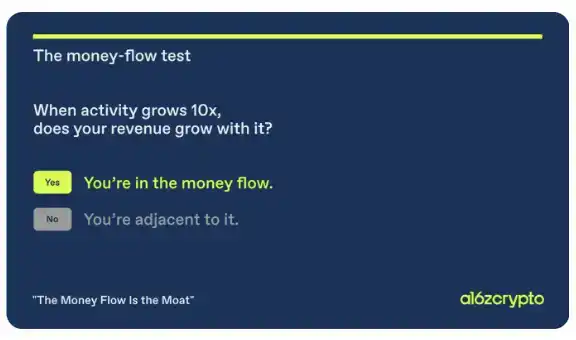
2. When activity value on your product grows 10x, does your revenue grow proportionally?

3. If you're building a new product, where in your target market does the highest profit extraction exist relative to the value created?
The opportunity is there. Compress it, step into the new value flow, and let the network compound from there.


İlgili Sorular

QAccording to the article, what is the core characteristic shared by history's most powerful companies like Visa, Google, and AWS?

AThe core characteristic is that they position themselves within a 'value flow' or 'capital flow.' They don't just sell a product; they facilitate the creation and transfer of value within a network and extract a portion of the revenue from that ongoing flow. As more value moves through the network, these companies grow stronger.

QHow does the article argue that Crypto technology uniquely empowers startups compared to traditional models?

AThe article argues that Crypto provides the first modern technology that is natively designed for this 'value flow' model. It offers an open ledger, programmable settlement, and global, internet-speed money movement via stablecoins. Most importantly, token mechanisms can align all network participants (users, developers, validators) by rewarding contributions to network growth. Startups inherit network effects from day one on this open infrastructure, rather than having to build them manually.

QWhat does the article mean by 'Your margin is my opportunity' in the context of traditional financial services?

AIn this context, it means that the high profit margins (or 'rents') extracted by traditional financial intermediaries represent a major opportunity for disruption. Services like payments, custody, lending, and cross-border transfers often have high fees relative to the value provided. These inefficient, high-cost areas are prime targets for Crypto startups to compress costs, increase speed, and redistribute value by building more efficient, programmable alternatives.

QBeyond finance, what other future markets does the article suggest could be transformed by 'capital flow' businesses?

AThe article suggests that future markets like compute/GPU markets, AI training data, energy, robotics, space, and rare earth metals could see the emergence of global-scale 'capital flow' businesses. These are areas where massive value will move, and the existing infrastructure may not be designed for that scale, creating open opportunities for new, programmable platforms built from scratch.

QWhat are the three key questions the article suggests founders should ask themselves about their business?

A1. Are you already standing in a capital flow today? 2. When the value of activity on your product grows 10x, will your revenue grow alongside it? 3. If you're building a new product, where in your target market is the highest profit extraction relative to the value created?

İlgili Okumalar

Warsh's Debut: Will the FED Chair Who Knows Crypto Best Bring Surprises or Shocks to the Market?

Kevin Warsh, the new Federal Reserve Chairman, prepares for his inaugural press conference amidst a challenging macroeconomic landscape: resurgent inflation, a bond market sell-off, and political pressure from President Trump for rate cuts. Uniquely, Warsh holds indirect investments in over 20 crypto and Web3 entities (e.g., Solana, dYdX), making him the first Fed Chair with disclosed crypto exposure. His stance may combine a hawkish, inflation-focused monetary policy with a crypto-friendly regulatory philosophy that shifts from Powell’s “same risk, same rule” approach toward a framework acknowledging blockchain’s productivity value. Warsh’s leadership could impact crypto markets across three dimensions: a paradigm shift in regulation (potentially accelerating pro-innovation legislation and stable币 rules), a re-pricing of risk premiums based on clearer communication and his view of AI as a structural disinflationary force, and a long-term reallocation of global institutional capital driven by increased legitimacy. Two potential scenarios for the press conference are outlined. A “positive surprise” would involve a dovish-leaning tone on rates coupled with signals of regulatory openness, potentially boosting crypto asset valuations. Conversely, a “negative shock” would see a more hawkish-than-expected stance on inflation and rates, triggering a broad risk-asset selloff that crypto markets would not escape. While ethics rules required Warsh to divest his crypto holdings upon confirmation, his deep understanding of the technology may fundamentally lower policy uncertainty and build a more receptive long-term foundation for digital assets’ integration into the mainstream financial system.

marsbit27 dk önce

Warsh's Debut: Will the FED Chair Who Knows Crypto Best Bring Surprises or Shocks to the Market?

marsbit27 dk önce

İşlemler

Spot
Futures

Popüler Makaleler

FLOW Nasıl Satın Alınır

HTX.com’a hoş geldiniz! Flow (FLOW) satın alma işlemlerini basit ve kullanışlı bir hâle getirdik. Adım adım açıkladığımız rehberimizi takip ederek kripto yolculuğunuza başlayın. 1. Adım: HTX Hesabınızı OluşturunHTX'te ücretsiz bir hesap açmak için e-posta adresinizi veya telefon numaranızı kullanın. Sorunsuzca kaydolun ve tüm özelliklerin kilidini açın. Hesabımı Aç2. Adım: Kripto Satın Al Bölümüne Gidin ve Ödeme Yönteminizi SeçinKredi/Banka Kartı: Visa veya Mastercard'ınızı kullanarak anında Flow (FLOW) satın alın.Bakiye: Sorunsuz bir şekilde işlem yapmak için HTX hesap bakiyenizdeki fonları kullanın.Üçüncü Taraflar: Kullanımı kolaylaştırmak için Google Pay ve Apple Pay gibi popüler ödeme yöntemlerini ekledik.P2P: HTX'teki diğer kullanıcılarla doğrudan işlem yapın.Borsa Dışı (OTC): Yatırımcılar için kişiye özel hizmetler ve rekabetçi döviz kurları sunuyoruz.3. Adım: Flow (FLOW) Varlıklarınızı SaklayınFlow (FLOW) satın aldıktan sonra HTX hesabınızda saklayın. Alternatif olarak, blok zinciri transferi yoluyla başka bir yere gönderebilir veya diğer kripto para birimlerini takas etmek için kullanabilirsiniz.4. Adım: Flow (FLOW) Varlıklarınızla İşlem YapınHTX'in spot piyasasında Flow (FLOW) ile kolayca işlemler yapın.Hesabınıza erişin, işlem çiftinizi seçin, işlemlerinizi gerçekleştirin ve gerçek zamanlı olarak izleyin. Hem yeni başlayanlar hem de deneyimli yatırımcılar için kullanıcı dostu bir deneyim sunuyoruz.

275 Toplam GörüntülenmeYayınlanma 2024.12.10Güncellenme 2026.06.02

FLOW Nasıl Satın Alınır

Tartışmalar

HTX Topluluğuna hoş geldiniz. Burada, en son platform gelişmeleri hakkında bilgi sahibi olabilir ve profesyonel piyasa görüşlerine erişebilirsiniz. Kullanıcıların FLOW (FLOW) fiyatı hakkındaki görüşleri aşağıda sunulmaktadır.

活动图片