Mùa Altcoin Đã Bắt Đầu? Đây Là Điều Chỉ Số Mùa Altcoin Cho Biết

bitcoinist2026-06-03 tarihinde yayınlandı2026-06-03 tarihinde güncellendi

Özet

Gần đây, một số altcoin đã có đợt tăng giá, đồng thời Ethereum cũng phục hồi, làm dấy lên ý kiến về một mùa altcoin (alt season). Tuy nhiên, dữ liệu từ Chỉ số Mùa Altcoin (Altcoin Season Index) lại cho thấy một bức tranh khác. Hiện tại, chỉ số này đang ở mức 36 trên thang điểm 100. Theo truyền thống, một mùa altcoin thực sự chỉ bắt đầu khi chỉ số vượt quá 75, nghĩa là 75% trong top 100 altcoin phải hoạt động tốt hơn Bitcoin trong khung thời gian 90 ngày. Với điểm số 36, điều này cho thấy thị trường chưa bước vào giai đoạn đó. Hơn nữa, tỷ trọng thống trị của Bitcoin trên thị trường tiền điện tử vẫn tiếp tục tăng, thay vì giảm xuống. Đây là một dấu hiệu khác cho thấy thị trường chưa chuyển sang mùa altcoin. Đặc biệt, Ethereum – nhà lãnh đạo lịch sử của các mùa altcoin – hiện đang hoạt động kém hơn so với Bitcoin. Do đó, các đợt tăng giá gần đây của một số altcoin có khả năng chỉ là những đợt tăng cục bộ, riêng lẻ. Dữ liệu cho thấy mùa altcoin tiếp theo vẫn chưa thực sự bắt đầu.

Gần đây, một số altcoin đã có đợt tăng giá mạnh, với Ethereum cũng chứng kiến sự phục hồi nhất định, thúc đẩy ý tưởng về một mùa altcoin. Với việc các đồng tiền như Hyperliquid bơm lên mức cao kỷ lục mới, điều này đã đẩy một số altcoin trong top 100 theo vốn hóa thị trường vượt trội hơn Bitcoin trong thời gian này. Khi ngày càng nhiều altcoin tiếp tục thể hiện tốt hơn, liệu điều này có nghĩa là một mùa altcoin khác đã bắt đầu? Báo cáo này xem xét dữ liệu nói gì.

Chỉ Số Mùa Altcoin Đang Ở Mức 36

Chỉ Số Mùa Altcoin từ trước đến nay vẫn là chỉ số cho biết khi nào thị trường tiền mã hóa bước vào một mùa altcoin. Theo chỉ số này, nó đo lường hiệu suất của 100 altcoin hàng đầu so với Bitcoin trong khoảng thời gian 90 ngày và sau đó vẽ biểu đồ điểm số từ 1-100 để cho thấy khi nào thị trường đã bước vào mùa altcoin.

Theo lịch sử, điểm số càng cao thì khả năng thị trường tiền mã hóa đang trải qua một mùa altcoin càng lớn. Thông thường, điều này có nghĩa là sự vượt trội của Bitcoin đã chững lại, và sự thống trị của nó so với phần còn lại của thị trường tiền mã hóa đã giảm mạnh.

Hiện tại, Chỉ Số Mùa Altcoin đang ở mức 36, theo dữ liệu từ trang web Coinglass. Ngoài ra, tỷ lệ thống trị của Bitcoin đã bắt đầu phục hồi trở lại vào cuối tuần, tăng lên trên 59.88% khi đến Chủ nhật. Đương nhiên, cả hai điều này đều không phải là dấu hiệu tốt cho một mùa altcoin.
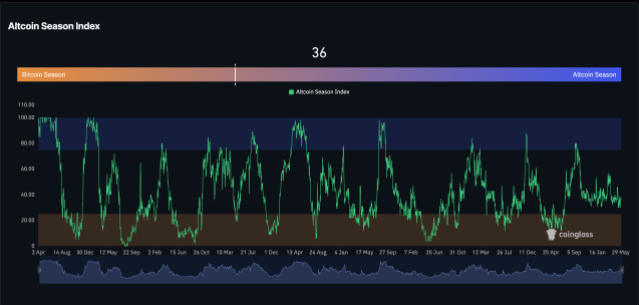
Nguồn: Coinglass

Phân Tích Dữ Liệu Cho Một Mùa Altcoin

Với Chỉ Số Mùa Altcoin đang ở mức thấp như 36, điều này có nghĩa là thị trường thực sự không đang trải qua một mùa altcoin. Thông thường, một mùa altcoin sẽ bắt đầu khi điểm số trên 75. Điều này có nghĩa là 75% trong số 100 altcoin hàng đầu đang hoạt động tốt hơn Bitcoin trong khung thời gian 3 tháng để điều này xảy ra.

Thêm vào đó, tỷ lệ thống trị của Bitcoin trên thị trường tiền mã hóa vẫn tiếp tục tăng thay vì giảm. Đây là dấu hiệu cho thấy thị trường thực sự không đang chuyển sang mùa altcoin. Điều này sẽ chỉ xảy ra khi sự thống trị của Bitcoin bắt đầu sụp đổ và sự thống trị của altcoin bắt đầu tăng lên.

Xét theo dữ liệu, nó cho thấy rằng đợt tăng giá của một số altcoin chỉ là những đợt tăng giá cục bộ. Ethereum cũng đang hoạt động kém hơn so với Bitcoin trong thời gian này, và với vai trò là nhà lãnh đạo lịch sử của mùa altcoin, Ethereum sẽ phải bắt đầu vượt trội hơn Bitcoin để kích hoạt mùa altcoin tiếp theo.

Vốn hóa thị trường altcoin gặp khó khăn | Nguồn: Crypto Total Market Cap Excluding BTC trên TradingView.com

Trend Kriptolar

İlgili Sorular

QChỉ số Altcoin Season Index hiện tại là bao nhiêu và nó cho biết điều gì?

ATheo dữ liệu từ trang Coinglass, Chỉ số Altcoin Season Index hiện tại đang ở mức 36. Điều này cho thấy thị trường tiền điện tử hiện không ở trong mùa altcoin, vì một mùa altcoin thực sự thường chỉ bắt đầu khi chỉ số này đạt trên 75.

QTheo bài viết, dấu hiệu nào cho thấy một mùa altcoin có thể đang bắt đầu?

AMột mùa altcoin thường bắt đầu khi Chỉ số Altcoin Season Index vượt quá 75, nghĩa là 75% trong số 100 altcoin hàng đầu hoạt động tốt hơn Bitcoin trong khoảng thời gian 90 ngày. Ngoài ra, sự thống trị của Bitcoin (Bitcoin Dominance) phải bắt đầu giảm mạnh trong khi sự thống trị của altcoin tăng lên.

QTỷ lệ thống trị (Dominance) của Bitcoin hiện tại như thế nào và nó ảnh hưởng gì đến ý tưởng về mùa altcoin?

ATỷ lệ thống trị của Bitcoin đã bắt đầu phục hồi vào cuối tuần và tăng lên trên 59.88%. Xu hướng này cho thấy Bitcoin vẫn đang chiếm ưu thế trên thị trường, đi ngược lại với điều kiện cần thiết cho một mùa altcoin. Mùa altcoin chỉ xảy ra khi tỷ lệ thống trị của Bitcoin giảm mạnh.

QVai trò của Ethereum đối với mùa altcoin được mô tả như thế nào trong bài viết?

ABài viết mô tả Ethereum như 'nhà lãnh đạo lịch sử' của mùa altcoin. Để kích hoạt mùa altcoin tiếp theo, Ethereum cần bắt đầu hoạt động tốt hơn Bitcoin. Tuy nhiên, hiện tại, Ethereum đang hoạt động kém hiệu quả hơn so với Bitcoin.

QBài viết kết luận như thế nào về các đợt tăng giá gần đây của một số altcoin?

ABài viết kết luận rằng các đợt tăng giá gần đây của một số altcoin chỉ là những đợt tăng giá cục bộ (spot rallies), chứ không phải là sự khởi đầu của một mùa altcoin toàn diện. Dữ liệu từ Chỉ số Altcoin Season và tỷ lệ thống trị của Bitcoin đều không ủng hộ giả thuyết rằng một mùa altcoin mới đã bắt đầu.

İlgili Okumalar

GPT-5.6 Countdown: Abandon the Illusion of a Single API, Computational Iteration Can't Outpace a Single Page of Compliance

In mid-June, three seemingly independent industry events—the compliance-driven throttling of Fable 5, the open-sourcing of GLM-5.2, and the leaked release timeline for GPT-5.6—are pushing the global AI industry toward a watershed moment. These shifts signal a fundamental restructuring of the industry's underlying logic. First, **"usability" has substantially overtaken "advanced capabilities"** as the primary weight, pushing the global large language model (LLM) supply chain into a "dual-track" phase of controlled closed-source and local open-source coexistence. Second, **the competitive moats of closed-source giants are shifting**. Their technical focus is moving from "language intelligence" toward "spatial intelligence (world models)"—a domain heavily reliant on computing power. Third, faced with常态化 transnational compliance risks, **a "model-agnostic" decoupled design has become a survival necessity for application-layer developers to maintain business continuity.** The article details how Anthropic's Fable 5, despite its advanced engineering feats, was restricted for non-U.S. citizens within 72 hours of launch, highlighting how geopolitical compliance can instantly limit even the most advanced models. In response, the open-source camp, exemplified by Zhipu AI's MIT-licensed GLM-5.2, is gaining market share by offering stable performance improvements and significant cost advantages (up to 70% savings for enterprises), while achieving full adaptation with domestic semiconductor platforms. Meanwhile, closed-source leaders like OpenAI are pivoting. The anticipated GPT-5.6 reportedly shifts focus from language to spatial intelligence and world models, aiming to rebuild a generational gap in areas like 3D understanding, simulation, and industrial design that demand immense compute. The core conclusion is that the LLM supply chain's logic has changed. Enterprises must now evaluate infrastructure based on a composite of technical performance and policy compliance. For developers, complete reliance on a single closed-source API poses unacceptable risk. Implementing a truly model-agnostic architecture—enabling swift switches to compliant, locally deployable open-source alternatives—is no longer just good practice but a fundamental baseline for business continuity.

marsbit1 saat önce

GPT-5.6 Countdown: Abandon the Illusion of a Single API, Computational Iteration Can't Outpace a Single Page of Compliance

marsbit1 saat önce

Is the 'Token Subsidy War' Among AI Giants Almost Over?

The article discusses the ongoing "token subsidy war" among AI giants like OpenAI and Anthropic, questioning whether it's nearing its end. It reveals that current AI subscription prices are heavily subsidized, with some plans offering tokens at up to 70 times the actual cost to attract and retain heavy users, especially developers and enterprises. This strategy mirrors past internet-era subsidy battles, but with a key difference: AI tokens lack "lock-in" effects. Unlike ride-hailing or food delivery apps, users can easily switch between AI providers as APIs become standardized, making it difficult for companies to raise prices post-subsidy. The piece highlights a structural asymmetry in the competition. Giants like Google, with massive advertising revenue, can afford to subsidize tokens indefinitely, akin to using "tokens as a weapon." In contrast, venture-backed companies like OpenAI and Anthropic face pressure to become profitable, especially as they approach IPO. The article cites Google Ventures founder Bill Maris, who suggests Google could slash token prices by 80%, putting immense pressure on competitors. Two potential endgames are presented: the "internet service" model (subsidize, monopolize, then raise prices) and the "utility" model (tokens become a standardized, low-margin commodity like electricity). Given the low switching costs, the latter seems more likely. The competition may not have a single winner but could instead accelerate AI's evolution into a foundational, infrastructure-level technology, akin to a public utility. For now, users continue to benefit from heavily subsidized token costs.

marsbit1 saat önce

Is the 'Token Subsidy War' Among AI Giants Almost Over?

marsbit1 saat önce

Beyond the Stadium: The Profitable Games Surrounding the World Cup

"Beyond the Pitch: The Profit Game Around the World Cup" The FIFA World Cup transcends being a sporting spectacle, evolving into a massive global arena for speculation and profit-seeking. The 2026 tournament has amplified this dynamic, creating a multi-layered ecosystem of financial opportunism alongside the football. **Prediction markets** have surged into the mainstream. Platforms like Polymarket and Kalshi saw trading volumes for World Cup contracts soar, attracting new users with their financial trading model and high-profile, chain-based wealth stories that overshadow traditional sports betting in terms of growth and narrative. However, **traditional sportsbooks** remain the dominant force, leveraging established user habits, legal markets, and comprehensive product offerings to handle the vast majority of speculative wagers, with projections suggesting record-breaking betting volumes. Capital markets also react. **"Concept stocks"** in countries like South Korea and Japan experience volatile price swings based on team performance and anticipated fan spending on items like chicken, beer, and viewing parties, effectively becoming a stock market reflecting fan sentiment. The **ticket resale market** has become a sophisticated arena for arbitrage. Prices fluctuate wildly based on team draws and star power, with sellers sometimes listing tickets they don't yet own in a practice akin to short-selling, while FIFA's own "Right to Buy" tokens add another layer of speculative trading. **Collectibles and merchandise** offer another avenue. Panini sticker albums, with their inherent scarcity and nostalgic value, can become high-value collectibles. Limited-edition or locally themed jerseys command significant premiums on secondary markets, and even counterfeit vendors profit from fans' desire for affordable match-day identity. The **cryptocurrency** space has seen a frenzy of speculative, unauthorized World Cup-themed meme coins on chains like Solana. These tokens, often exploiting team names and player imagery, experience extreme pump-and-dump cycles, creating stories of massive gains for a few early entrants and steep losses for many others. Finally, an entire industry thrives on **providing information and tools** to other speculators. Developers create platforms like SeatSidekick to track ticket inventory and prices, while paid Telegram groups and subscriptions sell betting tips and predictions, monetizing the widespread desire for an informational edge. In essence, the World Cup has become a compressed, global laboratory for speculation. While the games determine champions on the field, a parallel, complex network of financial transactions—spanning prediction contracts, bets, stocks, tickets, collectibles, crypto, and information services—settles its own scores in the global market.

marsbit2 saat önce

Beyond the Stadium: The Profitable Games Surrounding the World Cup

marsbit2 saat önce

How Does Codex Use a Computer? Three Entry Points and Permission Boundaries

This article explains the three primary methods for Codex to interact with a computer, each with distinct use cases, permission boundaries, and trust levels. **1. Computer Use:** This offers the broadest access, allowing Codex to visually control and interact with the graphical user interface of authorized macOS/Windows apps, system settings, and even iOS simulators. It's ideal for tasks lacking APIs or structured tools, such as operating legacy software or multi-app workflows. However, it's the slowest method and has the widest permission scope, requiring careful supervision for sensitive actions. **2. Chrome Extension:** This grants Codex access to the user's logged-in Chrome browser state, including cookies, profiles, and open tabs. It's best for tasks requiring user identity across websites like Gmail, LinkedIn, Salesforce, or internal dashboards. Its key advantage is multi-tab control for complex workflows. While more powerful for browser-based tasks than Computer Use, it carries higher sensitivity as actions are performed under the user's identity. **3. In-App Browser:** This is a browser isolated within the Codex thread, separate from the user's personal browsing data. It excels in web development and debugging scenarios—previewing local servers, testing responsive layouts, or annotating designs directly on the page. Its isolation is a strength for development but a limitation for tasks requiring login sessions. The core principle is to choose the narrowest, safest, and most structured interface for the task. Use plugins or MCPs first, resort to visual control (Computer Use) only for GUI-dependent tasks, employ the Chrome extension for identity-reliant browser work, and prefer the In-App Browser for isolated development. **Appshots** are clarified as a fourth, complementary tool for *inputting* context—capturing a screenshot of a window to point Codex to something—rather than a method for Codex to *act*. Together, this layered approach highlights a key to AI agent productization: not granting unlimited permissions, but constraining them within clear boundaries for specific tasks while preserving user oversight.

marsbit3 saat önce

How Does Codex Use a Computer? Three Entry Points and Permission Boundaries

marsbit3 saat önce

İşlemler

Spot
Futures

Popüler Makaleler

ALT Nasıl Satın Alınır

HTX.com’a hoş geldiniz! AltLayer (ALT) satın alma işlemlerini basit ve kullanışlı bir hâle getirdik. Adım adım açıkladığımız rehberimizi takip ederek kripto yolculuğunuza başlayın. 1. Adım: HTX Hesabınızı OluşturunHTX'te ücretsiz bir hesap açmak için e-posta adresinizi veya telefon numaranızı kullanın. Sorunsuzca kaydolun ve tüm özelliklerin kilidini açın. Hesabımı Aç2. Adım: Kripto Satın Al Bölümüne Gidin ve Ödeme Yönteminizi SeçinKredi/Banka Kartı: Visa veya Mastercard'ınızı kullanarak anında AltLayer (ALT) satın alın.Bakiye: Sorunsuz bir şekilde işlem yapmak için HTX hesap bakiyenizdeki fonları kullanın.Üçüncü Taraflar: Kullanımı kolaylaştırmak için Google Pay ve Apple Pay gibi popüler ödeme yöntemlerini ekledik.P2P: HTX'teki diğer kullanıcılarla doğrudan işlem yapın.Borsa Dışı (OTC): Yatırımcılar için kişiye özel hizmetler ve rekabetçi döviz kurları sunuyoruz.3. Adım: AltLayer (ALT) Varlıklarınızı SaklayınAltLayer (ALT) satın aldıktan sonra HTX hesabınızda saklayın. Alternatif olarak, blok zinciri transferi yoluyla başka bir yere gönderebilir veya diğer kripto para birimlerini takas etmek için kullanabilirsiniz.4. Adım: AltLayer (ALT) Varlıklarınızla İşlem YapınHTX'in spot piyasasında AltLayer (ALT) ile kolayca işlemler yapın.Hesabınıza erişin, işlem çiftinizi seçin, işlemlerinizi gerçekleştirin ve gerçek zamanlı olarak izleyin. Hem yeni başlayanlar hem de deneyimli yatırımcılar için kullanıcı dostu bir deneyim sunuyoruz.

197 Toplam GörüntülenmeYayınlanma 2024.12.10Güncellenme 2026.06.02

ALT Nasıl Satın Alınır

Tartışmalar

HTX Topluluğuna hoş geldiniz. Burada, en son platform gelişmeleri hakkında bilgi sahibi olabilir ve profesyonel piyasa görüşlerine erişebilirsiniz. Kullanıcıların ALT (ALT) fiyatı hakkındaki görüşleri aşağıda sunulmaktadır.

活动图片