La guerre des stablecoins vient de trouver un nouveau prétendant — et celui-ci dispose de 500 000 points de vente

bitcoinist2026-06-02 tarihinde yayınlandı2026-06-02 tarihinde güncellendi

Özet

MoneyGram, l'un des plus grands réseaux de transfert de fonds transfrontaliers, a lancé le 2 juin le MGUSD, un stablecoin natif adossé au dollar américain. Cette initiative marque un tournant stratégique : après s'être appuyé sur des infrastructures tierces comme l'USDC de Circle, l'entreprise émet désormais sa propre monnaie numérique, lui permettant de contrôler directement l'émission, les réserves et les rendements. L'importance de ce lancement réside dans l'envergure de MoneyGram : une institution de paiement de 85 ans, présente dans plus de 200 pays avec environ 500 000 points de vente. En ciblant les familles dépendantes des transferts d'argent, notamment en Amérique latine, en Afrique et en Asie du Sud-Est, ce stablecoin normalise l'utilisation des actifs numériques pour un public éloigné de la cryptosphère. Ce déploiement intervient dans le cadre du GENIUS Act de 2026, une loi américaine offrant un cadre réglementaire clair aux émetteurs de stablecoins. MoneyGram a progressivement construit son infrastructure numérique, via des partenariats (Stellar) et des intégrations (Fireblocks), pour réduire sa dépendance externe et maîtriser sa pile de paiement. L'entrée d'un géant des transferts d'argent dans l'émission de stablecoins signale que cette économie dépasse désormais le secteur cryptographique pour devenir un enjeu central de l'industrie mondiale des paiements.

MoneyGram, l'un des plus grands réseaux de paiement transfrontaliers au monde, a annoncé le 2 juin le lancement de MGUSD — un stablecoin natif adossé au dollar américain arborant la propre marque de l'entreprise et conçu pour servir de couche fondamentale à une gamme croissante de services financiers à travers son réseau mondial de transferts d'argent, selon le communiqué de presse officiel de l'entreprise.

Cette décision marque un virage décisif dans la stratégie de stablecoin de MoneyGram. Jusqu'à présent, l'entreprise basée à Dallas avait construit ses services de dollar numérique sur une infrastructure tierce — principalement l'USDC de Circle, déployé via son partenariat avec la Stellar Development Foundation pour alimenter les fonctionnalités de solde en stablecoin dans son application grand public en Colombie et au Salvador. MGUSD change complètement la donne.

Un stablecoin natif de marque donne à MoneyGram un contrôle direct sur l'émission, la gestion des réserves et l'économie des rendements qui auparavant revenaient à des émetteurs externes.
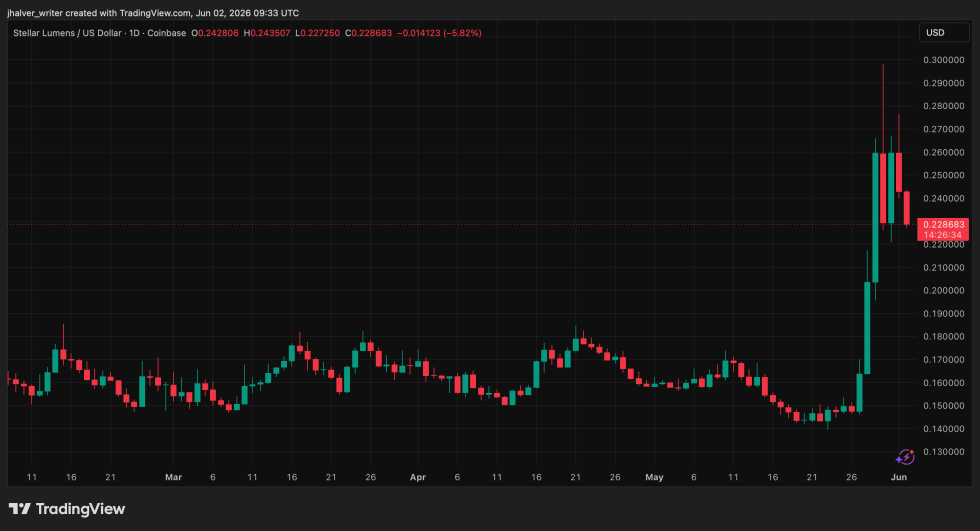
La tendance du prix du XLM est à la hausse sur le graphique journalier. Source : XLMUSD Tradingview

Pourquoi ce stablecoin est important pour l'industrie des transferts d'argent

MoneyGram n'est pas une entreprise native de la cryptographie qui construit un stablecoin pour des utilisateurs natifs de la cryptographie. C'est une institution de paiement vieille de 85 ans opérant dans plus de 200 pays avec environ 500 000 points de vente au détail et plus de 50 millions de clients annuels — et elle vient d'émettre son propre dollar numérique. La distinction est significative. Quand une entreprise de cette envergure et de ce statut réglementaire lance un stablecoin natif, elle normalise l'instrument pour la démographie exacte — les familles dépendantes des transferts d'argent en Amérique latine, en Afrique et en Asie du Sud-Est — qui a historiquement été la plus éloignée de l'adoption de la cryptographie.

Le timing est délibéré. La loi GENIUS, promulguée au début de l'année 2026, a établi le premier cadre réglementaire américain formel pour les émetteurs de stablecoins — un développement que le PDG de MoneyGram, Anthony Soohoo, avait publiquement décrit comme les garde-fous dont l'entreprise avait besoin pour développer ses services de dollar numérique en toute confiance. MGUSD est le premier lancement majeur de stablecoin grand public à arriver précisément dans cette nouvelle fenêtre réglementaire.

Le déploiement de l'infrastructure de MoneyGram a été délibéré et séquentiel — partenariat avec Stellar en 2021, intégration du trésor Fireblocks en décembre 2025, statut de validateur sur la blockchain Tempo en mai 2026, et maintenant un stablecoin propriétaire. Chaque étape a réduit sa dépendance envers des partenaires externes et approfondi son contrôle sur la pile de paiement numérique.

Ce développement marque un moment charnière pour la convergence de ce secteur naissant avec la finance mondiale grand public. Un géant du transfert d'argent qui émet son propre stablecoin — soutenu par des décennies d'infrastructure de conformité et un demi-million de points d'encaissement dans le monde — est le signal le plus clair à ce jour que l'économie des stablecoins n'est plus une histoire de l'industrie de la cryptographie. C'est une histoire de l'industrie mondiale des paiements.

Image de couverture de Grok, graphique XLM de Tradingview

Trend Kriptolar

İlgili Sorular

QQu'est-ce que MoneyGram a lancé et en quoi cela représente-t-il un changement stratégique ?

AMoneyGram a lancé le MGUSD, son propre stablecoin adossé au dollar américain, marquant un changement stratégique décisif. Jusqu'à présent, l'entreprise s'appuyait sur des infrastructures tierces comme l'USDC de Circle. Avec le MGUSD, MoneyGram prend le contrôle direct de l'émission, de la gestion des réserves et des rendements économiques.

QQuelle est la portée de MoneyGram et pourquoi le lancement de son stablecoin est-il significatif ?

AMoneyGram est une institution de paiement vieille de 85 ans, opérant dans plus de 200 pays avec environ 500 000 points de vente au détail et plus de 50 millions de clients par an. Le lancement de son propre stablecoin normalise cet instrument pour les familles dépendant des transferts de fonds, souvent éloignées de l'adoption des cryptomonnaies.

QQuel facteur réglementaire a influencé le timing du lancement du MGUSD ?

ALe lancement du MGUSD intervient peu après la promulgation du GENIUS Act en 2026, qui a établi le premier cadre réglementaire américain formel pour les émetteurs de stablecoins. Le PDG de MoneyGram a décrit cette loi comme les garde-fous nécessaires pour développer en toute confiance ses services de dollar numérique.

QQuelles étapes ont précédé le lancement du stablecoin MGUSD par MoneyGram ?

ALa construction de l'infrastructure a été progressive : partenariat avec Stellar en 2021, intégration de Fireblocks pour la trésorerie en décembre 2025, obtention du statut de validateur sur la blockchain Tempo en mai 2026, et enfin le lancement de son stablecoin propriétaire, le MGUSD.

QQue symbolise le lancement d'un stablecoin par MoneyGram pour l'industrie financière selon l'article ?

ACela marque un moment charnière pour la convergence du secteur naissant des stablecoins avec la finance mondiale grand public. Cela indique clairement que l'économie des stablecoins n'est plus seulement une histoire de l'industrie crypto, mais bien une histoire de l'industrie mondiale des paiements.

İlgili Okumalar

After Three Consecutive Quarters of Decline, Can the Crypto Market Find a Window for Stabilization in Q3?

The cryptocurrency market has just concluded its worst-performing quarter since 2022, with total capitalization dropping 12.6% to $2.1 trillion. All core metrics indicate capital is leaving the sector, not just rotating within it. Bitcoin fell 14.2% and Ethereum dropped 25.4% in Q2, breaking their previous correlation with US tech stocks. A key driver is the reversal in US spot Bitcoin ETF flows, which saw a net outflow of approximately $4.67 billion in Q2, including a record monthly outflow near $4.5 billion in June. While recent data suggests long-term holders are accumulating again, sustained ETF outflows mean continued selling pressure. Market focus is now singularly on the Federal Reserve. The upcoming July FOMC meeting is seen as the most critical event for Q3. A dovish signal could support Bitcoin reclaiming a $68,000-$84,000 range, while a hawkish stance might establish a new trading band around $50,000-$56,000. Additionally, regulatory uncertainty persists, with the progress of the crucial *CLARITY Act* stalling in the Senate, reducing its perceived 2026 passage probability to 40-45%. Despite the broad downturn, a few sectors showed growth. Prediction markets saw nominal volume surge 48.7% year-over-year to $113.8 billion, and tokenized collectibles transaction volume rose 143% quarterly to $1.4 billion. The Real-World Asset (RWA) tokenization sector also continued steady growth, now representing ~$28.1 billion in on-chain value. The market's foundation for an extreme crash appears limited, with Bitcoin price hovering near its 200-week moving average. However, the trading paradigm has shifted from narrative-driven speculation to decisions based on price action, policy developments, and interest rate expectations, making a broad sentiment-driven rally unlikely in the near term.

marsbitDün 08:36

After Three Consecutive Quarters of Decline, Can the Crypto Market Find a Window for Stabilization in Q3?

marsbitDün 08:36

BIT Trading Moment: BTC Still Suppressed by Weekly 200 EMA, Rejection May Restart Decline; Storage and Semiconductors that Surged Last Night Begin Falling in Evening Trading

**Crypto & Stock Market Wrap: Bitcoin Tests Resistance, Stocks Retreat After AI Surge** Bitcoin consolidates around $66,000, facing key resistance near $68,000—an area seen as a major psychological and technical hurdle where previous rallies have failed. Analysts note the cryptocurrency is caught between its 200-week moving average (~$63,333) and 200-week EMA (~$68,328). A clear break above $68k is needed to signal a stronger bullish trend, while a rejection could lead to a retest of $63k support. Market sentiment remains cautious, with low futures open interest pointing to a low-liquidity rebound rather than a full bull market. Bitcoin spot ETFs saw another $203 million inflow. US stock futures pointed lower after a strong Tuesday session led by a massive rebound in semiconductors and memory stocks. The rally was fueled by renewed optimism about AI-driven hardware demand, with Micron, SanDisk, and SK Hynix surging. However, those gains reversed in pre-market trading. Super Micro Computer (SMCI) soared over 20% after hours on strong guidance and a record backlog. Other standouts included Rocket Lab and nuclear energy plays Oklo and X-Energy. Rising oil prices (Brent above $91) and climbing Treasury yields (10-year near 4.64%), however, are reigniting inflation concerns and acting as a headwind for equities. In Asia, markets were mixed. South Korea's KOSPI pared early gains to close slightly higher as semiconductor stocks like SK Hynix gave back initial surges. Japan's Nikkei edged lower as the yen hit a fresh 38-year low against the dollar, raising fears of potential market intervention. Key events to watch include the Samsung Galaxy launch, AMD's AI event, and a slew of major tech earnings from Alphabet, Tesla, and IBM after the close on Wednesday, followed by the ECB meeting and Intel's earnings on Thursday.

marsbitDün 08:28

BIT Trading Moment: BTC Still Suppressed by Weekly 200 EMA, Rejection May Restart Decline; Storage and Semiconductors that Surged Last Night Begin Falling in Evening Trading

marsbitDün 08:28

Former CFTC Chairman, Circle President Tarbert: Preaching Long-Termism While Cashing Out $30 Million Himself

Former CFTC Chairman and Circle President Heath Tarbert has consistently advocated for a long-term vision in public, urging patience from investors as Circle’s stock price has fallen significantly from its peak. However, it has been revealed that since Circle’s IPO, Tarbert has continuously sold his CRCL shares through pre-arranged trading plans, cashing out approximately $30 million, without making any public market purchases. This contrast between his public messaging and personal actions has drawn criticism. Tarbert joined Circle in July 2023 as Chief Legal Officer, leveraging his regulatory experience to help guide the company through its IPO and expansion. Despite promoting stablecoins as long-term infrastructure, he established a 10b5-1 trading plan just before Circle went public, leading to substantial stock sales over the following year. In March 2026, he initiated another plan to sell more shares. His career trajectory highlights a pattern of moving between high-level regulatory roles and influential positions in the financial sector. After resigning as CFTC Chairman in early 2021, he joined Citadel Securities as Chief Legal Officer just 27 days later, during a period of intense regulatory scrutiny for the firm. He later joined Circle, aiding its efforts to navigate regulatory challenges for its public listing. While Tarbert's expertise in policy and compliance is valuable to companies like Circle, his actions—advocating long-term confidence while personally divesting—raise questions about the alignment between his public statements and his private financial decisions, leaving investors who followed his advice to bear the market risks.

marsbitDün 08:06

Former CFTC Chairman, Circle President Tarbert: Preaching Long-Termism While Cashing Out $30 Million Himself

marsbitDün 08:06

Gate Research Institute: The 'Wall Street-ization' Wave of Crypto Financial Products – Competition or Integration?

The article titled "Gate Research Institute: Are Crypto Financial Products Sparking a 'Wall Street' Wave—Competition or Convergence?" explores the evolving relationship between the crypto ecosystem and traditional finance (TradFi). The piece begins by reflecting on Bitcoin's original 2009 vision of decentralization, disintermediation, and moving away from banks. It then contrasts this with the 2024 landscape, where key crypto assets like Bitcoin are increasingly held through Wall Street products like ETFs issued by giants like BlackRock. The article questions whether this signifies that TradFi is systematically taking over the rights to issue, price, custody, and distribute crypto financial assets. The core argument is that this is not a zero-sum takeover but rather a bidirectional convergence where each side addresses the other's weaknesses. Crypto offers 24/7 global markets, programmable settlement, and open access but lacks compliant channels, institutional-grade custody, deep fiat liquidity, and mainstream distribution. TradFi possesses these but is constrained by legacy systems, limited operating hours, and slow settlement. Two primary convergence paths are highlighted: * **Path A (CEX to TradFi):** Exemplified by Gate, which has progressed from offering tokenized stocks and CFDs to providing direct, real stock trading (US, Hong Kong, South Korea) within its platform, using USDT. * **Path B (TradFi to Crypto):** Exemplified by Robinhood, which has integrated crypto trading, acquired exchanges like Bitstamp, and is moving traditional assets like stocks onto the blockchain via tokenization and its own Layer 2. Both paths are ultimately competing to become the next-generation, unified financial account—a "super account" where users can seamlessly trade cryptocurrencies, stocks, ETFs, RWA (Real World Assets), and tokenized treasury products in one interface. The growth of RWA and tokenized treasuries (e.g., BlackRock's BUIDL) is presented as the asset-layer fusion, providing stable, yield-bearing assets on-chain and acting as a bridge between the two worlds. In conclusion, the "Wall Street-ization" of crypto is framed as a mutual transformation. Decentralized ideals persist in the protocol layer, while at the application layer, a more efficient, global, and accessible unified capital market is emerging from this convergence. The future competition lies not between crypto exchanges and stockbrokers, but between platforms vying to offer the most comprehensive asset coverage, liquidity, and user experience within a single account.

marsbitDün 08:01

Gate Research Institute: The 'Wall Street-ization' Wave of Crypto Financial Products – Competition or Integration?

marsbitDün 08:01

İşlemler

Spot

Popüler Makaleler

ONE Nasıl Satın Alınır

HTX.com’a hoş geldiniz! Harmony (ONE) satın alma işlemlerini basit ve kullanışlı bir hâle getirdik. Adım adım açıkladığımız rehberimizi takip ederek kripto yolculuğunuza başlayın. 1. Adım: HTX Hesabınızı OluşturunHTX'te ücretsiz bir hesap açmak için e-posta adresinizi veya telefon numaranızı kullanın. Sorunsuzca kaydolun ve tüm özelliklerin kilidini açın. Hesabımı Aç2. Adım: Kripto Satın Al Bölümüne Gidin ve Ödeme Yönteminizi SeçinKredi/Banka Kartı: Visa veya Mastercard'ınızı kullanarak anında Harmony (ONE) satın alın.Bakiye: Sorunsuz bir şekilde işlem yapmak için HTX hesap bakiyenizdeki fonları kullanın.Üçüncü Taraflar: Kullanımı kolaylaştırmak için Google Pay ve Apple Pay gibi popüler ödeme yöntemlerini ekledik.P2P: HTX'teki diğer kullanıcılarla doğrudan işlem yapın.Borsa Dışı (OTC): Yatırımcılar için kişiye özel hizmetler ve rekabetçi döviz kurları sunuyoruz.3. Adım: Harmony (ONE) Varlıklarınızı SaklayınHarmony (ONE) satın aldıktan sonra HTX hesabınızda saklayın. Alternatif olarak, blok zinciri transferi yoluyla başka bir yere gönderebilir veya diğer kripto para birimlerini takas etmek için kullanabilirsiniz.4. Adım: Harmony (ONE) Varlıklarınızla İşlem YapınHTX'in spot piyasasında Harmony (ONE) ile kolayca işlemler yapın.Hesabınıza erişin, işlem çiftinizi seçin, işlemlerinizi gerçekleştirin ve gerçek zamanlı olarak izleyin. Hem yeni başlayanlar hem de deneyimli yatırımcılar için kullanıcı dostu bir deneyim sunuyoruz.

558 Toplam GörüntülenmeYayınlanma 2024.12.12Güncellenme 2026.06.02

ONE Nasıl Satın Alınır

Tartışmalar

HTX Topluluğuna hoş geldiniz. Burada, en son platform gelişmeleri hakkında bilgi sahibi olabilir ve profesyonel piyasa görüşlerine erişebilirsiniz. Kullanıcıların ONE (ONE) fiyatı hakkındaki görüşleri aşağıda sunulmaktadır.

活动图片