L'industrie de la cryptographie surveille la Pologne alors qu'elle avance un projet de loi réglementaire longtemps retardé

bitcoinist2026-05-16 tarihinde yayınlandı2026-05-16 tarihinde güncellendi

Özet

Le Premier ministre polonais Donald Tusk a lié l'adoption retardée d'une régulation crypto à un scandale de fraude impliquant l'échange Zondacrypto, mettant en lumière le manque de protection des investisseurs. En réponse, la chambre basse du parlement (Sejm) a approuvé, par 241 voix contre 200, le projet de loi n°2529 du gouvernement, confiant des pouvoirs étendus à l'Autorité de supervision financière (KNF) pour surveiller le marché, imposer des sanctions et bloquer des comptes ou transactions. Cependant, la communauté crypto critique le texte, car des dispositions controversées autorisant ces blocages, ayant déjà motivé deux vetos présidentiels précédents, demeurent. L'absence de contrôle judiciaire renforcé suscite des craintes que le président n'impose un troisième veto, prolongeant l'incertitude réglementaire. Cette impasse survient malgré l'urgence pour la Pologne de se conformer au règlement européen MiCA, dont les délais de mise en œuvre approchent en juillet. Le vote final a suivi l'examen de quatre propositions concurrentes, celle du gouvernement l'ayant emporté.

Le Premier ministre polonais a lié l'échec répété du pays à adopter des règles sur les cryptomonnaies à une affaire de fraude très médiatisée — une accusation qui a ajouté de l'urgence à un vote parlementaire qui avait déjà échoué deux fois auparavant.

Un scandale façonne le débat

Le Premier ministre Donald Tusk a pointé du doigt Zondacrypto, une plateforme d'échange de cryptomonnaies polonaise actuellement sous enquête du parquet pour fraude, comme preuve de ce qui se passe lorsque les protections des investisseurs ne sont pas en place.

Des milliers d'utilisateurs de la plateforme n'auraient pas pu accéder à leurs fonds, et Tusk a affirmé que la plateforme avait des liens avec le capital et l'influence russes remontant à ses premières années.

Il a soutenu que l'incapacité de la Pologne à finaliser un cadre réglementaire avait ralenti toute réponse officielle à la crise.

Le scandale de la plateforme a projeté une ombre longue sur la session de cette semaine du Sejm, la chambre basse du parlement polonais, où les députés ont débattu simultanément de quatre projets de loi distincts sur les cryptomonnaies.
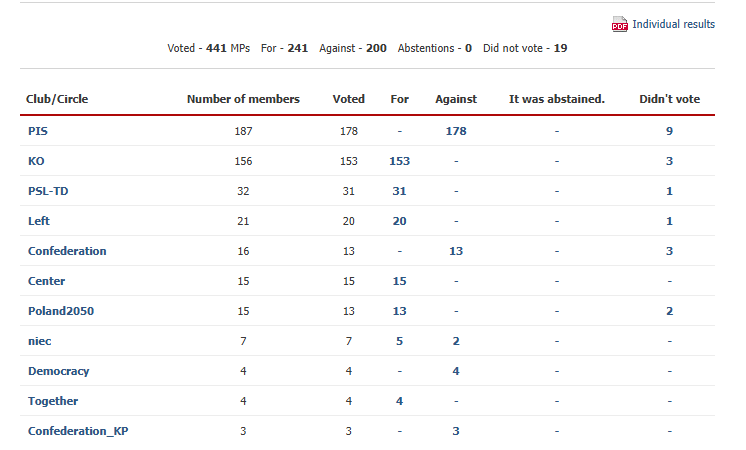
Source : SEJM

Vendredi, ils ont approuvé le projet de loi soutenu par le gouvernement — numéroté 2529 et soutenu par le ministère des Finances — par un vote de 241 voix contre 200. C'était la troisième fois que le gouvernement poussait ce type de législation au parlement après que le président Karol Nawrocki ait opposé son veto à deux versions antérieures.

Le projet de loi approuvé confie de larges pouvoirs à l'Autorité de surveillance financière polonaise, connue sous le nom de KNF, pour surveiller les participants au marché des cryptomonnaies, imposer des sanctions administratives et bloquer des comptes et des transactions lorsque cela est jugé nécessaire.

Les critiques soulignent des dispositions inchangées

Le résultat n'a pas été accueilli favorablement par toute la communauté des cryptomonnaies. Les acteurs du marché et les commentateurs ont noté que les dispositions sur le blocage des comptes et des transactions — les mêmes qui avaient motivé les vetos précédents de Nawrocki — restaient largement intactes dans le texte final. Des modifications proposées, telles qu'un contrôle judiciaire renforcé des mesures d'exécution, n'ont pas été incluses.

BTCUSD s'échange à 79 182 $ sur le graphique 24h : TradingView

Ces préoccupations n'étant pas résolues, de nombreux observateurs s'attendent à ce que le président oppose à nouveau son veto au projet de loi. Cette perspective inquiète les acteurs du secteur, car un troisième rejet approfondirait l'incertitude réglementaire à un moment particulièrement inopportun.

La Pologne est tenue d'aligner ses règles sur le Règlement de l'Union européenne sur les marchés des crypto-actifs, connu sous le nom de MiCA, avec des échéances de mise en œuvre approchant en juillet.

Quatre projets de loi, un seul résultat

Le vote est intervenu après que les députés aient examiné des propositions concurrentes provenant de quatre sources distinctes : le gouvernement, le président, le parti Confédération et un groupe parlementaire. Une commission a fusionné les textes avant le vote final, et la version gouvernementale a finalement prévalu.

Image principale de Hotels.com, graphique de TradingView

İlgili Sorular

QQuel événement a ajouté de l'urgence au vote parlementaire polonais sur la régulation des cryptomonnaies, selon l'article ?

ALe Premier ministre Donald Tusk a lié l'échec répété de l'adoption de règles sur les cryptomonnaies au cas de fraude très médiatisé de l'échange Zondacrypto, ce qui a ajouté de l'urgence au vote.

QQuelle est l'autorité qui obtiendra des pouvoirs étendus de surveillance du marché des cryptomonnaies selon le projet de loi approuvé ?

AL'autorité qui obtiendra des pouvoirs étendus est la Commission de surveillance financière polonaise, connue sous le nom de KNF (Komisja Nadzoru Finansowego).

QPourquoi de nombreux observateurs s'attendent-ils à un nouveau veto présidentiel contre ce projet de loi ?

ADe nombreux observateurs s'attendent à un nouveau veto présidentiel car les dispositions controversées sur le blocage des comptes et des transactions, qui avaient motivé les vetos précédents du président Nawrocki, sont restées largement inchangées dans le texte final.

QQuelle est la contrainte de temps qui pèse sur la Pologne concernant la régulation des cryptomonnaies, mentionnée dans l'article ?

ALa Pologne est tenue de mettre ses règles en conformité avec le Règlement de l'Union européenne sur les marchés des crypto-actifs (MiCA), avec des délais de mise en œuvre qui approchent en juillet 2026.

QCombien de projets de loi distincts ont été débattus simultanément au Sejm (la chambre basse du parlement polonais) ?

ALes députés ont débattu simultanément de quatre projets de loi distincts, provenant du gouvernement, du président, du parti Confédération et d'un groupe parlementaire.

İlgili Okumalar

Just Now, Ilya Drops Another Mind-Blowing Image ‘The Thinker’: What’s on His Mind in the Ocean of AI Chips?

Shortly after going quiet, Ilya Sutskever, AI's enigmatic spiritual leader, posted a mysterious sketch titled "The Thinker" on Instagram. The drawing depicts Rodin's iconic sculpture perched on a cliff, contemplating a vast, purple microscopic universe made of transistors and digital circuits—a chip die shot—signed "IS 2026." This cryptic image, saying "nothing yet everything," ignited widespread speculation in Silicon Valley. Some see it as a search for sacred meaning in silicon, others as a silent critique of brute-force compute scaling. It echoes Ilya's past influence, like the original OpenAI logo he once doodled on a wall. The post coincided with a triple announcement from OpenAI, intensifying the frenzy. First, an internal reasoning model discovered new geometric constructions, challenging a long-standing conjecture and impressing Fields Medalist Tim Gowers. Second, Codex for Mac introduced "Appshots," allowing it to access application windows—even text outside the view—and gained features like Goal Mode, a built-in browser, and plugin capabilities, evolving from a coding assistant into a persistent "resident engineer." Third, reports surfaced that OpenAI is preparing for a confidential IPO filing with banks like Goldman Sachs and Morgan Stanley, potentially eyeing a fall public listing. Together, these moves signal that AGI (Artificial General Intelligence) is not a distant slogan but an active force reshaping science, software engineering, and capital markets. Ilya's art hints at a paradigm shift where the boundary between human thought and silicon computation blurs. As OpenAI insiders excitedly say, "Feel the AGI," it suggests a tangible breakthrough may be imminent—one our generation is likely to witness.

marsbit19 dk önce

Just Now, Ilya Drops Another Mind-Blowing Image ‘The Thinker’: What’s on His Mind in the Ocean of AI Chips?

marsbit19 dk önce

Vitalik on the Future of the Ethereum Foundation: A Smaller, More Distinct, but Longer-Lasting Ship

Vitalik discusses the future direction of the Ethereum Foundation (EF), emphasizing a shift towards a smaller, more focused, and longer-lasting organization. He clarifies this is his personal view and that his own influence within EF is diminishing, which he welcomes. The key driver is aligning EF's actions with its stated values of decentralization, privacy, and being a "sanctuary technology," addressing criticism that its operations haven't fully reflected these ideals. He argues that EF should not be the "center" of Ethereum but one node among many with a specific mandate. With limited resources (holding only ~0.16% of all ETH), EF must focus its remaining efforts on long-term, mission-critical activities that wouldn't happen without its push, particularly those reinforcing Ethereum's core CROPS values (Censorship-Resistance, Resilience, Openness, Privacy, Security). This means making hard choices, potentially spinning out even respected projects to attract external capital, and cultivating a distinct cultural stance. The core technical vision is for Ethereum to be "amazing" not by chasing maximal throughput, but by excelling in the CROPS dimension. Key goals include: a provably bug-free Ethereum via AI-assisted formal verification; high-availability chain consensus combining the best of BFT and Bitcoin-style security; and minimization of intermediaries in transaction sending and user experience. These "unreasonable" ambitions aim to make Ethereum profoundly impressive in its core values, which also support ETH as a robust asset. The future EF will be a smaller, more opinionated ship built for longevity and meaningful impact.

链捕手25 dk önce

Vitalik on the Future of the Ethereum Foundation: A Smaller, More Distinct, but Longer-Lasting Ship

链捕手25 dk önce

Leading Players in Large Models Drain the Primary Market

The AI industry is witnessing an unprecedented concentration of capital into a handful of leading players, signaling what insiders call the "eve of a final shakeout." A staggering funding surge exceeding $7 billion hit just three Chinese companies in May alone—Kimi, StepFun (接近完成融资), and DeepSeek—with the latter's valuation reaching $45-$50 billion. Globally, giants like OpenAI, Anthropic, and SpaceX (set to merge with xAI) are preparing for public listings, collectively eyeing valuations over $3 trillion. This capital is no longer fueling a broad "hundred-model war" but is being funneled to "refuel" the final few contenders, following a sector-wide attrition rate exceeding 90%. This frenzy is driven by a fundamental shift in industry logic. The focus has moved from比拼模型智商 (competing on model intelligence) to "token factory economics." The explosion of long-context AI agents has massively increased token consumption per task. With token supply constrained by bottlenecks in HBM memory and power infrastructure—key factors in production costs—dominance now hinges on owning and efficiently operating large-scale compute resources. Major tech firms are investing hundreds of billions annually in this AI "power grid." Consequently, competition pivots to three core areas: 1) **Monetization** as the "AGI premium" cools, forcing a shift from user growth to revenue; 2) **Cost efficiency**, where reducing inference costs becomes the ultimate KPI as model capabilities commoditize; and 3) **Strategic path divergence** between enterprise-focused AI (prioritizing integration and reliability) and consumer-facing applications (betting on scale and user engagement). The message is clear: the final capital injections are determining the endgame lineup. Success will depend not just on technical prowess, but on transforming technology into a sustainable, profitable business model with demonstrable return on massive compute investments.

marsbit34 dk önce

Leading Players in Large Models Drain the Primary Market

marsbit34 dk önce

AI Giants Queueing Up for IPOs: Is This the 'Last Dance' for the U.S. Stock Market?

A massive wave of IPOs from AI giants like OpenAI, Anthropic, and SpaceX is taking shape, potentially reshaping the U.S. stock market. OpenAI is reportedly preparing for a historic IPO, targeting a valuation over $1 trillion and raising roughly $60 billion, which would dwarf previous records. Anthropic is also advancing its own IPO plans, projecting significant revenue growth and achieving quarterly operating profit. However, their financial profiles starkly differ. While Anthropic is nearing profitability with a focus on enterprise clients, OpenAI continues to report substantial losses, with a negative operating margin and expectations for positive cash flow only by 2029-2030. Analysts warn these listings could trigger a major "passive fund reshuffle," forcing index funds to sell holdings in established tech giants to make room for the new entrants, potentially pressuring the broader market. Some observers view the IPO rush as a "risk transfer," allowing early private investors to cash out at peak valuations while passing future financial uncertainty to public market investors. The divergent paths of Anthropic's near-term profitability versus OpenAI's long-term, high-cost growth narrative present a critical choice for investors. The outcome of these IPOs is seen as a major swing factor for risk assets in 2026, testing whether this surge marks a new cycle or a potential peak.

marsbit42 dk önce

AI Giants Queueing Up for IPOs: Is This the 'Last Dance' for the U.S. Stock Market?

marsbit42 dk önce

İşlemler

Spot
Futures

Popüler Makaleler

BILL Nasıl Satın Alınır

HTX.com’a hoş geldiniz! Billions Network (BILL) satın alma işlemlerini basit ve kullanışlı bir hâle getirdik. Adım adım açıkladığımız rehberimizi takip ederek kripto yolculuğunuza başlayın. 1. Adım: HTX Hesabınızı OluşturunHTX'te ücretsiz bir hesap açmak için e-posta adresinizi veya telefon numaranızı kullanın. Sorunsuzca kaydolun ve tüm özelliklerin kilidini açın. Hesabımı Aç2. Adım: Kripto Satın Al Bölümüne Gidin ve Ödeme Yönteminizi SeçinKredi/Banka Kartı: Visa veya Mastercard'ınızı kullanarak anında Billions Network (BILL) satın alın.Bakiye: Sorunsuz bir şekilde işlem yapmak için HTX hesap bakiyenizdeki fonları kullanın.Üçüncü Taraflar: Kullanımı kolaylaştırmak için Google Pay ve Apple Pay gibi popüler ödeme yöntemlerini ekledik.P2P: HTX'teki diğer kullanıcılarla doğrudan işlem yapın.Borsa Dışı (OTC): Yatırımcılar için kişiye özel hizmetler ve rekabetçi döviz kurları sunuyoruz.3. Adım: Billions Network (BILL) Varlıklarınızı SaklayınBillions Network (BILL) satın aldıktan sonra HTX hesabınızda saklayın. Alternatif olarak, blok zinciri transferi yoluyla başka bir yere gönderebilir veya diğer kripto para birimlerini takas etmek için kullanabilirsiniz.4. Adım: Billions Network (BILL) Varlıklarınızla İşlem YapınHTX'in spot piyasasında Billions Network (BILL) ile kolayca işlemler yapın.Hesabınıza erişin, işlem çiftinizi seçin, işlemlerinizi gerçekleştirin ve gerçek zamanlı olarak izleyin. Hem yeni başlayanlar hem de deneyimli yatırımcılar için kullanıcı dostu bir deneyim sunuyoruz.

85 Toplam GörüntülenmeYayınlanma 2026.05.07Güncellenme 2026.05.12

BILL Nasıl Satın Alınır

Tartışmalar

HTX Topluluğuna hoş geldiniz. Burada, en son platform gelişmeleri hakkında bilgi sahibi olabilir ve profesyonel piyasa görüşlerine erişebilirsiniz. Kullanıcıların BILL (BILL) fiyatı hakkındaki görüşleri aşağıda sunulmaktadır.

活动图片