Circle's Second Growth Curve: After the $222 Million ARC Financing, CRCL or ARC?

链捕手2026-05-14 tarihinde yayınlandı2026-05-14 tarihinde güncellendi

Özet

Circle, the issuer of USDC, announced that its new public blockchain Arc completed a $222 million private sale for its native token ARC, with the network's fully diluted valuation reaching $3 billion. The funding round was led by a16z crypto, with participation from major institutions including BlackRock, Apollo, and ICE. The article explains Circle's rationale for building its own L1 blockchain, Arc. Existing chains like Ethereum and Solana are seen as lacking native support for large-scale institutional needs, such as regulatory compliance, predictable transaction costs, and asset issuance/redemption workflows. Arc is designed to fill this gap as a foundational layer for the on-chain economy, moving beyond Circle's reliance on USDC reserve interest for revenue. It details the dual-token model of Arc: USDC serves as the stable gas token for predictable transactions, while ARC is the network's native asset used for staking in the planned transition to Proof-of-Stake, governance, and aligning long-term incentives among participants. ARC's total supply is 10 billion, with 60% allocated to ecosystem development, 25% to Circle, and 15% to a long-term reserve. All protocol fees are converted to ARC, with portions burned and distributed to stakers. The piece contrasts the value proposition of Circle's public stock (CRCL) and the ARC token. CRCL captures the company's core cash flows from USDC interest and other business lines. ARC captures the growth potential of the Arc network...

Author: Zhou, ChainCatcher

On May 11th, while releasing its Q1 2026 financial report, Circle announced that the ARC native token of its public blockchain Arc had completed a $222 million presale, with a fully diluted valuation of $3 billion for the network.

The round was led by a16z crypto with a $75 million investment, followed by top-tier institutions including BlackRock, Apollo, ICE (parent company of NYSE), SBI Group, SC Ventures, and ARK Invest.

CRCL's stock price surged nearly 16% that day, with its market cap rebounding above $30 billion.
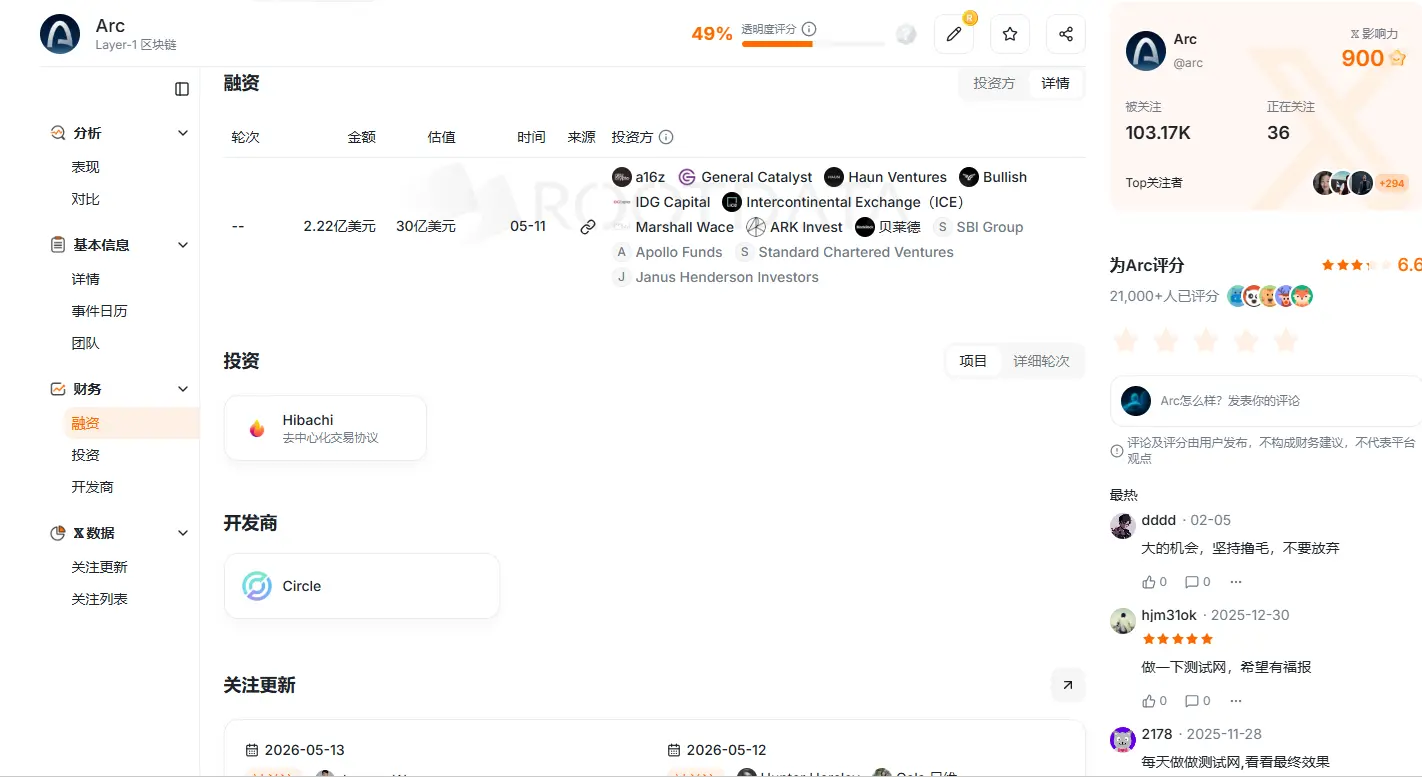
Image source: RootData

This development raises a core market question: Circle is already a public company; if investors are optimistic about its future, why not simply hold CRCL stock? Why issue the ARC token as well? Both are capturing the value of the Arc network. What exactly does each represent?

1. Why Did Circle Build Arc Itself?

Why did Circle choose to invest massive resources into building its own public blockchain instead of continuing to issue and use USDC on Ethereum or Solana?

a16z Crypto explains that as global finance gradually moves on-chain, only a few public blockchains will be able to serve as the "foundational base for an on-chain economic system."

Stablecoin transaction volume approached $9 trillion last year, placing it in the same league as global payment networks like Visa and PayPal. Cross-border payments, B2B settlement, and forex trading are becoming core use cases for stablecoins, which have upgraded to become a core layer of global financial infrastructure.

However, existing blockchain infrastructure is still primarily geared towards crypto-native users and individual developers, lacking native support for large-scale institutional-level demands.

Industry insiders point out that institutions face several core pain points when conducting business on-chain, including: the need for fully closed-loop on-chain/off-chain validation for asset issuance and redemption; payments requiring deterministic finality; compliance capabilities needing to be embedded at the foundational layer; configurable privacy protection; and the need for predictable Gas costs using USDC, among others.

Ethereum, Solana, and other existing public blockchains struggle to natively meet these demands.

For Circle, the company has historically relied primarily on USDC reserve interest for profitability. In Q1, USDC circulation reached $77 billion, a 28% year-over-year increase. As its business scale continues to expand, relying solely on existing public chains can no longer fully meet the deeper needs of institutional clients.

Therefore, Circle's launch of Arc aims precisely to fill this gap. The underlying logic is that having a stablecoin circulate on someone else's chain does not mean owning the stablecoin financial ecosystem—which is why Circle decided to build its own L1.
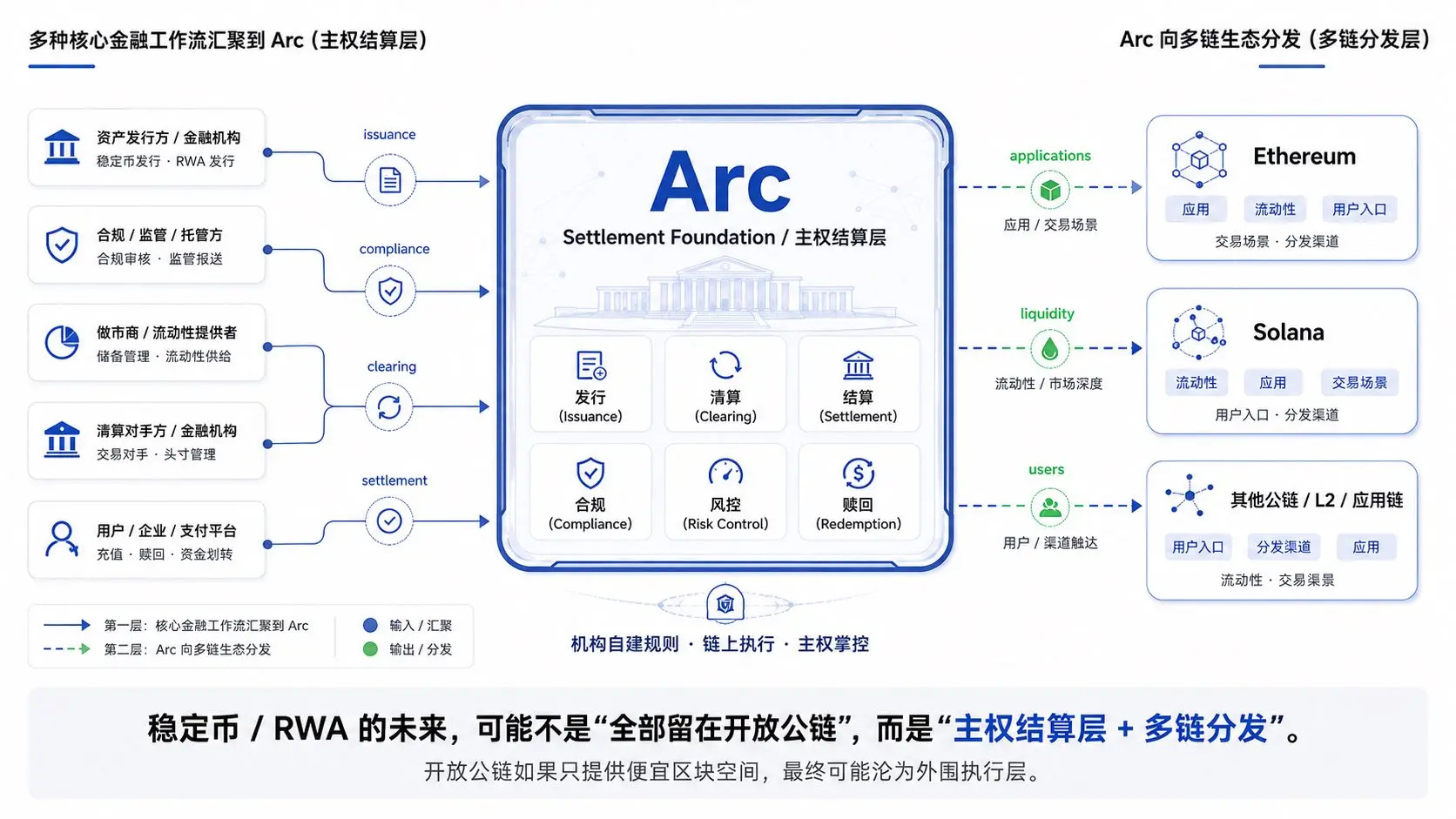
Image source: X user @vanisaxxm

2. USDC Solves the Transaction Problem, ARC Solves the Coordination Problem

Since USDC is already the Gas token for Arc, why is another ARC token needed?

USDC has effectively solved the stability issue at the transaction level. Institutions can pay fees directly priced in USD, with predictable costs that can be accounted for, avoiding the troubles caused by crypto asset price volatility for finance departments.

However, for a network to operate healthily in the long term, solving the transaction problem alone is not enough. It also needs to address coordination problems.

According to the official whitepaper, Arc will gradually transition from its current Proof-of-Authority to Proof-of-Stake. Validator nodes need to stake assets to secure the network, with the core principle of staking being to bind node behavior through economic incentives; malicious actions risk slashing. USDC's value is pegged at $1, making it unable to truly bind node interests to the network's success or failure. Only the native ARC token can provide such dynamic economic incentives.
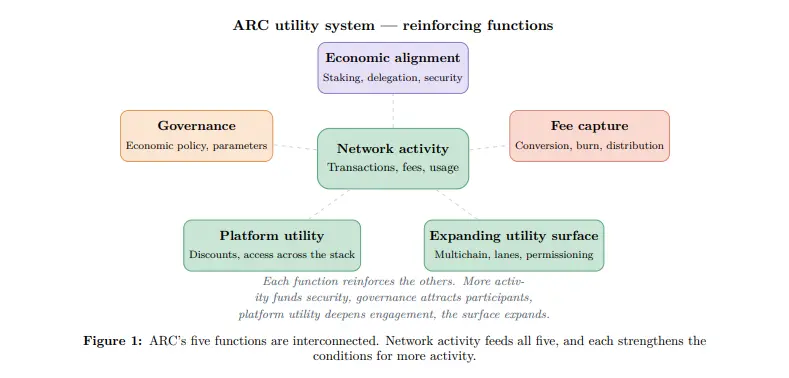
Governance also requires interest alignment. Key decisions such as fee rates, inflation parameters, and burn ratios require participants to adopt a long-term perspective. If voting were based solely on USDC, holders could easily lack sustained motivation, potentially voting and then exiting. ARC holders' asset value is directly tied to network performance, giving them stronger motivation to make choices beneficial for the network's long-term development.

The whitepaper also clarifies that ARC's governance authority has phased boundaries. Economic parameters are determined by token holder votes, but important matters like protocol upgrades, security incident handling, and validator qualification reviews initially remain under Circle's control, with gradual decentralization planned as governance matures.

In simple terms, USDC is the lifeblood of the Arc network, responsible for efficient daily flow; ARC is the equity of the network, responsible for aligning the long-term interests of all parties. This dual-token design also partially transforms the cost of ecosystem development from Circle's fixed cash expenditures into incentive arrangements tied to the network's success or failure.

3. CRCL and ARC: Which Pieces of the Pie Do They Capture?

Thus, Circle now holds both the publicly listed equity CRCL and the network's native token ARC, both capturing the value of the same Arc network. So, which pieces of the pie do they respectively capture?

According to the whitepaper, the total supply of ARC is 10 billion tokens, with a clear allocation: 60% for the ecosystem, including developer incentives, network growth programs, and user participation rewards; 25% allocated to Circle for operating validator nodes, staking, and governance; 15% as a long-term reserve for network stability and strategic flexibility.
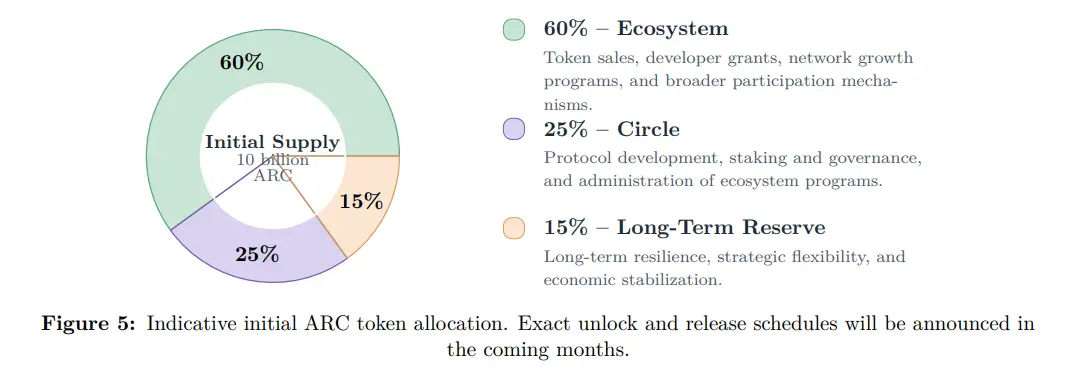
Regarding the fee mechanism, all protocol fees on Arc, regardless of the asset used for payment, will be fully converted to ARC at the protocol layer, with a portion permanently burned and a portion distributed to stakers and validators. The more active the network, the stronger the value capture by ARC.

CRCL shareholders primarily benefit through Circle as a company. The company continues to enjoy the core revenue from USDC reserve interest, along with gains from the growth of other businesses like the payment network CPN. Simultaneously, Circle's 25% ARC holdings allow it to indirectly share in network-level rewards.

Crypto analyst BTCdayu proposes a three-dimensional valuation framework for CRCL: The first dimension is reserve interest income, the most stable current cash flow and the valuation floor. The second dimension is payment network revenue, which, as CPN scales, could approach a Visa-like network fee model. The third dimension is the network option value brought by Arc, reflecting market expectations for Circle's transformation from a stablecoin issuer to a financial infrastructure platform.

Simply put, CRCL captures the company's overall stable cash flow and existing business growth, while ARC captures the growth elasticity at the network level, including Gas fee conversion, ecosystem expansion, and long-term network effects.

This forms a clear dual-track structure. The more successful the Arc network, the greater the USDC usage and business synergies, benefiting Circle at the corporate level. Concurrently, the rising value of the ARC token increases the value of Circle's 25% share, ultimately benefiting CRCL shareholders.

However, the two are legally completely separate. As mentioned officially, ARC does not represent equity in Circle and does not grant any claim to Circle's revenue, profits, assets, or CRCL shares. This means ARC holders lack the fiduciary duty protections afforded to public company shareholders; their returns depend entirely on the network's actual adoption and the tokenomics design.

4. How Can Ordinary Users Participate?

Having understood the value distribution between CRCL and ARC, a practical question arises: Who exactly is the ARC token being sold to? And how can ordinary users participate at low cost?

The first category of buyers is strategic institutional investors. They entered via the $222 million presale at a unit price of $0.3, with lock-up periods ranging from 1 to 4 years. These institutions not only provide capital but are also potential users and builders of Arc. For example, BlackRock is already testing tokenized asset settlement on the testnet; ICE, as the parent of NYSE, and SBI Group, as Japan's largest financial group, are strategically positioning themselves for future business on Arc.

The second category is ecosystem builders and long-term holders. Developers and liquidity providers receive ARC incentives for their contributions; the 60% ecosystem allocation is for this purpose. They prioritize the network's long-term growth, akin to early employees holding company equity.

The third category is retail speculators and participants. They focus on early narrative opportunities and ecosystem incentives, anticipating price volatility post-mainnet launch.

For ordinary users without presale access, Arc offers several low-cost participation paths.

The Arc Testnet launched in October 2025 and has processed over 244 million test transactions to date. The mainnet is expected to launch in the summer of 2026. Users can claim free test tokens to perform operations like Swaps, bridging, and contract deployment to familiarize themselves with network interaction.

The Arc House community is the primary entry point for ordinary users. Users can accumulate points by registering, staying active, posting, reading content, and participating in Q&A. Having an answer accepted yields extra points.

Advanced methods include content contribution, video sharing, event organization, and even hosting offline Meetups. Additionally, users with teams or products can apply for Circle Developer Grants.

It should be noted that Arc House points merely represent community contribution recognition; they hold no monetary value, nor do they guarantee any specific rights allocation. Specific rules are subject to the latest official announcements.

Conclusion

Currently, competition in the institutional on-chain sector is fierce, and Arc is not alone. Canton Network, under Digital Asset, is reportedly completing a new funding round at a valuation of around $2 billion, led by a16z crypto; Plasma positions itself as a stablecoin-native settlement layer with a relatively more attractive valuation; Visa included Arc, Canton, Plasma, Base, Tempo, and others as stablecoin settlement test points in April. This indicates the sector is still in a phase of parallel development with multiple competitors.

Against this backdrop, Arc's $3 billion presale FDV (Fully Diluted Valuation) sits at a relatively high level. Retail investors considering secondary market participation need to thoroughly evaluate the project's narrative potential and the competitive landscape within the sector.

From a long-term perspective, holding ARC, which carries an annual inflation of 2% to 3%, requires the network to generate sufficient real transaction fees to offset the inflation pressure for value appreciation. CRCL, in contrast, relies on USDC reserve interest and payment network revenue, supported by relatively clear cash flows. They represent different risk-return structures.

Short-term, market sentiment often follows its own logic. Around the mainnet launch, concentrated narrative hype could bring periodic opportunities. During such times, the value of Circle's 25% ARC holdings would also appreciate, benefiting CRCL shareholders.

On the regulatory front, the passage of the GENIUS Act has solidified Circle's moat, while the CLARITY Act's new draft version has been made public and is advancing in Congress, potentially providing clearer regulatory certainty for the digital asset ecosystem—a significant positive for Circle.

Overall, Arc is currently one of Circle's key strategic initiatives. As the whitepaper states, "A global economic operating system cannot be coordinated by a single entity; it transforms participants who use Arc into participants who sustain Arc." Whether this vision ultimately materializes still depends on the network's ability to attract sufficient real institutional transactions and economic activity after the mainnet launch.

Until all data lands, all narratives remain just narratives.

Trend Kriptolar

İlgili Sorular

QWhat is the purpose of Circle launching its own Layer 1 blockchain, Arc, instead of continuing to operate on established chains like Ethereum or Solana?

ACircle launched Arc to address the core needs of institutional clients, such as asset issuance/redemption with on/off-chain settlement, deterministic finality for payments, embedded compliance, configurable privacy, and predictable Gas costs paid in USDC. These needs are not natively met by existing public chains. Arc is designed to be an economic infrastructure base capable of hosting a global financial system on-chain, allowing Circle to capture more value from the stablecoin ecosystem it facilitates.

QWhy does the Arc network need a native ARC token when it already uses USDC for transaction fees?

AUSDC is used as a stable gas token for predictable transaction costs. The ARC token is needed to solve network coordination problems. It provides economic incentives for staking in the planned Proof-of-Stake security model, aligns long-term interests for governance decisions, and binds participants to the network's success. While USDC handles the flow of value, ARC acts as the network's 'equity', facilitating security and decentralized governance.

QHow do the CRCL stock and ARC token capture value differently from the Arc network and Circle's business?

ACRCL stock captures the value of Circle the company, primarily through stable revenue streams like USDC reserve interest and its payment network (CPN). It also benefits indirectly from Circle's 25% holding of ARC tokens. The ARC token directly captures the value of the Arc network itself, including gas fees converted to ARC (partly burned, partly distributed), ecosystem growth, and long-term network effects. CRCL offers stable cash flows, while ARC offers growth elasticity tied to network adoption.

QWhat are the main ways for ordinary users to participate in the Arc ecosystem early, such as for potential airdrops or rewards?

AOrdinary users can participate through several low-cost methods: 1) Using the Arc Testnet to perform transactions and interact with dApps. 2) Joining the Arc House community to earn contribution points through activities like registration, posting, reading content, and answering questions. 3) More advanced participation includes content creation, video sharing, event organization, and applying for Circle Developer Grants. Note that Arc House points are for community recognition and do not guarantee specific token rewards.

QWhat are some of the competitive challenges and considerations for Arc mentioned in the article?

AThe institutional on-chain sector is highly competitive. Key competitors include Canton Network (backed by Digital Asset), Plasma (positioned for stablecoin-native settlement), and others like Base and Tempo. Visa is testing multiple networks including Arc. The article notes that Arc's $3 billion fully diluted valuation (FDV) from its presale is relatively high. For long-term value, the ARC token needs to generate sufficient real transaction fees to offset its 2-3% annual inflation. Success depends on attracting substantial real institutional activity post-mainnet launch.

İlgili Okumalar

Examining the Open USD Partner Lineup: Follow Who's Joining to See Where the Money Flows

**Title: Deciphering the Open USD Partner Roster: Following the Money** The launch of Open USD is notable less for the stablecoin itself and more for its expansive list of over 140 founding partners, which reads like a "who's who" of global finance and tech. This coalition, including asset managers like BlackRock, card networks Visa and Mastercard, banks (BNY Mellon, Standard Chartered, etc.), tech giants (Google, IBM), merchants (Shopify), and crypto firms (Coinbase, Ripple, Aave, MetaMask), signals a strategic shift. The diverse membership reveals that stablecoins are increasingly viewed not as products to compete over, but as shared infrastructure too critical to be left to any single entity. Each partner category has distinct motives. Asset managers like BlackRock seek to manage the large, sticky cash reserves, a lucrative fee-generating opportunity. Merchants like Shopify aim for lower-cost settlement and potential yield on balances. Banks join defensively to retain custody and settlement roles, fearing deposit outflows to stablecoins. Tech companies bet on programmable money for future machine-to-machine commerce. Crypto firms gain mainstream legitimacy and distribution channels. Remarkably, the consortium includes direct competitors (Visa vs. Mastercard, Coinbase vs. Ripple), indicating that the fear of exclusion from this emerging financial layer outweighs competitive rivalries. However, this shared governance could also lead to slow decision-making. The roster's composition is the real message: it represents a collective bet that a widely accepted, consortium-owned stablecoin is preferable to proprietary versions or having none at all. For incumbents like Circle and Tether, this alliance poses a significant threat, as potential clients have collectively chosen to build their own alternative. The absence of major U.S. retail banks (busy with their own tokenized deposit networks) is equally telling. In essence, the partner list maps where the industry believes value and risk will flow in a tokenized dollar future, marking stablecoin's evolution from a product to a utility.

Foresight News12 dk önce

Examining the Open USD Partner Lineup: Follow Who's Joining to See Where the Money Flows

Foresight News12 dk önce

IOSG: Q-Day Countdown, Will Quantum Computing End Cryptocurrency?

IOSG: The Q-Day Countdown – Will Quantum Computing End Cryptocurrency? This analysis explores the looming threat quantum computing poses to blockchain technology. Quantum computers, leveraging Shor's algorithm, could theoretically break the elliptic curve cryptography (ECC) underpinning cryptocurrencies like Bitcoin and Ethereum. The article outlines a hypothetical "Q-Day" scenario where exposed public keys from dormant assets are compromised, leading to fund theft and a deep governance crisis. The core risk is not the complete erasure of blockchains but a systemic reset of public-key cryptography. Bitcoin faces significant challenges due to its "code-is-law" ethos and the immense social consensus required for migration. Its primary vulnerability lies in legacy UTXOs with publicly exposed keys. Ethereum's path involves a more complex, full-stack cryptographic agility upgrade across execution, consensus, and data layers. The industry has a limited "engineering comfort window" of 5-8 years to coordinate a migration to post-quantum cryptography (PQC), such as lattice-based or hash-based signatures. While the existential threat is often overstated, the real bottleneck is the immense coordination required across protocol developers, node operators, wallet providers, exchanges, and custodians. Market repricing of crypto assets may occur well before an actual Q-Day if quantum hardware roadmaps accelerate or regulatory pressure mounts. The article concludes that quantum computing is not a doomsday weapon but a severe stress test for blockchain's foundational security model and governance structures.

marsbit41 dk önce

IOSG: Q-Day Countdown, Will Quantum Computing End Cryptocurrency?

marsbit41 dk önce

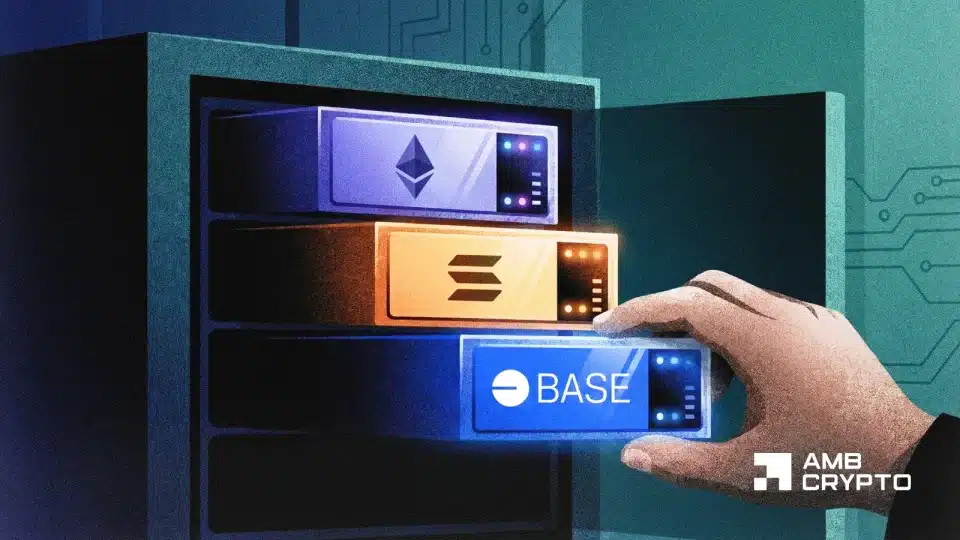
Why 2026 could redefine Ethereum, Solana, Base and Avalanche

Blockchain infrastructure is undergoing a major coordinated transformation, driven by institutional demand for reliability, compliance, and predictable settlement. Over $30 billion in Real-World Assets (RWA) on-chain has exposed network weaknesses. Major blockchains are responding with foundational upgrades, moving beyond incremental speed improvements. Ethereum's "Glamsterdam" upgrade, planned for H1 2026, will significantly increase gas limits and introduce features like PBS (pre-blocked state) for enhanced settlement and parallel execution. Solana's "Alpenglow," targeting a mainnet launch in H2 2026, focuses on reducing finality time dramatically and freeing network resources to improve reliability. Beyond speed, compliance is critical. Base's "Beryl" upgrade in Q3 2026 will introduce a standardized, regulatory-compliant token framework (B20). Avalanche's "Octane" upgrade aims to boost transaction processing and reduce costs for enterprise applications. Even Bitcoin is evolving with the potential activation of OP_CAT by late 2026/early 2027. The competition is shifting. While technical upgrades are widespread, institutions will ultimately allocate capital based on proven execution, operational resilience, and regulatory compatibility during market stress. Ethereum currently leads in tokenized assets, while networks like Base and Solana are strengthening their institutional offerings. The blockchain that best delivers reliable, compliant, and uninterrupted service is poised to attract the greatest share of future institutional capital.

ambcrypto1 saat önce

Why 2026 could redefine Ethereum, Solana, Base and Avalanche

ambcrypto1 saat önce

İşlemler

Spot

Popüler Makaleler

ARC Nasıl Satın Alınır

HTX.com’a hoş geldiniz! AI Rig Complex (ARC) satın alma işlemlerini basit ve kullanışlı bir hâle getirdik. Adım adım açıkladığımız rehberimizi takip ederek kripto yolculuğunuza başlayın. 1. Adım: HTX Hesabınızı OluşturunHTX'te ücretsiz bir hesap açmak için e-posta adresinizi veya telefon numaranızı kullanın. Sorunsuzca kaydolun ve tüm özelliklerin kilidini açın. Hesabımı Aç2. Adım: Kripto Satın Al Bölümüne Gidin ve Ödeme Yönteminizi SeçinKredi/Banka Kartı: Visa veya Mastercard'ınızı kullanarak anında AI Rig Complex (ARC) satın alın.Bakiye: Sorunsuz bir şekilde işlem yapmak için HTX hesap bakiyenizdeki fonları kullanın.Üçüncü Taraflar: Kullanımı kolaylaştırmak için Google Pay ve Apple Pay gibi popüler ödeme yöntemlerini ekledik.P2P: HTX'teki diğer kullanıcılarla doğrudan işlem yapın.Borsa Dışı (OTC): Yatırımcılar için kişiye özel hizmetler ve rekabetçi döviz kurları sunuyoruz.3. Adım: AI Rig Complex (ARC) Varlıklarınızı SaklayınAI Rig Complex (ARC) satın aldıktan sonra HTX hesabınızda saklayın. Alternatif olarak, blok zinciri transferi yoluyla başka bir yere gönderebilir veya diğer kripto para birimlerini takas etmek için kullanabilirsiniz.4. Adım: AI Rig Complex (ARC) Varlıklarınızla İşlem YapınHTX'in spot piyasasında AI Rig Complex (ARC) ile kolayca işlemler yapın.Hesabınıza erişin, işlem çiftinizi seçin, işlemlerinizi gerçekleştirin ve gerçek zamanlı olarak izleyin. Hem yeni başlayanlar hem de deneyimli yatırımcılar için kullanıcı dostu bir deneyim sunuyoruz.

247 Toplam GörüntülenmeYayınlanma 2025.01.09Güncellenme 2026.06.02

ARC Nasıl Satın Alınır

Tartışmalar

HTX Topluluğuna hoş geldiniz. Burada, en son platform gelişmeleri hakkında bilgi sahibi olabilir ve profesyonel piyasa görüşlerine erişebilirsiniz. Kullanıcıların ARC (ARC) fiyatı hakkındaki görüşleri aşağıda sunulmaktadır.

活动图片