$414mln exits crypto funds – Why sentiment is suddenly shifting

ambcrypto2026-03-31 tarihinde yayınlandı2026-03-31 tarihinde güncellendi

Özet

In the last week of March, cryptocurrency investment products experienced significant outflows totaling $414 million, marking the first net withdrawals in five weeks. This shift was driven by escalating global tensions, high inflation, and anticipation around Federal Reserve meetings, reducing total assets under management to $129 billion. Ethereum was hit hardest with $222 million in outflows, while Bitcoin saw $194 million withdrawn despite strong year-to-date inflows. Solana also recorded outflows, whereas XRP was the sole asset with inflows of $15.8 million. On-chain metrics showed reduced network engagement for major cryptocurrencies. The U.S. led outflows with $454 million, while Canada and Germany saw modest inflows. Despite a recent market cap rebound to $2.34 trillion, short-term volatility remains high due to macroeconomic uncertainty, cautioning investors against relying on temporary rallies for long-term predictions.

The last week of March (from the 23rd to the 24th) was not good for the cryptocurrency investment product. As per a weekly report from CoinShares, digital assets funds recorded their first outflows in five weeks, worth $414 million.

This has more to do with just investors’ sentiments and price actions.

Escalating global tensions involving the U.S and Iran, accompanied by high inflation and the growing expectations around the upcoming Federal Reserve meetings, are the major reasons behind this shift.

Because of these developments from politics to economics, the total Assets under Management (AuM) have declined to $129 billion. If looked carefully, such levels have already been hit during early February and back in April 2025, when volatility was high due to changing tariff policies.
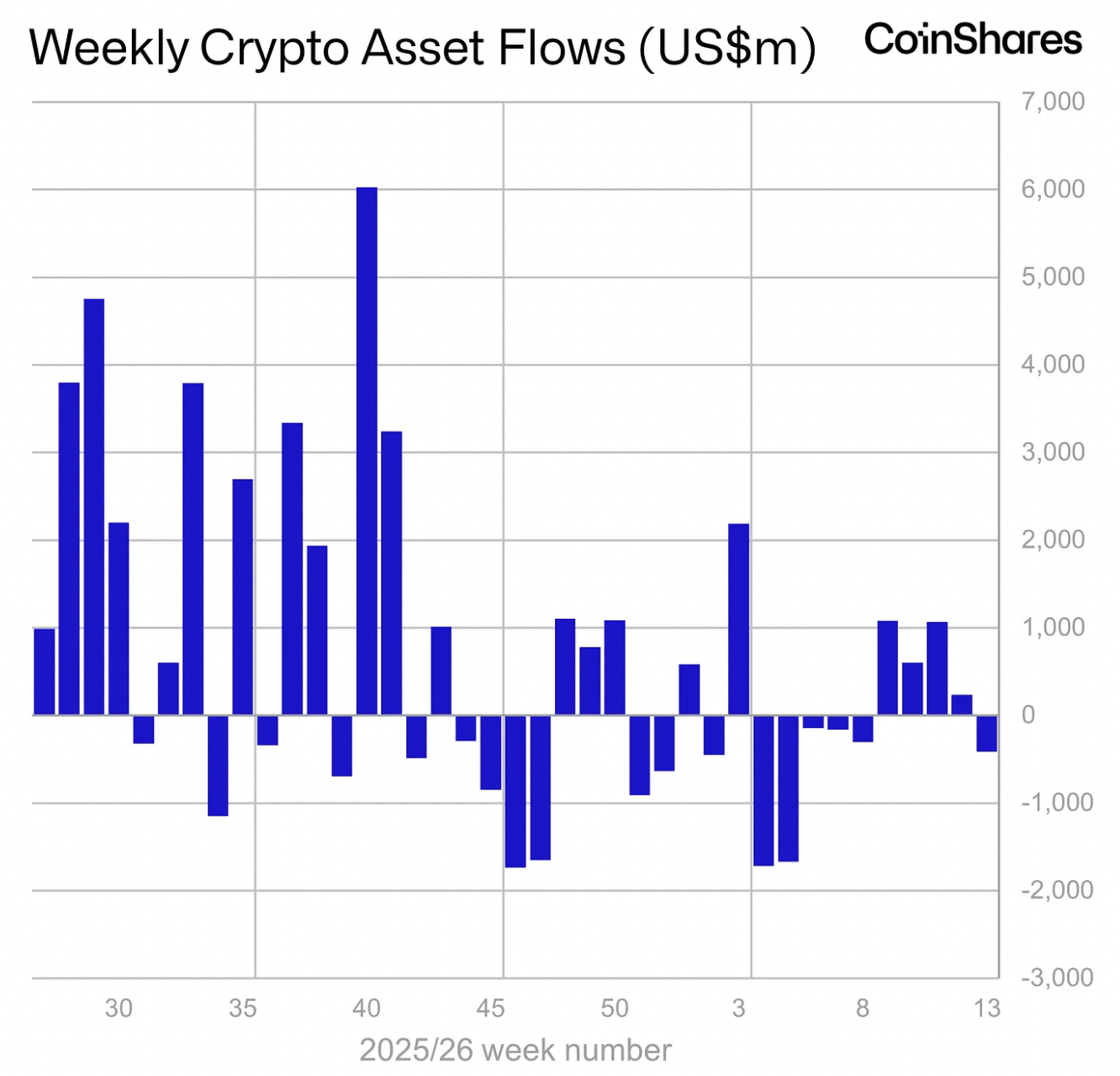
Source: CoinShares

Winners and losers of the last week

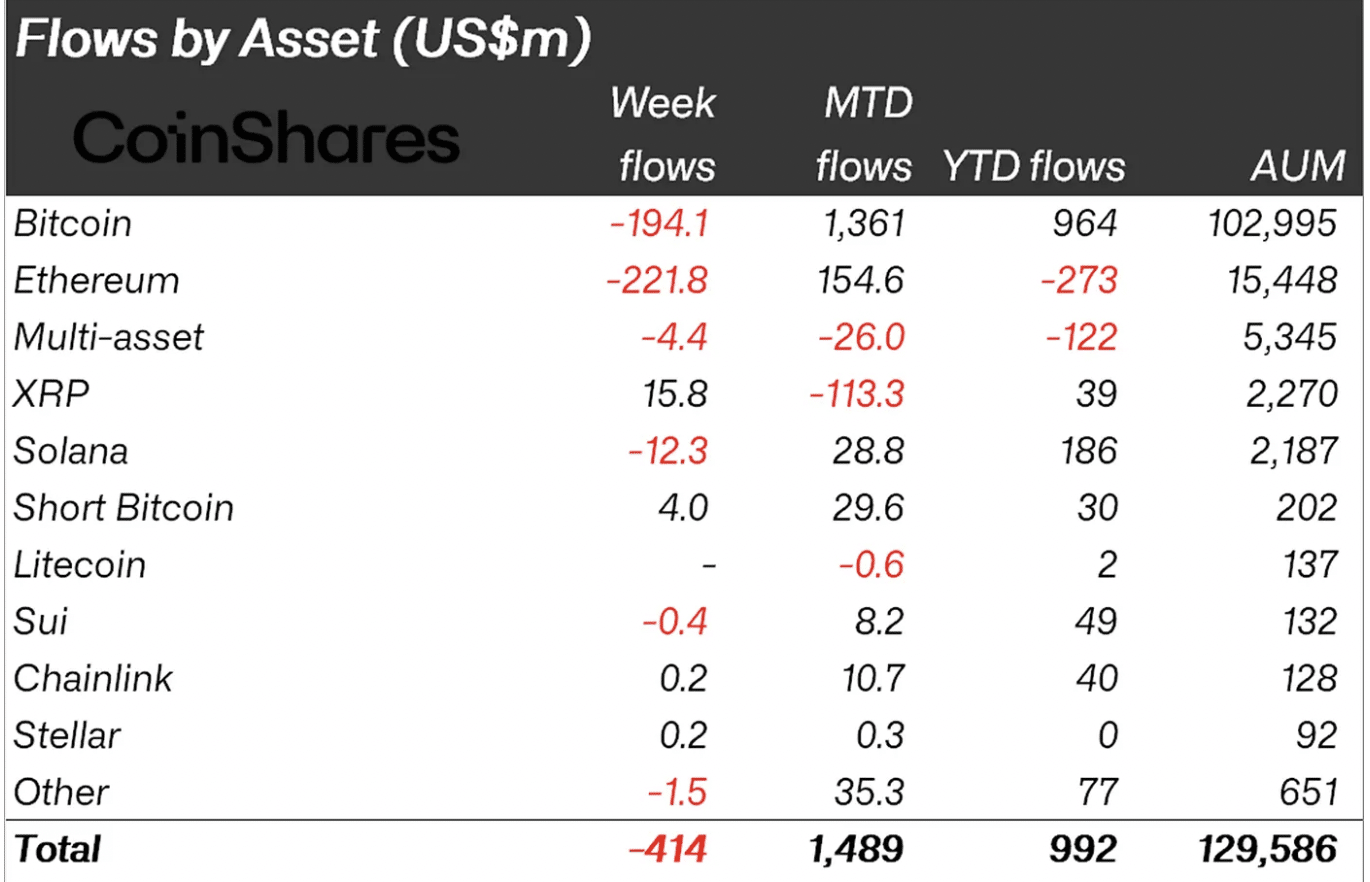
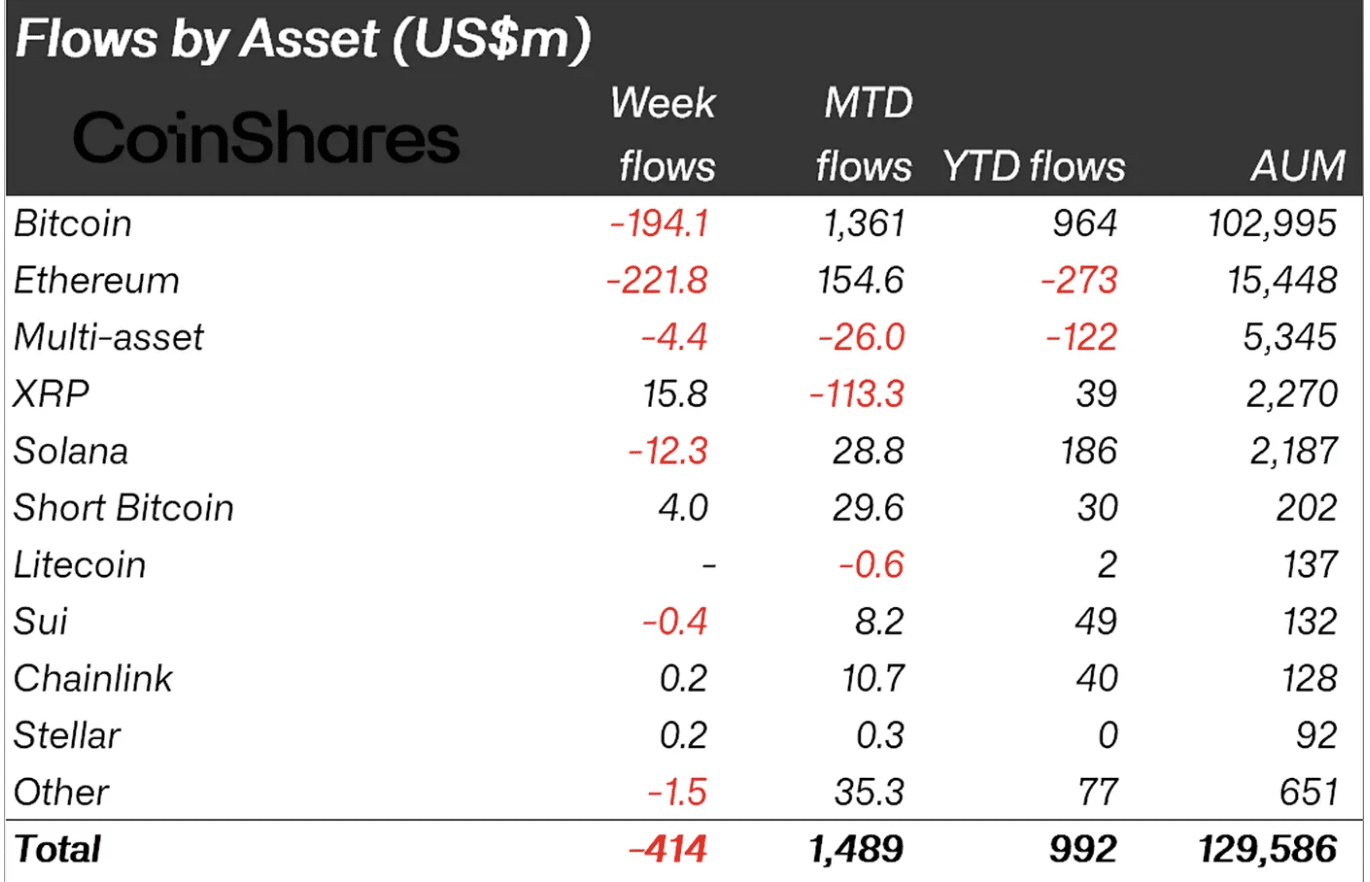
That said, in this outflow, Ethereum [ETH] was hit the hardest, recording $222 million worth of outflows. This further caused its year-to-date outflow to fall to $273 million.

Well, this drop might be due to the ongoing uncertainty around the CLARITY Act. Meanwhile, ETH’s price was also choppy as it faced a downturn of 2.48% in the past week.

Interestingly, Bitcoin [BTC] was standing strong, but the room for caution still remained. The leading cryptocurrency recorded outflows worth $194 million in the last week.

However, if you looked at its year-to-date data, its net inflow stood strong at $964 million. This came as Bitcoin’s price witnessed a weekly drop of 3.48%.
Source: CoinShares

Needless to say, Solana [SOL] was no exception as it too recorded $12.3 million in outflows as its price swung down by 5.97% in the past week.

Interestingly, Ripple’s XRP was the only one to record inflows worth $15.8 million. However, its price mirrored the broader market downturn, dropping by 4.68% in the past week.

Thus, XRP was the winner of the digital asset funds in the past week, whereas ETH was the loser.

Are on-chain metrics in favour?

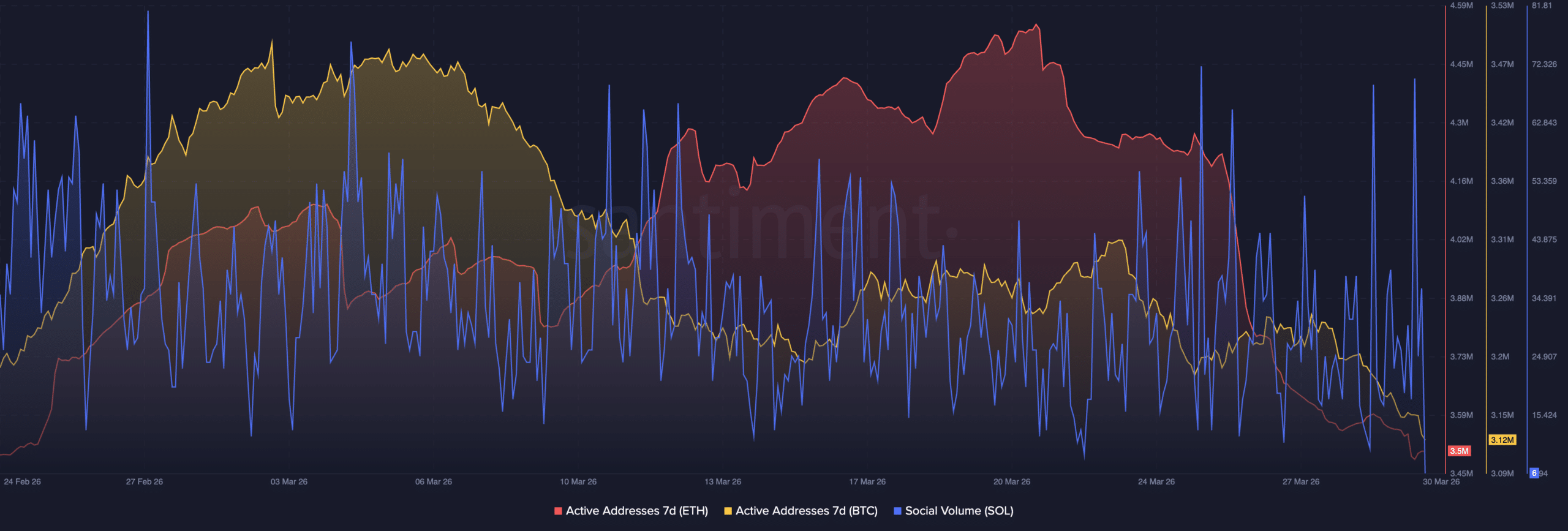
This sentiment was further confirmed by the active address metric by Santiment, wherein Bitcoin and Ethereum had both seen a drop in the aforementioned metric by the end of March.
Source: Santiment

This suggests that only a few people were invested in the network as compared to the high activity seen in early March.

Meanwhile, Solana’s Social Volume has also dropped, meaning fewer people are talking about the altcoin.

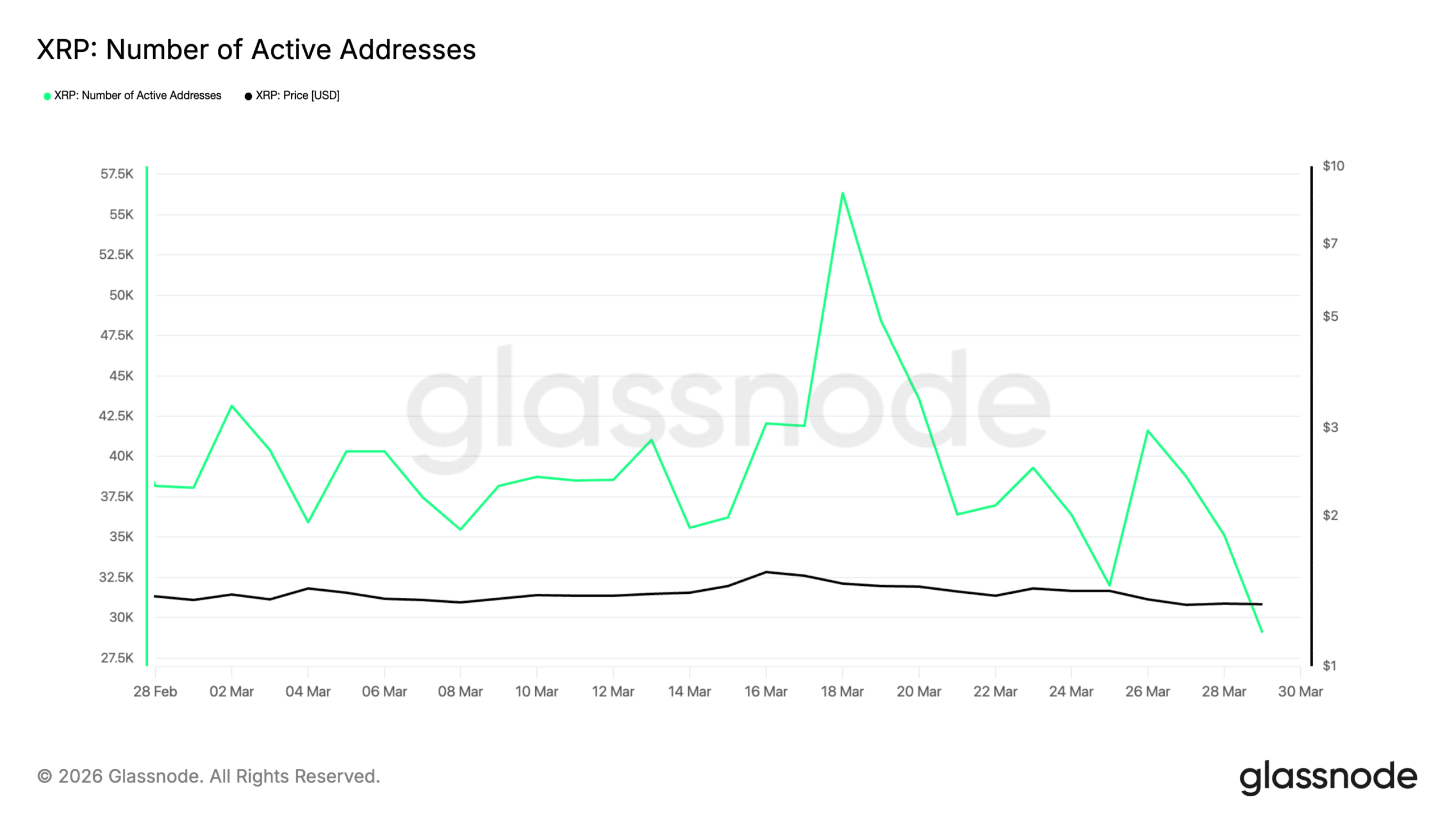
Lastly, though XRP was the winner, its network activity suggests that caution remains due to a sharp drop in active addresses in late March.
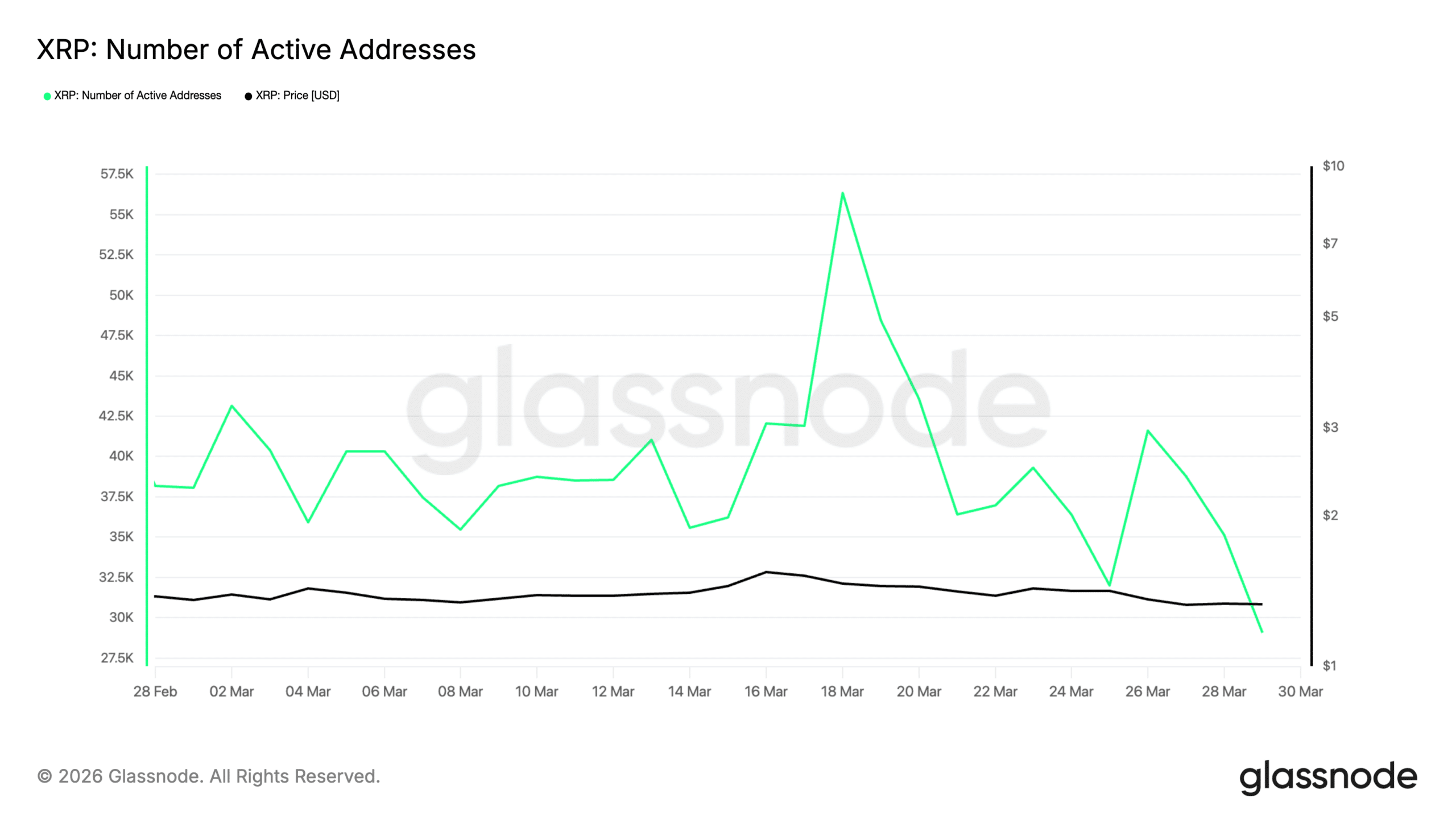
Source: Glassnode

The U.S faces the most choppy week

Now, while the U.S saw maximum outflows worth $454 million, Switzerland saw $4 million in outflows. Whereas Canada and Germany saw inflows worth $15.9 million and $21.2 million, respectively

However, as we move towards the end of March and with the 30th of March being the first day of a fresh week, the market is picking up again. The total crypto market cap is back in bullish hands, trading at $2.34 trillion at press time.

Yet despite this surge, investors should not be fooled by short-term booms, as even last week $635 millon had flowed in just before the Fed meeting and created optimism in the market.

However, as soon as the meeting drew to a conclusion, $405 million flowed out of the market, leaving investors in shock. Therefore, until situations calm down globally, short-term prices are not a clear sign for long-term market predictions.


Final Summary

  • The shift from inflows to outflows suggests that there is a lot of FUD in the market, and investors are positioning their bets cautiously.
  • Bitcoin is holding strong, but XRP stealing the spotlight highlights that investors are no longer just betting on Bitcoin.


İlgili Sorular

QWhat was the total value of outflows from cryptocurrency investment funds in the last week of March, and what was the primary reason for this shift?

AThe total value of outflows was $414 million. The primary reasons were escalating global tensions involving the U.S. and Iran, high inflation, and growing expectations around the upcoming Federal Reserve meetings.

QWhich cryptocurrency was hit the hardest with outflows, and what was the specific amount?

AEthereum (ETH) was hit the hardest, recording $222 million worth of outflows.

QDespite the overall outflows, which digital asset was the only one to record inflows, and how much was it?

ARipple's XRP was the only digital asset to record inflows, worth $15.8 million.

QAccording to on-chain metrics from Santiment, what trend was observed for Bitcoin and Ethereum by the end of March?

ABoth Bitcoin and Ethereum saw a drop in their active address metrics by the end of March, suggesting reduced network activity.

QWhich country faced the maximum outflows, and what was the amount? Which countries saw inflows?

AThe U.S. faced the maximum outflows, worth $454 million. Canada and Germany saw inflows of $15.9 million and $21.2 million, respectively.

İlgili Okumalar

Now the Greatest Regret Is to My Family: Crypto Experts Took a Stumble in the Stock Market

Summary: This article examines the significant losses recently suffered by cryptocurrency traders and influencers who ventured into the stock market, specifically by heavily investing in AI-related and semiconductor storage stocks. The narrative centers on the dramatic reversal in the Korean and US equity markets in late July, with stocks like SK Hynix and related leveraged ETFs experiencing historic plunges, erasing massive gains. The analysis highlights several key factors behind the "flip." Traders, accustomed to crypto's high volatility and frustrated by a stagnant market, chased the apparent momentum in AI-themed equities. Many made fatal mistakes: applying high-leverage strategies common in crypto (e.g., 2x ETFs, on-chain perpetual contracts) to stocks, and failing to understand the distinct rules of different stock markets (like Korean pre-market trading). This led to widespread liquidations, especially when a thin Korean pre-market trade triggered a cascading flash crash on a decentralized exchange. Post-crash reflections from prominent figures reveal deep regret and self-criticism. They acknowledge misjudging their expertise, overestimating their edge against sophisticated institutional players, and the dangers of leverage. The article concludes that while such setbacks are part of trading, surviving long-term requires recognizing one's limitations and the inherent risks of cross-market strategies.

marsbit15 dk önce

Now the Greatest Regret Is to My Family: Crypto Experts Took a Stumble in the Stock Market

marsbit15 dk önce

US Senate Makes Important Amendments to "Conflict of Interest" Section of Cryptocurrency Bill

The U.S. Senate has taken a key step regarding the CLARITY Act, which could shape the future of the U.S. crypto market. On July 29, Senators Tom Tillis and Ruben Gallego finalized amendments to the bill's "conflict of interest" rules, one of its most contentious aspects. The bipartisan bill aims to tighten restrictions on high-level federal officials' ties to digital assets. The new text, crafted as an alternative to a White House-endorsed ethics code, is expected to impose stricter rules limiting officials' ability to issue or directly participate in digital asset projects. However, with Congress entering an August recess and the revised text not yet reviewed by much of the Senate, the bill's timeline is uncertain. Senate Majority Leader John Thune indicated a procedural vote could occur between July 29 and August 1 but expressed doubt the full bill could pass before the break. The House-approved CLARITY Act, passed in July 2025, has been under Senate negotiation for over a year. Key goals of the CLARITY Act include clarifying jurisdictional boundaries between the SEC and CFTC, setting rules for digital commodity spot markets, and addressing topics like stablecoin yields, DeFi, and illicit financing. The stablecoin yield provisions could significantly impact U.S.-based DeFi protocols, exchanges, and issuers, affecting their global competitiveness. The outcome is being closely watched by both the U.S. and global digital asset markets.

cryptonews.ru1 saat önce

US Senate Makes Important Amendments to "Conflict of Interest" Section of Cryptocurrency Bill

cryptonews.ru1 saat önce

Pavel Durov Designated as a Terrorist in Russia. What Does This Mean for Telegram Users?

Pavel Durov, the founder of Telegram, has been added to Russia's list of terrorists and extremists by Rosfinmonitoring, as published on July 30. The entry includes his name and date of birth. The designation follows an announcement by the Russian Federal Security Service (FSB) on July 29, which charged Durov with aiding terrorist activity. The FSB alleges that a Telegram dating bot named "DaiVinchik" was used to recruit 46 individuals for attacks on police and arson, orchestrated by Ukrainian special services. The FSB also accuses Telegram's administration of failing to remove channels and bots used by Ukrainian intelligence and extremist groups. Durov is reportedly subject to an international arrest warrant. Inclusion on the Rosfinmonitoring list leads to significant restrictions: the freezing of Durov's bank accounts and assets, severe limitations on financial transactions, and a ban on election participation, media interaction, and event organization. Transfers to his accounts may be considered terrorism financing. For ordinary Russian Telegram users, purchasing Telegram Premium is not classified as financing terrorism, according to an IT expert. General use of the messenger—messaging, managing channels—does not automatically make a user a participant in extremist activity. There has been no official decision to ban Telegram itself. It is noted that French authorities are also investigating Durov over allegations of inadequate measures against criminal activity on the platform and insufficient cooperation with law enforcement. Durov denies all charges.

cryptonews.ru1 saat önce

Pavel Durov Designated as a Terrorist in Russia. What Does This Mean for Telegram Users?

cryptonews.ru1 saat önce

İşlemler

Spot
活动图片