Telegram Takes Direct Control of TON, Social Traffic Rewrites the Public Chain Narrative

marsbit2026-05-11 tarihinde yayınlandı2026-05-11 tarihinde güncellendi

Özet

Telegram founder Pavel Durov announced that Telegram will replace the TON Foundation as the core driver and largest validator of The Open Network (TON). Key initiatives include a sixfold reduction in transaction fees, performance upgrades, and improved developer tools within the next few weeks. This marks a strategic shift from Telegram merely providing user access to deeply integrating TON into its platform's core infrastructure. The goal is to transform Telegram's massive social traffic into sustainable on-chain activity. While viral mini-apps like Notcoin have demonstrated Telegram's ability to drive user adoption, TON aims to support frequent, low-value transactions inherent to social platforms—such as tipping, in-app payments, and game rewards. Ultra-low fees and sub-second finality (0.6 seconds) are crucial to making blockchain interactions seamless and nearly invisible within the Telegram user experience. However, Telegram's increased central role raises questions about network decentralization. Durov argues that Telegram's participation will attract more large validators, thereby enhancing decentralization. TON also offers high annual staking rewards (18.8%), aiming to retain capital within its ecosystem. The fundamental challenge for TON is no longer leveraging Telegram's user base, but becoming an indispensable, seamless infrastructure layer for Telegram's everyday applications—moving from an adjacent chain to an embedded utility.

Author | Asher(@Asher_ 0210)
On May 4th, Telegram founder Pavel Durov announced on platform X that TON network transaction fees have been reduced by 6 times, nearing zero. More crucially, he stated that Telegram will replace the TON Foundation, becoming the new core driving force of the TON network and its largest validator. TON's focus will now shift to technological advantages, including a new ton.org, new developer tools, and performance upgrades, with a timeframe of the next 2 to 3 weeks.
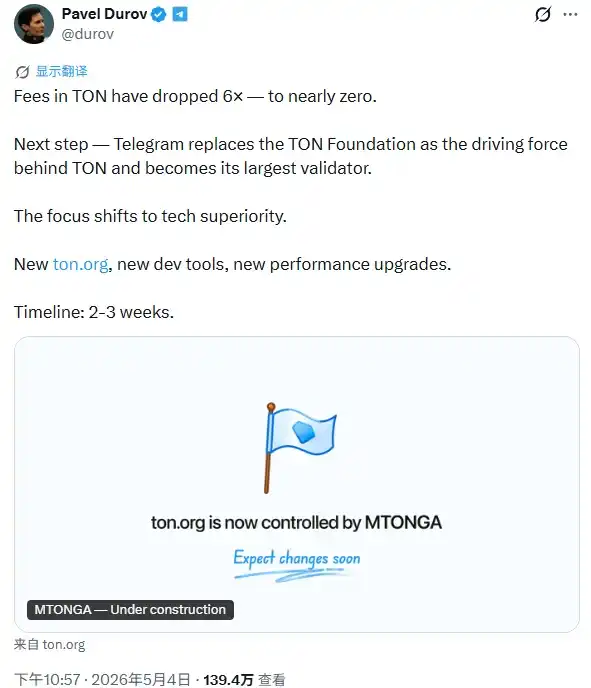
Telegram Founder: TON Fees Reduced by 6x, Telegram to Become Largest Validator

In the past, the relationship between TON and Telegram was more like a strong binding with weak leadership. Telegram provided the gateway, while the Foundation and community were responsible for advancement, with a layer of distance always between them. But this time, Telegram isn't just continuing to bring users to TON; it's beginning to enter more foundational positions such as validator, technical roadmap, and development tools. TON is no longer just a chain adjacent to the Telegram ecosystem but is being reintegrated into Telegram's product system.

TON Doesn't Lack a Gateway; It Lacks Turning the Gateway into Use Cases

Past market discussions about TON often revolved around Telegram's user scale. But for a public chain, having a gateway doesn't equal having an ecosystem, and having user reach doesn't equal having long-term usage. TON's unique aspect is its inherent attachment to a high-frequency social platform, where Mini Apps, wallets, channels, bots, games, and payments already exist within Telegram. This allows TON to avoid having to find users from scratch like most Layer1s. However, if these scenarios cannot solidify into sustained on-chain interactions, Telegram's traffic can only bring waves of short-term hype.

Projects like Notcoin and Dogs have proven that Telegram can quickly generate viral spreads. Simple gameplay combined with social relationship chains can indeed attract a large number of users into crypto applications in a short time. But such explosions come and go quickly. TG mini-games and airdrops can bring attention but can hardly alone sustain a long-term ecosystem.

Therefore, the fee reduction, speed increase, developer tools, and validator role emphasized by Pavel Durov this time point not to a single technological upgrade, but to TON addressing its most critical missing link—transforming Telegram's gateway into sustainable use cases. Only when fees are low enough, confirmation speeds are fast enough, and developer integration is simple enough can scenarios like channel tipping, Mini Apps tasks, game rewards, creator revenue, ad revenue sharing, bot calls, and group micropayments potentially evolve from product features into on-chain activities.

TON no longer needs to repeat the story of "backed by Telegram." What it truly needs to prove is whether the high-frequency behaviors within Telegram can be effectively borne by TON.

Fee Reduction and Speed Increase Aim to Enable Smaller, Higher-Frequency Transactions

The fee reduction by TON this time shouldn't be understood merely as cost optimization typical of public chains. Viewed within the context of Telegram, it actually solves the problem of whether small-amount, high-frequency interactions can become viable.

Most potential on-chain behaviors within Telegram are not large transfers but more fragmented daily operations. Individual transaction amounts are low, but occurrence frequency is high. If users have to perceive fees, wait for confirmations, and repeatedly handle wallet interactions with every button click, these scenarios can hardly truly take off.

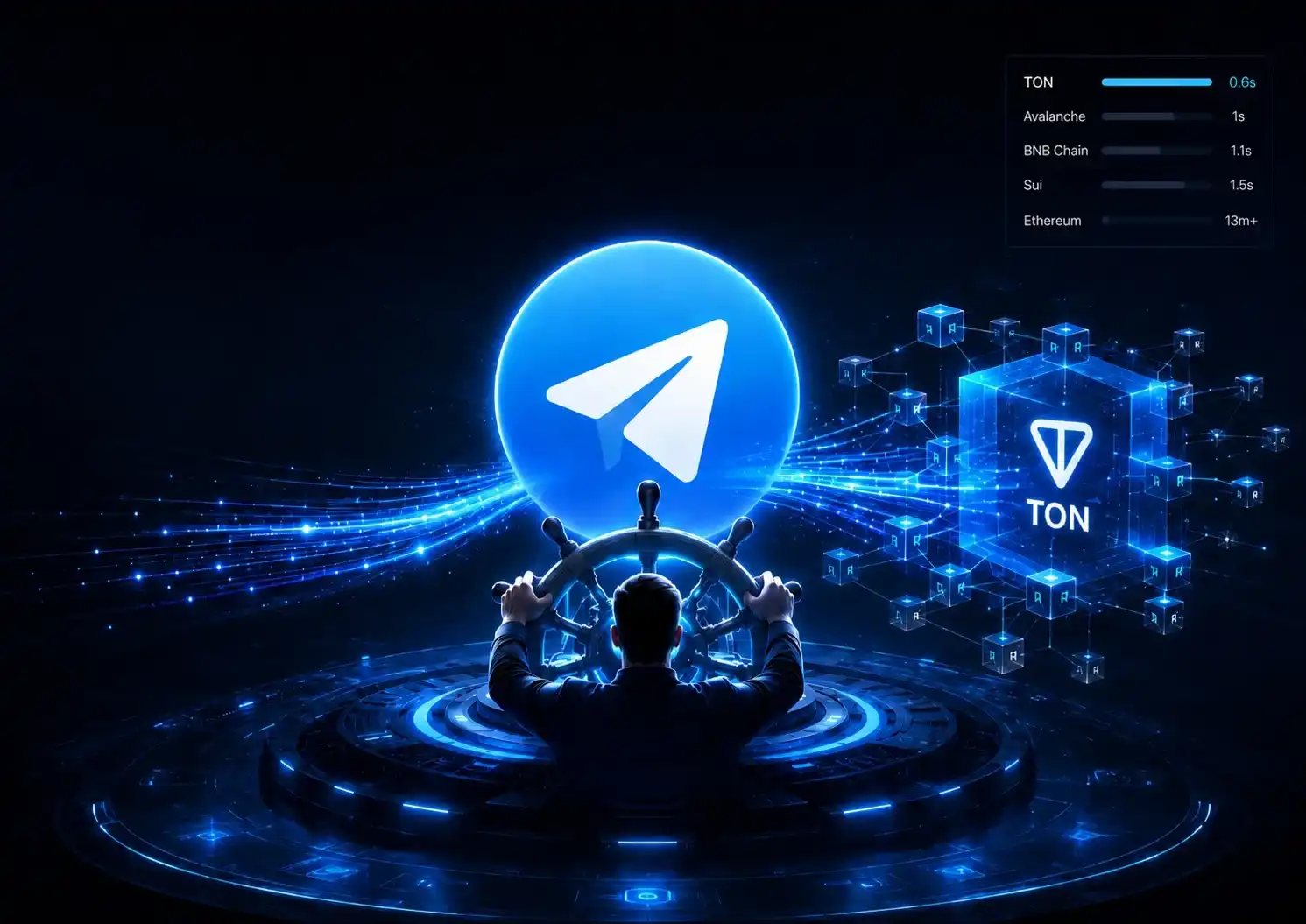
Therefore, fee reduction and speed increase must be considered together. Fees approaching zero lower the usage barrier; reducing finality time to 0.6 seconds lowers the perception of waiting. For Telegram, the chain shouldn't become an extra layer perceived by users but should be hidden as much as possible behind product actions like sending messages, clicking buttons, and viewing balance changes.
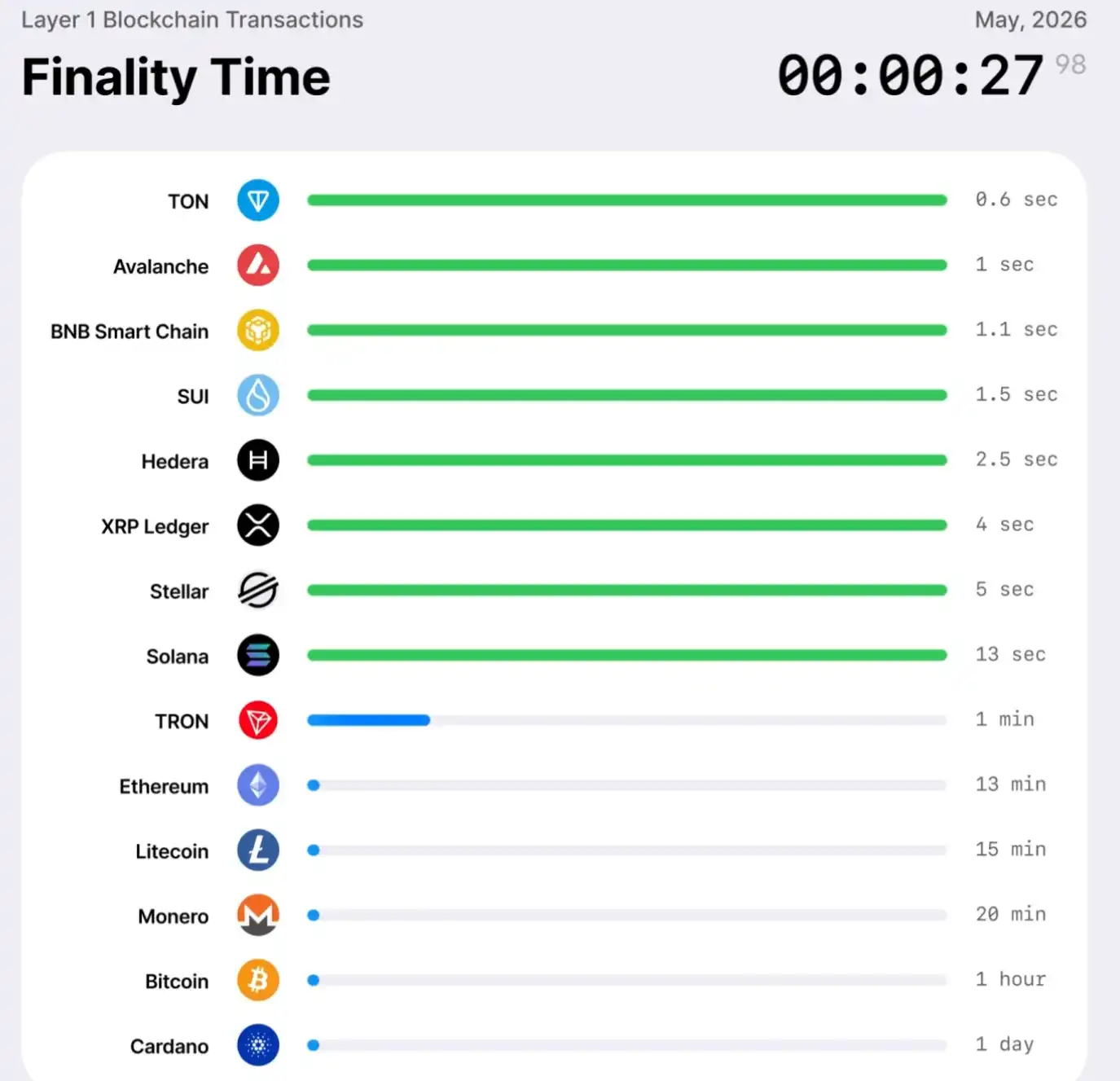
Comparison of "Finality Time" Among Mainstream Public Chains

This also distinguishes TON from many other Layer1s. Its goal isn't solely to make DeFi trades faster or transfers cheaper; it aims to embed the chain into Telegram's daily use. Only when cost, waiting time, and wallet operations are minimized enough can TON potentially evolve from a Telegram-related public chain into the underlying network directly invoked by Telegram's application layer.

From Gateway to Validator, Telegram Begins Penetrating TON's Core

Telegram becoming TON's largest validator is the most significant step in this change. It means Telegram is no longer just providing TON with a gateway and brand endorsement but is entering the network's security and operational mechanisms. Previously, TON was driven by the Foundation and community, which offered greater openness but a relatively decentralized pace. Now, with Telegram directly involved, its products, wallet, Mini Apps, payments, and developer tools have the opportunity to be realigned.

Efficiency may increase, but controversy will also grow. Telegram replacing the TON Foundation as the main driving force and becoming the largest validator will inevitably lead to renewed external discussions about TON's centralization risks. In response, Pavel Durov stated that Telegram's participation would attract more large-scale participants into the validator pool, thereby enhancing decentralization. This logic is not without merit, but the final judgment will depend on results, not statements.

The truly important aspects going forward are whether the validator structure can become more diverse, whether governance information is sufficiently transparent, whether the Foundation and community retain independent space, and whether ecosystem projects can continue developing without relying on Telegram's will.

Therefore, Telegram's return is not a simple positive but a trade-off. For TON to enter the mainstream application layer, it needs Telegram's strong execution capabilities; but the more prominent Telegram's role, the more TON needs to prove it is not merely an internal settlement chain serving Telegram.

High Staking Rewards Retain More Tokens for TON

Pavel Durov subsequently emphasized that TON ranks first in annual staking rewards among the top 50 cryptocurrencies by market cap, with a high rate of 18.8%. Compared to fee reduction and speed increase, high staking rewards are more likely to mobilize capital sentiment and provide TON with another layer of holding rationale in the market's eyes.
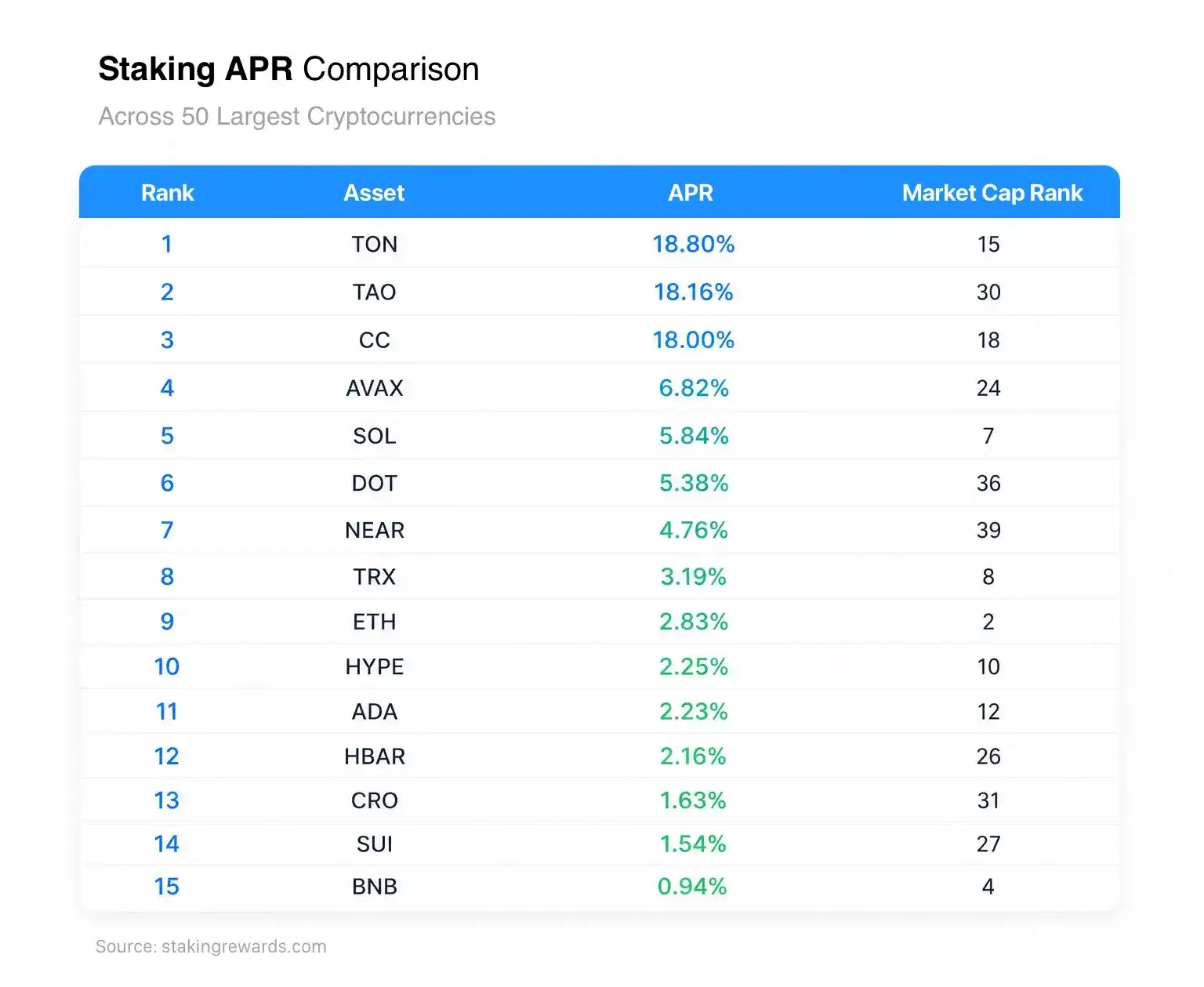
TON Annual Staking Rewards Rank First Among Top 50 Cryptocurrencies

This also makes TON's narrative somewhat more complete. It's not just relying on Telegram's user gateway to attract attention or improving experience through technical upgrades; it's also using staking rewards to keep capital within its ecosystem. The simultaneous presence of gateway, performance, validators, and rewards makes this change more substantial than a single positive factor.

Of course, high yield itself is not the end goal; it's more like buying TON a longer observation period. As long as subsequent developer tools and performance upgrades are delivered, and more capital is locked into the network, a positive feedback loop with real usage may form. For TON, the value of staking rewards isn't just about increasing holding returns but making the market willing to continue waiting for it to truly convert Telegram's gateway advantage.

TON's Return to Telegram Is Not the Finish Line, But a Tougher Challenge

The key for TON going forward is not to continue leveraging Telegram for traffic, but to truly become part of Telegram's application ecosystem. If Telegram's chat, payments, applications, creator economy, and automated interactions are gradually undertaken by TON, then TON's competitors will not just be other Layer1s, but all networks attempting to become the next-generation application infrastructure.

TON isn't just repeating the social traffic story; it's beginning to attempt to turn social traffic into on-chain order. The gateway is just the beginning; usage is the answer. Telegram can push TON to the forefront, but whether it stays there ultimately depends on whether TON can become the layer of infrastructure that operates behind user perception, within the functioning of applications.

If the past TON was still proving how close it is to Telegram, now it must prove how deeply integrated it can be within Telegram's daily use. True mainstream adoption isn't about making users aware they are using a chain, but about making the chain part of the application experience.

TON's opportunity lies here, and so does its pressure.

İlgili Sorular

QAccording to the article, what is the new role that Telegram will assume in the TON network, as announced by Pavel Durov?

ATelegram will become the new core driver of the TON network, replacing the TON Foundation. It will also become the network's largest validator.

QWhat is identified as the key challenge TON needs to overcome, beyond just having access to Telegram's large user base?

ATON needs to transform its access and user reach into sustainable, long-term usage scenarios. It must convert Telegram's high-frequency social interactions into persistent on-chain activities.

QWhy are the reductions in transaction fees and improvements in speed particularly important for TON within the Telegram context?

ALow fees (approaching zero) and fast finality (0.6 seconds) are crucial to enable the small, frequent, and fragmented transactions typical of Telegram's daily use cases. They lower the barrier and reduce user friction, allowing the blockchain to operate seamlessly in the background of the app experience.

QWhat potential downside or concern is raised regarding Telegram becoming the core driver and largest validator of TON?

AThe move raises concerns about increased centralization risk and questions regarding the future independence of the TON Foundation and community projects. It represents a trade-off between stronger execution from Telegram and the need for TON to maintain network decentralization.

QHow does the article frame the high annual staking reward offered by TON, and what purpose does it serve?

AThe high staking reward (18.8% annually, ranked first among top 50 cryptocurrencies) is seen as a mechanism to attract and lock in capital within the TON ecosystem. It provides an additional incentive for holding TON and buys time for the network to realize its potential in converting Telegram's user base into active usage.

İlgili Okumalar

The Hunter Becomes the Hunted: The Most Profitable MEV Bot Gets Hacked

A well-known and highly profitable Ethereum MEV Bot, Jaredfromsubway.eth, suffered a sophisticated on-chain attack this Saturday, losing over $7.5 million. Analysis by Blockaid and others reveals this was not a conventional phishing or smart contract exploit, but a targeted "counter-MEV honeypot attack." The attacker meticulously laid a trap over several weeks, deploying 66 fake token contracts and liquidity pools disguised as major assets like WETH and USDC. These pools created the illusion of arbitrage opportunities. The MEV Bot's automated system detected these signals, executed trades, and in the process, granted approval permissions to attacker-controlled contracts. These approvals were not revoked, creating a persistent vulnerability. The attacker then exploited this in a single transaction, draining the bot's ETH, USDC, and USDT holdings. Jaredfromsubway.eth is notorious as one of Ethereum's most active and profitable MEV Bots, primarily known for executing "sandwich attacks" to profit from transaction slippage. Estimates suggest it has earned tens of millions in MEV revenue. The incident highlights escalating crypto security threats, demonstrating that even top-tier automated "predators" are vulnerable to novel, logic-based attacks designed to exploit their own operational rules. Following the hack, an unverified X account impersonating Jaredfromsubway.eth emerged, falsely offering a bounty for the return of funds, prompting developer warnings for users to stay vigilant.

marsbit27 dk önce

The Hunter Becomes the Hunted: The Most Profitable MEV Bot Gets Hacked

marsbit27 dk önce

The Reality of Payments in Latin America Is Not What You Think

The payment landscape in Latin America is undergoing a fundamental shift, driven by on-the-ground realities that challenge common perceptions. Based on over 500 hours of field research across the region, key insights emerge. Firstly, QR code payments, like Brazil's Pix, are becoming the dominant payment method in most emerging markets, overtaking cards. However, these domestic instant payment systems lack international interoperability, creating a significant gap for cross-border users. Secondly, the narrative around crypto cards is often misunderstood; their primary volume comes from high-net-worth professionals using them for salary conversions (e.g., USDT to local currency via Pix), not retail micro-payments. Competition in payments is shifting from customer acquisition to controlling the settlement layer, leading fintechs to acquire banking licenses for efficiency. Thirdly, treating "Latin America" as a single market is a mistake. Countries like Argentina, Brazil, and Mexico have distinct economic realities, user segments, and regulatory approaches. Brazil alone has at least five distinct user segments with different financial flows. Overlooked markets like Guatemala, Honduras, and El Salvador (the "forgotten five") offer high remittance volumes with lower competitive density. Finally, regulation in Latin America is often ahead of the US, with clearer frameworks for digital assets and a pragmatic approach from regulators focused on safety rather than obstruction. The margin on stablecoin forex is rapidly compressing toward zero, meaning future winners will be those building value-added services on top of the infrastructure, not just the cheapest exchange.

marsbit43 dk önce

The Reality of Payments in Latin America Is Not What You Think

marsbit43 dk önce

Making Music in a Bear Market: The Survival Experiment of a Bitcoin Band

"Orange Pill Jam: A Bitcoin Band's Survival in the Bear Market" Orange Pill Jam is a musical group exploring themes of financial sovereignty and privacy, born from the Bitcoin community. Formed after singer Mermaid performed her song "Dollar Apocalypse" at a 2022 conference, the band creates music intended for both Bitcoin enthusiasts and general audiences. Their creative process involves Mermaid writing lyrics and melodies, which producer/multi-instrumentalist Michi then shapes with a precise, rhythm-focused approach, often demanding numerous retakes to achieve his unique standard of timing. Their songs, like "Cypherpunks' Manifesto" and "Fire of Freedom," tackle concepts of digital privacy, the pitfalls of "free" services, and personal sovereignty, influenced by experiences in places like El Salvador. Despite operating in a crypto bear market with a Copyleft model (offering music for free sharing/remixing and accepting optional Bitcoin donations), they face practical challenges. Their growth is slow on platforms like YouTube and Spotify, which aren't optimized for their niche content. The band also navigates the rise of AI-generated music. While acknowledging AI's efficiency for certain tasks, they believe human creativity occupies a unique space that algorithms cannot replicate—the ability to create new genres and capture intangible rhythmic feeling. For Orange Pill Jam, the core argument for both Bitcoin in a downturn and human artistry in the AI age lies in this irreplaceable, intentional, and imperfectly human creative process. Their project persists as an anti-algorithm experiment, valuing the unquantifiable impact of music over scalable metrics.

marsbit49 dk önce

Making Music in a Bear Market: The Survival Experiment of a Bitcoin Band

marsbit49 dk önce

İşlemler

Spot
Futures
活动图片