Musk vs. Altman: Who Will Be the 'Fisherman'?

marsbit2026-05-09 tarihinde yayınlandı2026-05-09 tarihinde güncellendi

Özet

Elon Musk and Sam Altman are locked in a fierce legal and commercial battle. Musk, a co-founder of OpenAI, has sued the company and Altman, alleging they betrayed its original non-profit, open-source mission by transforming into a for-profit entity with significant Microsoft backing, now valued at $852 billion. He demands damages, a return to a non-profit structure, and management changes. The lawsuit hinges on whether OpenAI's founding charter was a legally binding charitable trust or merely an idealistic statement. OpenAI counters that Musk himself pushed for a for-profit model in 2017 but left when he couldn't gain full control, and now acts as a commercial rival with his xAI venture. Despite the high-profile feud, the article suggests the real winners (the "fishermen") may be others in the AI race. While Musk has folded xAI into SpaceX to pursue a "space-based computing" vision, his Grok chatbot lags in market share and user growth compared to leaders. OpenAI faces its own challenges, notably from rival Anthropic, which is rapidly catching up in revenue and enterprise adoption. Musk is reportedly leasing significant computing power to Anthropic, creating an "enemy of my enemy" dynamic. Furthermore, Chinese AI models like DeepSeek are quickly closing the capability gap. Ultimately, the lawsuit is seen as setting a precedent for AI governance, but the intense competition between Musk and Altman may primarily benefit other players, infrastructure providers like Nvidia, an...

By | TingtongTech (ID:tingtongtech),Author | Yang Lin,Editor | Rao Xiafei

The showdown between Elon Musk and Sam Altman is intensifying.

Their feud, which has been brewing for a decade, has escalated from public spats on platform X to direct competition between their companies' product lines, and now to a courtroom confrontation.

Musk accuses Altman of "stealing a charity," arguing that OpenAI, now valued at approximately $852 billion and planning an IPO, has betrayed its founding principles.

The world's richest man believes Altman and others swindled him out of $38 million in donations and personal assistance. In his lawsuit, he has two core demands: one, seeking $130-150 billion in damages; two, requesting the court to order OpenAI to revert to a non-profit status and replace its current management.

The market defines this duel as the "AI Century Lawsuit." For the AI era, in a sense, whether discussing legal principles, capital competition, or discourse power, the essence of this game is no longer merely a personal grudge between the two men.

In the market's view, the true significance of this lawsuit lies in the fact that the judgment will essentially anchor the basic industry rules for the global AI ecosystem.

Although the final winner will not change the rules of the AI game, this is a microcosm of an era of global industry differentiation and fierce competition.

Especially, behind the scenes of frantic pursuit, there is an even more important question to ask: while Musk and Altman are tearing each other apart in court and competing fiercely outside, who will be the real "fisherman"?

A Courtroom Battle Exposing More Than Just a Personal Feud

"Without me, OpenAI would never have existed," Musk has repeatedly emphasized.

In 2015, Musk invested about $38 million in seed funding and co-authored the founding manifesto for OpenAI with Altman, pledging to "build safe, beneficial AGI (artificial general intelligence) for humanity, unconstrained by the need for financial return."

Musk poached top researchers from Google and personally contacted Nvidia CEO Jensen Huang to secure early supercomputers for the startup. However, in February 2018, he left the board due to disagreements over direction.

A decade later, OpenAI is no longer a non-profit lab. It has established a for-profit subsidiary, brought in Microsoft investment, and rapidly grown into a tech empire valued at around $852 billion and planning an IPO.

All disputes between the two revolve around that initial pledge. The core controversy is whether it was a charitable trust agreement or a legally non-binding "idealistic slogan."

In fact, from a legal interpretation perspective, if it is deemed merely a visionary statement, it holds no legal binding force. Then OpenAI's for-profit transformation would have no legal flaws, Musk's accusations would completely collapse, and the lawsuit would end immediately.

However, if the founding manifesto is deemed to constitute a legally effective "charitable trust" or an enforceable "public welfare commitment," then every subsequent step by OpenAI could constitute a fundamental violation of the original promise.

Musk's accusation is that OpenAI transformed from a "non-profit organization" into a "for-profit entity." He wants Altman and his AI empire to face the consequences: a $150 billion compensation demand, dissolution of OpenAI's for-profit structure, removal of Altman and Brockman, forced disclosure of technology, and cancellation of Microsoft's licensing agreement.
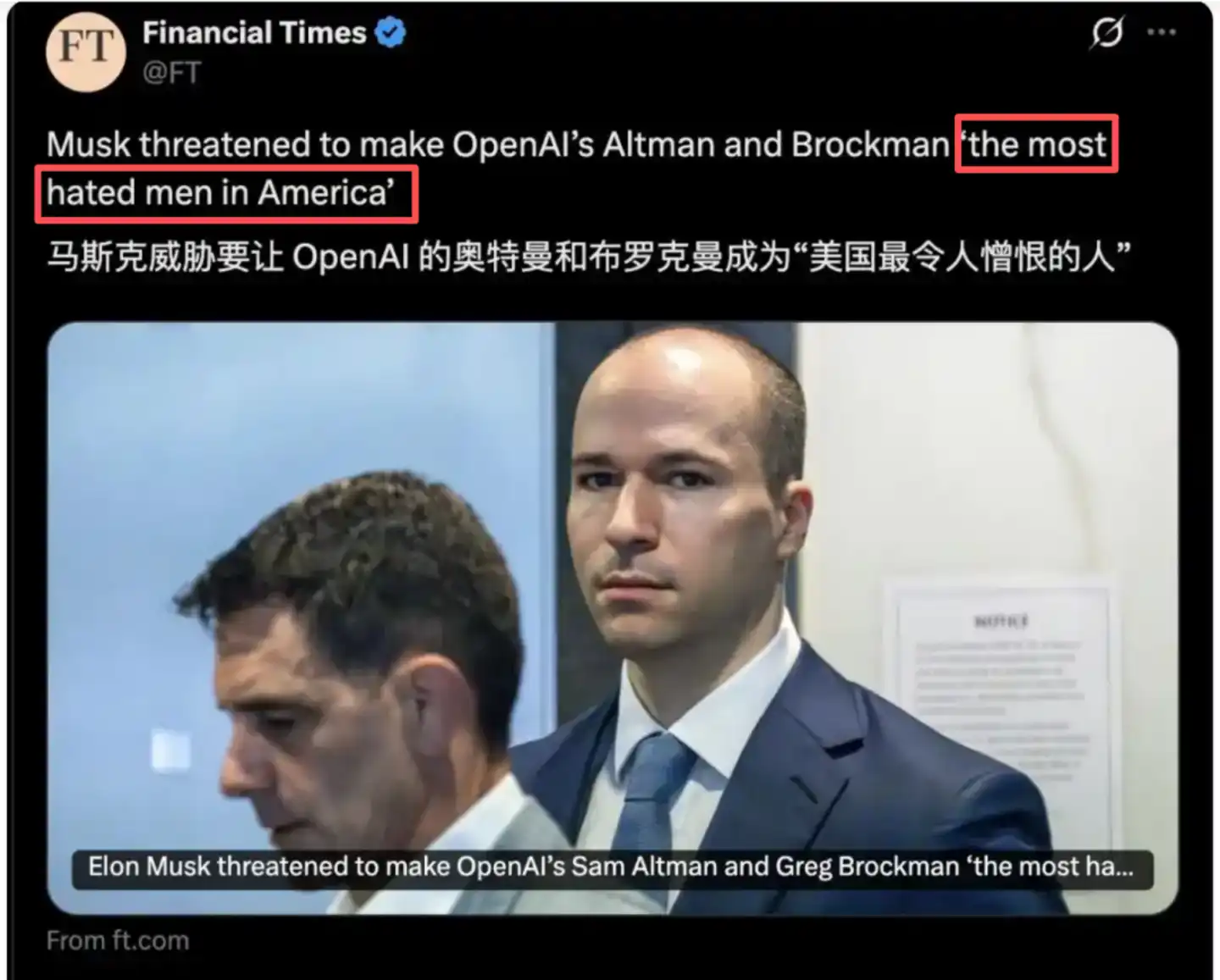
But OpenAI has presented a counter-narrative pointing in a different direction.

In their view, Musk was once a power-holder and is now a business rival. According to media reports, OpenAI lawyers also believe Musk filed the lawsuit not to guard any non-profit mission, but because "he didn't get the outcome he wanted."

For instance, court documents from OpenAI show that Musk himself had suggested establishing a for-profit entity as early as 2015, and in 2017 not only engaged in control struggles but also secretly registered a for-profit company in OpenAI's name.

OpenAI President Greg Brockman testified that in 2017, Musk himself had pushed for OpenAI to transform into a for-profit company, but with the condition that he have "complete control."

In fact, Musk also admitted that his xAI had used OpenAI's models to train its own Grok, which, in the market's view, corroborates OpenAI's assertion of "commercial rivals suppressing each other."

Some market commentary also points out: If Musk is truly fighting for the benefit of all humanity, why did he angrily exit in 2018 after failing to gain control when proposing a for-profit entity? Why publicly mock OpenAI and then found xAI in 2023?

In other words, what Musk wants—is it a "non-profit organization," or an AI enterprise/dominance he can control?

Or perhaps, Musk just wants to "defeat Altman"?

The AI Game Between Two Companies

Indeed, judging from the scope of Musk's empire, he certainly wants to "defeat Altman." After all, Musk's journey in AI has not been easy.

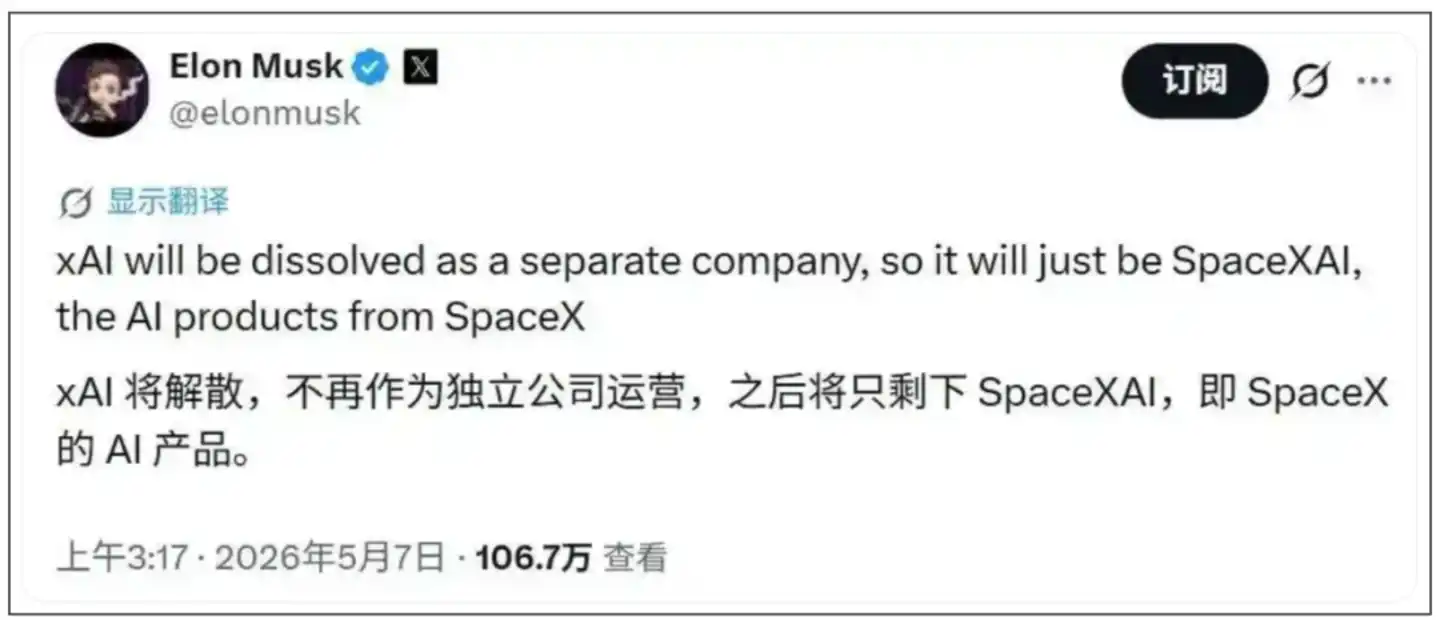
On the product side, Musk had high hopes for xAI. But during the second week of the trial, Musk dropped a bombshell on X: xAI would be fully integrated into SpaceX, renamed SpaceXAI, completely abandoning its independent identity.

"xAI will no longer exist as an independent company; it will simply be SpaceXAI, the AI product of SpaceX," Musk defined this move.
In the market's view, this move might be Musk's attempt to deeply integrate his AI business with aerospace. After all, Musk's X platform can provide over 500 million real-time data points daily to train his Grok model.

Musk's vision is: X provides usable data, Starlink provides global communications, and SpaceX rockets send computing equipment into space. In his view, Earth's energy and heat dissipation limits will soon constrain AI development; he estimates that within two to three years, the minimum cost for generative AI computation will shift to space. Thus, he aims to link AI from Earth to space, creating a closed-loop commercial ecosystem.

However, more analysis suggests this might be Musk's "smokescreen," because, on the product side, Musk's AI performance is not as "excellent" as he describes.

In fact, Grok, which Musk considers "the smartest AI on Earth," has shown increasingly mediocre market performance.

By late 2025, Grok was the runner-up globally among AI chat apps, second only to ChatGPT. But now, it has been overtaken by Claude, Gemini, and even DeepSeek.

Looking at global AI tool traffic, a year ago, Grok could still occupy the second spot in the US AI market with a 7.03% share. By early 2026, it had shrunk to 3.44%, surpassed by DeepSeek's 3.7% share.

Public data shows that in April 2026, Grok's global mobile daily active users dropped from 13.9 million to 12.2 million, a 12.5% decline. The drop was more significant in the US market, falling from 1.4 million to 1.1 million, a 15.6% reduction.

During the same period, however, Claude's daily active users surged from 16 million to 23 million, a 44% month-over-month spike, leaving Grok far behind.

Most embarrassing for xAI is its user composition. Public reports state that over the past six months, Grok's user base has been "overwhelmingly male," a gender imbalance extremely rare among mainstream AI products.

Market analysis points out this directly reflects that Grok's user scenarios primarily come from traffic diversion from social platform X, rather than establishing independent brand recognition and user ecosystems. Much analysis suggests that once the traffic红利 from platform X diminishes or user interest shifts, Grok's growth engine will face severe challenges.

Behind the user data lies the worrying operational status of xAI.

Although xAI was valued at $250 billion in its independent funding round, its core AI business scale remains relatively small, with no public independent ARR (Annual Recurring Revenue) data released yet.

Meanwhile, in Q1 2026, OpenAI's ARR had already reached $25 billion.

In March 2026, Musk himself publicly admitted that xAI would need until the end of 2026 to catch up with leading AI firms and might only achieve a significant lead by 2029.

This, perhaps, is the fundamental reason behind Musk's decision to disband xAI.

In contrast, OpenAI's market data performance is clearly better than xAI's.

Just a month before the trial, OpenAI pulled off a move significant enough to shake Silicon Valley, announcing the completion of a $122 billion financing round, with a post-money valuation of $852 billion, setting a record for the highest private financing in business history.

Moreover, OpenAI's annualized revenue exceeds $25 billion, with monthly revenue of $2 billion. ChatGPT boasts over 900 million weekly active users and over 50 million paying subscribers.

Musk has to face the fact that, despite his AI ambition lying in "space-based computing," at least on the product side, OpenAI's growth has indeed left xAI far behind.

Who Will Be the Real 'Fisherman'?

Of course, regardless of how Musk and Altman compete, and regardless of the trial's final outcome, the AI field will certainly not pause because of the feud between two individuals.

Especially, both Musk and Altman must realize that in this "two tigers fighting" war of attrition, the real "fisherman" is making an entrance.

At least for now, OpenAI's biggest challenger is not Musk's xAI, but its arch-rival Anthropic.

As is well known, Anthropic's announced annualized revenue of $30 billion in April 2026 already exceeds OpenAI's $25 billion level from February. Claude's global downloads tripled year-over-year, while ChatGPT's US weekly active users saw their first year-on-year decline.

Particularly in OpenAI's core enterprise user segment, Anthropic is catching up and might even surpass it. Data shows that in March 2026, nearly one-third of US enterprises used Anthropic's Claude tools, an increase of over 6 percentage points month-over-month, almost neck and neck with OpenAI's 35%.

On May 8th, according to media reports, Anthropic is considering raising tens of billions of dollars this summer to significantly expand computing capacity. If realized, Anthropic's valuation would approach $1 trillion, surpassing OpenAI.

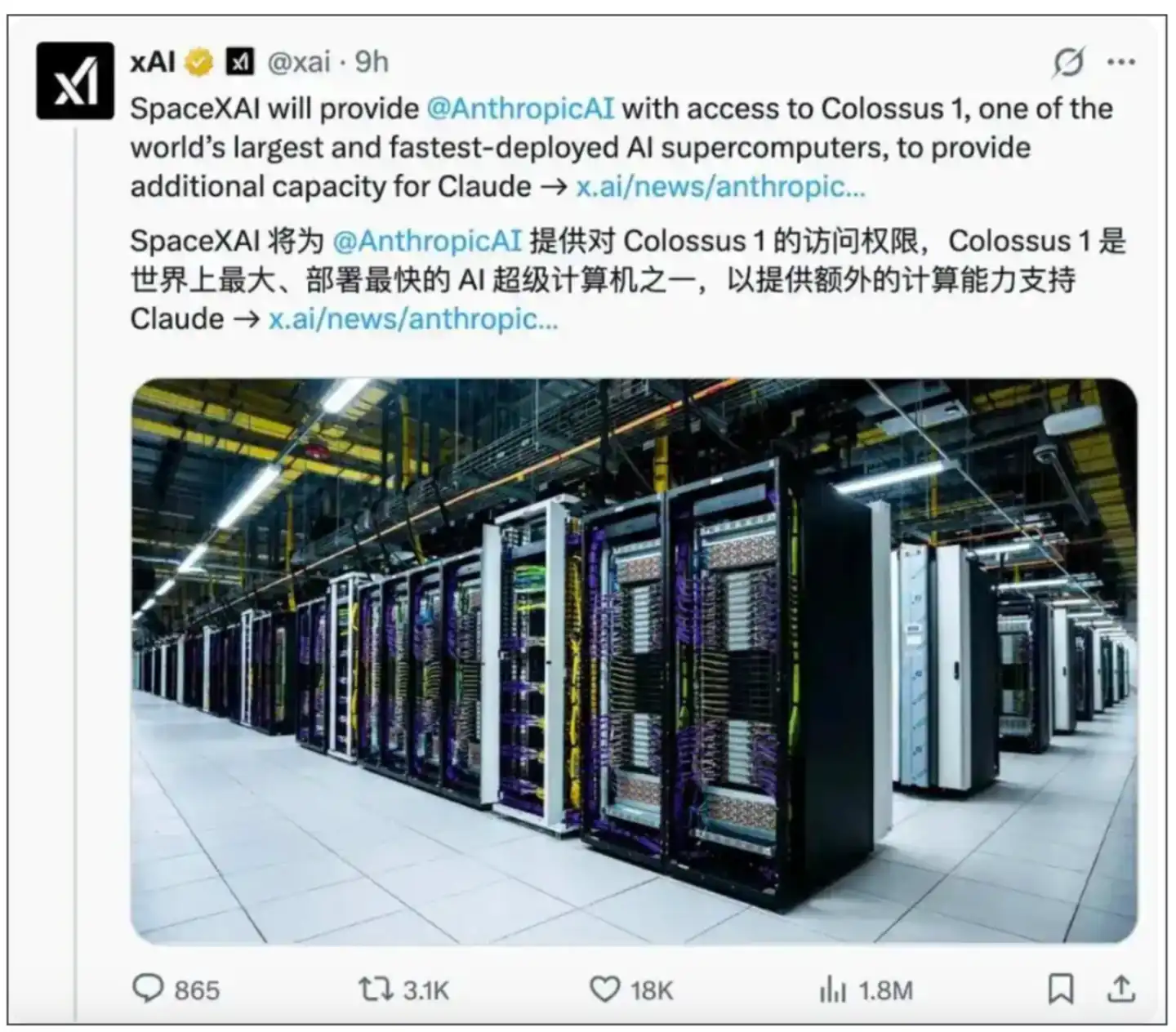
More interestingly, after disbanding xAI, Musk will lease all 300 megawatts of computing power and 220,000 GPUs from the Colossus 1 supercomputer to Anthropic to support model training and inference. The market jokes that Musk has turned "the enemy of my enemy into an ally."
It is worth noting that Anthropic's founders also left OpenAI to start their venture. In a way, this mirrors the story of Altman breaking away from Musk.

Another reality is that China's large language models are demonstrating rapid iterative capabilities.

Public data shows that the gap between top-tier Chinese and US AI in human evaluation tests has narrowed to 2.7%, almost negligible.

Especially, DeepSeek's low-cost, high-quality model once surpassed ChatGPT in download rankings on the Apple App Store.

Although the release of DeepSeek R2 has been repeatedly delayed, in terms of foundational capabilities, Chinese AI is no longer just a "follower." Moreover, China's other large models are also rapidly catching up.

Of course, in the market's view, regardless of who wins between the two, looking back at computing power, there are more winners behind the scenes, such as Nvidia and Google.

Returning to the lawsuit itself, at least for the market, this litigation has subjected the governance structures, ethical commitments, and business logic of all AI companies to public scrutiny. Regardless of the final verdict, its symbolic significance for AI governance rules has been established.

Especially, beyond legal victory or defeat, a more thought-provoking question is: In the AI race, involving hundreds of billions of dollars and capturing the entire industry's attention, who will be the ultimate winner?

Perhaps, in the AI industry, the real "fisherman" is never a single company or individual.

The true beneficiaries might be other players who, leveraging this century-defining duel to hype the market, are quietly accumulating strength elsewhere; they might be the sellers of computing infrastructure, the "water vendors," or the rising "third forces."

When the snipe and the clam grapple, the fisherman profits. And this fisherman is quietly watching it all.

(All images are from the internet, contact for removal if infringement.)

(Disclaimer: This article is for information exchange only and does not constitute any investment advice.)


Trend Kriptolar

İlgili Sorular

QWhat is the core legal dispute between Elon Musk and Sam Altman regarding OpenAI's origins?

AThe core dispute centers on whether the founding declaration of OpenAI, which promised to 'build safe and broadly beneficial AGI for humanity, unfettered by the need to generate financial return,' constituted a legally binding charitable trust or was merely an unenforceable 'idealistic slogan.' Musk argues it was the former, while OpenAI contends it was the latter.

QHow has OpenAI's financial and market position changed since its founding, according to the article?

AOpenAI has transformed from a non-profit lab into a for-profit tech empire with a valuation of approximately $852 billion (planning an IPO). It recently completed a record $122 billion private funding round. Its annual recurring revenue (ARR) has reached $25 billion, with over 900 million weekly active ChatGPT users and more than 50 million subscribers.

QWhat were the key factors behind Elon Musk's decision to disband xAI and merge it into SpaceX as 'SpaceXAI'?

AKey factors include Grok's declining market performance (being surpassed by competitors like Claude and DeepSeek), its shrinking user base and gender imbalance, its relatively small business scale with no public ARR data compared to OpenAI's $25 billion, and Musk's strategic vision to integrate AI with SpaceX's space-based computing and communication infrastructure to overcome Earth's energy and thermal limits.

QWho are the potential 'beneficiaries' or 'fishermen' mentioned in the article that could gain from the Musk-Altman rivalry?

AThe potential 'fishermen' include Anthropic (OpenAI's direct competitor, which is growing rapidly and may receive compute resources from Musk), Chinese AI models like DeepSeek (which are rapidly closing the capability gap), and foundational infrastructure providers like NVIDIA and Google who supply the essential computing power (the 'water sellers').

QWhat significance does the article attribute to the Musk vs. Altman lawsuit beyond their personal conflict?

AThe article states that the lawsuit's true significance lies in its potential to substantially anchor the basic industry rules for the global AI ecosystem. Regardless of the verdict, it has already subjected the governance structures, ethical commitments, and business logic of all AI companies to intense public scrutiny, establishing a landmark precedent for AI governance.

İlgili Okumalar

Breaking: Google Earth Urgently Pulls Back Nano Banana 2 Image Generation Feature!

Google Earth's newly launched "Create image" feature, powered by the Nano Banana 2 AI image generation model, was abruptly withdrawn shortly after its release due to being "played" by users. The feature allowed users to generate and overlay AI-created visuals directly onto real-world satellite and 3D maps in Google Earth. The tool enabled creative applications like historical recreations (e.g., visualizing ancient Pompeii), generating informational graphics for landmarks, and envisioning architectural projects or futuristic cityscapes on real terrain. It operated under "geospatial grounding," meaning the AI respected the underlying geography, topography, and perspective of the chosen map view. The model also integrated with Gemini to retrieve relevant factual information. However, upon release, users quickly tested its limits. A prominent example involved reimagining Philadelphia's historic Independence Hall as a post-apocalyptic ruin overrun by "happy" zombies, evil clowns, and giant alien mechs. This highlighted both the feature's playful potential and its risks regarding the generation of inappropriate or misleading content on realistic maps, leading to its swift temporary removal. Google stated it would re-release the feature after implementing "enhanced guardrails." Analysts note this move strategically leverages Google's vast proprietary geospatial data, positioning its AI not just for artistic generation but for spatially accurate world visualization—a unique advantage in the competitive AI image generation landscape.

marsbit25 dk önce

Breaking: Google Earth Urgently Pulls Back Nano Banana 2 Image Generation Feature!

marsbit25 dk önce

Altman Admits: Overestimated AI Snatching Jobs! Huang Renxun: The Unemployment Narrative Is Completely Backwards

Sam Altman has revised his earlier predictions about AI rapidly replacing jobs, admitting he overestimated the speed at which AI would eliminate entry-level white-collar roles. Speaking on the "Invest Like the Best" podcast, he stated that people do not truly want an AI CEO, as accountability and human connection remain critical. He found that individuals prefer interacting with people who can be held responsible for decisions. Similarly, NVIDIA's Jensen Huang argued that the narrative of AI destroying jobs is misguided. He distinguishes between tasks and jobs, noting that while AI can automate specific tasks, entire jobs—encompassing communication, judgment, coordination, and accountability—are not eliminated. He cited examples like radiologists and software engineers, where demand for these roles has increased as AI handles repetitive tasks, allowing for business expansion and the creation of more positions. Data from a University of Maryland and LinkUp study supports this, showing that U.S. job postings for new graduates have actually risen, countering the fear of vanishing entry-level roles. However, a significant shift is occurring: the traditional entry-level tasks that help newcomers gain experience are being automated, making initial career access more challenging. The key insight is that as AI takes over standardized tasks, the enduring value of human work shifts toward areas of responsibility, trust-building, and final decision-making—aspects that AI cannot replicate. The real "moat" for professionals lies in these irreplaceable human elements.

marsbit31 dk önce

Altman Admits: Overestimated AI Snatching Jobs! Huang Renxun: The Unemployment Narrative Is Completely Backwards

marsbit31 dk önce

Weekly Editor's Picks (0725-0731)

Weekly Editor's Picks (0725-0731) provides a curated selection of deep analysis, filtering out market noise. Key themes from this week include: **Macro & Policy:** The Federal Reserve's upcoming meeting is marked by high uncertainty, balancing cooling inflation data against persistent price pressures. Meanwhile, the U.S. crypto regulatory Clarity Act faces critical political hurdles, with its 2026 passage probability seen as low. **Investing & Crypto:** Analysis suggests long-term crypto success depends on conviction through volatile cycles, focusing on assets like Bitcoin and core smart contract platforms. A trend noted is the increasing similarity between global equity markets (especially tech) and crypto, driven by narrative and leverage. Several major crypto protocols show strong revenue growth, but this isn't always translating to token price appreciation due to sell pressure and structural factors. **AI & Semiconductors:** Nvidia's rising credit default swap rates signal market concern over AI infrastructure financing risks. The storage sector experienced volatility as markets began pricing in potential 2027 oversupply. Despite a record profitable quarter, SK Hynix's results were deemed "below expectations," reflecting heightened investor demands for future growth visibility. **Markets & DeFi:** TradeXYZ demonstrated remarkable accuracy in pre-market pricing for a major A股 listing. The token ONDO saw gains, linked to its growing role in the on-chain tokenized stock ecosystem. **Ethereum:** Post-Pectra upgrade, a major structural shift is underway as Lido begins migrating millions of ETH to new validator architectures designed for capital efficiency. **Also Highlighted:** Butian's bullish stock market move; OpenAI's Altman promising major advances; Samsung and SK Hynix securing large AI chip deals; Apple reaching a $5T market cap; and ongoing discussions around exchange security following Poolin's bankruptcy case.

marsbit1 saat önce

Weekly Editor's Picks (0725-0731)

marsbit1 saat önce

Low Investment Isn't Apple's Immunity Pass

While Meta and Google face investor scrutiny over ballooning AI capital expenditures, Apple's minimal AI investment has paradoxically become a strength. Its market cap recently reclaimed the global top spot, surpassing $5 trillion. The irony is deep: Apple's own AI efforts have lagged, with "Apple Intelligence" delayed and core talent lost, forcing reliance on partners like Google Gemini and Alibaba's Qianwen. Its Q3 FY2026 (Q2 CY) earnings initially seemed stellar. Revenue hit $109.4B (up 16% YoY), with iPhone and Mac sales, growing 22% and 29% respectively, driving most of the growth. However, the stock fell over 8% post-earnings. The primary concern was a weaker Q4 revenue growth forecast of 9-11%, below expectations, due to looming supply chain constraints. Apple is feeling the indirect cost of the AI boom. Soaring memory and chip prices, fueled by massive data center investments from Microsoft, Amazon, and others, are forcing Apple to raise Mac and iPad prices significantly. The upcoming iPhone launch is also expected to see substantial price hikes. Despite avoiding heavy AI infrastructure spending—its capital expenditures are actually down 28%—Apple cannot escape the industry-wide supply and cost pressures. While Apple's operating cash flow remains robust, its substantial R&D spending (up 32% YoY) has yet to yield major AI breakthroughs. As Tim Cook prepares to step down as CEO, Apple faces a challenging transition: balancing its premium hardware success against the strategic and cost pressures of the AI era it has so far cautiously navigated.

marsbit1 saat önce

Low Investment Isn't Apple's Immunity Pass

marsbit1 saat önce

İşlemler

Spot

Popüler Makaleler

ID Nasıl Satın Alınır

HTX.com’a hoş geldiniz! SPACE ID (ID) satın alma işlemlerini basit ve kullanışlı bir hâle getirdik. Adım adım açıkladığımız rehberimizi takip ederek kripto yolculuğunuza başlayın. 1. Adım: HTX Hesabınızı OluşturunHTX'te ücretsiz bir hesap açmak için e-posta adresinizi veya telefon numaranızı kullanın. Sorunsuzca kaydolun ve tüm özelliklerin kilidini açın. Hesabımı Aç2. Adım: Kripto Satın Al Bölümüne Gidin ve Ödeme Yönteminizi SeçinKredi/Banka Kartı: Visa veya Mastercard'ınızı kullanarak anında SPACE ID (ID) satın alın.Bakiye: Sorunsuz bir şekilde işlem yapmak için HTX hesap bakiyenizdeki fonları kullanın.Üçüncü Taraflar: Kullanımı kolaylaştırmak için Google Pay ve Apple Pay gibi popüler ödeme yöntemlerini ekledik.P2P: HTX'teki diğer kullanıcılarla doğrudan işlem yapın.Borsa Dışı (OTC): Yatırımcılar için kişiye özel hizmetler ve rekabetçi döviz kurları sunuyoruz.3. Adım: SPACE ID (ID) Varlıklarınızı SaklayınSPACE ID (ID) satın aldıktan sonra HTX hesabınızda saklayın. Alternatif olarak, blok zinciri transferi yoluyla başka bir yere gönderebilir veya diğer kripto para birimlerini takas etmek için kullanabilirsiniz.4. Adım: SPACE ID (ID) Varlıklarınızla İşlem YapınHTX'in spot piyasasında SPACE ID (ID) ile kolayca işlemler yapın.Hesabınıza erişin, işlem çiftinizi seçin, işlemlerinizi gerçekleştirin ve gerçek zamanlı olarak izleyin. Hem yeni başlayanlar hem de deneyimli yatırımcılar için kullanıcı dostu bir deneyim sunuyoruz.

206 Toplam GörüntülenmeYayınlanma 2024.12.12Güncellenme 2026.06.02

ID Nasıl Satın Alınır

Tartışmalar

HTX Topluluğuna hoş geldiniz. Burada, en son platform gelişmeleri hakkında bilgi sahibi olabilir ve profesyonel piyasa görüşlerine erişebilirsiniz. Kullanıcıların ID (ID) fiyatı hakkındaki görüşleri aşağıda sunulmaktadır.

活动图片