$40B Crypto Crash: Jane Street Sued Over Terra Insider Trading

bitcoinist2026-02-24 tarihinde yayınlandı2026-02-24 tarihinde güncellendi

Özet

Crypto firm Terraform Labs' wind-down administrator, Todd R. Snyder, has sued trading firm Jane Street and several individuals, including Bryce Pratt, for alleged insider trading, fraud, and market manipulation. The complaint, filed in Manhattan federal court, centers on trading activity around the May 2022 collapse of TerraUSD (UST) and Luna. It alleges Pratt, who moved from a Terraform internship to Jane Street, maintained a confidential back channel with Terraform insiders and shared material non-public information. The suit claims a specific 85 million UST trade by Jane Street "precipitated a steep sell off" and helped trigger the broader $40 billion ecosystem collapse. It cites private messages to argue Jane Street had an informational edge and was in direct contact with Terraform leadership during the crisis. Jane Street is expected to contest the allegations.

Crypto firm Terraform Labs’ wind-down administrator has sued Jane Street in Manhattan federal court, alleging the trading firm used material non-public information from Terraform insiders to trade around the May 2022 collapse of TerraUSD (UST) and Luna.

The complaint was filed by Todd R. Snyder, the administrator overseeing recoveries tied to Terraform’s bankruptcy wind-down. It names Jane Street entities and several individuals, including Bryce Pratt, and accuses the defendants of insider trading, fraud, and market manipulation tied to trading during the depeg crisis. The suit seeks damages and disgorgement, with any recovery intended to support creditor distributions.

Did Jane Street Cause The $40 Billion Crypto Crash?

A central part of the case is the role of Pratt, who allegedly moved from an internship at Terraform to a position at Jane Street while maintaining contact with Terraform personnel. The complaint claims he kept a confidential back channel with Terraform’s head of research and passed along sensitive information.

The filing quotes messages that, according to the plaintiff, show both the existence of confidential communications and an understanding that the information should not be shared. One message allegedly included the phrase “don’t share pls.” The complaint also claims Terraform personnel asked Pratt what Jane Street was discussing internally.

That point is critical to the plaintiff’s theory. The case is not framed as Jane Street simply trading aggressively during a volatile market event. It is framed as a claim that Jane Street had a private informational edge at a moment when the market was relying on public signals and deteriorating liquidity.

The lawsuit’s market narrative centers on the early phase of the UST depeg and liquidity movements on Curve. Snyder alleges that after Terraform adjusted liquidity in Curve’s 3pool, a Jane Street-linked 85 million UST trade hit the pool and became “the largest single swap on the Curve 3pool.”

The complaint goes further, alleging that this trade “precipitated a steep sell off in UST” and helped trigger the broader collapse of the Terra ecosystem. It also describes how conditions worsened over May 8 and 9, with UST trading volume surging and the token falling below $0.80 as Terraform attempted to defend the peg.

This sequence matters because the plaintiff is trying to connect alleged access to non-public information with a specific trading action and then link that action to damages suffered during the unwind.

The suit also cites direct communications during the meltdown. In one May 9 message referenced in the complaint, Pratt allegedly wrote to Do Kwon: “Hey Do Kwon, just wanted to express our interest in bidding on either BTC or LUNA.”

According to the filing, Kwon responded that “Bill from Jump” should have contacted Jane Street regarding a Terraform fundraise. The plaintiff uses that exchange to argue that Jane Street was not just an outside trading firm reacting to market prices, but was in direct communication with Terraform leadership while emergency options were being discussed.

Jane Street has pushed back on the allegations and is expected to contest the claims aggressively. As in other post-Terra litigation, key issues will likely include whether the information was truly material and non-public, whether the trades were causally connected to the collapse, and whether the plaintiff can prove intent.

At press time, the total crypto market cap stood at $2.17 trillion.
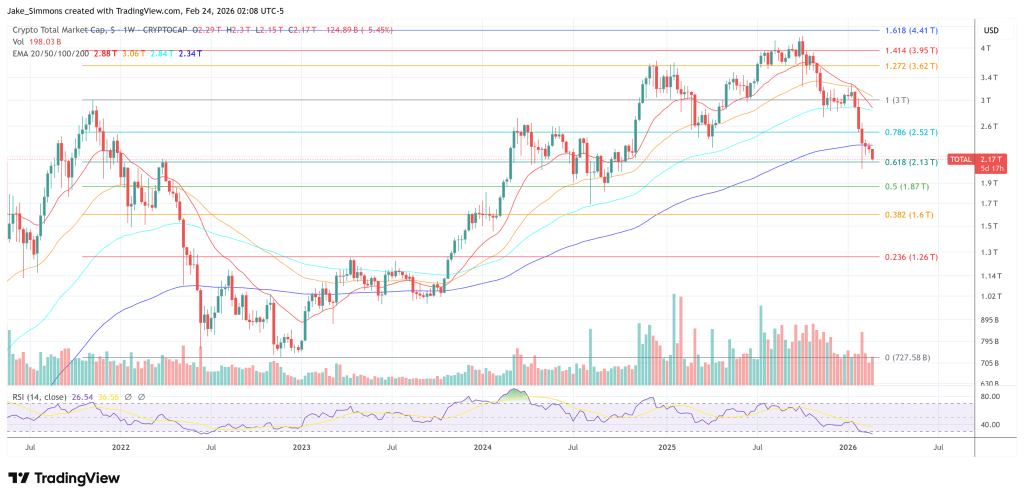
Total crypto market cap falls below the 200-week EMA, 1-week chart | Source: TOTAL on TradingView.com

İlgili Sorular

QWhat is the main allegation against Jane Street in the lawsuit filed by Terraform Labs' wind-down administrator?

AThe lawsuit alleges that Jane Street used material non-public information from Terraform insiders to trade around the May 2022 collapse of TerraUSD (UST) and Luna, engaging in insider trading, fraud, and market manipulation.

QWho is Bryce Pratt and what role does he allegedly play in this case?

ABryce Pratt is an individual named in the complaint who allegedly moved from an internship at Terraform to a position at Jane Street while maintaining a confidential back channel with Terraform's head of research and passing along sensitive, non-public information.

QWhat specific trade is alleged to have 'precipitated a steep sell off in UST' and where did it occur?

AThe complaint alleges that a Jane Street-linked 85 million UST trade on the Curve's 3pool liquidity pool was 'the largest single swap on the Curve 3pool' and that it precipitated a steep sell off in UST.

QWhat key piece of evidence is cited to show Jane Street was in direct communication with Terraform leadership during the crisis?

AThe complaint cites a May 9 message where Bryce Pratt allegedly wrote to Terraform co-founder Do Kwon expressing interest in bidding on BTC or LUNA, and Kwon's response referencing 'Bill from Jump' contacting them about a fundraise.

QWhat are some of the key legal defenses Jane Street is expected to raise against these allegations?

AJane Street is expected to contest the claims by challenging whether the information was truly material and non-public, whether their trades were causally connected to the collapse, and whether the plaintiff can prove intent.

İlgili Okumalar

The AI Agent Era Accelerates Its Arrival: Questflow Defines a New Paradigm of Financial Intelligence with On-Chain AI Brokerage

The AI Agent era is accelerating, with the CB Insights AI 100 list highlighting global investment confidence. The focus has shifted from whether AI works to its speed of deployment and ability to manage complex workflows, with autonomous AI Agents driving this transformation. At the forefront is Questflow, a Singapore-based startup redefining financial intelligence through its on-chain AI brokerage. Unlike tools that merely provide data dashboards, Questflow deploys AI Agents that proactively scan markets, form judgments, and execute trades via a conversational interface—operating 24/7 without requiring manual confirmation for each decision. This embodies the new AI paradigm of agents capable of executing multi-step workflows autonomously. Questflow's mission is to democratize institutional-grade trading intelligence. Historically reserved for the ultra-wealthy, this capability is now accessible starting from just $1 through Questflow's "AI Clone + Copy Trade" model. The platform charges only a 1% execution fee, aligning its incentives directly with users and eliminating traditional management or performance fees. The timing is opportune, aligning with key trends identified by CB Insights: the scalable deployment of AI Agents, accelerated AI adoption in financial services, and the maturation of on-chain infrastructure. With robust liquidity on platforms like Hyperliquid and Polymarket, alongside advancements in AI reasoning and non-custodial wallet security, Questflow is positioned to merge the roles of broker, fund, and exchange into a single, accessible platform for millions.

链捕手40 dk önce

The AI Agent Era Accelerates Its Arrival: Questflow Defines a New Paradigm of Financial Intelligence with On-Chain AI Brokerage

链捕手40 dk önce

Why Pricing Social Interactions is Doomed to Fail?

Titled "Why Putting a Price on Social Interaction Is Doomed to Fail," this article critiques attempts to monetize social networks directly through SocialFi models, arguing their inevitable failure stems from a fundamental misunderstanding of media dynamics. Using Marshall McLuhan's theory of "hot" and "cold" media, the author posits that social networks are inherently "cold" media. Their value isn't contained in individual posts but is co-created through user participation, interpretation, and fragmented, ongoing interaction (e.g., replies, shares). This ambiguity and need for user involvement are core to their function. The article asserts that SocialFi projects like Friend.tech failed because introducing real-time, tradable financial pricing (a definitive "hot" signal) into this "cold" environment doesn't add a layer—it replaces the medium's essence. The unambiguous price signal overshadows and nullifies the nuanced, participatory social signal. Users become traders, not participants, and when speculative profits vanish, the underlying social ecosystem—never genuinely cultivated—collapses entirely. This principle extends beyond crypto. The author argues platforms like Twitter have gradually "heated up" through metrics (likes, retweets counts, algorithmically defined value), shifting users from participants to performers and eroding organic engagement. The solution isn't to abandon capital but to manage its entry point. Successful models like Substack, Patreon, or Bandcamp allow capital to "condense" at specific, isolated nodes (e.g., subscriptions, one-time payments) without permeating and "heating" every social interaction. They preserve the core "cold," participatory medium while enabling monetization at designated boundaries. The NFT boom and bust serves as a stark parallel: the ancient "cold" medium of collecting (valued for story, community, gradual accumulation) was rapidly destroyed by platforms that introduced real-time floor prices, rarity scores, and trading dashboards, transforming collectors into speculators and vaporizing cultural value when prices fell. The core lesson: "Liquidity equals heat." Injecting high liquidity and definitive pricing into a "cold" participatory medium doesn't optimize it; it fundamentally alters and destroys its value-creating mechanism. The future lies not in pricing every social gesture but in finding precise, non-invasive points for capital to condense without overheating the entire ecosystem.

marsbit48 dk önce

Why Pricing Social Interactions is Doomed to Fail?

marsbit48 dk önce

İşlemler

Spot
Futures
活动图片





