Bitcoin Cash thất bại ở mức 478 USD – Nhưng phe giá lên BCH có thể bảo vệ mức 406 USD tiếp theo không?

ambcrypto2026-04-09 tarihinde yayınlandı2026-04-09 tarihinde güncellendi

Özet

Bitcoin Cash (BCH) đã giảm nhẹ dưới 1% trong tuần qua và 1,25% trong tháng, thể hiện sự yếu kém tương đối so với Bitcoin. Giá BCH đang giao dịch trong khoảng $272–$685 từ đầu năm 2024, nhưng đã không thể vượt qua ngưỡng kháng cự quan trọng ở $478. Cấu trúc giá ngắn hạn và dài hạn đều cho thấy dấu hiệu giảm giá mạnh, với việc các hỗ trợ chính bị phá vỡ. Phân tích kỹ thuật trên biểu đồ 4 giờ xác nhận xu hướng giảm, với các mức Fibonacci chỉ ra mục tiêu tiếp theo ở $406 và $385. Dù có khả năng phục hồi nhẹ lên vùng $455–$465, áp lực bán vẫn chiếm ưu thế. Nhà đầu tư dài hạn được khuyến nghị chờ đợi mua vào nếu giá giảm sâu dưới $300.

Bitcoin Cash [BCH] chỉ giảm chưa đến 1% trong tuần qua và chỉ mất 1,25% trong tháng qua. Nó hoạt động kém hơn Bitcoin [BTC], đã tăng 7,5% trong một tuần và chỉ tăng hơn 1% trong 30 ngày.

Sự yếu kém tương đối của Bitcoin Cash cho thấy sự thiếu niềm tin của thị trường, nhưng trên bề mặt, nó trông có vẻ vô hại.

Tuy nhiên, hành động giá của nó trong tháng 4 đã rất rõ ràng. Trong cuộc chiến giữa phe giá lên và phe giá xuống, một bên rõ ràng đang thắng thế.

Cảnh báo spoiler, đó không phải là phe giá lên của Bitcoin Cash
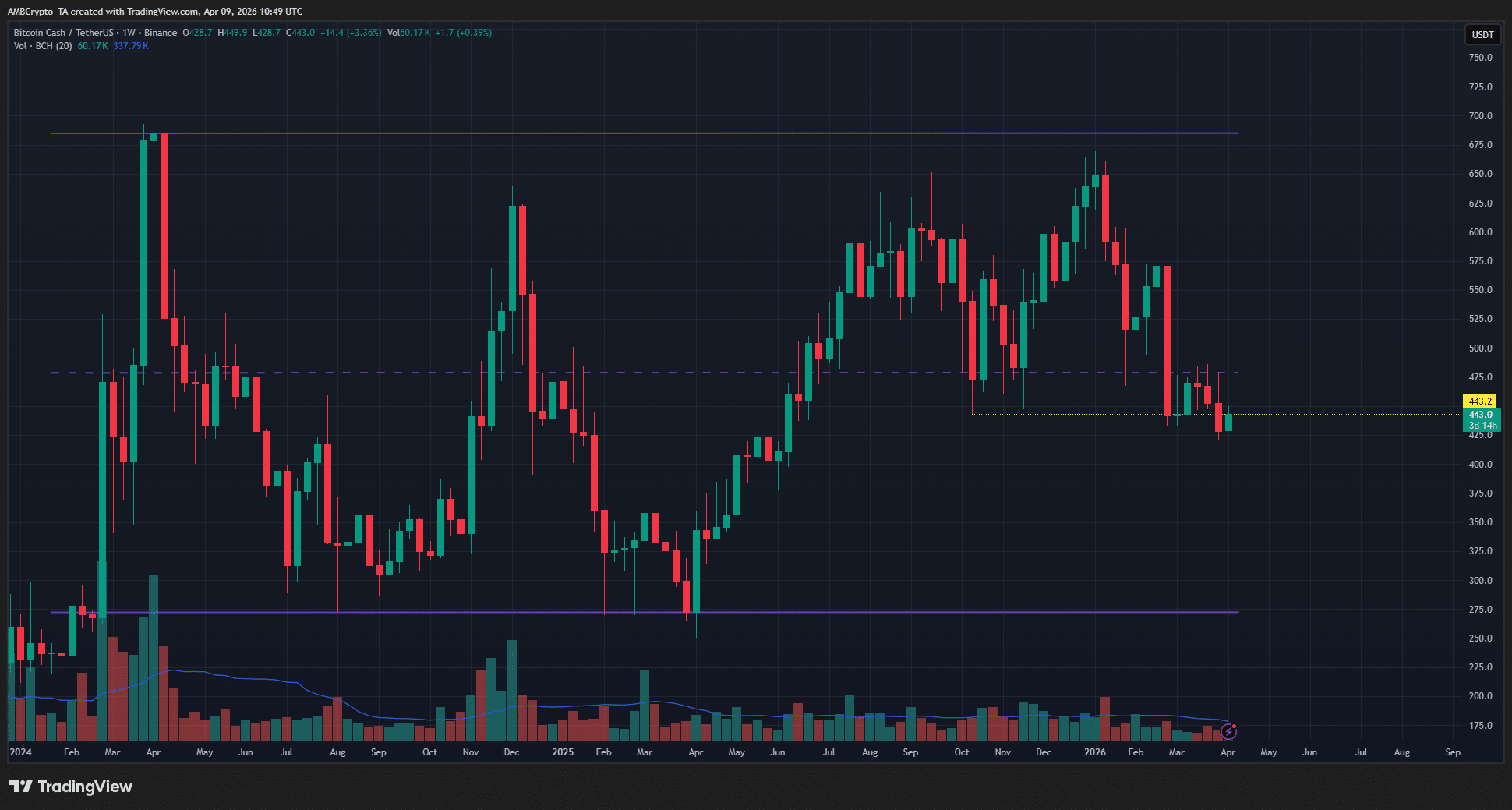
Nguồn: BCH/USDT trên TradingView

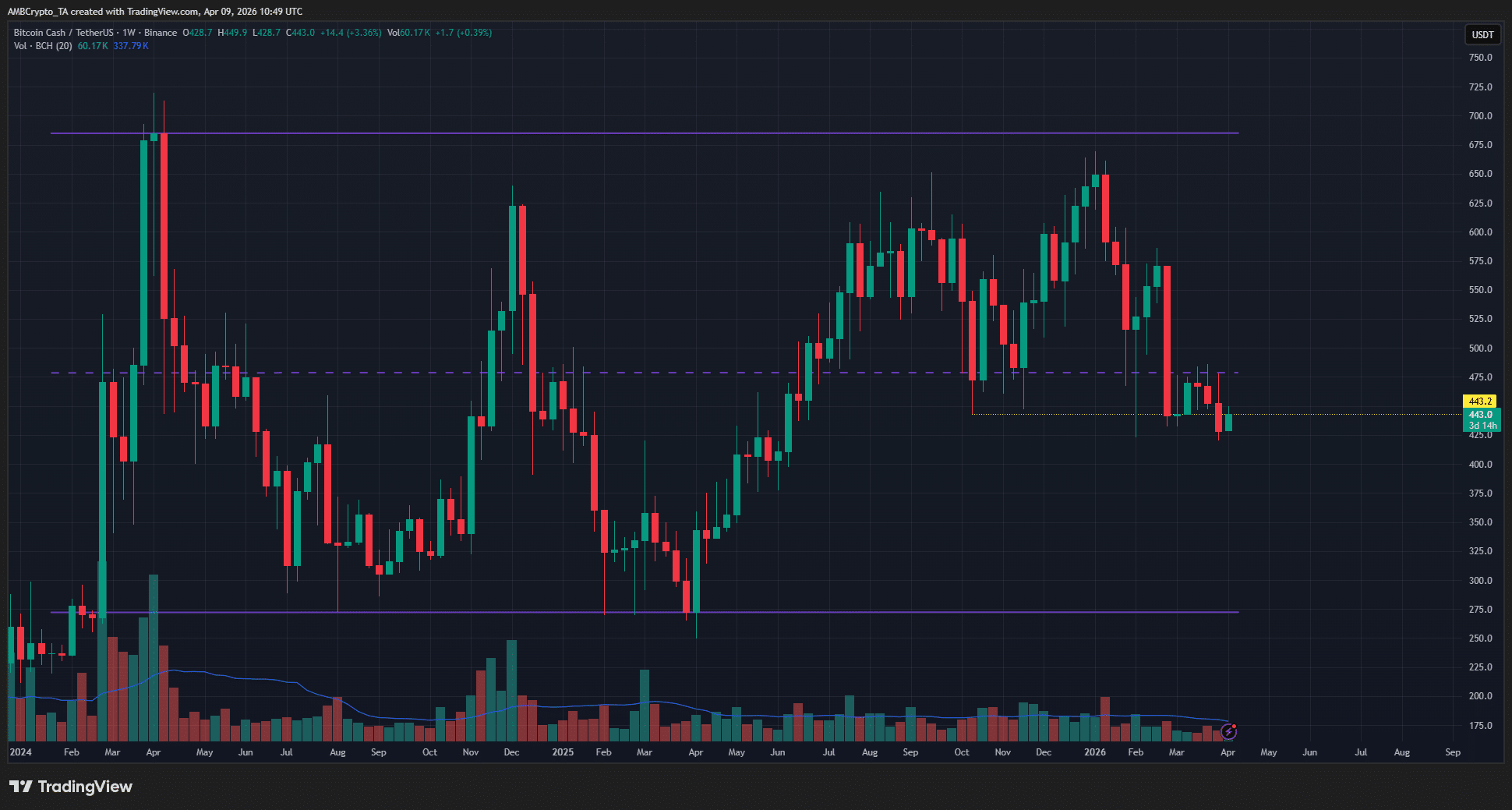
Kể từ tháng 2 năm 2024, Bitcoin Cash đã được giao dịch trong một phạm vi (màu tím) từ 272 USD đến 685 USD. Altcoin này đã cố gắng và thất bại trong việc đạt mức cao của phạm vi ba lần kể từ tháng 12 năm 2024.

Vào năm 2025, hỗ trợ giữa phạm vi ở mức 478 USD đã nhiều lần đóng vai trò là hỗ trợ. Trong tháng qua, nó đã được kiểm tra như một kháng cự. Việc không thể vượt qua mức này trong đợt tăng giá tiền điện tử giữa tháng 3 đã xác nhận rằng phe giá xuống đang kiểm soát.

Mức thấp 443 USD từ vụ sụp đổ tháng 10 đang được kiểm tra lại như kháng cự tại thời điểm viết bài. Tổn thất giá tiếp theo có thể sẽ xảy ra trong những tháng tới.

Nhà đầu tư dài hạn có thể chờ đợi mức giảm xuống dưới 300 USD trước khi tìm mua BCH.

Lời kêu gọi hành động của traders – Đã đến lúc bán ra?
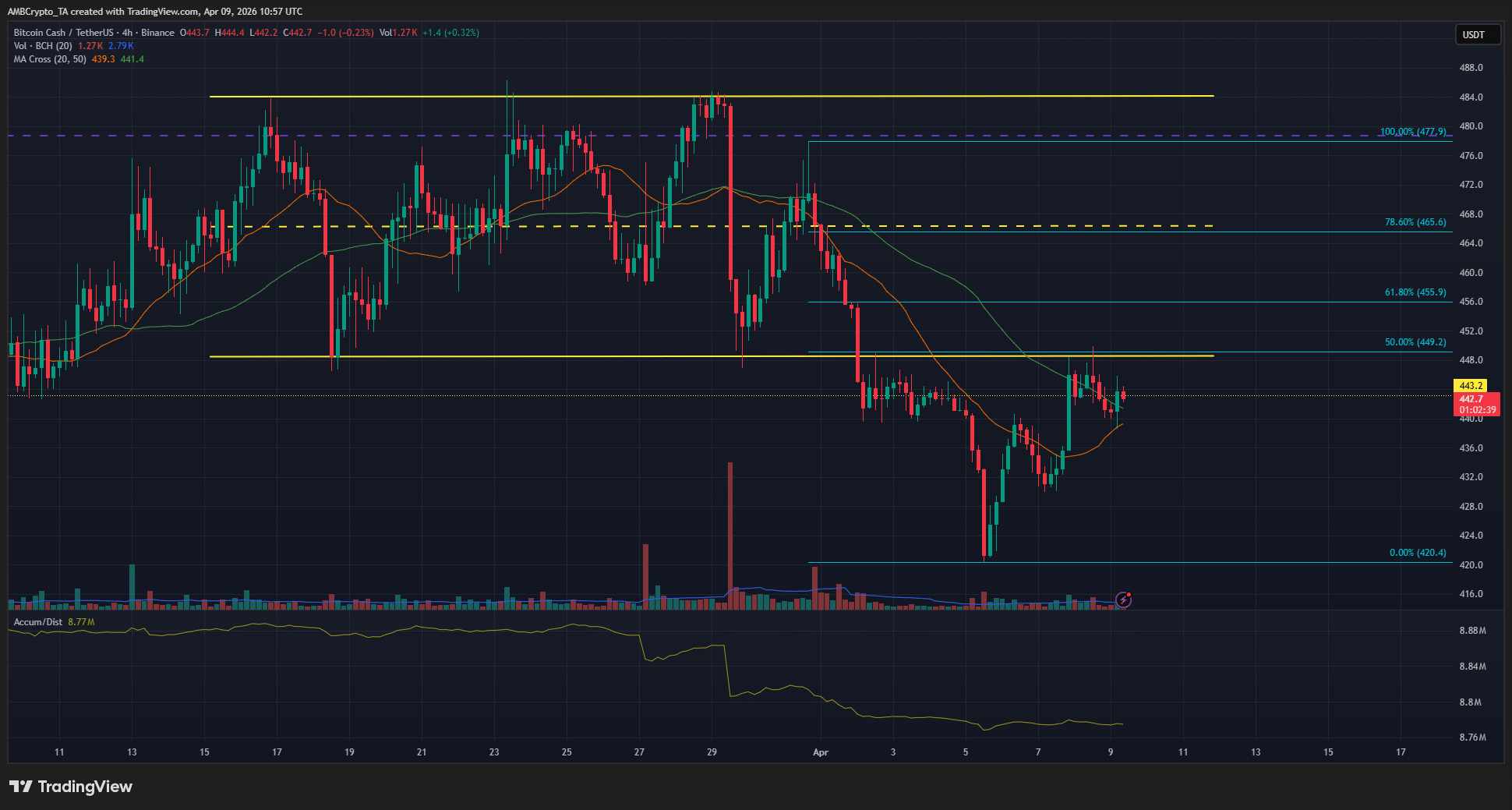
Nguồn: BCH/USDT trên TradingView

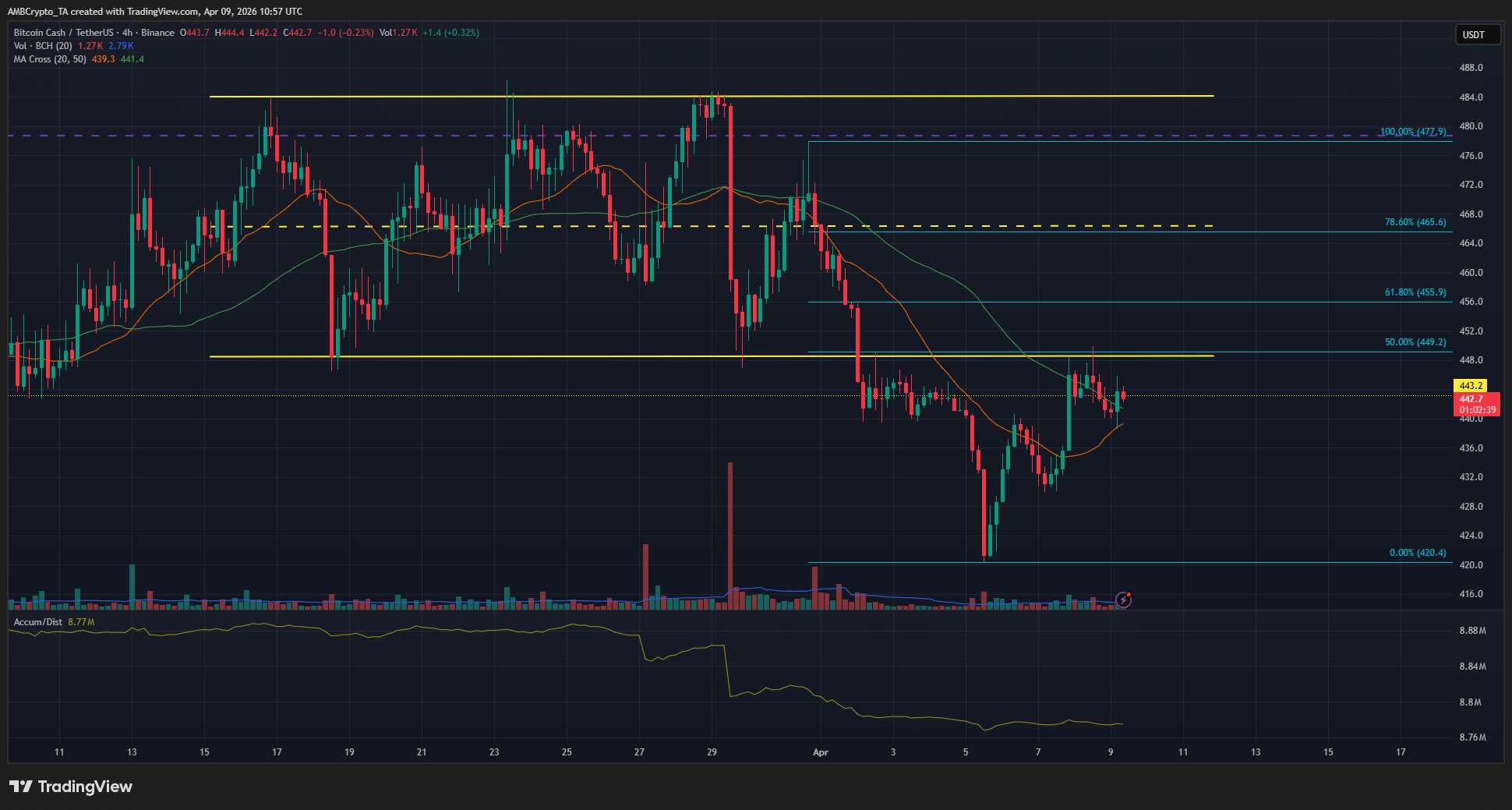
Biểu đồ 4 giờ cho thấy một cấu trúc swing giảm giá. Phạm vi ngắn hạn giữa 448 USD và 484 USD đã bị phá vỡ vào đầu tháng 4. Mức thấp của phạm vi đang được kiểm tra lại như kháng cự tại thời điểm viết bài.

Hơn nữa, bằng cách sử dụng động thái swing giảm H4, một tập hợp các mức Fibonacci retracement (màu lục lam) đã được vẽ.

Mức 50% ở 449,2 USD đã được kiểm tra và giá đã bắt đầu giảm thấp hơn từ đó.

Có khả năng đợt phục hồi hiện tại có thể mở rộng về phía 455-465 USD.

Tuy nhiên, xu hướng của trend là giảm giá và các trader Bitcoin Cash cần chuẩn bị cho một đợt giảm giá trong những tuần tới.

Các mức mở rộng Fibonacci cho thấy 406 USD và 385 USD là các mục tiêu giá giảm tiếp theo.


Tóm tắt cuối cùng

  • Các mô hình phạm vi ngắn hạn và dài hạn cho thấy các mức chính đã bị phá vỡ và cảnh báo về biến động giá giảm hơn nữa.
  • Các mục tiêu giá BCH tiếp theo là 306 USD và 385 USD, mặc dù một đợt phục hồi lên 455-465 USD là khả năng có thể xảy ra trước một đợt giảm như vậy.


İlgili Sorular

QBitcoin Cash (BCH) đã giảm bao nhiêu phần trăm trong tuần qua và tháng qua?

ABitcoin Cash (BCH) giảm chưa đến 1% trong tuần qua và giảm 1,25% trong tháng qua.

QMức hỗ trợ giữa phạm vi giao dịch dài hạn của BCH là bao nhiêu và nó đã đóng vai trò gì vào năm 2025?

AMức hỗ trợ giữa phạm vi dài hạn là $478. Vào năm 2025, nó đã nhiều lần đóng vai trò là hỗ trợ.

QTheo phân tích kỹ thuật, các mức giá mục tiêu giảm tiếp theo cho BCH là gì?

ACác mức giá mục tiêu giảm tiếp theo cho BCH là $406 và $385.

QBiểu đồ 4 giờ cho thấy cấu trúc swing như thế nào và phạm vi ngắn hạn bị phá vỡ là bao nhiêu?

ABiểu đồ 4 giờ cho thấy một cấu trúc swing giảm giá. Phạm vi ngắn hạn bị phá vỡ là từ $448 đến $484.

QNhà đầu tư dài hạn được khuyến nghị nên làm gì theo bài viết?

ANhà đầu tư dài hạn được khuyến nghị nên chờ đợi giá giảm xuống dưới $300 trước khi xem xét mua BCH.

İlgili Okumalar

Google TPU Shipments Revised Up by 50%

Recent industry research indicates a significant upward revision in the shipments of Google's TPU (Tensor Processing Unit) chips. Previous expectations for 2027 were set at around 10 million units, but new estimates now point to 15 million units, a 50% increase. This substantial boost directly translates to higher demand across the entire supporting supply chain. Google's TPU clusters utilize a standardized all-optical interconnect architecture. Consequently, key hardware components are deeply integrated and scaled in fixed ratios with the chips. The 15 million TPU target will drive corresponding demand increases for NPO optical engines (roughly a 1:1 match), 1.6T optical modules, OCS optical switches, high-end server power supplies, fiber optics & MPO connectors, and liquid cooling solutions. Among these, liquid cooling is highlighted as the sector experiencing the most significant transformation and offering the most stable potential for excess returns. As next-generation TPU chips reach power levels where traditional air cooling is insufficient, liquid cooling becomes essential. 2026 is forecasted as the first year of substantial adoption for Google's liquid cooling solutions. This shift, coupled with delivery and capacity bottlenecks faced by incumbent overseas manufacturers, is creating a prime window for domestic Chinese suppliers to enter and secure Google's core supply chain. The market size for Google-specific liquid cooling is projected to potentially triple from a baseline of hundreds of billions to around 300 billion units by 2028. The logic for the fiber optic sector is also being rewritten. Once considered a cyclical commodity tied to telecom operator procurement, fiber is now a strategic and scarce resource for AI Data Centers (AIDC). A severe supply-demand imbalance, driven by the long lead time for preform production (18-24 months) and surging demand from cloud giants, is supporting strong performance. Chinese fiber manufacturers are well-positioned to capture a significant share of global AIDC demand, with exports potentially reaching 200-300 million core kilometers in 2026. Overall, the investment focus within the AI computing industry is shifting from pure "chip performance speculation" towards the more certain incremental growth in computing infrastructure and its supporting ecosystem. The upward revision in Google TPU shipments, along with the potential for further doubling by 2028, is seen as solidifying performance visibility for the entire supporting supply chain over the next two years.

marsbit1 saat önce

Google TPU Shipments Revised Up by 50%

marsbit1 saat önce

What Wall Street Really Wants After the Crypto Story Recedes

The tide of speculative crypto narratives has receded, revealing Wall Street's true objective: building a controlled, yield-generating, and compliant financial pipeline on distributed ledgers. They are migrating core functions onto blockchains, not for decentralization, but for efficiency and new revenue streams. Key developments include BlackRock's BUIDL fund, a tokenized treasury fund acting as a foundational reserve asset, and the rise of Securitize, which is going public and partnering with the NYSE to build a 24/7 digital securities trading and settlement system. This signals a major shift of securities clearing to blockchain technology. To make volatile assets like Bitcoin palatable for institutional investors, firms like BlackRock and Goldman Sachs are creating "covered call" ETFs (e.g., BITA). These products systematically sell options on Bitcoin holdings, transforming price volatility into stable monthly income, effectively repackaging crypto as a yield-bearing asset. Stablecoins are being positioned not as speculative tools but as efficient payment rails. Companies like Stripe and Mastercard are integrating them for instant, low-cost merchant settlements and cross-border card payments, respectively. Critically, new legislation like the GENIUS Act shapes them as non-interest-bearing, heavily regulated extensions of the US dollar system. In summary, Wall Street is quietly constructing a parallel, blockchain-based financial infrastructure featuring tokenized traditional assets, structured crypto yields, and programmable dollar pipelines—all under its control and fully integrated with existing regulatory and credit frameworks.

marsbit1 saat önce

What Wall Street Really Wants After the Crypto Story Recedes

marsbit1 saat önce

Tying Itself to SpaceX: Cursor's $60 Billion Rise

This article recounts the rapid rise of AI-powered coding startup Cursor and its 25-year-old MIT graduate CEO, Michael Truell. Launched in 2023, Cursor achieved explosive growth, reaching over 10 billion USD in revenue by late 2025. However, its journey highlights a central dilemma for AI application companies: dependence on foundational model providers. Cursor initially relied heavily on Anthropic's models but faced an existential threat when Anthropic launched its own competing coding tool, Claude Code. In response, Cursor declared an internal emergency in early 2026 and accelerated development of its own model, Composer. To secure the immense computing power needed, Truell struck a pivotal deal with Elon Musk's SpaceX in April 2026. The collaboration grants Cursor access to SpaceX's supercomputing resources for Composer, while SpaceX's Grok model benefits from Cursor's programming data. The agreement includes a potential 600 billion USD acquisition of Cursor by SpaceX later in the year, though a substantial termination fee is in place if the deal falls through. The story explores Cursor's intense, sometimes controversial hiring practices involving lengthy unpaid "work trials," its complex partnership-turned-rivalry with Anthropic, and its high-stakes gamble to ensure independence through the SpaceX alliance. The core question remains: will Cursor evolve into a defining, independent "generational" software company, or become a key piece in a tech giant's AI arsenal?

marsbit1 saat önce

Tying Itself to SpaceX: Cursor's $60 Billion Rise

marsbit1 saat önce

İşlemler

Spot
Futures

Popüler Makaleler

BCH Nasıl Satın Alınır

HTX.com’a hoş geldiniz! Bitcoin Cash (BCH) satın alma işlemlerini basit ve kullanışlı bir hâle getirdik. Adım adım açıkladığımız rehberimizi takip ederek kripto yolculuğunuza başlayın. 1. Adım: HTX Hesabınızı OluşturunHTX'te ücretsiz bir hesap açmak için e-posta adresinizi veya telefon numaranızı kullanın. Sorunsuzca kaydolun ve tüm özelliklerin kilidini açın. Hesabımı Aç2. Adım: Kripto Satın Al Bölümüne Gidin ve Ödeme Yönteminizi SeçinKredi/Banka Kartı: Visa veya Mastercard'ınızı kullanarak anında Bitcoin Cash (BCH) satın alın.Bakiye: Sorunsuz bir şekilde işlem yapmak için HTX hesap bakiyenizdeki fonları kullanın.Üçüncü Taraflar: Kullanımı kolaylaştırmak için Google Pay ve Apple Pay gibi popüler ödeme yöntemlerini ekledik.P2P: HTX'teki diğer kullanıcılarla doğrudan işlem yapın.Borsa Dışı (OTC): Yatırımcılar için kişiye özel hizmetler ve rekabetçi döviz kurları sunuyoruz.3. Adım: Bitcoin Cash (BCH) Varlıklarınızı SaklayınBitcoin Cash (BCH) satın aldıktan sonra HTX hesabınızda saklayın. Alternatif olarak, blok zinciri transferi yoluyla başka bir yere gönderebilir veya diğer kripto para birimlerini takas etmek için kullanabilirsiniz.4. Adım: Bitcoin Cash (BCH) Varlıklarınızla İşlem YapınHTX'in spot piyasasında Bitcoin Cash (BCH) ile kolayca işlemler yapın.Hesabınıza erişin, işlem çiftinizi seçin, işlemlerinizi gerçekleştirin ve gerçek zamanlı olarak izleyin. Hem yeni başlayanlar hem de deneyimli yatırımcılar için kullanıcı dostu bir deneyim sunuyoruz.

656 Toplam GörüntülenmeYayınlanma 2024.12.11Güncellenme 2026.06.02

BCH Nasıl Satın Alınır

Tartışmalar

HTX Topluluğuna hoş geldiniz. Burada, en son platform gelişmeleri hakkında bilgi sahibi olabilir ve profesyonel piyasa görüşlerine erişebilirsiniz. Kullanıcıların BCH (BCH) fiyatı hakkındaki görüşleri aşağıda sunulmaktadır.

活动图片