Les rachats et Telegram alimentent la hausse de 40 % du LIT, mais le rallye peut-il se poursuivre ?

ambcrypto2026-04-09 tarihinde yayınlandı2026-04-09 tarihinde güncellendi

Özet

LIT, le jeton natif de la DEX perpétuelle Lighter soutenue par Peter Thiel, a connu une hausse de 40% en avril, stimulée par un programme agressif de rachats et une intégration avec Telegram. Le projet a racheté et verrouillé 10 millions de LIT, soit 4% de l'offre circulante de 250 millions de jetons. Ce rythme de rachat, environ 1% par mois, pourrait conduire au verrouillage de l'offre circulante actuelle en 10 mois. Parallèlement, l'intégration avec Telegram a généré 40 000 nouveaux utilisateurs inscrits et a permis à la messagerie d'utiliser Lighter pour le trading avec effet de levier. Bien que les revenus quotidiens aient augmenté pour atteindre plus de 100 000 $, l'intérêt ouvert (OI) n'a progressé que légèrement. Les analystes notent que la poursuite de la hausse dépendra du dépassement d'une résistance technique clé, la moyenne mobile exponentielle sur 200 jours.

Lighter, la DEX perpétuelle soutenue par Peter Thiel, a accéléré le rachat de son jeton natif LIT. Le 8 avril, le projet a annoncé avoir acheté et verrouillé 10 millions de LIT. Cela représente 4 % de la circulation actuelle de 250 millions de jetons depuis son lancement en décembre dernier.

Il y a un mois, le programme de rachat était à 3 % de l'offre en circulation. À son rythme actuel, le projet rachète environ 1 % de l'offre, soit une moyenne de 2,4 millions de LIT par mois. Si cette tendance se maintient, il faudrait environ 10 mois à la DEX pour verrouiller l'intégralité de l'offre circulante actuelle.

Il est cependant important de noter que l'offre totale de LIT est plafonnée à 1 milliard, et seulement 250 millions de jetons LIT ont été mis en circulation après le lancement. La première vague de déverrouillages commencera en décembre 2026.

En attendant, comment le marché réagit-il à ce rachat agressif de LIT ?

Telegram booste l'engouement pour Lighter

Eh bien, l'accueil a été très positif et haussier. Depuis fin mars, le jeton a rebondi de plus de 40 %, passant d'un plus bas historique de 0,74 $ à plus de 1,13 $.

L'élan haussier du LIT a été encore renforcé par une récente intégration à Telegram. Le messager axé sur la confidentialité utilisera Lighter pour alimenter son trading natif avec un effet de levier allant jusqu'à 50x sur les actifs cryptos et non-cryptos.

Cela fait environ une semaine que l'intégration avec Telegram a eu lieu. AMBCrypto a donc creusé plus profondément pour vérifier si ce partenariat génère un trafic significatif pour la DEX ou non.

Selon les données de Lightalytics, Lighter a enregistré environ 40 000 nouveaux utilisateurs inscrits après la mise à jour Telegram.
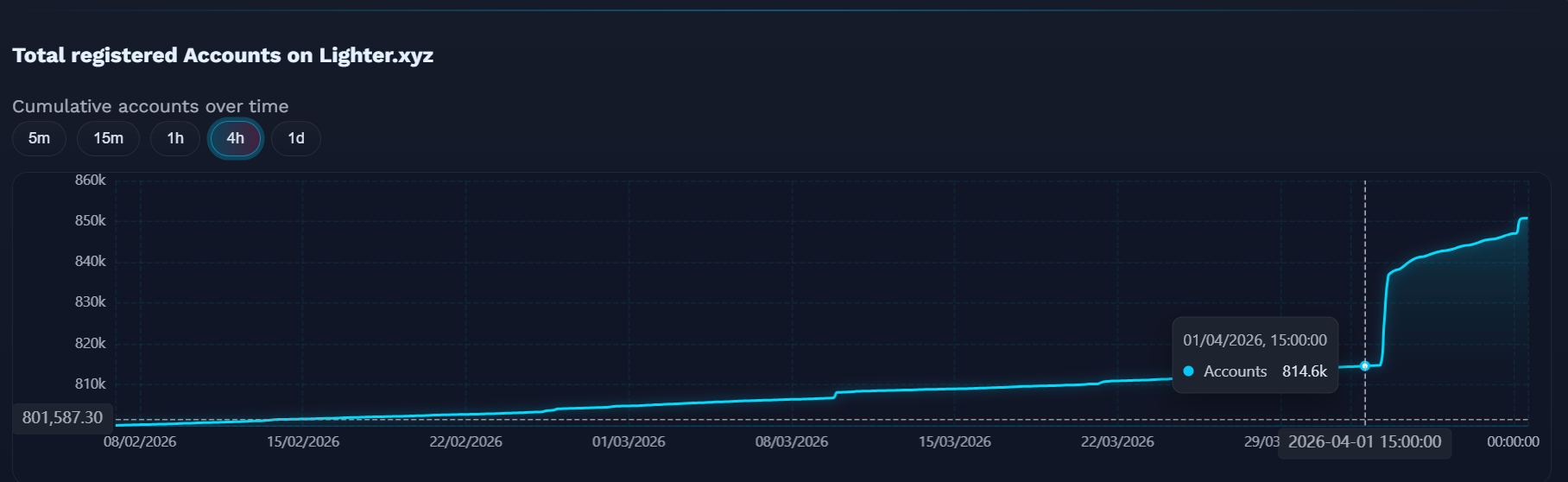
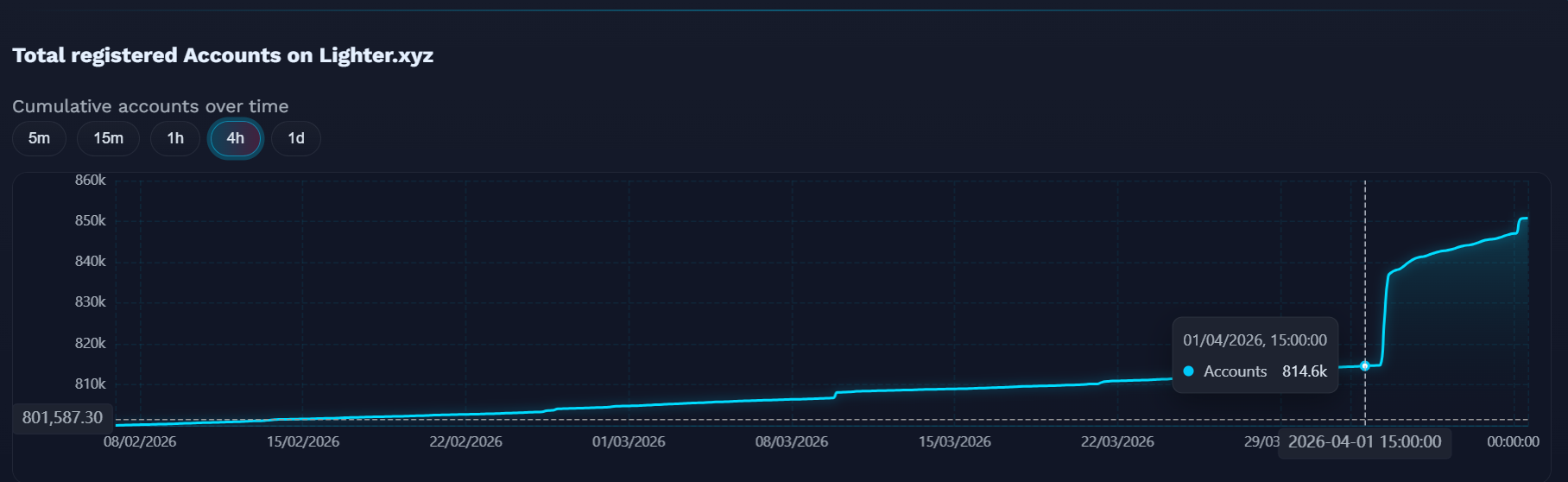
Source : Lightalytics

Le LIT va-t-il prolonger la hausse de 40 % ?

Cependant, l'Open Interest (OI), qui suit les paris ouverts des utilisateurs, n'a affiché qu'une légère amélioration.

L'OI a augmenté d'environ 40 millions de dollars, passant de 675 millions de dollars à 717 millions de dollars. Fait intéressant, ce faible regain d'activité a vu les revenus quotidiens passer de 35 000 $ à plus de 100 000 $ au cours des sept derniers jours.
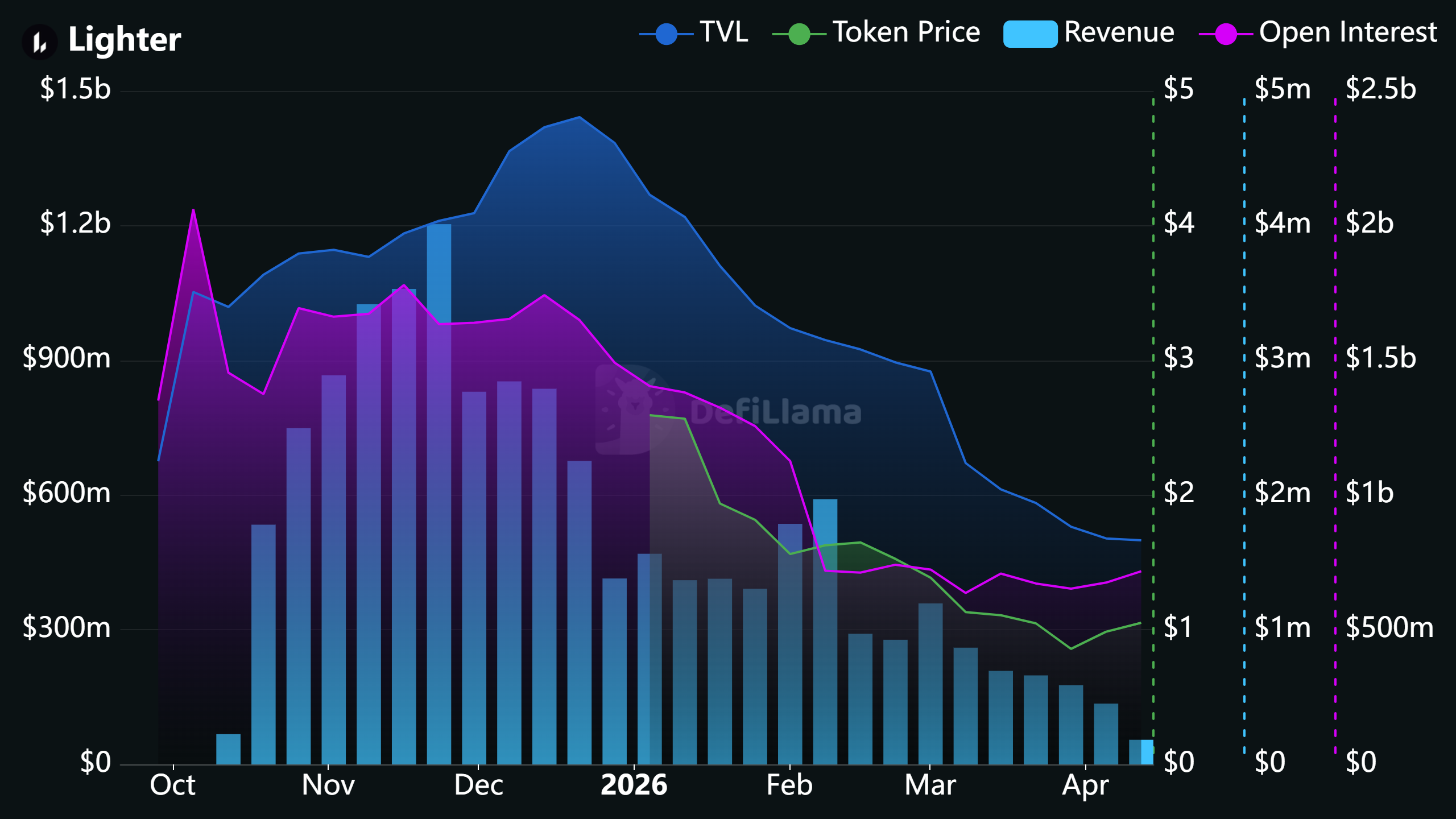
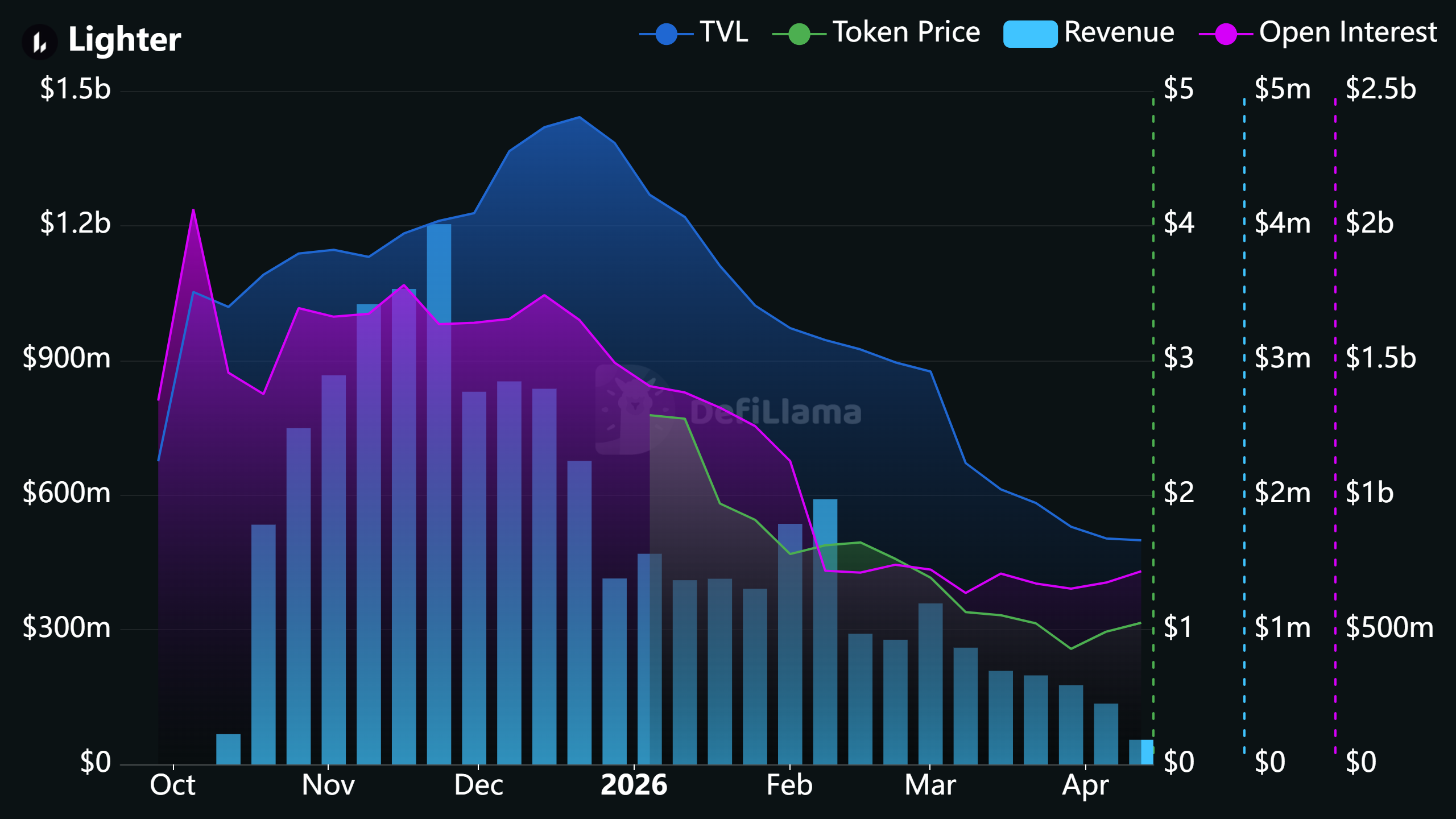
Source : DeFiLlama

Étant donné que la majeure partie des revenus est acheminée vers des rachats, toute amélioration supplémentaire de l'activité pourrait aider à soutenir la reprise du LIT.

Néanmoins, un trader a récemment averti que le rallye avait atteint la 200-EMA (Moyenne Mobile Exponentielle) – une résistance dynamique clé qui pourrait freiner les haussiers à court terme. Une prolongation de la hausse ne pourrait être confirmée que si les haussiers transforment la 200-EMA en support.
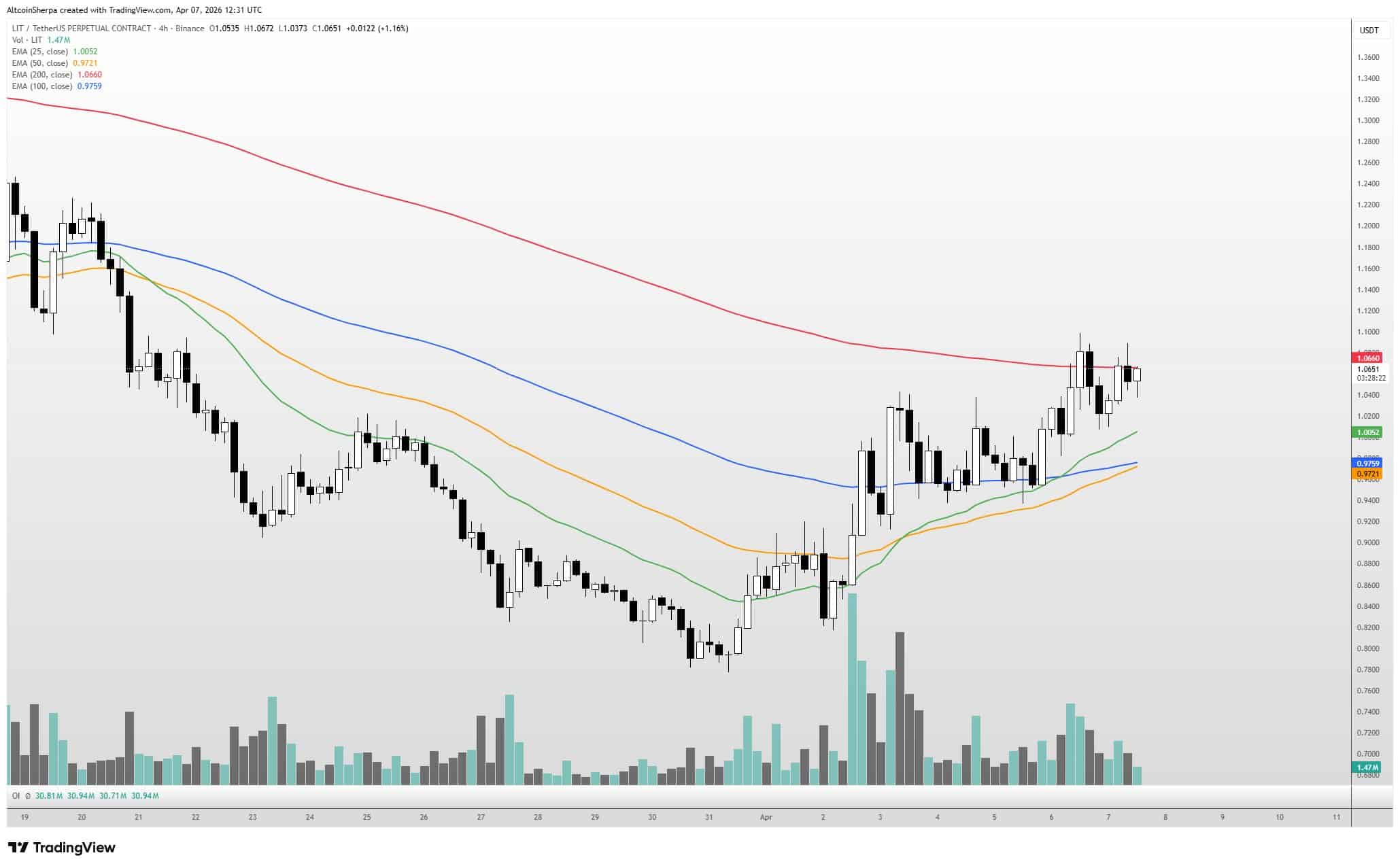
Source : X

Résumé final

  • Le programme de rachat de Lighter a atteint 10 millions de LIT, soit 4 % de l'offre en circulation de 250 millions.
  • Le programme de rachat agressif et l'intégration à Telegram ont alimenté la hausse de 40 % du LIT en avril.


İlgili Sorular

QQuel est l'impact du programme de rachat de LIT sur l'offre en circulation ?

ALe programme de rachat a atteint 10 millions de LIT, soit 4% de l'offre en circulation de 250 millions de tokens. Le rythme actuel est d'environ 1% par mois, ce qui pourrait conduire au verrouillage de l'offre circulante totale en 10 mois.

QComment l'intégration de Telegram a-t-elle influencé la traction de Lighter ?

AL'intégration avec Telegram a généré environ 40 000 nouveaux utilisateurs inscrits sur Lighter et a contribué à une augmentation des revenus quotidiens de 35 000 $ à plus de 100 000 $ en une semaine.

QQuel a été l'effet combiné des rachats et de Telegram sur le prix de LIT ?

ALa combinaison du programme de rachat agressif et de l'intégration de Telegram a propulsé une hausse de 40% du prix de LIT, passant d'un plus bas de 0,74 $ à plus de 1,13 $ depuis fin mars.

QQuel est le principal défi technique pour la poursuite de la hausse de LIT ?

ALe principal défi technique est le franchissement de la résistance dynamique clé de la moyenne mobile exponentielle 200 (200-EMA). Une poursuite de la hausse ne sera confirmée que si les acheteurs parviennent à transformer ce niveau en support.

QQuelle est la structure de l'offre totale de LIT et quand auront lieu les premiers déblocages ?

AL'offre totale de LIT est plafonnée à 1 milliard de tokens, avec seulement 250 millions actuellement en circulation. La première vague de déblocages est prévue pour décembre 2026.

İlgili Okumalar

Has the 'Digital Gold' Narrative for BTC Failed?

**Title: Has the "Digital Gold" Narrative for Bitcoin Failed?** The article argues that Bitcoin's "digital gold" narrative remains valid despite a recent sharp price decline (from a peak near $126k in Oct 2025 to briefly under $61k in Feb 2026). It presents a long-term investment framework based on three core points: **1. Viewing Bitcoin as an Asset:** Bitcoin is presented as a superior potential store of value compared to gold. Key arguments are its absolute scarcity (21 million cap), superior portability, and transparent auditability via its public ledger. While acknowledging its current use in early, volatile stages (~3-4% global adoption), the author draws parallels to the early, disruptive phases of the internet and e-commerce. **2. Understanding the Recent Downturn:** The current ~50% correction is framed as a predictable, consensus-driven cycle following its post-halving peak (the 2024 halving preceded the Oct 2025 high). A crucial factor is a historic "changing of hands": the influx of new institutional buyers via ETFs allowed early, low-cost holders (miners, OG believers) to take profits. The author notes that while severe, Bitcoin's historical drawdowns (e.g., 93% in 2011, 77% in 2021-22) have been progressively smaller, suggesting maturing holder structure and decreasing volatility over time. **3. The Long-Term Perspective:** The long-term thesis hinges on Bitcoin capturing a portion of gold's market value. With Bitcoin's market cap at ~$1.4 trillion (at $70k) versus gold's ~$20 trillion, significant upside potential exists if the "digital gold" narrative is partially realized. However, the author strongly cautions that short-term risks remain, the bottom is unpredictable, and high volatility is inherent. The real risk is not Bitcoin failing but poor personal position management (over-leverage, wrong capital) and a lack of deep understanding, which can force investors out during severe downturns. The conclusion uses Amazon's 95% crash post-2000 dot-com bubble and subsequent 42x recovery as an analogy. The ultimate question is not if Bitcoin's price will rise, but if an investor's strategy and conviction can withstand the volatility to see the long-term play out. The recent divergence (gold up, Bitcoin down) is posed not as a narrative failure, but as potential evidence of this ongoing, painful transition from a speculative asset to a mainstream allocation.

marsbit51 dk önce

Has the 'Digital Gold' Narrative for BTC Failed?

marsbit51 dk önce

Has BTC's 'Digital Gold' Narrative Failed?

The article discusses Bitcoin's "digital gold" narrative, its recent price drop, and long-term outlook through the perspective of "Jason". It argues the narrative is not a failure but that Bitcoin represents a superior, new asset class due to its fixed supply (21 million), portability, and auditability. The piece compares its current ~3-4% global adoption rate to early internet/e-commerce, suggesting significant growth potential. Regarding the 2025-2026 price decline (from ~$126k to briefly under $61k), the author views it as a predictable, consensus-driven sell-off within Bitcoin's ~4-year cycle post-halving, exacerbated by a major "handover" from early, low-cost holders to new institutional buyers via ETFs. A key observation is that historical peak-to-trough drawdowns have lessened over time (e.g., 93% in 2011 to ~50% in 2026), indicating maturing volatility as holder structure changes. For the long term, the author uses a simple framework: Bitcoin's total market cap (~$1.4T at $70k) is only about 7% of gold's (~$20T). Even capturing 30-50% of gold's value would imply substantial upside. However, the article strongly cautions against viewing this as investment advice, emphasizing extreme volatility and the critical importance of risk management, position sizing, and deep fundamental understanding to survive severe drawdowns. It concludes by drawing a parallel to Amazon's 95% crash in 2000 and subsequent 42x recovery, stressing that the key is surviving market cycles to realize long-term potential.

链捕手1 saat önce

Has BTC's 'Digital Gold' Narrative Failed?

链捕手1 saat önce

From Code to Cognition: A Ten-Thousand-Word Guide to the Evolution of the Robot Brain

"From Code to Cognition: The Evolution of Robot Brains" The journey of robotic intelligence has shifted dramatically from manually coded systems to AI-driven brains. For decades, robots relied on layered software stacks—perception, state estimation, planning, control—each handcrafted. While predictable, they lacked adaptability. The 2010s saw deep learning revolutionize perception (e.g., object detection) and control (via reinforcement learning), but learned skills remained narrow. The arrival of Large Language Models (LLMs) marked a turning point. LLMs acted as high-level planners, interpreting natural language instructions and generating sequences of actions for traditional robotic systems to execute. However, true integration came with Visual-Language-Action (VLA) models, which fused vision, language, and motion prediction into a single network. Pioneered by models like RT-2 and open-source projects like OpenVLA, VLAs enable robots to reason and act directly from visual input and commands. The most advanced humanoid robots now employ a "dual-brain" architecture: a slow-thinking, large VLA (System 2) for reasoning and planning, and a fast-reacting, small network (System 1) for high-frequency motion control, sometimes with an even lower-level System 0 for balance. This split balances cognition with the physics of real-time movement. Computation is split between onboard hardware (e.g., NVIDIA Jetson) for safety-critical control loops and cloud/edge servers for non-critical tasks like learning and interfaces. A crucial driver is the open-source ecosystem—models like GR00T and OpenVLA allow startups to build upon pre-trained brains and fine-tune them with their own data, accelerating development. Despite progress, current systems struggle with recovery from errors, sample inefficiency, and long-horizon tasks. This has spurred the rise of **World Models**—neural networks that predict the consequences of actions. By simulating possible futures before acting (like NVIDIA Cosmos or Meta V-JEPA), robots can plan, recover, and generalize better. This represents the next frontier: shifting intelligence from learned reactions to an internal model of physics and cause-and-effect. The field is rapidly evolving. While not yet at its "ChatGPT moment," the convergence of cheaper hardware, scalable simulation, and world models points toward robots that are increasingly capable, adaptive, and useful. The question is shifting from "what can robots do?" to "what *should* they do?"

marsbit1 saat önce

From Code to Cognition: A Ten-Thousand-Word Guide to the Evolution of the Robot Brain

marsbit1 saat önce

AI Bubble Is Bursting

The AI Bubble is Bursting: A Necessary Purge on the Path to Ubiquitous Intelligence Market volatility has reignited debates about an AI bubble, with figures like Ray Dalio pointing to high valuations. However, this parallels the dot-com bubble, which, despite its crash, laid the physical infrastructure for today's internet era. The current AI investment frenzy, with tech giants planning trillions in infrastructure spending far outstripping current AI application revenues, appears similarly imbalanced. This 'bubble' is seen as an inevitable phase for a disruptive technology, paying the "innovation tax." Critically, AI inference costs have plummeted over 99.7% since 2023, making intelligence nearly free at the margin. This hasn't reduced spending but has instead unlocked massive new demand, as seen in enterprise AI cloud expenditure tripling. This follows the Jevons Paradox: efficiency gains lead to greater total consumption. The market is now entering a cleansing phase, weeding out speculative ventures lacking real moats. The deeper shift is a move from capital expenditure (CapEx) on hardware to value creation in operational expenditure (OpEx) through AI applications that solve real industry problems. While infrastructure valuations are high, rapid earnings growth from widespread AI adoption across sectors—from manufacturing and finance to law and healthcare—may digest these valuations over time. Ultimately, this creative destruction will leave behind robust infrastructure and optimized models, cheaply powering an AI-augmented future for all industries, much as the internet became indispensable after its own bubble burst. The core productive potential remains undiminished.

链捕手1 saat önce

AI Bubble Is Bursting

链捕手1 saat önce

İşlemler

Spot
Futures

Popüler Makaleler

TON Nasıl Satın Alınır

HTX.com’a hoş geldiniz! The Open Network (TON) satın alma işlemlerini basit ve kullanışlı bir hâle getirdik. Adım adım açıkladığımız rehberimizi takip ederek kripto yolculuğunuza başlayın. 1. Adım: HTX Hesabınızı OluşturunHTX'te ücretsiz bir hesap açmak için e-posta adresinizi veya telefon numaranızı kullanın. Sorunsuzca kaydolun ve tüm özelliklerin kilidini açın. Hesabımı Aç2. Adım: Kripto Satın Al Bölümüne Gidin ve Ödeme Yönteminizi SeçinKredi/Banka Kartı: Visa veya Mastercard'ınızı kullanarak anında The Open Network (TON) satın alın.Bakiye: Sorunsuz bir şekilde işlem yapmak için HTX hesap bakiyenizdeki fonları kullanın.Üçüncü Taraflar: Kullanımı kolaylaştırmak için Google Pay ve Apple Pay gibi popüler ödeme yöntemlerini ekledik.P2P: HTX'teki diğer kullanıcılarla doğrudan işlem yapın.Borsa Dışı (OTC): Yatırımcılar için kişiye özel hizmetler ve rekabetçi döviz kurları sunuyoruz.3. Adım: The Open Network (TON) Varlıklarınızı SaklayınThe Open Network (TON) satın aldıktan sonra HTX hesabınızda saklayın. Alternatif olarak, blok zinciri transferi yoluyla başka bir yere gönderebilir veya diğer kripto para birimlerini takas etmek için kullanabilirsiniz.4. Adım: The Open Network (TON) Varlıklarınızla İşlem YapınHTX'in spot piyasasında The Open Network (TON) ile kolayca işlemler yapın.Hesabınıza erişin, işlem çiftinizi seçin, işlemlerinizi gerçekleştirin ve gerçek zamanlı olarak izleyin. Hem yeni başlayanlar hem de deneyimli yatırımcılar için kullanıcı dostu bir deneyim sunuyoruz.

687 Toplam GörüntülenmeYayınlanma 2024.12.10Güncellenme 2026.06.02

TON Nasıl Satın Alınır

Tartışmalar

HTX Topluluğuna hoş geldiniz. Burada, en son platform gelişmeleri hakkında bilgi sahibi olabilir ve profesyonel piyasa görüşlerine erişebilirsiniz. Kullanıcıların TON (TON) fiyatı hakkındaki görüşleri aşağıda sunulmaktadır.

活动图片












