Celestia sụp đổ: Áp lực bán gia tăng trước thềm mở khóa 85.000 token TIA

ambcrypto2026-03-29 tarihinde yayınlandı2026-03-29 tarihinde güncellendi

Özet

Celestia (TIA) đang đối mặt với áp lực giảm giá do cấu trúc thị trường và tâm lý yếu kém. Một đợt mở khóa token trị giá ~85.000 USD vào ngày 29/3, dù nhỏ (0,032% nguồn cung), đã gây áp lực bán. Nhà đầu tư spot đã bán 513.000 USD TIA, đảo ngược xu hướng tích lũy trước đó. Thị trường phái sinh cũng nghiêng về phe bán, với lệnh short chiếm ưu thế và lệnh long bị thanh lý gần 100.000 USD. Về kỹ thuật, TIA đã phá vỡ vùng tích lũy từ tháng 2, vượt dưới mức hỗ trợ 0,2967 USD và có nguy cơ giảm xuống 0,233 USD. Cả chỉ số kỹ thuật và cơ bản đều cho thấy xu hướng giảm tiếp tục, trừ khi lực mua quay trở lại.

Celestia [TIA] ngày càng chịu áp lực giảm giá khi cả cấu trúc thị trường và tâm lý đều xấu đi.

Mặc dù tài sản này chỉ ghi nhận mức giảm nhẹ 1,3% trong 24 giờ qua, nhưng các điều kiện cơ bản cho thấy một sự dịch chuyển rộng hơn có thể đẩy nhanh thua lỗ. Nguồn cung lưu thông gia tăng và nhu cầu suy yếu tiếp tục làm nghiêng cán cân về phía người bán.

Mở khóa token làm gia tăng nguồn cung

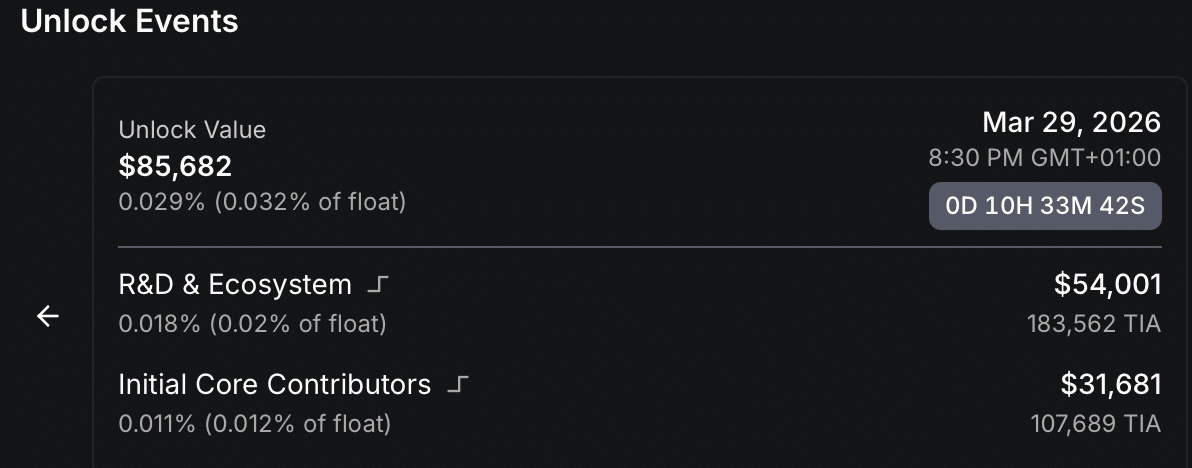
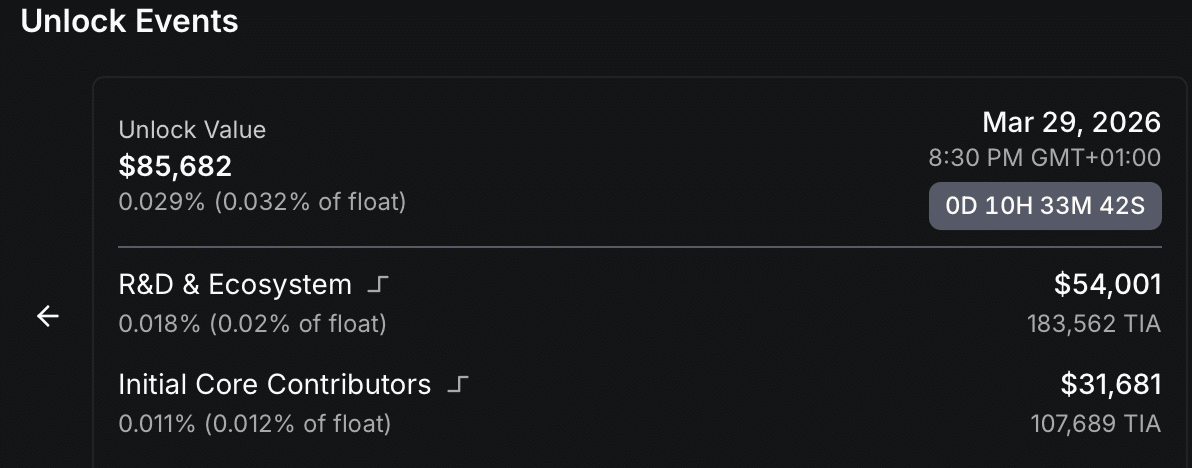
Một đợt mở khóa token sắp tới sẽ ảnh hưởng đến thị trường, với nguồn cung TIA mới dự kiến được đưa vào lưu thông vào ngày 29 tháng 3.

Theo DeFiLlama, đợt mở khóa này chỉ chiếm 0,032% nguồn cung lưu hành hiện tại, có giá trị khoảng 85.000 USD tại thời điểm viết bài. Mặc dù tương đối nhỏ, nhưng những sự kiện như vậy thường ảnh hưởng không cân xứng đến tâm lý ngắn hạn.
Nguồn: CoinGlass

Khoản phân bổ dự kiến sẽ dành cho nghiên cứu và phát triển cùng các cộng tác viên cốt lõi trong hệ sinh thái, cho thấy một sự phân phối hướng đến tiện ích.

Tuy nhiên, phản ứng của thị trường với các đợt mở khóa có xu hướng phản ánh tâm lý hơn là yếu tố cơ bản. Với điều kiện thị trường rộng hơn vốn đã nghiêng về giảm giá, nguồn cung bổ sung này có thể củng cố thêm áp lực giảm.

Thị trường giao ngay chuyển sang giảm giá

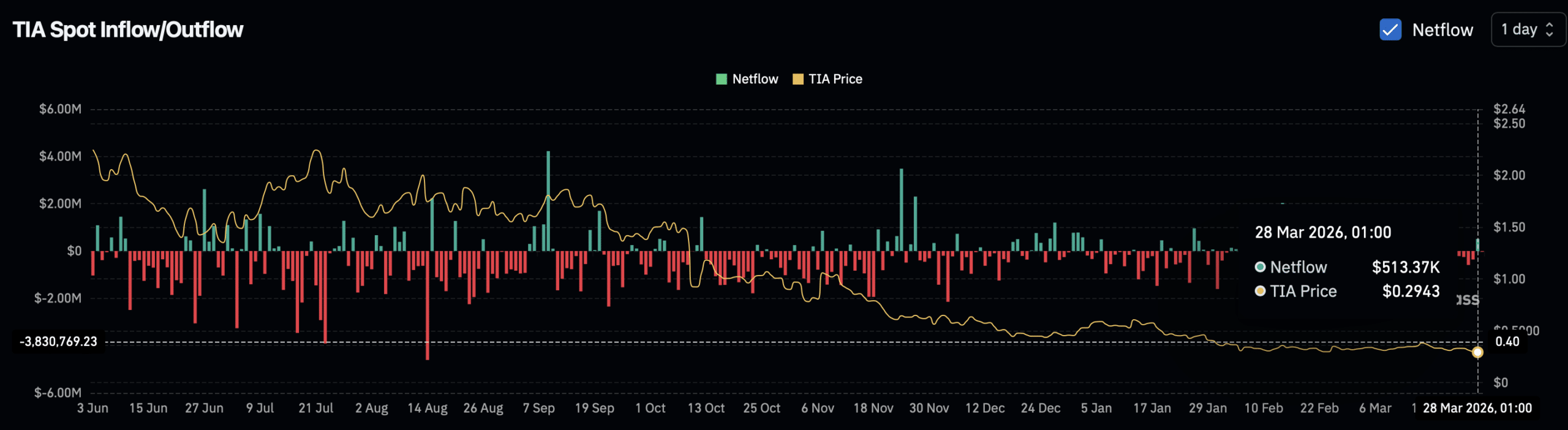
Hoạt động bán ra trên thị trường giao ngay (Spot) đã gia tăng. Vào ngày 28 tháng 3, các nhà đầu tư giao ngay đã bán ra khoảng 513.000 USD trị giá TIA, đánh dấu một sự dịch chuyển rõ rệt trong định vị.

Động thái này diễn ra sau bốn ngày tích lũy dần dần liên tiếp, khiến cho sự đảo chiều càng trở nên quan trọng. Sự chuyển đổi từ mua vào ổn định sang bán ra mạnh mẽ thường phản ánh niềm tin suy giảm và triển vọng thị trường thận trọng hơn.

Xu hướng giảm giá mở rộng ra ngoài thị trường giao ngay. Dữ liệu phái sinh cho thấy một mô hình tương tự, củng cố thêm sự yếu kém rộng hơn trong định vị của TIA.
Nguồn: CoinGlass

Tỷ lệ tài trợ theo trọng số lợi ích mở (Open Interest-Weighted Funding Rate) đã chuyển sang âm, cho thấy các trader đã tập trung các vị thế đòn bẩy vào phe bán khống (short).

Ở mức -0,0057%, chỉ số này phản ánh khuynh hướng ngày càng tăng đối với các lệnh cá cược giảm giá. Sự định vị này đã chuyển thành thua lỗ cho các trader mua (long), những người đã ghi nhận gần 99.990 USD bị thanh lý trong giai đoạn này, so với khoảng 16.690 USD đối với các trader bán khống (short).

Sự phá vỡ dịch chuyển trọng tâm xuống các mức thấp hơn

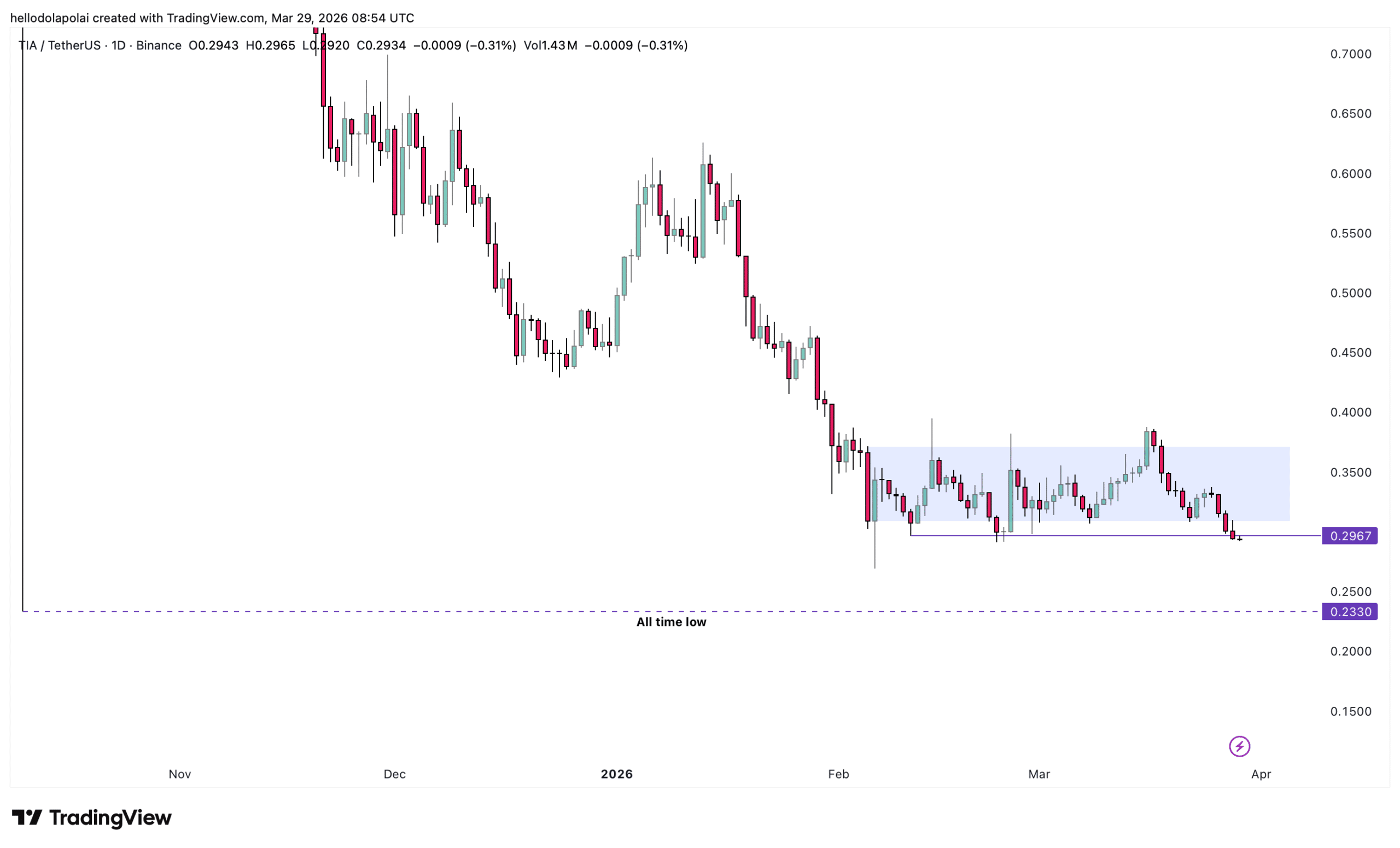
Về mặt kỹ thuật, TIA đã phá vỡ xuống dưới một phạm vi tích lũy kéo dài vốn được duy trì kể từ ngày 5 tháng 2, chấm dứt nhiều tháng di chuyển đi ngang. Sự phá vỡ này báo hiệu việc mất đi hỗ trợ cấu trúc và củng cố thêm đà giảm.

Tài sản hiện giao dịch dưới mức hỗ trợ $0.2967. Một phiên đóng cửa duy trì dưới ngưỡng này sẽ xác nhận sự tiếp tục của xu hướng giảm và làm tăng khả năng di chuyển xuống vùng $0.233.
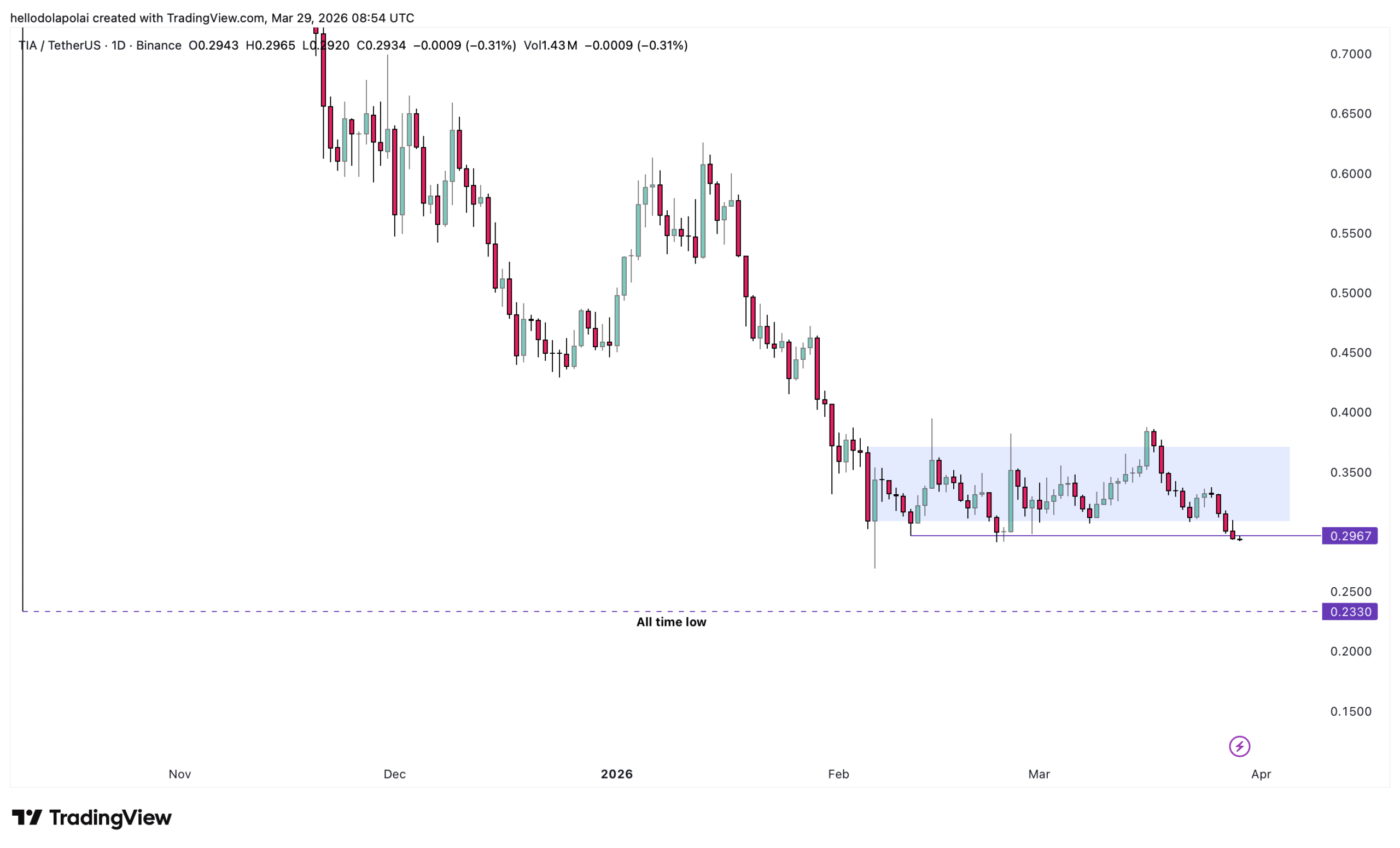
Nguồn: TradingView

Với cả chỉ báo cơ bản và kỹ thuật đều nghiêng về giảm, TIA vẫn dễ bị tổn thương trước những đợt giảm sâu hơn trừ khi người mua giành lại các mức giá then chốt và khôi phục đà tăng.


Tóm tắt cuối cùng

  • Các đợt mở khóa token được dự đoán đã bắt đầu gây áp lực lên tâm lý của Celestia, với các trader giao ngay đảo chiều sau nhiều ngày tích lũy ổn định.
  • Các mức hỗ trợ chính sẽ quyết định liệu TIA có ổn định hay mở rộng đợt giảm giá của nó.

Trend Kriptolar

İlgili Sorular

QTại sao Celestia (TIA) đang chịu áp lực bán?

ACelestia (TIA) đang chịu áp lực bán do cấu trúc thị trường và tâm lý giảm sút, cùng với việc một lượng token mới trị giá khoảng 85.000 USD sắp được mở khóa vào ngày 29 tháng 3, làm tăng nguồn cung lưu hành.

QSự kiện mở khóa token TIA sắp tới có quy mô như thế nào?

ATheo DeFiLlama, đợt mở khóa sắp tới sẽ bổ sung khoảng 0.032% vào nguồn cung lưu hành hiện tại của TIA, với giá trị ước tính khoảng 85.000 USD tại thời điểm bài viết.

QHoạt động trên thị trường giao ngay (Spot) cho TIA đã thay đổi ra sao?

AVào ngày 28 tháng 3, các nhà đầu tư trên thị trường giao ngay đã bán ra khoảng 513.000 USD giá trị TIA, đánh dấu sự đảo chiều rõ rệt sau bốn ngày tích lũy dần dần trước đó.

QDữ liệu phái sinh cho thấy điều gì về tâm lý thị trường đối với TIA?

ATỷ lệ tài trợ theo trọng số lợi ích mở (Open Interest-Weighted Funding Rate) đã chuyển sang âm, ở mức -0.0057%, cho thấy các nhà giao dịch đang tập trung vào các vị thế bán khống (short), phản ánh kỳ vọng giá giảm.

QTình hình kỹ thuật hiện tại của TIA như thế nào?

AVề mặt kỹ thuật, TIA đã phá vỡ dưới một phạm vi hợp nhất kéo dài từ ngày 5 tháng 2. Token hiện đang giao dịch dưới mức hỗ trợ quan trọng 0.2967 USD, và nếu duy trì dưới ngưỡng này, nó có khả năng giảm xuống vùng 0.233 USD.

İlgili Okumalar

Behind the AI Scorecards Lies a Chinese 'Question Setter'

Behind the AI scorecards that dominate industry discussions—benchmarks like MMLU-Pro, MMMU, and MMMU-Pro—stands a Chinese-Canadian researcher: Wenhu Chen. As an assistant professor at the University of Waterloo and founder of the TIGER Lab, Chen has become a key "exam-setter" for evaluating large language and multimodal models. Chen first gained broader recognition with MMLU-Pro, a more challenging and stable update to the popular MMLU benchmark. As top models like OpenAI’s o3 began achieving near-perfect scores on the original MMLU, it became difficult to distinguish their true capabilities. MMLU-Pro introduced more complex reasoning questions, expanded answer choices, and filtered out ambiguous or simple items, effectively reintroducing differentiation among state-of-the-art models. His work on MMMU addressed the evaluation of multimodal models, requiring them to integrate visual information (like charts, diagrams, or tables) with textual knowledge across diverse academic subjects. Even the strongest models initially scored only around 56-59%, highlighting significant room for improvement in genuine multimodal reasoning. MMMU-Pro further refined this by preventing models from bypassing visual cues. Chen’s research focus has long been on complex information understanding and reasoning. His background—including a PhD at UC Santa Barbara, research at Google/DeepMind on Gemini, and now a role in Meta’s superintelligence lab—provides deep insight into model development and their potential weaknesses. His TIGER Lab also builds models (e.g., for video understanding and generation), ensuring his evaluation benchmarks are grounded in practical challenges. While AI headlines often spotlight company leaders and product launches, Chen’s work exemplifies the critical, behind-the-scenes contributions of researchers crafting the rigorous standards that define and drive progress in AI capabilities.

marsbit7 dk önce

Behind the AI Scorecards Lies a Chinese 'Question Setter'

marsbit7 dk önce

STRC Unpegged by 11%, Can Strategy's Perpetual Motion Machine Keep Turning?

STRC, the perpetual preferred stock of MicroStrategy, is experiencing a persistent de-pegging from its target par value of $100, with the discount recently widening to over 11%. This de-anchoring challenges the core design of STRC, which was intended as a stable, income-oriented security operating near $100. As a crucial funding engine for MicroStrategy's Bitcoin acquisition strategy, STRC's price reflects market confidence in the company's entire capital model. The company's "capital flywheel" relies on issuing STRC at or above $100 via an At-the-Market (ATM) program to raise cash for buying Bitcoin, thereby boosting company equity and theoretically supporting STRC's value. A monthly adjustable dividend mechanism was designed to maintain this peg. Despite raising the dividend to 11.5% and increasing payment frequency, the de-pegging persists. Market concerns extend beyond technical factors like leveraged arbitrage unwinding. Analysts point to MicroStrategy's limited cash reserves relative to its ~$1.7 billion annual dividend obligation for preferred shares. While the company counters that its vast Bitcoin holdings could cover decades of payments, this argument hinges on the potential need to sell Bitcoin—a shift from its longstanding "hodl" narrative. The company's recent sale of a small amount of BTC, framed as a test, amplified these liquidity and strategy concerns. If STRC remains discounted, impairing MicroStrategy's ability to raise cheap capital, fears may grow that the company could sell more Bitcoin to meet obligations. This scenario could transform MicroStrategy from a major market buyer into a potential seller, posing significant downside risk for Bitcoin. The re-pegging of STRC is thus a key indicator for the health of MicroStrategy's capital structure and its market impact.

Odaily星球日报21 dk önce

STRC Unpegged by 11%, Can Strategy's Perpetual Motion Machine Keep Turning?

Odaily星球日报21 dk önce

Silicon Valley's Most Sought-After New Role Has Emerged

Silicon Valley's New Most Wanted Job: The Rise of the Forward Deployment Engineer The AI industry is witnessing a significant shift. The focus has moved from developing cutting-edge models to deploying them effectively within enterprises. This has made the "Forward Deployment Engineer" (FDE) a critical and highly sought-after role at major firms like OpenAI, Anthropic, and Google. For the past three years, the industry prioritized model scientists. However, companies are now facing a harsh reality: purchasing powerful AI tools does not guarantee productivity gains or organizational change. The biggest hurdle is not the technology itself, but integrating it into complex legacy systems, workflows, and corporate cultures. This includes challenges like data silos, compliance requirements, and internal resistance. The FDE role, pioneered by Palantir Technologies, addresses this "last-mile" problem. FDEs are deployed on-site with clients for extended periods. Their job is to deeply understand the client's specific organizational structure, processes, and pain points, then tailor and implement the AI solution accordingly. They combine skills in technology, project management, and organizational change. A clear signal of this trend emerged in May 2026 when three AI giants made major moves. Anthropic launched a $1.5B joint venture for enterprise deployment. OpenAI formed an independent deployment subsidiary, DeployCo, with over $4B in commitments and acquired a deployment consultancy. Google Cloud's CEO publicly announced a large-scale recruitment drive for FDEs. This shift represents a fundamental change in the software business model: from selling tools to selling guaranteed outcomes. FDEs are the agents of this change, responsible for delivering a working system within the production environment, not just a demo. Real-world cases, such as challenges at Goldman Sachs (compliance barriers) and Target (internal cultural resistance), illustrate that the primary obstacles to AI adoption are organizational, not technical. An FDE's value lies in navigating these human and procedural complexities to facilitate a successful "AI migration." In essence, as core AI technology becomes more accessible and affordable, the true premium is shifting to the human expertise required to understand organizations and drive change—making the FDE role pivotal for the next phase of the AI revolution.

marsbit21 dk önce

Silicon Valley's Most Sought-After New Role Has Emerged

marsbit21 dk önce

When the World Cup Collides with Agents: From Web2 to Web3, How Are Wallets Evolving into Agentic Wallets?

World Cup as a Catalyst for Agentic Wallets: From Web2 to Web3 This article explores how the World Cup provides a real-world scenario for observing the evolution of digital wallets from simple asset managers towards "Agentic Wallets"—intelligent, AI-powered interfaces. Using the example of prediction markets like Polymarket, it illustrates how AI Agents can lower the barrier to Web3 interaction. Instead of navigating complex DApps, users can express intent in natural language (e.g., "I think Portugal will win") within platforms like Discord or web pages. The Agent then interprets this intent, finds the relevant market, and seamlessly guides the user through the on-chain transaction via their wallet. The core shift is from wallets as mere "function menus" for signing transactions to "intent interpreters" that understand user goals. The article highlights parallel developments in traditional finance, such as Mastercard's "Agent Pay" and WeChat Pay's AI tests, which focus on granting AI controlled, authorized, and auditable payment capabilities. This underscores a broader trend of AI entering the financial layer. However, the article emphasizes that the primary challenge for Agentic Wallets in Web3 is not automation but establishing clear security boundaries. Unlike traditional systems with chargebacks, on-chain transactions are often irreversible. Therefore, future wallets must ensure users retain ultimate control and comprehension. They need to transparently communicate an Agent's permissions, spending limits, authorized durations, and provide easy ways to pause or revoke access. The World Cup experiments represent early steps toward wallets that are not just applications but ubiquitous, intelligent interfaces that simplify Web3 while keeping users securely in control.

marsbit1 saat önce

When the World Cup Collides with Agents: From Web2 to Web3, How Are Wallets Evolving into Agentic Wallets?

marsbit1 saat önce

Options Don't Work in DeFi? Vitalik Might Not Agree

For years, the prevailing view has been that options struggle to gain traction in DeFi due to complexity, fragmented liquidity, and lack of natural demand compared to products like perpetual futures. However, a recent algorithmic stablecoin design proposed by Vitalik Buterin presents a different perspective, using options not as a standalone trading product, but as foundational infrastructure for other financial instruments. In this design, one unit of ETH is split into two components: a "stable" side (P) that retains value up to a specified strike price, and an "upside" side (N) that captures all appreciation above that strike. Combined, they always equal one ETH, eliminating debt, margin, and liquidation risks inherent in typical collateralized debt position (CDP) stablecoins. The stable component essentially mimics the payoff of a covered call option. To function as a stablecoin, this structure requires continuously rolling deep in-the-money calls, which introduces challenges like rollover slippage, predictable transaction flow vulnerable to front-running, and persistent liquidity needs. A core hurdle is finding consistent buyers for the leveraged ETH upside exposure (N). While it offers leverage without funding rates or liquidation, it must compete with simpler alternatives like direct call options or perpetuals. The system's scalability depends on a sustained demand for this specific form of leverage. The author draws parallels to their experience with Rysk, where earlier versions of DeFi options protocols struggled. The breakthrough came with Rysk V12, which aligns incentives: asset holders generate yield by selling covered calls against their holdings, while market makers efficiently acquire the desired option exposure. This demonstrates that options can find product-market fit when embedded as a risk distribution and pricing engine within structured products, stablecoins, or yield-generating assets, rather than marketed as a complex direct trading instrument. Vitalik's proposal reinforces this architectural approach—using fully collateralized, non-custodial, and physically settled options as a fundamental building block. The real opportunity for options in DeFi may lie not in becoming the next perpetual swap, but in powering the next generation of on-chain financial products.

marsbit2 saat önce

Options Don't Work in DeFi? Vitalik Might Not Agree

marsbit2 saat önce

İşlemler

Spot
Futures

Popüler Makaleler

TIA Nasıl Satın Alınır

HTX.com’a hoş geldiniz! Celestia (TIA) satın alma işlemlerini basit ve kullanışlı bir hâle getirdik. Adım adım açıkladığımız rehberimizi takip ederek kripto yolculuğunuza başlayın. 1. Adım: HTX Hesabınızı OluşturunHTX'te ücretsiz bir hesap açmak için e-posta adresinizi veya telefon numaranızı kullanın. Sorunsuzca kaydolun ve tüm özelliklerin kilidini açın. Hesabımı Aç2. Adım: Kripto Satın Al Bölümüne Gidin ve Ödeme Yönteminizi SeçinKredi/Banka Kartı: Visa veya Mastercard'ınızı kullanarak anında Celestia (TIA) satın alın.Bakiye: Sorunsuz bir şekilde işlem yapmak için HTX hesap bakiyenizdeki fonları kullanın.Üçüncü Taraflar: Kullanımı kolaylaştırmak için Google Pay ve Apple Pay gibi popüler ödeme yöntemlerini ekledik.P2P: HTX'teki diğer kullanıcılarla doğrudan işlem yapın.Borsa Dışı (OTC): Yatırımcılar için kişiye özel hizmetler ve rekabetçi döviz kurları sunuyoruz.3. Adım: Celestia (TIA) Varlıklarınızı SaklayınCelestia (TIA) satın aldıktan sonra HTX hesabınızda saklayın. Alternatif olarak, blok zinciri transferi yoluyla başka bir yere gönderebilir veya diğer kripto para birimlerini takas etmek için kullanabilirsiniz.4. Adım: Celestia (TIA) Varlıklarınızla İşlem YapınHTX'in spot piyasasında Celestia (TIA) ile kolayca işlemler yapın.Hesabınıza erişin, işlem çiftinizi seçin, işlemlerinizi gerçekleştirin ve gerçek zamanlı olarak izleyin. Hem yeni başlayanlar hem de deneyimli yatırımcılar için kullanıcı dostu bir deneyim sunuyoruz.

171 Toplam GörüntülenmeYayınlanma 2024.12.10Güncellenme 2026.06.02

TIA Nasıl Satın Alınır

Tartışmalar

HTX Topluluğuna hoş geldiniz. Burada, en son platform gelişmeleri hakkında bilgi sahibi olabilir ve profesyonel piyasa görüşlerine erişebilirsiniz. Kullanıcıların TIA (TIA) fiyatı hakkındaki görüşleri aşağıda sunulmaktadır.

活动图片