Lighter atteint un nouveau plus bas historique à 0,91 $ – Jusqu'où LIT peut-il encore chuter ?

ambcrypto2026-03-23 tarihinde yayınlandı2026-03-23 tarihinde güncellendi

Özet

Lighter (LIT) a atteint un nouveau plus bas historique à 0,91 $ après avoir perdu le niveau clé de soutien à 1,00 $, marquant une baisse hebdomadaire de 17 %. La pression de vente est intense, avec une dominance des vendeurs à 2,8 millions et une force des acheteurs tombée à -8. Les positions short ont généré des profits importants, comme en témoigne un gain flottant de 2,07 millions $ pour une baleine. L’Open Interest a chuté de 54 millions $, indiquant une sortie massive des capitaux. Le RSI à 32 signale un marché presque survendu. Tant que LIT restera sous les moyennes mobiles (au-dessus de 1,00 $), la tendance baissière pourrait se poursuivre vers 0,85 $. Un renversement nécessiterait de reconquérir le seuil de 1,00 $.

Lighter [LIT] subit une pression proche de l'effondrement, l'altcoin évoluant dans une forte tendance baissière. Depuis que LIT a été rejeté à 1,3 $ il y a une semaine, il clôture à des plus bas, reflétant une intense pression baissière.

En conséquence, LIT est tombé à un nouveau plus bas historique de 0,91 $ après avoir franchi le niveau de support de 1 $. En fait, au moment de la rédaction, l'altcoin s'échangeait à 0,92 $, en baisse de 10,19 %, ajoutant à son déclin hebdomadaire de 17 %.

Avec l'altcoin en forte baisse, les détenteurs de positions courtes ont vu leur marge bénéficiaire monter en flèche. Onchain Lens a rapporté qu'une baleine détenant une position courte 2x affiche désormais un profit flottant de 2,07 millions de dollars.

La marge bénéficiaire croissante pour les vendeurs à découvert reflète l'intense momentum baissier prévalant.

Lighter fait face à une intense pression de vente

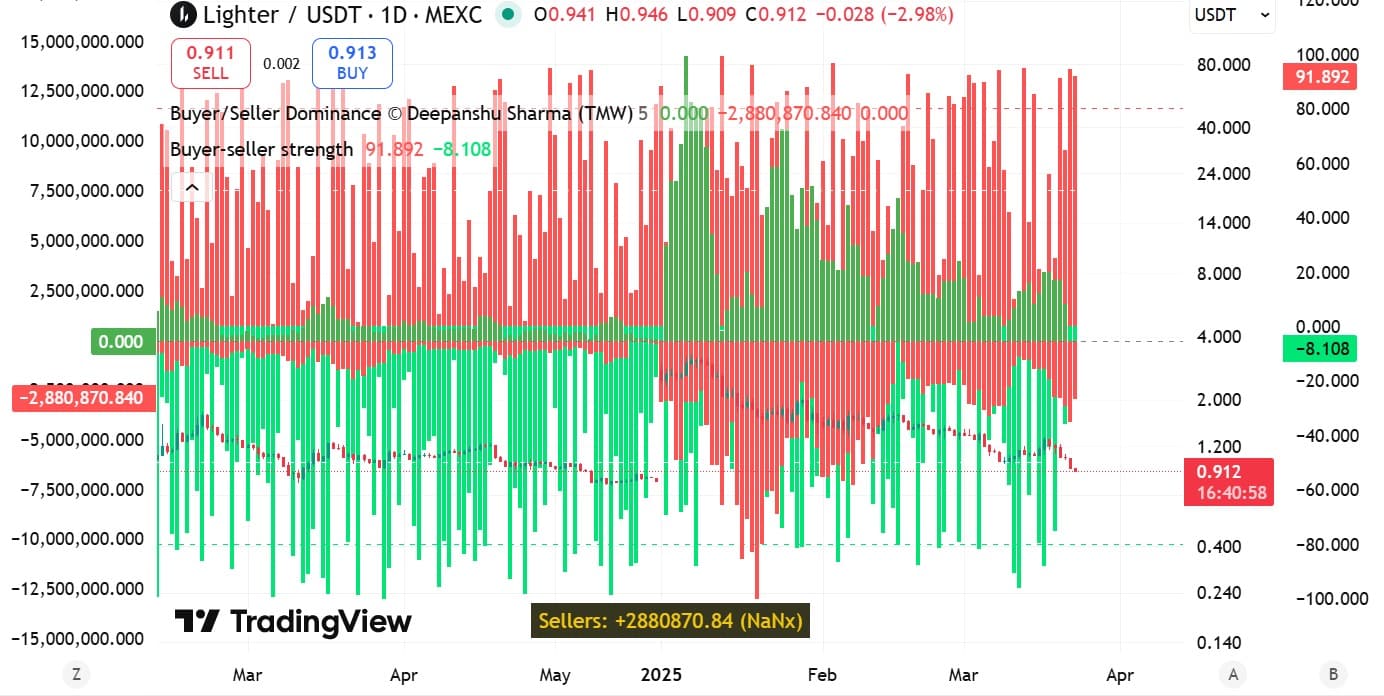
Lighter a continué de baisser alors que les vendeurs, paniqués, ont augmenté leurs ventes après que LIT n'a pas réussi à maintenir le niveau de support de 1 $, provoquant une nouvelle baisse.

En fait, les acheteurs ont presque disparu du marché, leur dominance tombant à zéro. Dans le même temps, la dominance des vendeurs a grimpé en flèche à 2,8 millions, indiquant une activité du côté vendeur.
Source : TradingView

Les vendeurs ont dominé le marché au cours des sept derniers jours, leur dominance atteignant un pic à 4 millions tandis que la demande continuait de diminuer.

Couplée à cela, la Force des Vendeurs a bondi à 91, tandis que la Force des Acheteurs est tombée à -8, validant davantage cette dominance des vendeurs.

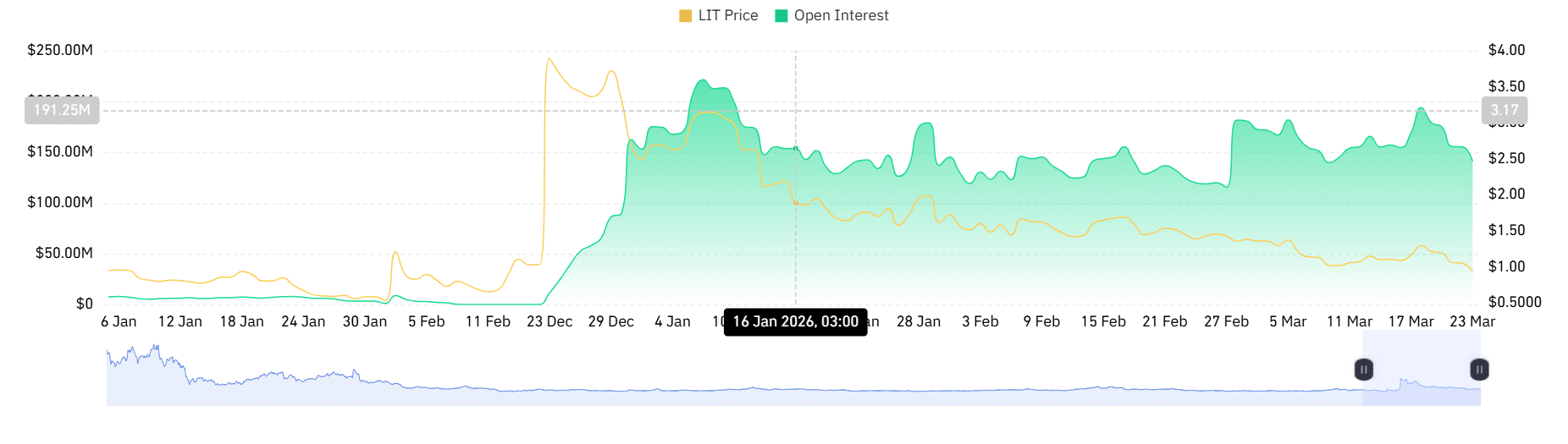
Sur le côté dérivés, les participants au marché ont réduit leur exposition et retiré des capitaux importants des marchés.
Source : CoinGlass

Les données de Coinglass ont montré que l'Open Interest de Lighter est tombé de 193 millions de dollars à 140 millions de dollars, une baisse de 54 millions de dollars.

La baisse de l'OI indiquait des sorties agressives du marché alors que les traders réduisaient leur exposition, très probablement en anticipation de pertes supplémentaires. En conséquence, plus de 171 millions de dollars se sont retirés du marché des futures.

Traditionnellement, une demande affaiblie et une activité renforcée du côté vendeur ont tendance à accélérer le momentum baissier, conduisant à des prix plus bas. Ainsi, les conditions de marché prévalantes ont laissé LIT exposé à un risque de baisse supplémentaire potentiel.

Y a-t-il un risque de baisse supplémentaire ?

Lighter a franchi le support de 1 $, les vendeurs devenant de plus en plus agressifs. Avec l'intensification de la pression de vente, le momentum à la baisse s'est encore renforcé.

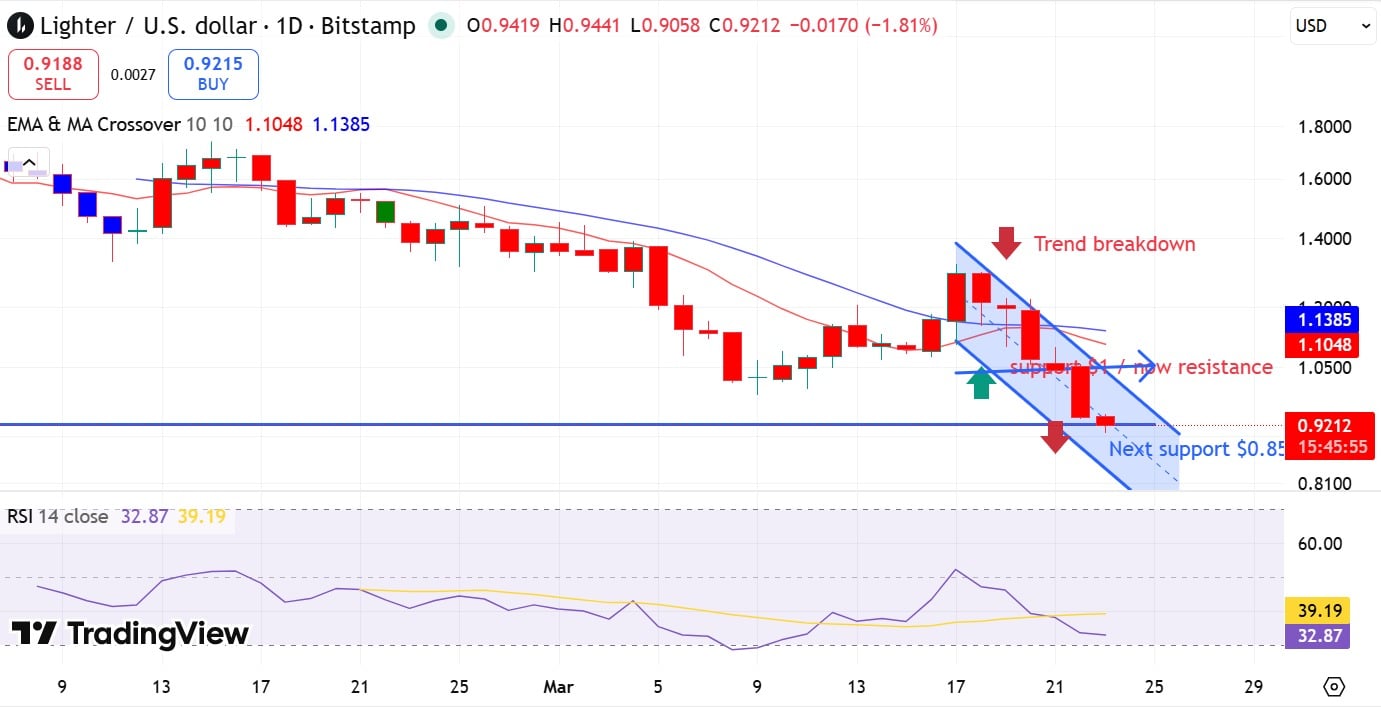
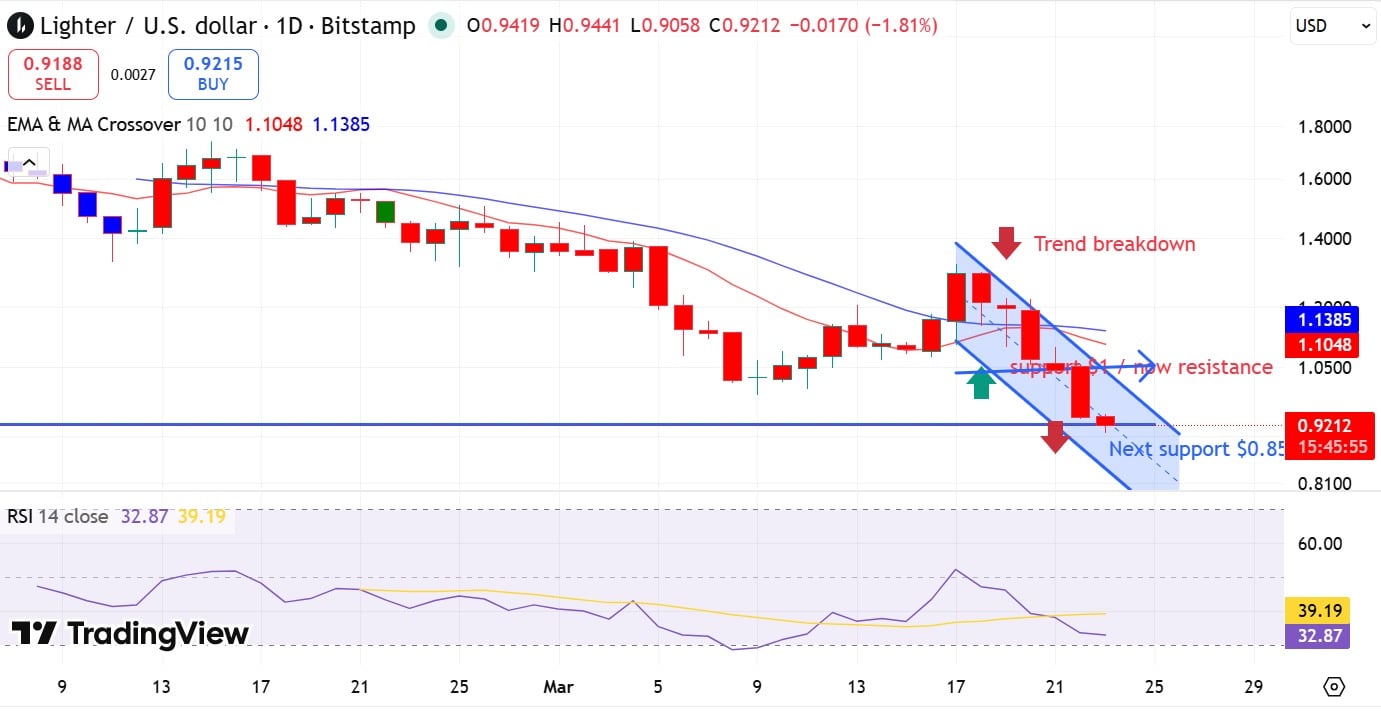
En conséquence, le Relative Strength Index (RSI) est tombé à 32, atteignant un territoire presque survendu. Le RSI est tombé consécutivement de 55 à 32, reflétant l'intensité des vendeurs.
Source : TradingView

Le momentum s'est encore renforcé alors que l'altcoin continuait de se maintenir en dessous de la MA et de l'EMA, qui se situaient toutes deux au-dessus de 1 $. Ces deux indicateurs de momentum signalaient la probabilité d'une continuation de la tendance, les conditions de marché prévalantes restant constantes.

Par conséquent, si la tendance persiste, LIT franchira très probablement le support de 0,9 $ et déclinera vers 0,85 $. Pour voir un renversement de tendance, LIT doit non seulement maintenir 0,9 $ mais reconquérir 1 $.

Ce faisant, le momentum haussier sera suffisamment fort pour permettre des gains significatifs.


Résumé Final

  • Lighter [LIT] est tombé en dessous du support clé de 1 $, touchant un nouveau plus bas historique près de 0,91 $ amid des plus bas soutenus.
  • Le prix reste sous un fort contrôle baissier, avec une baisse hebdomadaire de 17 % et une pression baissière continue.


İlgili Sorular

QÀ quel prix Lighter (LIT) a-t-il atteint un nouveau plus bas historique ?

ALighter (LIT) a atteint un nouveau plus bas historique à 0,91 $.

QQuel indicateur technique montre que LIT est proche du territoire de survente ?

ALe Relative Strength Index (RSI) a chuté à 32, ce qui indique que LIT est proche du territoire de survente.

QQuel niveau de support clé LIT a-t-il récemment perdu ?

ALIT a récemment perdu le niveau de support clé de 1 $.

QQue signifie la baisse de l'Open Interest (intérêt ouvert) pour Lighter ?

ALa baisse de l'Open Interest de 193 millions de dollars à 140 millions de dollars indique que les traders réduisent leur exposition et retirent des capitaux du marché, anticipant probablement d'autres pertes.

QQuelles sont les conditions nécessaires pour qu'un renversement de tendance haussier se produise pour LIT ?

APour qu'un renversement de tendance se produise, LIT doit non seulement maintenir le support des 0,9 $ mais aussi reconquérir le niveau des 1 $ afin de générer un momentum haussier suffisant.

İlgili Okumalar

Has the 'Digital Gold' Narrative for BTC Failed?

**Title: Has the "Digital Gold" Narrative for Bitcoin Failed?** The article argues that Bitcoin's "digital gold" narrative remains valid despite a recent sharp price decline (from a peak near $126k in Oct 2025 to briefly under $61k in Feb 2026). It presents a long-term investment framework based on three core points: **1. Viewing Bitcoin as an Asset:** Bitcoin is presented as a superior potential store of value compared to gold. Key arguments are its absolute scarcity (21 million cap), superior portability, and transparent auditability via its public ledger. While acknowledging its current use in early, volatile stages (~3-4% global adoption), the author draws parallels to the early, disruptive phases of the internet and e-commerce. **2. Understanding the Recent Downturn:** The current ~50% correction is framed as a predictable, consensus-driven cycle following its post-halving peak (the 2024 halving preceded the Oct 2025 high). A crucial factor is a historic "changing of hands": the influx of new institutional buyers via ETFs allowed early, low-cost holders (miners, OG believers) to take profits. The author notes that while severe, Bitcoin's historical drawdowns (e.g., 93% in 2011, 77% in 2021-22) have been progressively smaller, suggesting maturing holder structure and decreasing volatility over time. **3. The Long-Term Perspective:** The long-term thesis hinges on Bitcoin capturing a portion of gold's market value. With Bitcoin's market cap at ~$1.4 trillion (at $70k) versus gold's ~$20 trillion, significant upside potential exists if the "digital gold" narrative is partially realized. However, the author strongly cautions that short-term risks remain, the bottom is unpredictable, and high volatility is inherent. The real risk is not Bitcoin failing but poor personal position management (over-leverage, wrong capital) and a lack of deep understanding, which can force investors out during severe downturns. The conclusion uses Amazon's 95% crash post-2000 dot-com bubble and subsequent 42x recovery as an analogy. The ultimate question is not if Bitcoin's price will rise, but if an investor's strategy and conviction can withstand the volatility to see the long-term play out. The recent divergence (gold up, Bitcoin down) is posed not as a narrative failure, but as potential evidence of this ongoing, painful transition from a speculative asset to a mainstream allocation.

marsbit50 dk önce

Has the 'Digital Gold' Narrative for BTC Failed?

marsbit50 dk önce

Has BTC's 'Digital Gold' Narrative Failed?

The article discusses Bitcoin's "digital gold" narrative, its recent price drop, and long-term outlook through the perspective of "Jason". It argues the narrative is not a failure but that Bitcoin represents a superior, new asset class due to its fixed supply (21 million), portability, and auditability. The piece compares its current ~3-4% global adoption rate to early internet/e-commerce, suggesting significant growth potential. Regarding the 2025-2026 price decline (from ~$126k to briefly under $61k), the author views it as a predictable, consensus-driven sell-off within Bitcoin's ~4-year cycle post-halving, exacerbated by a major "handover" from early, low-cost holders to new institutional buyers via ETFs. A key observation is that historical peak-to-trough drawdowns have lessened over time (e.g., 93% in 2011 to ~50% in 2026), indicating maturing volatility as holder structure changes. For the long term, the author uses a simple framework: Bitcoin's total market cap (~$1.4T at $70k) is only about 7% of gold's (~$20T). Even capturing 30-50% of gold's value would imply substantial upside. However, the article strongly cautions against viewing this as investment advice, emphasizing extreme volatility and the critical importance of risk management, position sizing, and deep fundamental understanding to survive severe drawdowns. It concludes by drawing a parallel to Amazon's 95% crash in 2000 and subsequent 42x recovery, stressing that the key is surviving market cycles to realize long-term potential.

链捕手1 saat önce

Has BTC's 'Digital Gold' Narrative Failed?

链捕手1 saat önce

From Code to Cognition: A Ten-Thousand-Word Guide to the Evolution of the Robot Brain

"From Code to Cognition: The Evolution of Robot Brains" The journey of robotic intelligence has shifted dramatically from manually coded systems to AI-driven brains. For decades, robots relied on layered software stacks—perception, state estimation, planning, control—each handcrafted. While predictable, they lacked adaptability. The 2010s saw deep learning revolutionize perception (e.g., object detection) and control (via reinforcement learning), but learned skills remained narrow. The arrival of Large Language Models (LLMs) marked a turning point. LLMs acted as high-level planners, interpreting natural language instructions and generating sequences of actions for traditional robotic systems to execute. However, true integration came with Visual-Language-Action (VLA) models, which fused vision, language, and motion prediction into a single network. Pioneered by models like RT-2 and open-source projects like OpenVLA, VLAs enable robots to reason and act directly from visual input and commands. The most advanced humanoid robots now employ a "dual-brain" architecture: a slow-thinking, large VLA (System 2) for reasoning and planning, and a fast-reacting, small network (System 1) for high-frequency motion control, sometimes with an even lower-level System 0 for balance. This split balances cognition with the physics of real-time movement. Computation is split between onboard hardware (e.g., NVIDIA Jetson) for safety-critical control loops and cloud/edge servers for non-critical tasks like learning and interfaces. A crucial driver is the open-source ecosystem—models like GR00T and OpenVLA allow startups to build upon pre-trained brains and fine-tune them with their own data, accelerating development. Despite progress, current systems struggle with recovery from errors, sample inefficiency, and long-horizon tasks. This has spurred the rise of **World Models**—neural networks that predict the consequences of actions. By simulating possible futures before acting (like NVIDIA Cosmos or Meta V-JEPA), robots can plan, recover, and generalize better. This represents the next frontier: shifting intelligence from learned reactions to an internal model of physics and cause-and-effect. The field is rapidly evolving. While not yet at its "ChatGPT moment," the convergence of cheaper hardware, scalable simulation, and world models points toward robots that are increasingly capable, adaptive, and useful. The question is shifting from "what can robots do?" to "what *should* they do?"

marsbit1 saat önce

From Code to Cognition: A Ten-Thousand-Word Guide to the Evolution of the Robot Brain

marsbit1 saat önce

AI Bubble Is Bursting

The AI Bubble is Bursting: A Necessary Purge on the Path to Ubiquitous Intelligence Market volatility has reignited debates about an AI bubble, with figures like Ray Dalio pointing to high valuations. However, this parallels the dot-com bubble, which, despite its crash, laid the physical infrastructure for today's internet era. The current AI investment frenzy, with tech giants planning trillions in infrastructure spending far outstripping current AI application revenues, appears similarly imbalanced. This 'bubble' is seen as an inevitable phase for a disruptive technology, paying the "innovation tax." Critically, AI inference costs have plummeted over 99.7% since 2023, making intelligence nearly free at the margin. This hasn't reduced spending but has instead unlocked massive new demand, as seen in enterprise AI cloud expenditure tripling. This follows the Jevons Paradox: efficiency gains lead to greater total consumption. The market is now entering a cleansing phase, weeding out speculative ventures lacking real moats. The deeper shift is a move from capital expenditure (CapEx) on hardware to value creation in operational expenditure (OpEx) through AI applications that solve real industry problems. While infrastructure valuations are high, rapid earnings growth from widespread AI adoption across sectors—from manufacturing and finance to law and healthcare—may digest these valuations over time. Ultimately, this creative destruction will leave behind robust infrastructure and optimized models, cheaply powering an AI-augmented future for all industries, much as the internet became indispensable after its own bubble burst. The core productive potential remains undiminished.

链捕手1 saat önce

AI Bubble Is Bursting

链捕手1 saat önce

İşlemler

Spot
Futures

Popüler Makaleler

LIT Nasıl Satın Alınır

HTX.com’a hoş geldiniz! Lighter (LIT) satın alma işlemlerini basit ve kullanışlı bir hâle getirdik. Adım adım açıkladığımız rehberimizi takip ederek kripto yolculuğunuza başlayın. 1. Adım: HTX Hesabınızı OluşturunHTX'te ücretsiz bir hesap açmak için e-posta adresinizi veya telefon numaranızı kullanın. Sorunsuzca kaydolun ve tüm özelliklerin kilidini açın. Hesabımı Aç2. Adım: Kripto Satın Al Bölümüne Gidin ve Ödeme Yönteminizi SeçinKredi/Banka Kartı: Visa veya Mastercard'ınızı kullanarak anında Lighter (LIT) satın alın.Bakiye: Sorunsuz bir şekilde işlem yapmak için HTX hesap bakiyenizdeki fonları kullanın.Üçüncü Taraflar: Kullanımı kolaylaştırmak için Google Pay ve Apple Pay gibi popüler ödeme yöntemlerini ekledik.P2P: HTX'teki diğer kullanıcılarla doğrudan işlem yapın.Borsa Dışı (OTC): Yatırımcılar için kişiye özel hizmetler ve rekabetçi döviz kurları sunuyoruz.3. Adım: Lighter (LIT) Varlıklarınızı SaklayınLighter (LIT) satın aldıktan sonra HTX hesabınızda saklayın. Alternatif olarak, blok zinciri transferi yoluyla başka bir yere gönderebilir veya diğer kripto para birimlerini takas etmek için kullanabilirsiniz.4. Adım: Lighter (LIT) Varlıklarınızla İşlem YapınHTX'in spot piyasasında Lighter (LIT) ile kolayca işlemler yapın.Hesabınıza erişin, işlem çiftinizi seçin, işlemlerinizi gerçekleştirin ve gerçek zamanlı olarak izleyin. Hem yeni başlayanlar hem de deneyimli yatırımcılar için kullanıcı dostu bir deneyim sunuyoruz.

256 Toplam GörüntülenmeYayınlanma 2026.01.15Güncellenme 2026.06.02

LIT Nasıl Satın Alınır

Tartışmalar

HTX Topluluğuna hoş geldiniz. Burada, en son platform gelişmeleri hakkında bilgi sahibi olabilir ve profesyonel piyasa görüşlerine erişebilirsiniz. Kullanıcıların LIT (LIT) fiyatı hakkındaki görüşleri aşağıda sunulmaktadır.

活动图片












