"No hay acuerdos especiales": CEO de LayerZero niega vínculos con ballena que posee el 2.6% de ZRO

ambcrypto2026-03-19 tarihinde yayınlandı2026-03-19 tarihinde güncellendi

Özet

Un gran inversor anónimo ha acumulado 2.6% del suministro circulante de ZRO, el token de LayerZero, comprando aproximadamente 24.5 millones de tokens (valorados en $47.5 millones) a través de 9 carteras financiadas desde Coinbase Prime. La acumulación comenzó en marzo, tres semanas después del anuncio de la cadena Zero, lo que generó especulaciones sobre un posible vínculo interno. Sin embargo, el CEO de LayerZero, Bryan Pellegrino, negó conocer al inversor y enfatizó que no se ofrecen acuerdos especiales o descuentos. Mientras tanto, ZRO enfrenta una resistencia clave en $2.5, nivel que ha obstaculizado su avance desde 2025. Aunque los holders continúan acumulando, la venta de tokens comprados en esa zona podría reforzar esta barrera. La cadena Zero se lanzará en otoño de 2026.

Una entidad o individuo desconocido ha estado acumulando en secreto el token ZRO de LayerZero. Al momento de escribir, dicha ballena ha adquirido 47.5 millones de dólares en ZRO, aproximadamente 24.5 millones de tokens, un abrumador 2.6% de la oferta circulante.

Según la plataforma de análisis cripto Nansen, la frenética acumulación ha ocurrido en 9 billeteras, financiadas por una única fuente: Coinbase Prime. La firma destacó además.

A principios de marzo, la acumulación comienza en silencio en Coinbase. La acumulación comenzó exactamente 3 semanas después del anuncio de la cadena Zero.

Dada la coincidencia del anuncio de la cadena y la inversión a nivel de ballena, algunos observadores del mercado especularon que el inversor podría ser parte del círculo interno de LayerZero.

LayerZero niega conocer al comprador misterioso

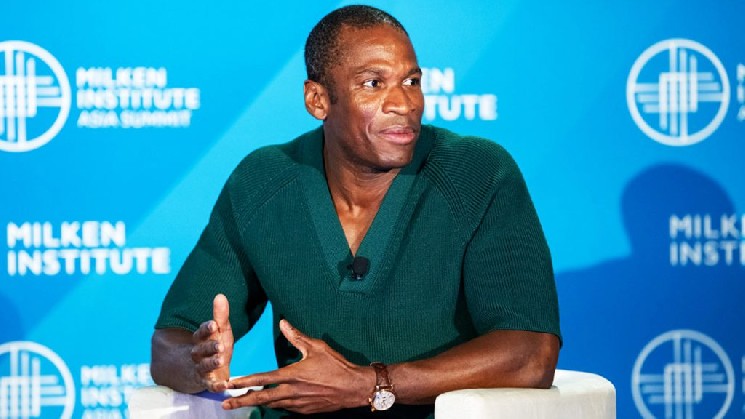
Sin embargo, el CEO de LayerZero, Bryan Pellegrino, aclaró que no conocía al inversor.

Le hemos dicho a todos los fondos e instituciones con los que hemos hablado que nuestra preferencia es que simplemente compren ZRO directamente en el mercado abierto, en lugar de comprar a los laboratorios o a la fundación. No hay acuerdos especiales, ni descuentos.

La cadena Zero está programada para lanzarse en el otoño de 2026, y el proyecto atrajo a importantes patrocinadores financieros, incluyendo Citadel Securities, Tether, Ark Invest y Google. Para algunos, esto podría ser un posicionamiento para el trading institucional de mercados tokenizados.

Pero aún no está claro si el misterioso comprador ballena planeaba vender los tokens cuando la cadena se lance.

ZRO golpea un muro de venta

Dicho esto, ZRO subió un 60% desde el mínimo del rango de $1.49 y había llegado a $2.5, una zona de resistencia clave desde la segunda mitad de 2025. Los recientes intentos de recuperación en enero y febrero fueron rechazados en este obstáculo (rojo).
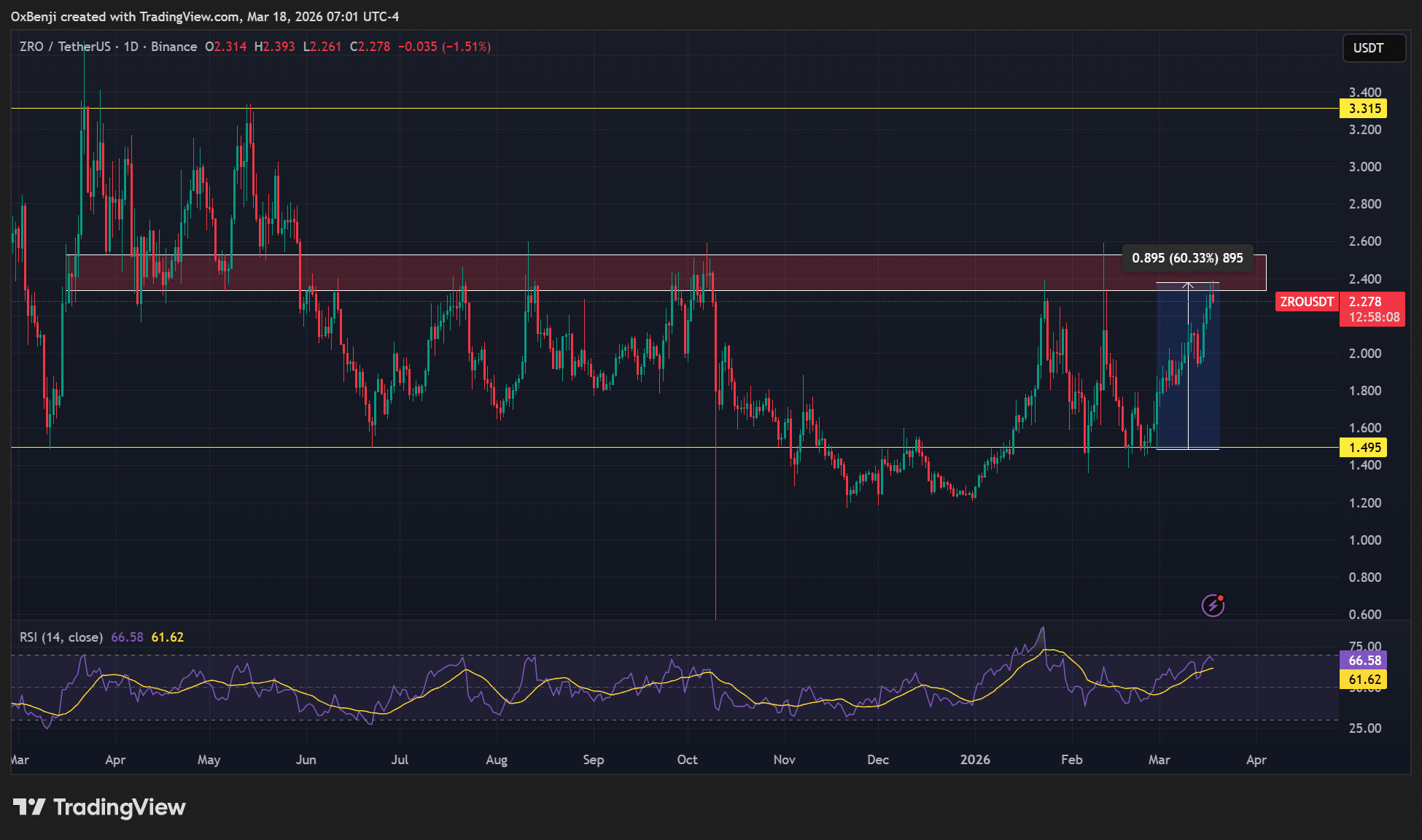
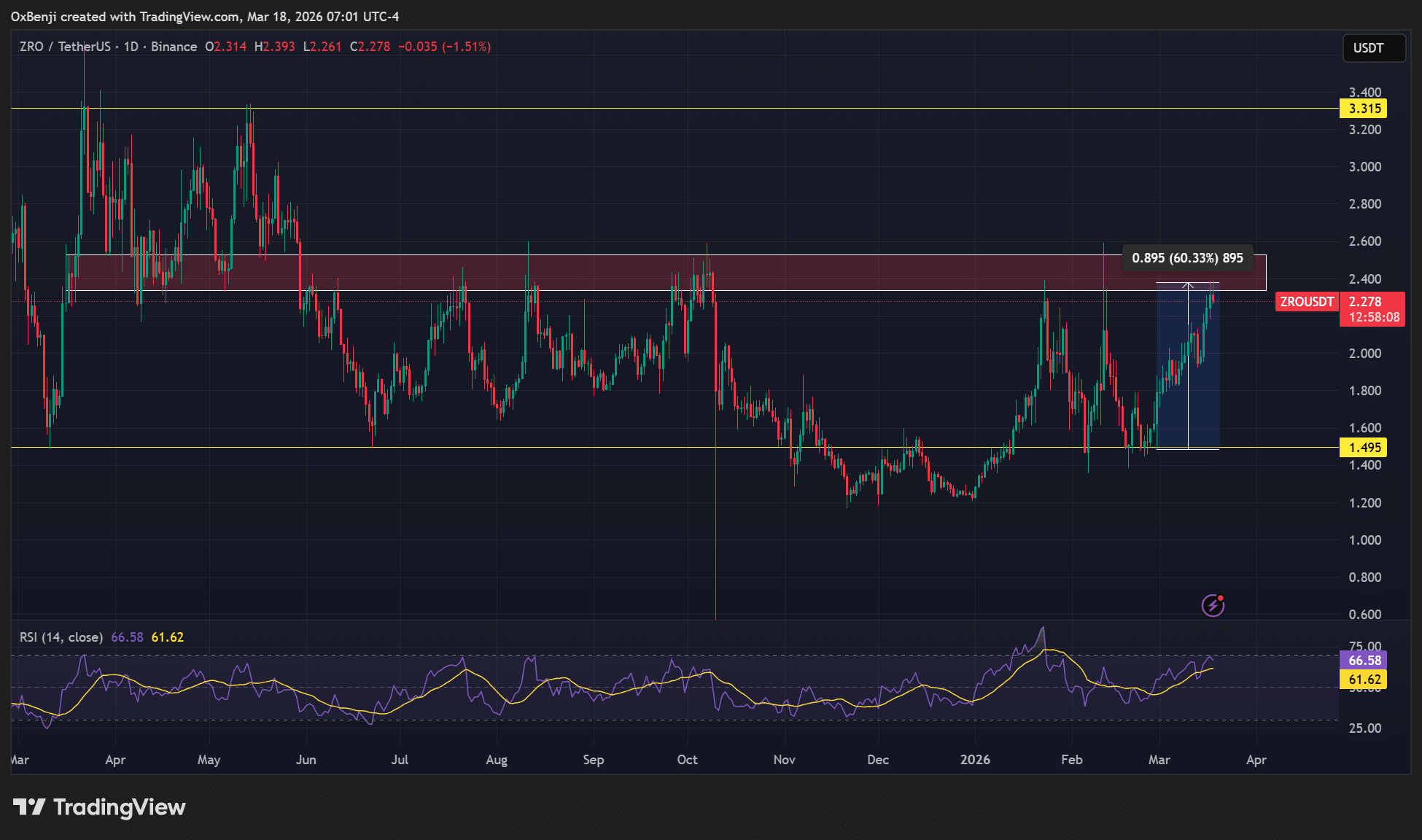
Fuente: ZRO/USDT, TradingView

Si la tendencia se repite, los compradores tardíos podrían esperar otra oportunidad de compra en $1.5. Sin embargo, convertir $2.5 en soporte podría impulsar el rally a $3.3.

No obstante, se adquirieron más de 34 millones de ZRO en la zona de resistencia, lo que podría inclinar a algunos inversores que han alcanzado el punto de equilibrio a cerrar sus posiciones. De ser así, esto podría añadir presión y reforzar el área como un obstáculo clave.
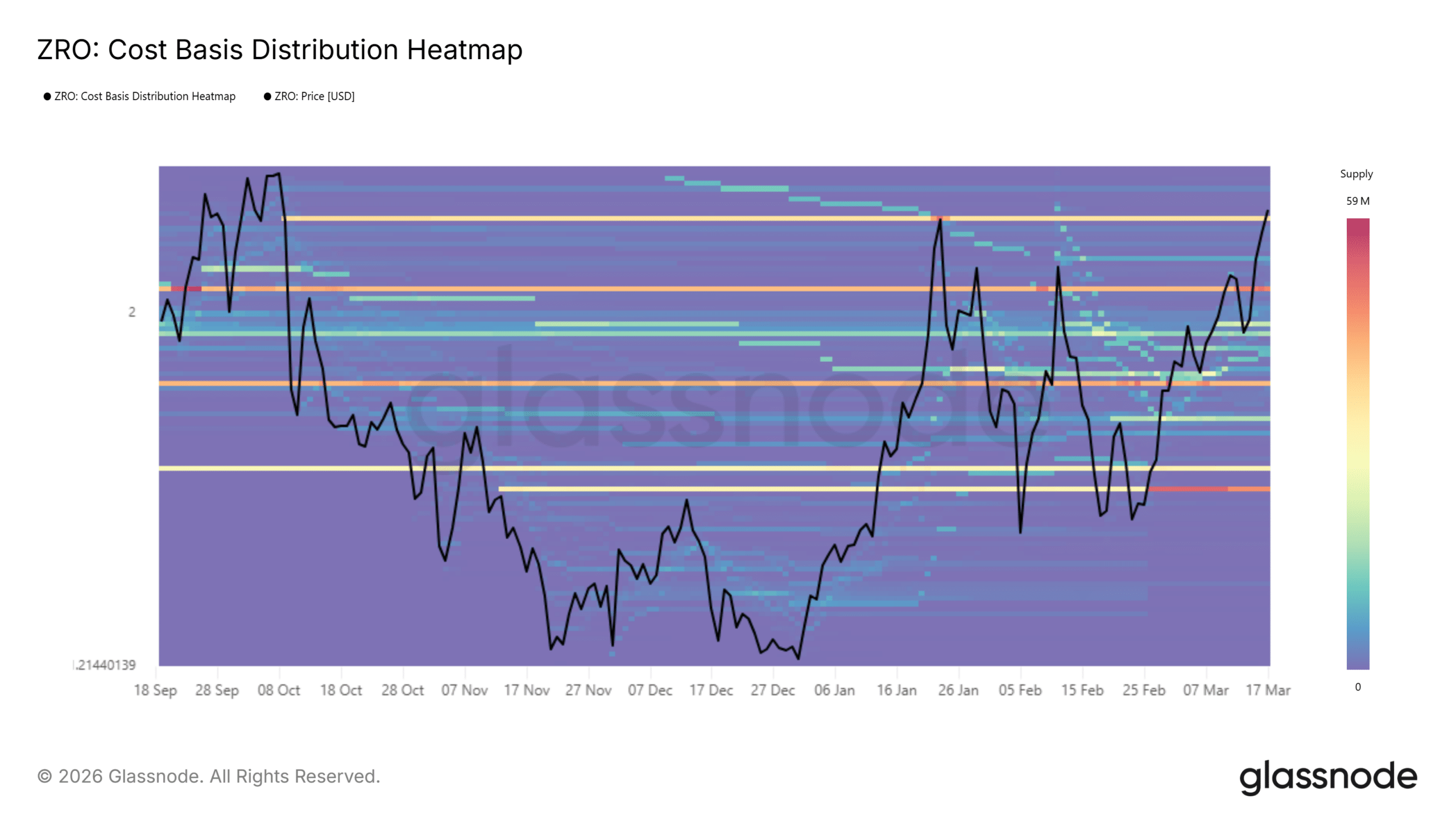
Fuente: Glassnode

Aun así, al momento de escribir, la presión de venta de los tenedores aún no era evidente.

Según el Cambio Neto de Posición de Tenedores promedio de 14 días, los inversores aún estaban manteniendo y añadiendo a sus reservas, como lo muestran las barras verdes.
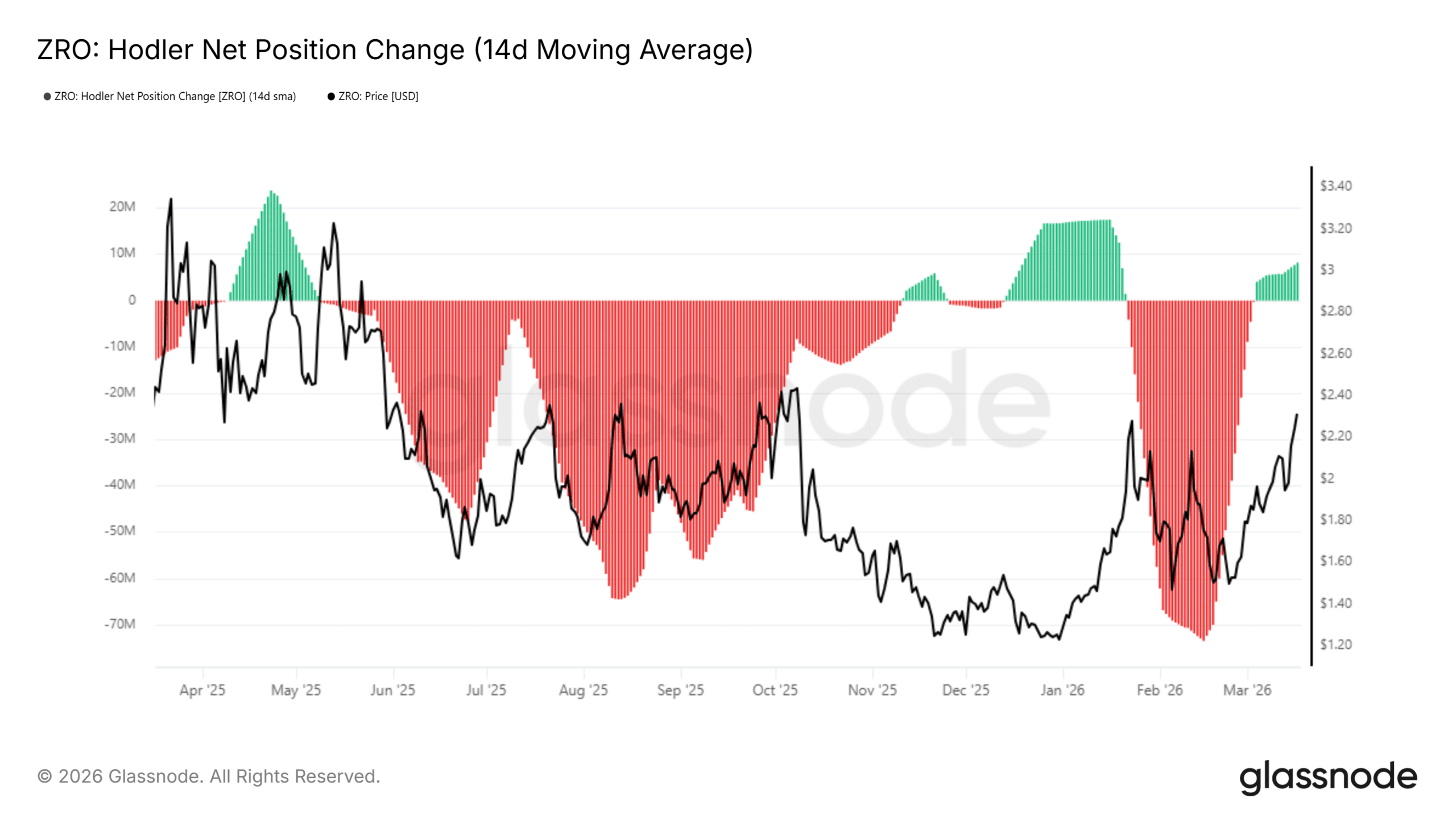
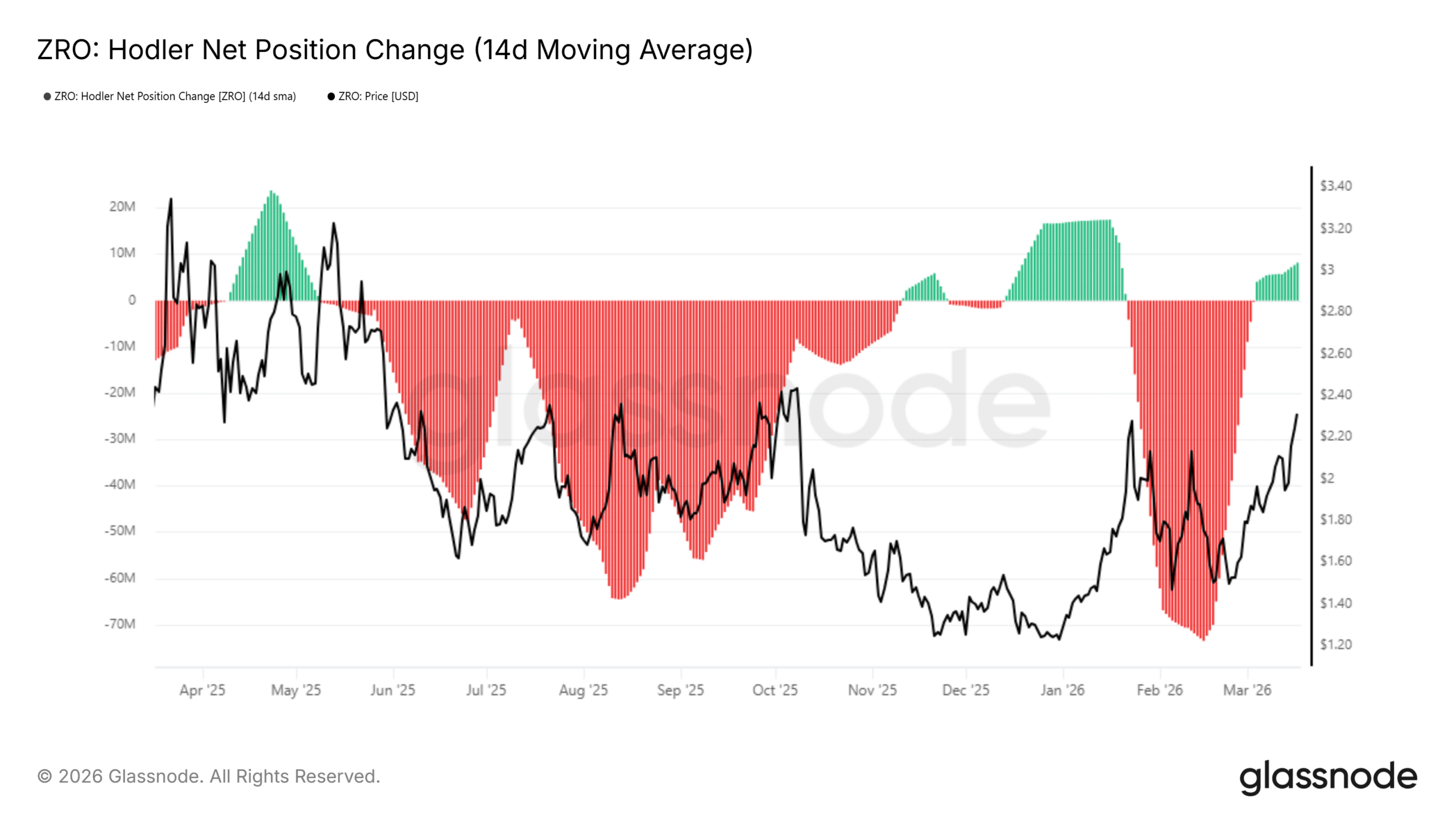
Fuente: Glassnode

Sin embargo, si el indicador se volviera rojo, sugeriría que los tenedores han comenzado a descargar. Tal movimiento podría reforzar aún más los $2.5 como un obstáculo clave que los toros deben superar para extender el rally.


Resumen Final

  • Una ballena misteriosa ha adquirido el 2.6% de la oferta circulante total de ZRO, pero LayerZero negó cualquier afiliación con el inversor.
  • El nivel de $2.5 ha sido un obstáculo desde 2025 y podría descarrilar la recuperación de ZRO si no hay un catalizador a corto plazo.


İlgili Sorular

Q¿Qué porcentaje de la oferta circulante de ZRO ha adquirido la ballena misteriosa?

ALa ballena misteriosa ha adquirido un 2,6% de la oferta circulante de ZRO, lo que equivale a aproximadamente 24,5 millones de tokens.

Q¿Cómo ha negado LayerZero su relación con este gran inversor?

AEl CEO de LayerZero, Bryan Pellegrino, aclaró que no conoce al inversor y afirmó que no ofrecen 'acuerdos especiales ni descuentos', prefiriendo que los fondos e instituciones compren ZRO directamente en el mercado abierto.

Q¿A través de qué plataforma se financiaron las carteras utilizadas para la acumulación de ZRO?

ASegún la plataforma de análisis Nansen, la acumulación se realizó a través de 9 carteras, todas financiadas por una única fuente: Coinbase Prime.

Q¿Cuál es un nivel de resistencia clave para el precio de ZRO según el artículo?

AEl nivel de $2,5 ha sido una zona de resistencia clave desde la segunda mitad de 2025, y superarlo podría impulsar el precio hasta $3,3.

Q¿Qué indicador sugiere que los tenedores actuales no están vendiendo sus ZRO aún?

AEl indicador 'Holder Net Position Change' de 14 días muestra barras verdes, lo que indica que los inversores aún están manteniendo e incluso aumentando sus tenencias de ZRO.

İlgili Okumalar

Dalio's Latest Warning: Don't Get Carried Away by AI, Real Returns on US Stocks in the Next 5-10 Years Could Be -5% to -10%

Ray Dalio, founder of Bridgewater Associates, warns investors against excessive concentration in AI stocks. He argues the current market, dominated by a few AI giants, mirrors historical patterns where revolutionary new technologies lead to high risk, volatility, and uncertainty. While acknowledging AI's transformative potential, Dalio emphasizes that most investors fail at this stage of the cycle by over-concentrating in a handful of leading companies. He cites inherent risks: companies cannot accurately forecast investment needs or external shocks (e.g., monetary policy, geopolitics, taxes), face potential disruption from future technologies and international competition (notably from China), and experience significant price swings. Dalio's core advice is diversification, calling it his "Holy Grail of Investing." He presents a mathematical case that a well-diversified portfolio of 15-20 uncorrelated, good bets offers a superior risk-adjusted return compared to a concentrated position. Dalio also offers a cautious outlook, suggesting U.S. stocks may deliver real returns of -5% to -10% over the next 5-10 years based on valuation and bubble indicators. He concludes that in the face of high uncertainty, the prudent strategy is not to avoid betting entirely, but to avoid large, concentrated bets where one lacks sufficient informational edge. Instead, investors should build a strategically balanced, diversified portfolio.

marsbit11 dk önce

Dalio's Latest Warning: Don't Get Carried Away by AI, Real Returns on US Stocks in the Next 5-10 Years Could Be -5% to -10%

marsbit11 dk önce

Rain Valuation Approaches $20 Billion: The Battle for U-Cards Extends to Rewards Systems

Rain, a stablecoin payments infrastructure company, is shifting the competitive focus for U Cards from simple issuance to user retention and repeated usage. On June 15, Rain launched "Rain Rewards," an embedded loyalty program capability within its card-issuing infrastructure. This allows partner businesses—like fintech platforms and neobanks—to configure branded loyalty points, earning rules, redemptions, and merchant promotions directly within their card products. The system, built from the 2025 acquisition of Uptop, ensures points are only issued upon final transaction settlement, preventing liabilities from refunds. Trials, such as with Avalanche Card, reportedly boosted spending by 25% among enrolled users. Founded by Farooq Malik and Charles Yoo-Naut, Rain evolved from a tool for managing Web3 company expenses into a full-stack enterprise platform. It is a Principal Member of Visa and Mastercard, enabling partners to issue stablecoin-backed cards and wallets while leveraging traditional payment networks. Notably, the popular U Card Plasma One is issued by Rain under Visa's authority. Rain also integrates with Visa's stablecoin settlement pilot, using USDC for network settlement. Rain's rapid funding reflects growing institutional interest in stablecoin payment infrastructure. It raised a $245 million Series A in March 2025, a $58 million Series B in August 2025, and a $250 million Series C in January of this year, reaching a $19.5 billion valuation. Annualized transaction volume exceeds $3 billion, serving over 200 partners including Western Union and Nuvei. Beyond cards, Rain is expanding into programmable payments. Its June 2026 "Agent Control Layer" allows businesses to set spending rules—like merchant categories, amounts, and frequency—for AI agents before transactions occur. This positions Rain not as a single product but as an operating system for stablecoin payments, handling everything from card issuance and wallet management to rewards, on/off-ramps, and automated compliance. The goal is to enable seamless, often invisible, real-world spending of on-chain assets.

Foresight News14 dk önce

Rain Valuation Approaches $20 Billion: The Battle for U-Cards Extends to Rewards Systems

Foresight News14 dk önce

Google TPU Shipments Revised Up by 50%

Recent industry research indicates a significant upward revision in the shipments of Google's TPU (Tensor Processing Unit) chips. Previous expectations for 2027 were set at around 10 million units, but new estimates now point to 15 million units, a 50% increase. This substantial boost directly translates to higher demand across the entire supporting supply chain. Google's TPU clusters utilize a standardized all-optical interconnect architecture. Consequently, key hardware components are deeply integrated and scaled in fixed ratios with the chips. The 15 million TPU target will drive corresponding demand increases for NPO optical engines (roughly a 1:1 match), 1.6T optical modules, OCS optical switches, high-end server power supplies, fiber optics & MPO connectors, and liquid cooling solutions. Among these, liquid cooling is highlighted as the sector experiencing the most significant transformation and offering the most stable potential for excess returns. As next-generation TPU chips reach power levels where traditional air cooling is insufficient, liquid cooling becomes essential. 2026 is forecasted as the first year of substantial adoption for Google's liquid cooling solutions. This shift, coupled with delivery and capacity bottlenecks faced by incumbent overseas manufacturers, is creating a prime window for domestic Chinese suppliers to enter and secure Google's core supply chain. The market size for Google-specific liquid cooling is projected to potentially triple from a baseline of hundreds of billions to around 300 billion units by 2028. The logic for the fiber optic sector is also being rewritten. Once considered a cyclical commodity tied to telecom operator procurement, fiber is now a strategic and scarce resource for AI Data Centers (AIDC). A severe supply-demand imbalance, driven by the long lead time for preform production (18-24 months) and surging demand from cloud giants, is supporting strong performance. Chinese fiber manufacturers are well-positioned to capture a significant share of global AIDC demand, with exports potentially reaching 200-300 million core kilometers in 2026. Overall, the investment focus within the AI computing industry is shifting from pure "chip performance speculation" towards the more certain incremental growth in computing infrastructure and its supporting ecosystem. The upward revision in Google TPU shipments, along with the potential for further doubling by 2028, is seen as solidifying performance visibility for the entire supporting supply chain over the next two years.

marsbit1 saat önce

Google TPU Shipments Revised Up by 50%

marsbit1 saat önce

What Wall Street Really Wants After the Crypto Story Recedes

The tide of speculative crypto narratives has receded, revealing Wall Street's true objective: building a controlled, yield-generating, and compliant financial pipeline on distributed ledgers. They are migrating core functions onto blockchains, not for decentralization, but for efficiency and new revenue streams. Key developments include BlackRock's BUIDL fund, a tokenized treasury fund acting as a foundational reserve asset, and the rise of Securitize, which is going public and partnering with the NYSE to build a 24/7 digital securities trading and settlement system. This signals a major shift of securities clearing to blockchain technology. To make volatile assets like Bitcoin palatable for institutional investors, firms like BlackRock and Goldman Sachs are creating "covered call" ETFs (e.g., BITA). These products systematically sell options on Bitcoin holdings, transforming price volatility into stable monthly income, effectively repackaging crypto as a yield-bearing asset. Stablecoins are being positioned not as speculative tools but as efficient payment rails. Companies like Stripe and Mastercard are integrating them for instant, low-cost merchant settlements and cross-border card payments, respectively. Critically, new legislation like the GENIUS Act shapes them as non-interest-bearing, heavily regulated extensions of the US dollar system. In summary, Wall Street is quietly constructing a parallel, blockchain-based financial infrastructure featuring tokenized traditional assets, structured crypto yields, and programmable dollar pipelines—all under its control and fully integrated with existing regulatory and credit frameworks.

marsbit2 saat önce

What Wall Street Really Wants After the Crypto Story Recedes

marsbit2 saat önce

İşlemler

Spot
Futures

Popüler Makaleler

ZRO Nasıl Satın Alınır

HTX.com’a hoş geldiniz! LayerZero (ZRO) satın alma işlemlerini basit ve kullanışlı bir hâle getirdik. Adım adım açıkladığımız rehberimizi takip ederek kripto yolculuğunuza başlayın. 1. Adım: HTX Hesabınızı OluşturunHTX'te ücretsiz bir hesap açmak için e-posta adresinizi veya telefon numaranızı kullanın. Sorunsuzca kaydolun ve tüm özelliklerin kilidini açın. Hesabımı Aç2. Adım: Kripto Satın Al Bölümüne Gidin ve Ödeme Yönteminizi SeçinKredi/Banka Kartı: Visa veya Mastercard'ınızı kullanarak anında LayerZero (ZRO) satın alın.Bakiye: Sorunsuz bir şekilde işlem yapmak için HTX hesap bakiyenizdeki fonları kullanın.Üçüncü Taraflar: Kullanımı kolaylaştırmak için Google Pay ve Apple Pay gibi popüler ödeme yöntemlerini ekledik.P2P: HTX'teki diğer kullanıcılarla doğrudan işlem yapın.Borsa Dışı (OTC): Yatırımcılar için kişiye özel hizmetler ve rekabetçi döviz kurları sunuyoruz.3. Adım: LayerZero (ZRO) Varlıklarınızı SaklayınLayerZero (ZRO) satın aldıktan sonra HTX hesabınızda saklayın. Alternatif olarak, blok zinciri transferi yoluyla başka bir yere gönderebilir veya diğer kripto para birimlerini takas etmek için kullanabilirsiniz.4. Adım: LayerZero (ZRO) Varlıklarınızla İşlem YapınHTX'in spot piyasasında LayerZero (ZRO) ile kolayca işlemler yapın.Hesabınıza erişin, işlem çiftinizi seçin, işlemlerinizi gerçekleştirin ve gerçek zamanlı olarak izleyin. Hem yeni başlayanlar hem de deneyimli yatırımcılar için kullanıcı dostu bir deneyim sunuyoruz.

187 Toplam GörüntülenmeYayınlanma 2024.12.10Güncellenme 2026.06.02

ZRO Nasıl Satın Alınır

Tartışmalar

HTX Topluluğuna hoş geldiniz. Burada, en son platform gelişmeleri hakkında bilgi sahibi olabilir ve profesyonel piyasa görüşlerine erişebilirsiniz. Kullanıcıların ZRO (ZRO) fiyatı hakkındaki görüşleri aşağıda sunulmaktadır.

活动图片