PIPPIN chute de 49 % après qu'un transfert de 560 000 $ vers les bourses a déclenché une vente massive

ambcrypto2026-03-17 tarihinde yayınlandı2026-03-17 tarihinde güncellendi

Özet

PIPPIN a chuté de 49% après qu’un transfert de 560 000 dollars vers des exchanges a déclenché une vague de ventes. Le token est passé d’une fourchette de 0,35–0,40 dollar à environ 0,19 dollar. Deux portefeuilles ont effectué ces transferts vers Gate.io peu avant la chute, suggérant une distribution anticipée. La baisse a provoqué des liquidations en cascade et un effondrement du financement, qui est passé en territoire négatif (-0,8), indiquant une fermeture aggressive des positions longues. Le marché est désormais dominé par les shorts, mais un rebond reste possible si la pression vendeuse s’atténue. Cet épisode illustre la volatilité des actifs peu liquides.

PIPPIN a enregistré une forte baisse de 49 % au cours de la dernière séance de trading, les données on-chain suggérant que des entrées sur les bourses ont peut-être précédé le mouvement.

La chute a fait passer le token de la fourchette 0,35 $ – 0,40 $ à environ 0,19 $, marquant l'une de ses plus fortes pertes en une seule séance ces dernières semaines.

Des données de Bubblemaps ont montré que deux portefeuilles ont transféré environ 560 000 $ en PIPPIN vers des adresses de dépôt. Ces adresses ont ensuite acheminé les tokens vers Gate.io vers 8:00 UTC, juste quelques minutes avant le début de l'effondrement des prix.

Les transferts de portefeuilles ont précédé la vente massive

Selon Bubblemaps, les transferts se sont produits à quelques minutes d'intervalle, les deux portefeuilles envoyant des fonds à des adresses de dépôt liées à des bourses peu avant la baisse.

Bien que les données ne confirment pas l'intention, le timing suggère que les tokens ont été déplacés vers des bourses avant une pression de vente accrue.

Sur les marchés crypto, de telles entrées sont souvent surveillées comme des indicateurs potentiels de distribution, en particulier lorsqu'elles sont suivies de mouvements de prix brusques.

L'effondrement des prix déclenche une cascade de liquidations

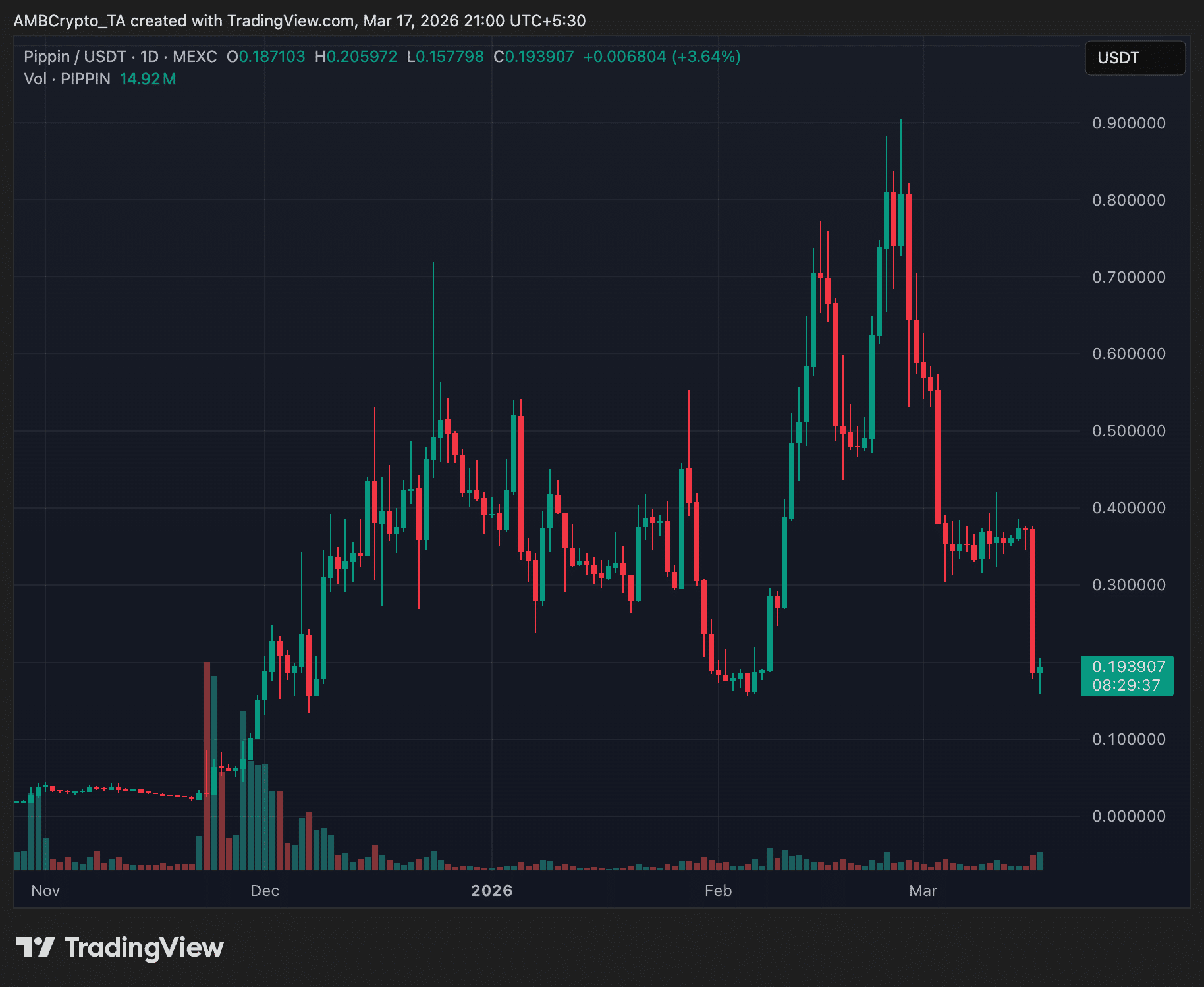
Le graphique des prix a montré une perte nette de structure avant que la chute ne s'accélère. Après avoir échoué à maintenir le niveau de consolidation de 0,30 $, PIPPIN a cassé à la baisse avec un fort momentum, accompagné d'un pic visible du volume de trading.
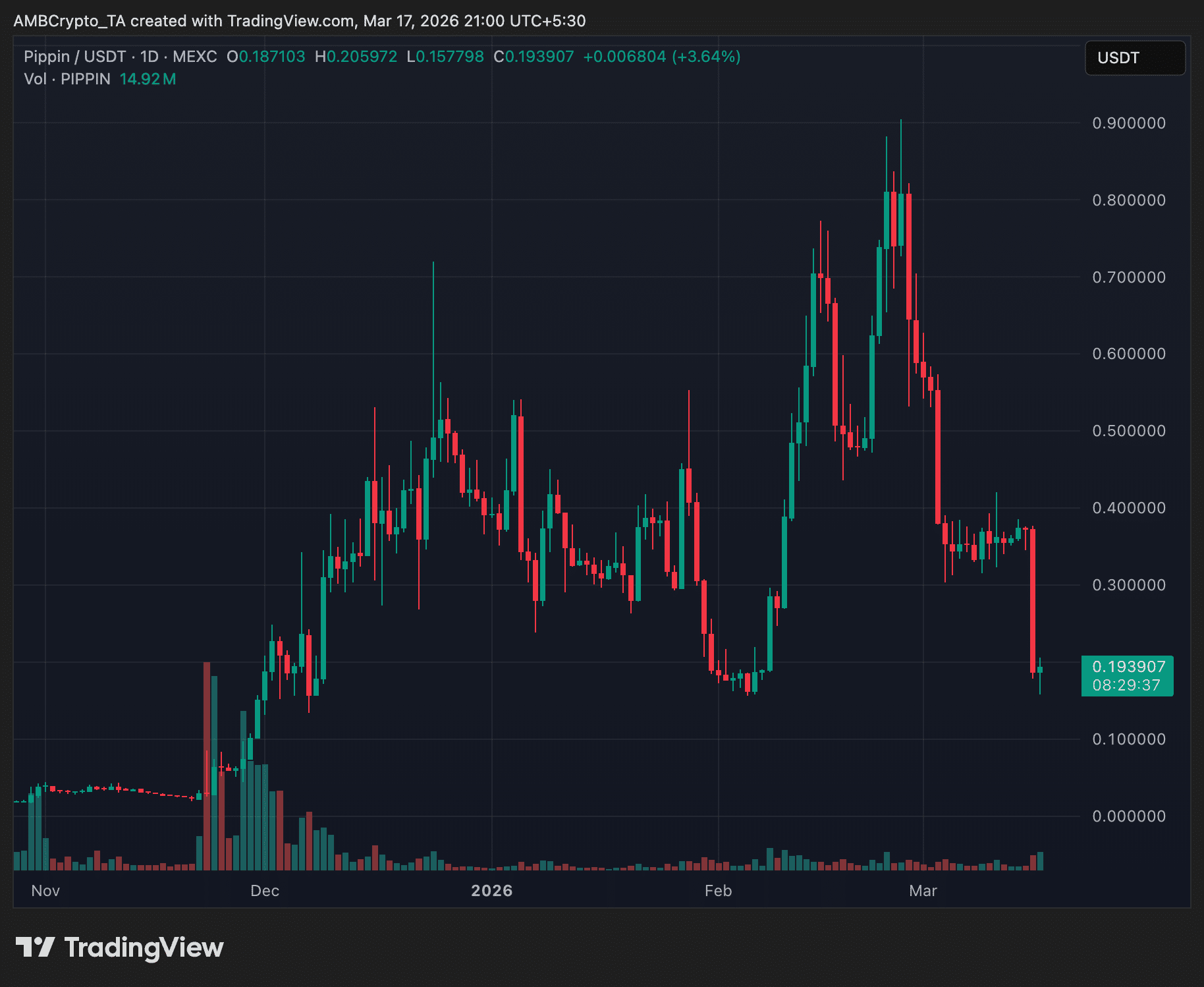
Source : TradingView

Le mouvement a accéléré les pertes, anéantissant les gains récents et repoussant le token vers des niveaux vus pour la dernière fois dans sa fourchette de trading. La vitesse de la baisse indiquait une vente forcée et des liquidations en cascade, plutôt qu'une prise de bénéfices graduelle.

Le financement bascule alors que les positions longues sont anéanties

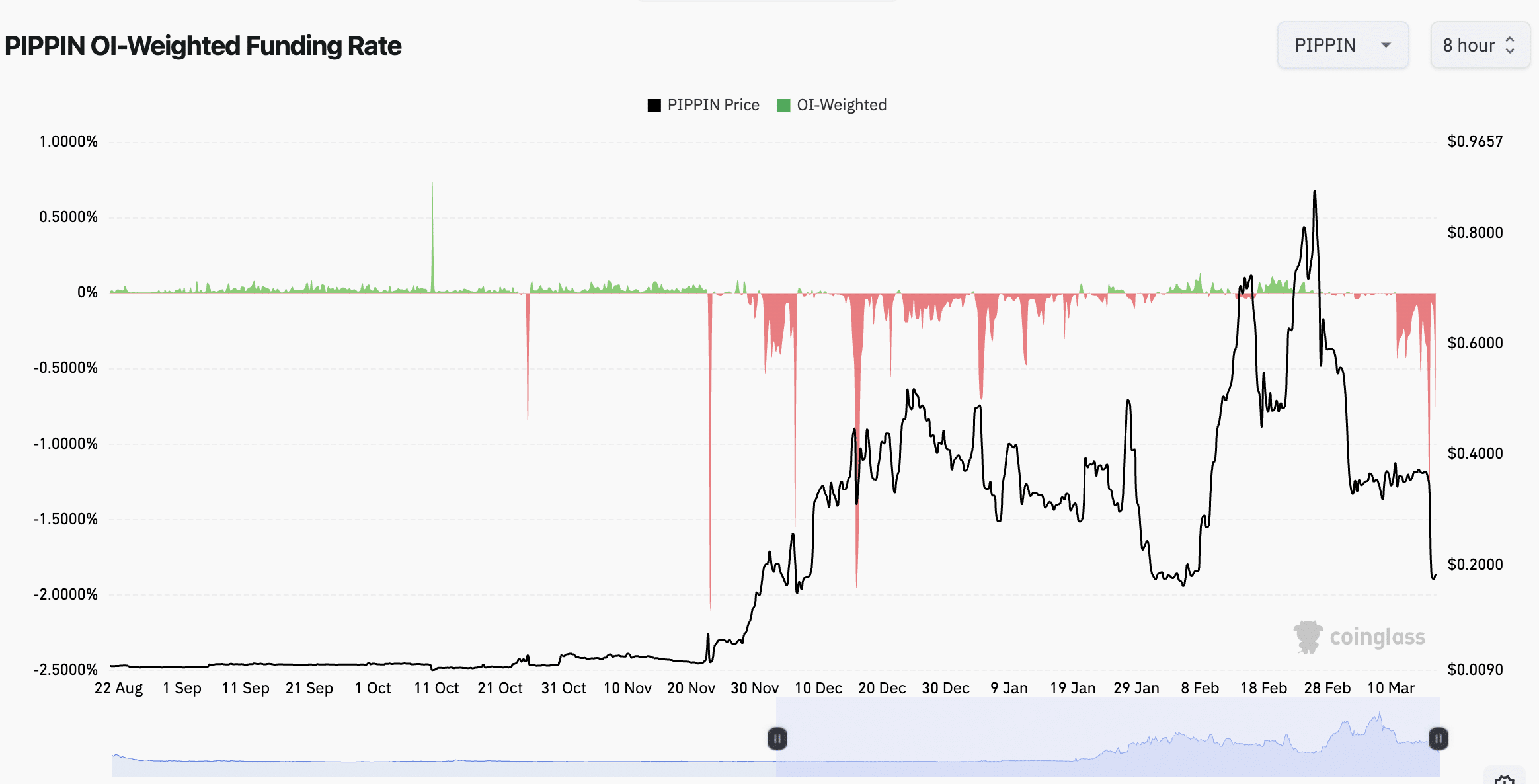
Les données sur les produits dérivés ont renforcé le récit des liquidations. Le taux de financement pondéré par l'Open Interest (OI) est devenu profondément négatif après la chute. Au moment de la rédaction, le taux de financement était de -0,8, une amélioration par rapport à –1,5 lors de la séance de trading précédente.

Cela indique que les positions longues ont été fermées agressivement ou liquidées pendant le mouvement.
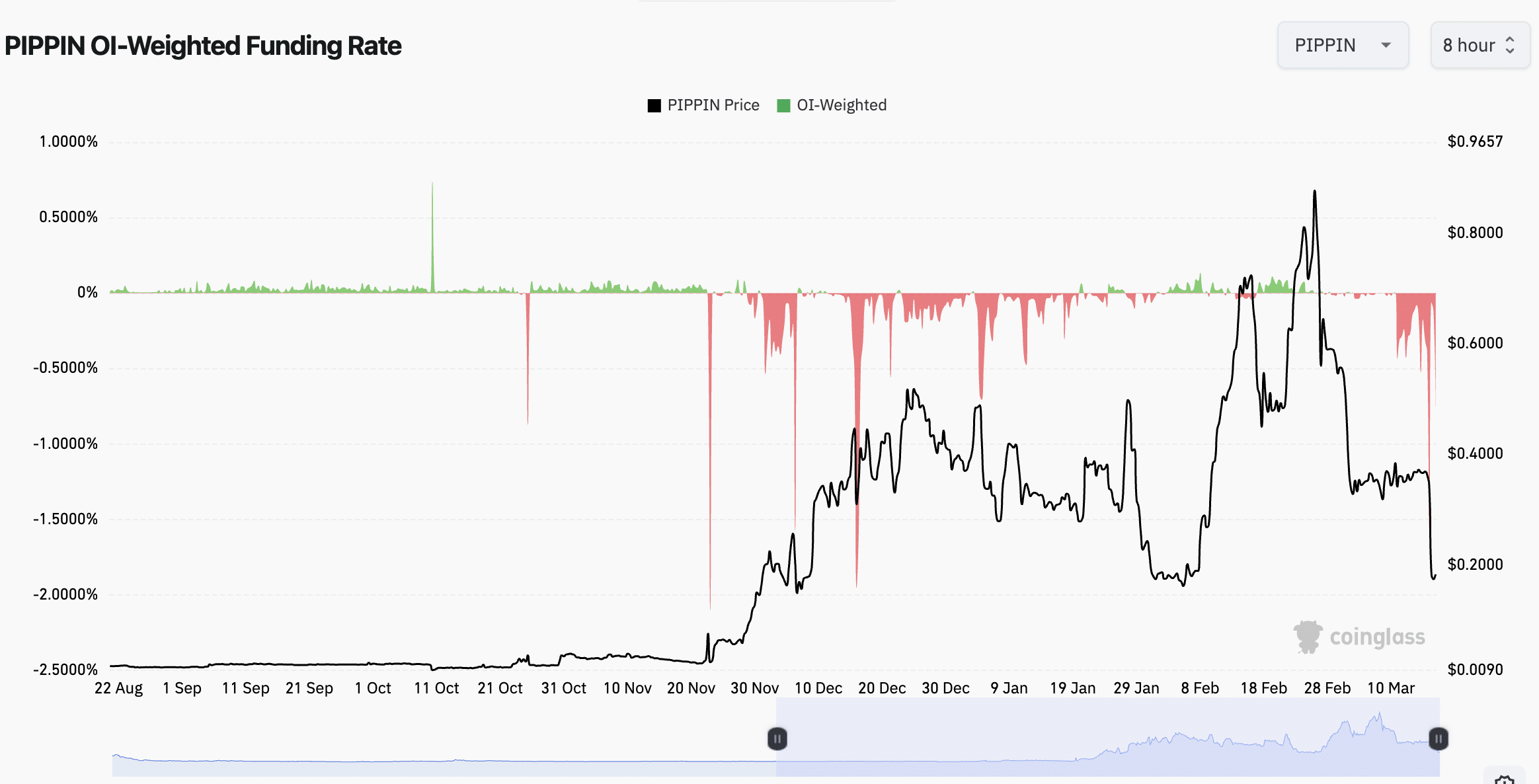
Source : Coinglass

Plus tôt dans le cycle, le financement était resté relativement stable ou légèrement positif, suggérant que le marché était positionné pour la hausse. Le renversement soudain met en lumière un passage de positions longues surchargées à une dominance des shorts, un schéma typique suivant un squeeze des acheteurs.

Et maintenant pour PIPPIN ?

Avec un financement désormais négatif et un prix nettement plus bas, le marché est confronté à une perspective divisée.

D'un côté, une faiblesse persistante pourrait suivre si les entrées sur les bourses reflètent une distribution plus large. De l'autre, un positionnement short surchargé pourrait créer les conditions d'un rebond à court terme si l'intérêt d'achat revient.

Pour l'instant, l'action des prix de PIPPIN semble être motivée par une combinaison de flux on-chain, de pression de vente au spot et de liquidations sur produits dérivés, le dernier mouvement soulignant à quelle vitesse le sentiment peut changer dans des environnements à faible liquidité.


Résumé final

  • La chute de 49 % de PIPPIN a suivi des transferts de tokens d'une valeur de 560 000 $ vers des bourses, le timing suggérant que les entrées ont peut-être précédé la vente massive.
  • Le mouvement a déclenché des liquidations de positions longues et a fait basculer le financement en territoire négatif, laissant le marché penché en faveur des shorts à court terme.


Trend Kriptolar

İlgili Sorular

QQu'est-ce qui a déclenché la chute de 49% du prix de PIPPIN ?

ALa chute de 49% du prix de PIPPIN a été déclenchée par le transfert de 560 000 dollars de jetons vers les bourses par deux portefeuilles, ce qui a précédé une forte pression de vente.

QÀ quel niveau de prix PIPPIN est-il tombé après cette baisse soudaine ?

AAprès cette baisse soudaine, le prix de PIPPIN est tombé d'une fourchette de 0,35 $ à 0,40 $ pour atteindre environ 0,19 $.

QQuel indicateur sur le marché des dérivés a confirmé les liquidations à la baisse ?

ALe taux de financement pondéré par l'open interest (OI) est devenu profondément négatif, atteignant -1,5, ce qui a confirmé la liquidation agressive des positions longues.

QQuelle plateforme d'échange a reçu les jetons PIPPIN peu avant l'effondrement du prix ?

ALes jetons PIPPIN ont été acheminés vers la plateforme d'échange Gate.io vers 8h00 UTC, quelques minutes seulement avant le début de l'effondrement du prix.

QQuelles sont les deux perspectives possibles pour PIPPIN après cette chute ?

ALes deux possibilités pour PIPPIN sont soit une faiblesse continue si les entrées en bourse reflètent une distribution plus large, soit un rebond à court terme en raison du positionnement court sur le marché.

İlgili Okumalar

Weekly Editor's Picks (0725-0731)

Weekly Editor's Picks (0725-0731) provides a curated selection of deep analysis, filtering out market noise. Key themes from this week include: **Macro & Policy:** The Federal Reserve's upcoming meeting is marked by high uncertainty, balancing cooling inflation data against persistent price pressures. Meanwhile, the U.S. crypto regulatory Clarity Act faces critical political hurdles, with its 2026 passage probability seen as low. **Investing & Crypto:** Analysis suggests long-term crypto success depends on conviction through volatile cycles, focusing on assets like Bitcoin and core smart contract platforms. A trend noted is the increasing similarity between global equity markets (especially tech) and crypto, driven by narrative and leverage. Several major crypto protocols show strong revenue growth, but this isn't always translating to token price appreciation due to sell pressure and structural factors. **AI & Semiconductors:** Nvidia's rising credit default swap rates signal market concern over AI infrastructure financing risks. The storage sector experienced volatility as markets began pricing in potential 2027 oversupply. Despite a record profitable quarter, SK Hynix's results were deemed "below expectations," reflecting heightened investor demands for future growth visibility. **Markets & DeFi:** TradeXYZ demonstrated remarkable accuracy in pre-market pricing for a major A股 listing. The token ONDO saw gains, linked to its growing role in the on-chain tokenized stock ecosystem. **Ethereum:** Post-Pectra upgrade, a major structural shift is underway as Lido begins migrating millions of ETH to new validator architectures designed for capital efficiency. **Also Highlighted:** Butian's bullish stock market move; OpenAI's Altman promising major advances; Samsung and SK Hynix securing large AI chip deals; Apple reaching a $5T market cap; and ongoing discussions around exchange security following Poolin's bankruptcy case.

marsbit24 dk önce

Weekly Editor's Picks (0725-0731)

marsbit24 dk önce

Low Investment Isn't Apple's Immunity Pass

While Meta and Google face investor scrutiny over ballooning AI capital expenditures, Apple's minimal AI investment has paradoxically become a strength. Its market cap recently reclaimed the global top spot, surpassing $5 trillion. The irony is deep: Apple's own AI efforts have lagged, with "Apple Intelligence" delayed and core talent lost, forcing reliance on partners like Google Gemini and Alibaba's Qianwen. Its Q3 FY2026 (Q2 CY) earnings initially seemed stellar. Revenue hit $109.4B (up 16% YoY), with iPhone and Mac sales, growing 22% and 29% respectively, driving most of the growth. However, the stock fell over 8% post-earnings. The primary concern was a weaker Q4 revenue growth forecast of 9-11%, below expectations, due to looming supply chain constraints. Apple is feeling the indirect cost of the AI boom. Soaring memory and chip prices, fueled by massive data center investments from Microsoft, Amazon, and others, are forcing Apple to raise Mac and iPad prices significantly. The upcoming iPhone launch is also expected to see substantial price hikes. Despite avoiding heavy AI infrastructure spending—its capital expenditures are actually down 28%—Apple cannot escape the industry-wide supply and cost pressures. While Apple's operating cash flow remains robust, its substantial R&D spending (up 32% YoY) has yet to yield major AI breakthroughs. As Tim Cook prepares to step down as CEO, Apple faces a challenging transition: balancing its premium hardware success against the strategic and cost pressures of the AI era it has so far cautiously navigated.

marsbit1 saat önce

Low Investment Isn't Apple's Immunity Pass

marsbit1 saat önce

PA Graphics Explanation | One Chart to Understand the Major Web3 Events in August 2026

**PANews Crypto Calendar: Key Web3 Events in August 2026** PANews introduces its revamped crypto calendar, featuring comprehensive coverage, flexible filtering, and easy export options. The market in August will be shaped by multiple key events across macroeconomics, regulation, tokenomics, and project developments: * **Macro & Policy:** Key US economic data releases (July Non-Farm Payrolls, CPI), the Federal Reserve meeting minutes, and the Jackson Hole Economic Symposium will be in focus. On the regulatory front, the US Senate plans to release a new draft of the *CLARITY Act*, while the EU's expanded crypto ban against Belarus comes into effect. * **Token Unlocks:** Significant token unlocks are scheduled for assets including ENA, AVAX, CONX, ZRO, and KAITO, which may influence market volatility. * **Project Updates & Shutdowns:** Several services, including Exchange Art, Ctrl Wallet, Zapper, NFTfi, and Summer.fi, are set to cease operations or undergo major adjustments. Users are advised to manage their assets accordingly. * **Corporate Activity:** Q2 earnings reports from companies like SpaceX, Circle, and Nvidia are due. Unitree Robotics will initiate its IPO subscription on the STAR Market, and Moonshot AI plans to begin a Pre-IPO financing round. * **Industry Events:** Major conferences such as Bitcoin Asia 2026 and the 2026 Digital Expo will take place. The overarching market narrative for August will revolve around macroeconomic expectations, regulatory developments, token unlock schedules, and ongoing industry consolidation.

marsbit1 saat önce

PA Graphics Explanation | One Chart to Understand the Major Web3 Events in August 2026

marsbit1 saat önce

Wall Street's Most Famous 'Cassandra' Now Has His Sights Set on Nvidia

Michael Burry, the famed "Big Short" investor, has once again captured Wall Street's attention with a series of short positions against major tech and semiconductor stocks, most notably Nvidia. In late June and July, through his "Cassandra Unchained" newsletter, Burry disclosed short bets against Nvidia, Tesla, Applied Materials, Caterpillar, the SOXX semiconductor ETF, and later, Micron Technology. His core thesis revolves around potential distortions in the AI infrastructure boom, specifically questioning whether extended depreciation schedules (e.g., 6 years vs. a realistic 2-3 years for AI chips) by cloud giants like Microsoft and Google artificially inflate profits. He also raises concerns about possible "off-balance-sheet circular financing," where chip demand might be propped up by vendor-backed funding to clients. Nvidia's stock experienced volatility following these disclosures, briefly dipping but largely holding near Burry's reported entry points, leaving his positions roughly flat or slightly underwater as of late July. This move is part of a pattern for Burry, whose track record since his legendary 2008 bet is mixed. He has faced notable losses, such as on Tesla in 2021, while scoring on broader market turns like the 2020 pandemic crash. His methodology focuses intensely on free cash flow and scrutinizing original financial documents to spot overvaluation and structural risks, but it often struggles with timing the market. The article contrasts Burry's stance with other prominent investors. Steve Eisman, another "Big Short" figure, is not shorting Nvidia, citing strong fundamentals but expressing nervousness about sustainability. Jim Chanos agrees with the broad "accounting mismatch" concern—comparing it to the dot-com bubble—but targets financial leverage in private equity firms rather than the chip stocks themselves. While Nvidia's short interest remains relatively low at 1.3-1.4% of float, the massive stock size means absolute short losses have been significant, exceeding $5 billion earlier this year. The piece concludes that for ordinary investors, the key takeaway is not replicating specific short bets but learning from the critical frameworks these investors use: questioning rosy accounting, identifying structural vulnerabilities, and maintaining skepticism during market euphoria, even if pinpointing the exact catalyst for a downturn remains elusive.

marsbit1 saat önce

Wall Street's Most Famous 'Cassandra' Now Has His Sights Set on Nvidia

marsbit1 saat önce

İşlemler

Spot

Popüler Makaleler

PIPPIN Nasıl Satın Alınır

HTX.com’a hoş geldiniz! pippin (PIPPIN) satın alma işlemlerini basit ve kullanışlı bir hâle getirdik. Adım adım açıkladığımız rehberimizi takip ederek kripto yolculuğunuza başlayın. 1. Adım: HTX Hesabınızı OluşturunHTX'te ücretsiz bir hesap açmak için e-posta adresinizi veya telefon numaranızı kullanın. Sorunsuzca kaydolun ve tüm özelliklerin kilidini açın. Hesabımı Aç2. Adım: Kripto Satın Al Bölümüne Gidin ve Ödeme Yönteminizi SeçinKredi/Banka Kartı: Visa veya Mastercard'ınızı kullanarak anında pippin (PIPPIN) satın alın.Bakiye: Sorunsuz bir şekilde işlem yapmak için HTX hesap bakiyenizdeki fonları kullanın.Üçüncü Taraflar: Kullanımı kolaylaştırmak için Google Pay ve Apple Pay gibi popüler ödeme yöntemlerini ekledik.P2P: HTX'teki diğer kullanıcılarla doğrudan işlem yapın.Borsa Dışı (OTC): Yatırımcılar için kişiye özel hizmetler ve rekabetçi döviz kurları sunuyoruz.3. Adım: pippin (PIPPIN) Varlıklarınızı Saklayınpippin (PIPPIN) satın aldıktan sonra HTX hesabınızda saklayın. Alternatif olarak, blok zinciri transferi yoluyla başka bir yere gönderebilir veya diğer kripto para birimlerini takas etmek için kullanabilirsiniz.4. Adım: pippin (PIPPIN) Varlıklarınızla İşlem YapınHTX'in spot piyasasında pippin (PIPPIN) ile kolayca işlemler yapın.Hesabınıza erişin, işlem çiftinizi seçin, işlemlerinizi gerçekleştirin ve gerçek zamanlı olarak izleyin. Hem yeni başlayanlar hem de deneyimli yatırımcılar için kullanıcı dostu bir deneyim sunuyoruz.

565 Toplam GörüntülenmeYayınlanma 2025.01.11Güncellenme 2026.06.02

PIPPIN Nasıl Satın Alınır

Tartışmalar

HTX Topluluğuna hoş geldiniz. Burada, en son platform gelişmeleri hakkında bilgi sahibi olabilir ve profesyonel piyasa görüşlerine erişebilirsiniz. Kullanıcıların PIPPIN (PIPPIN) fiyatı hakkındaki görüşleri aşağıda sunulmaktadır.

活动图片