Core 'Key Contributors' Depart One After Another, Has Aave's DAO Dream Shattered?

比推2026-03-03 tarihinde yayınlandı2026-03-03 tarihinde güncellendi

Özet

Recent weeks have seen major internal turbulence within Aave, one of DeFi’s most successful DAOs. The Aave Chan Initiative (ACI), a core governance team, announced it would cease operations and exit the ecosystem on March 3, following the departure of BGD Labs, the development team behind Aave V3, just two weeks earlier. The crisis stems from governance disputes that began in December, when Aave Labs unilaterally switched the protocol’s front-end aggregator from ParaSwap to CoW Swap, redirecting fee revenue from the DAO treasury to Aave Labs. In response, Aave Labs proposed the bundled “Aave Will Win” proposal in February, requesting $51M in funding for V4 development in exchange for routing all future product revenue to the DAO and phasing out V3. ACI strongly criticized the proposal, alleging that a significant portion of supporting votes came from addresses linked to Aave Labs, raising concerns about self-dealing and lack of transparency. Despite ACI’s attempts to introduce stricter accountability measures, their proposals were not adopted. The departures of both BGD Labs and ACI—key contributors responsible for technical development and governance—raise serious questions about Aave’s future, including technical risks associated with transitioning to V4 and the centralization of decision-making power. The situation highlights broader challenges in DAO governance, where power often remains concentrated among founders, developers despite the ideal of decentralized token-h...

On March 3rd, the Aave protocol's core governance team, Aave Chan Initiative (ACI), announced it would cease operations and exit AAVE.

This is the second major contributor to leave within two weeks—previously, on February 20th, the development team behind the Aave V3 codebase, BGD Labs, announced its departure.
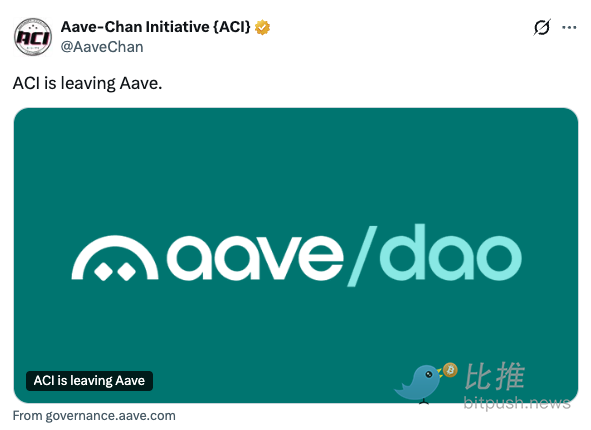
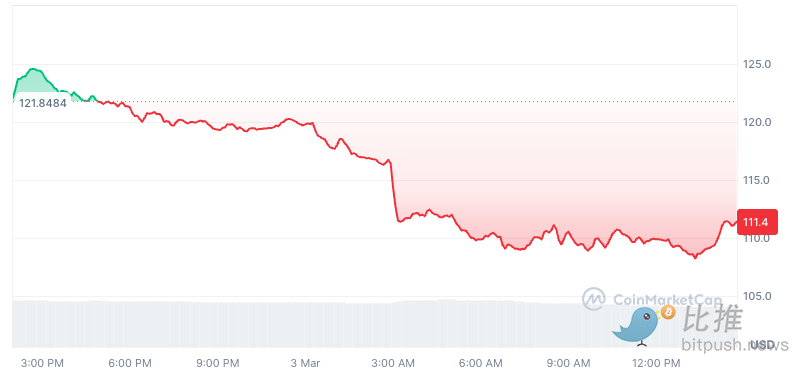
Following the announcement, the price of the AAVE token fell by more than 11%.

As one of the most successful DAOs (Decentralized Autonomous Organizations) in DeFi history, this DeFi leader with nearly $27 billion in TVL (Total Value Locked) is undergoing profound internal turmoil.
From Revenue Attribution Dispute to Bundled Voting

The seeds of this crisis were sown as early as last December.

At that time, Aave Labs replaced the front-end transaction aggregator from ParaSwap to CoW Swap without prior governance discussion. The fees that originally flowed to the DAO treasury instead went into Aave Labs' accounts.

Facing质疑 (query/doubt), Aave founder Stani Kulechov responded: the front-end interface was built by Labs, so the revenue naturally belongs to Labs; the smart contracts and liquidity pools belong to the DAO. This explanation was legally sound but caused discontent within the community.

To quell the controversy, Aave Labs proposed a plan called "Aave Will Win" in February. The proposal主要内容 (main content) included: requesting DAO approval for approximately $51 million in funding for V4 development; in exchange, all future revenue from Aave-branded products would be assigned to the DAO, and Aave V4 would be established as the sole technical foundation, gradually phasing out V3.

The problem was that these three matters were bundled together. Support revenue going to the DAO but think the funding amount is too large? No choice. Believe V3 still has value and shouldn't be sidelined?同样没得选 (Similarly, no choice). Either accept the entire package or reject it entirely.

ACI's Grievance: Opaque Voting

In its exit statement, ACI's core accusation was: a significant portion of the votes supporting the proposal came from addresses associated with Aave Labs. A temperature check vote passed by a narrow margin of 52.58%, and ACI believes the result might have been different without these "self-votes".
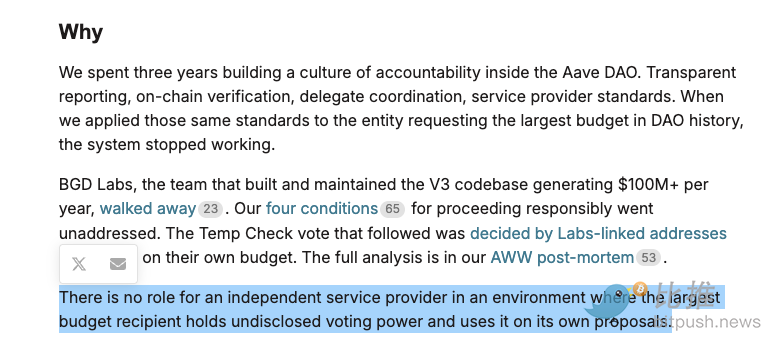
ACI founder Marc Zeller wrote: "If a major budget recipient can use its undisclosed voting power to force through its own proposals, then independent service providers lose their raison d'être within the DAO."

ACI did try to resolve the issue. Before the vote, it proposed four conditions, including stricter on-chain milestone tracking and restrictions on self-voting by budget recipients, but none were adopted.

This conflict reflects structural problems in DAO governance.

Aave Labs controls the codebase, brand domains, social media, and development discourse. BGD Labs maintains the main version V3—it contributes over 75% of the protocol's revenue and 97% of the total deposits. ACI is responsible for governance coordination and business development, claiming to have driven 61% of governance actions over the past three years, helping Aave's DeFi market share rise from less than 50% to over 65%.

These three teams were supposed to check and balance each other. But with BGD and ACI leaving one after another, the remaining power center, no matter how it表态 (states its position), is difficult to be fully trusted.

Stani Kulechov responded after ACI announced its exit: "Thank you Marc for years of contribution, the protocol will continue to operate normally."
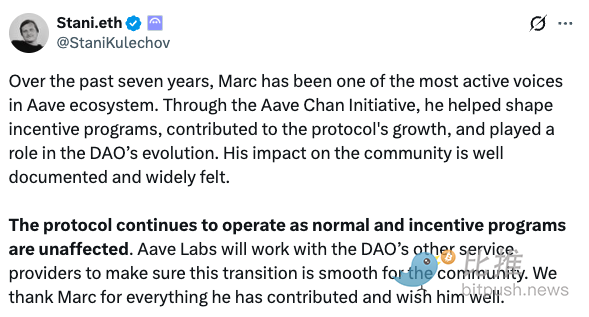
But this response did not address the core issue: when the people most capable of assessing the technical risks of V3 have left, how can the DAO feel confident betting its future on the untested V4?

Another noteworthy detail is that institutional investor Blockchain Capital stated afterwards that they were unable to participate in the snapshot vote with their held AAVE because their custody platform did not support it. This reveals another reality of DAO governance: nominally based on collective decision-making by token holders, voting power is often concentrated in the hands of a few.

DAO's Governance Dilemma

ACI stated that during the four-month transition period, it will transfer or open-source tools and responsibilities such as the governance dashboard, incentive framework, and committee roles. But some things are difficult to transfer: three years of accumulated governance experience, familiarity with protocol details, and the interpersonal network for coordinating different stakeholders.

Data shows that ACI spent $4.6 million from the DAO over the past three years, helping the GHO stablecoin grow from $35 million to $527 million. Who will take over these tasks in the future remains unknown.

This turmoil at Aave is essentially a microcosm of the DAO governance dilemma.

In theory, a DAO is a community of token holders. But in practice, governance is often dominated by the founding team, early investors, and core developers. These roles are both rule-makers, rule-enforcers, and sometimes budget recipients. When conflicts of interest arise, whether "procedural justice" is sufficient becomes the焦点 (focus) of controversy.

A DeFi practitioner commented: "This is not a question of who is right or wrong, but rather that the existing governance mechanisms do not provide an effective way to resolve conflicts when interests and positions diverge."

What Happens Next?

The ARFC (Request for Comments) stage revisions to the "Aave Will Win" proposal will be the first window to observe the direction of events. If the "structural improvements" promised by Kulechov can be implemented, such as unbundling the proposal and clarifying the boundaries of voting behavior, it might draw a line under this turmoil.

If consensus cannot be reached, the most extreme possibility is that BGD and ACI start anew, forking a new protocol. Although liquidity barriers are high, it's not impossible—the simultaneous departure of core developers and the governance team provides both the technical foundation and community basis for a fork.

For Aave, the immediate problem is how to fill the void left by the departure of the two core teams. The longer-term problem is how to find a more sustainable balance between the founder's vision, the interests of core developers, and the will of the community. If the paradox of "power concentration" cannot be resolved, even the strongest protocol may lose its first-mover advantage in endless internal friction.

Author: Bootly


Twitter:https://twitter.com/BitpushNewsCN

Bitpush TG Discussion Group:https://t.me/BitPushCommunity

Bitpush TG Subscription: https://t.me/bitpush

Original link:https://www.bitpush.news/articles/7616451

İlgili Sorular

QWhat was the immediate market reaction to the announcement of Aave Chan Initiative (ACI) shutting down operations?

AThe AAVE token price dropped by over 11%.

QWhat was the core accusation made by ACI in their exit statement regarding the 'Aave Will Win' proposal vote?

AACI alleged that a significant portion of the votes supporting the proposal came from addresses associated with Aave Labs, and that the vote might have failed without this 'self-voting'.

QWhat three main things were bundled together in the controversial 'Aave Will Win' proposal from Aave Labs?

AThe proposal bundled a request for ~$51M in funding for V4 development, the future redirection of all Aave brand product revenue to the DAO, and the establishment of Aave V4 as the sole technical base while phasing out V3.

QAccording to the article, what fundamental problem does Aave's crisis expose about DAO governance?

AIt exposes the structural problem where governance is often dominated by the founding team, early investors, and core developers, who are rule-makers, executors, and budget recipients, creating conflicts of interest that existing mechanisms struggle to resolve.

QWhat is one potential extreme outcome mentioned if a consensus cannot be reached after the departure of BGD Labs and ACI?

AThe most extreme possibility is that BGD and ACI could fork the protocol to create a new one, as their departure provides both the technical foundation and community basis for a fork.

İlgili Okumalar

When AI Starts Paying with USDC, Circle's Victory and the Custodial Challenge of Funds

The article discusses the rise of AI agents as independent economic entities, highlighting that 99% of their payments are made using USDC, positioning Circle as a key beneficiary. Over a nine-month period, AI agents conducted 140 million transactions totaling $43 million, with an average transaction size of $0.31. This shift signifies AI's transition from conceptual to real economic activity, raising questions about financial infrastructure and asset management for autonomous agents. Circle’s three-layer infrastructure—stablecoin issuance, efficient on-chain settlement, and integration with traditional finance—enables seamless micro-payments. However, as AI agents accumulate capital, they will need to manage idle funds, creating opportunities for Real World Asset (RWA) tokenization. Projects like Ondo Finance are making RWA assets machine-readable and programmable, allowing AI agents to automate investments in tokenized treasury bonds or other low-risk assets. The integration of payment and asset management systems could enable AI agents to optimize operational efficiency by automatically investing surplus USDC into yield-generating RWA products. However, challenges remain, including data authenticity, model and liquidity risks, regulatory disparities, and technical security. The article concludes that while Circle provides the "payment nervous system" for AI economies, RWA must evolve to serve as the "energy storage system," ensuring AI agents can manage assets as efficiently as they execute transactions.

比推34 dk önce

When AI Starts Paying with USDC, Circle's Victory and the Custodial Challenge of Funds

比推34 dk önce

İşlemler

Spot
Futures

Popüler Makaleler

ONE Nasıl Satın Alınır

HTX.com’a hoş geldiniz! Harmony (ONE) satın alma işlemlerini basit ve kullanışlı bir hâle getirdik. Adım adım açıkladığımız rehberimizi takip ederek kripto yolculuğunuza başlayın. 1. Adım: HTX Hesabınızı OluşturunHTX'te ücretsiz bir hesap açmak için e-posta adresinizi veya telefon numaranızı kullanın. Sorunsuzca kaydolun ve tüm özelliklerin kilidini açın. Hesabımı Aç2. Adım: Kripto Satın Al Bölümüne Gidin ve Ödeme Yönteminizi SeçinKredi/Banka Kartı: Visa veya Mastercard'ınızı kullanarak anında Harmony (ONE) satın alın.Bakiye: Sorunsuz bir şekilde işlem yapmak için HTX hesap bakiyenizdeki fonları kullanın.Üçüncü Taraflar: Kullanımı kolaylaştırmak için Google Pay ve Apple Pay gibi popüler ödeme yöntemlerini ekledik.P2P: HTX'teki diğer kullanıcılarla doğrudan işlem yapın.Borsa Dışı (OTC): Yatırımcılar için kişiye özel hizmetler ve rekabetçi döviz kurları sunuyoruz.3. Adım: Harmony (ONE) Varlıklarınızı SaklayınHarmony (ONE) satın aldıktan sonra HTX hesabınızda saklayın. Alternatif olarak, blok zinciri transferi yoluyla başka bir yere gönderebilir veya diğer kripto para birimlerini takas etmek için kullanabilirsiniz.4. Adım: Harmony (ONE) Varlıklarınızla İşlem YapınHTX'in spot piyasasında Harmony (ONE) ile kolayca işlemler yapın.Hesabınıza erişin, işlem çiftinizi seçin, işlemlerinizi gerçekleştirin ve gerçek zamanlı olarak izleyin. Hem yeni başlayanlar hem de deneyimli yatırımcılar için kullanıcı dostu bir deneyim sunuyoruz.

208 Toplam GörüntülenmeYayınlanma 2024.12.12Güncellenme 2025.03.21

ONE Nasıl Satın Alınır

Tartışmalar

HTX Topluluğuna hoş geldiniz. Burada, en son platform gelişmeleri hakkında bilgi sahibi olabilir ve profesyonel piyasa görüşlerine erişebilirsiniz. Kullanıcıların ONE (ONE) fiyatı hakkındaki görüşleri aşağıda sunulmaktadır.

活动图片