Original | Odaily Planet Daily (@OdailyChina)
Author|jk
February 28, 2026, the United States and Israel jointly launched a large-scale military strike against Iran. The operation aimed to destroy Iran's nuclear facilities, ballistic missile systems, and military leadership, and publicly declared the intention to overthrow the current Iranian regime. The airstrikes covered multiple cities including Tehran and Isfahan. According to Israeli claims, the Supreme Leader Khamenei has died, and at least 200 people have been killed within Iran.
Iran immediately launched large-scale retaliation, firing missiles and drones at Israel and seven Arab countries hosting US military bases, including Bahrain, Kuwait, Qatar, and the UAE, and announced a blockade of the Strait of Hormuz. The iconic Fairmont hotel on Palm Jumeirah in Dubai caught fire due to missile interception debris, the Burj Khalifa was urgently evacuated, and airspace was closed in multiple Middle Eastern countries. It is reported that both Khamenei and the Iranian President have been relocated to secure locations. The EU, Oman, and other countries have called for restraint, and the international community widely fears this conflict will escalate into a full-scale regional war.
Background: Long-Standing Grievances Reach a Boiling Point
Since late December 2025, Iran has witnessed the largest nationwide protest wave since the 1979 Islamic Revolution. The trigger was the continuous collapse of the Iranian Rial and the worsening economic crisis. The demonstrations quickly spread to over a hundred cities, with some citizens openly calling for the regime's overthrow. The Iranian government responded with violent suppression, with death toll estimates ranging widely between 3,000 and 32,000.
Simultaneously, diplomatic tensions between the US and Iran continued to escalate. In January 2026, US President Trump publicly expressed support for the Iranian protesters and announced the deployment of a large naval force to the Middle East, including two aircraft carriers. On February 6, indirect nuclear talks between the US and Iran were held in Muscat, Oman. However, just hours before the attack, the Omani Foreign Minister still stated that the talks had made "significant progress."
On February 24, Trump, in a State of the Union address, accused Iran of "restarting its nuclear weapons program" and claimed Iran was developing long-range missiles capable of threatening the US mainland, warning that the US would act if necessary. It is reported that Israel had been secretly planning this operation for months, with the specific launch date decided weeks in advance, and did not notify the Iranian negotiating party before the attack.
US-Israel Alliance Launches Large-Scale Airstrikes
On the morning of Saturday, February 28, 2026 (local time), Israel and the United States jointly launched a large-scale military strike against Iran. Israel named the operation "Operation Roaring Lion," while the US Department of Defense named it "Operation Epic Fury." The attack commenced on the first day of the Iranian work week, with millions of Iranians caught in the airstrikes while commuting to work or taking their children to school.
Airstrike targets covered multiple cities including Tehran, Isfahan, Qom, Karaj, and Kermanshah. The US focus was on Iranian ballistic missile facilities and nuclear program-related targets, while Israel targeted the Iranian military and political leadership. It was reported that the official residence of Supreme Leader Ali Khamenei in Tehran was directly hit by seven missiles, with satellite imagery showing severe damage to the complex. Israeli military officials stated that several senior Iranian officials were killed in the initial strikes, though this has not been definitively confirmed.
Iranian Foreign Minister Alaghchi stated that both Khamenei and President Pezeshkian had been safely relocated to a secret location and were unharmed. However, according to a senior Israeli official, "Iran's Supreme Leader Khamenei died in the Israeli airstrike on Iran," while Reuters reported that Khamenei's body had been found.
Latest news update at 9 AM today: Iranian state media has confirmed that Supreme Leader Khamenei has been killed.
In an eight-minute video posted on Truth Social, Trump announced that the US had initiated a "major combat operation" against Iran, aiming to "eliminate the direct threat the Iranian regime poses to the American people," "destroy Iran's missile industry," and stated the intent to "completely eliminate" the Iranian navy. He also addressed members of the Iranian Revolutionary Guard, urging them to lay down their arms in exchange for "full immunity." Trump further addressed the Iranian people, saying: "Your moment of freedom has arrived...... When we are finished, take over your government, it will belong to you. This may be your only chance in generations."
Israeli Prime Minister Netanyahu stated that the joint strike operation would continue for "as long as necessary." Unlike the limited strike in June 2025, this operation is expected to last for several days. Iranian official media, citing Red Cross data, reported that as of the time of reporting, at least 201 people have been killed in the attacks across 24 provinces within Iran.
Iran Launches Comprehensive Retaliation, Multiple Middle Eastern Countries Affected
Iran immediately launched报复, firing a large number of ballistic missiles and drones at Israel and multiple Arab countries hosting US military bases. The Iranian Islamic Revolutionary Guard Corps declared that "all Israeli and US military targets in the Middle East have been strongly struck by Iranian missiles" and stated that "the operation will continue non-stop until the enemy is completely defeated."
In Israel, air raid sirens sounded in multiple locations, with explosions reported in northern regions. Israel's "Iron Dome" defense system intensively intercepted incoming missiles over Jerusalem and Tel Aviv.
In the Persian Gulf region, Bahrain, Kuwait, and the UAE confirmed missile impacts; Saudi Arabia, Iraq, Jordan, and Qatar stated they had successfully intercepted incoming missiles. The Bahraini government confirmed that Manama, the location of the US Navy's Fifth Fleet headquarters, was hit by a missile and condemned this as a "blatant violation of Bahrain's sovereignty." An Iranian drone hit a civilian residential building near the capital of Bahrain, with footage showing the building engulfed in flames.
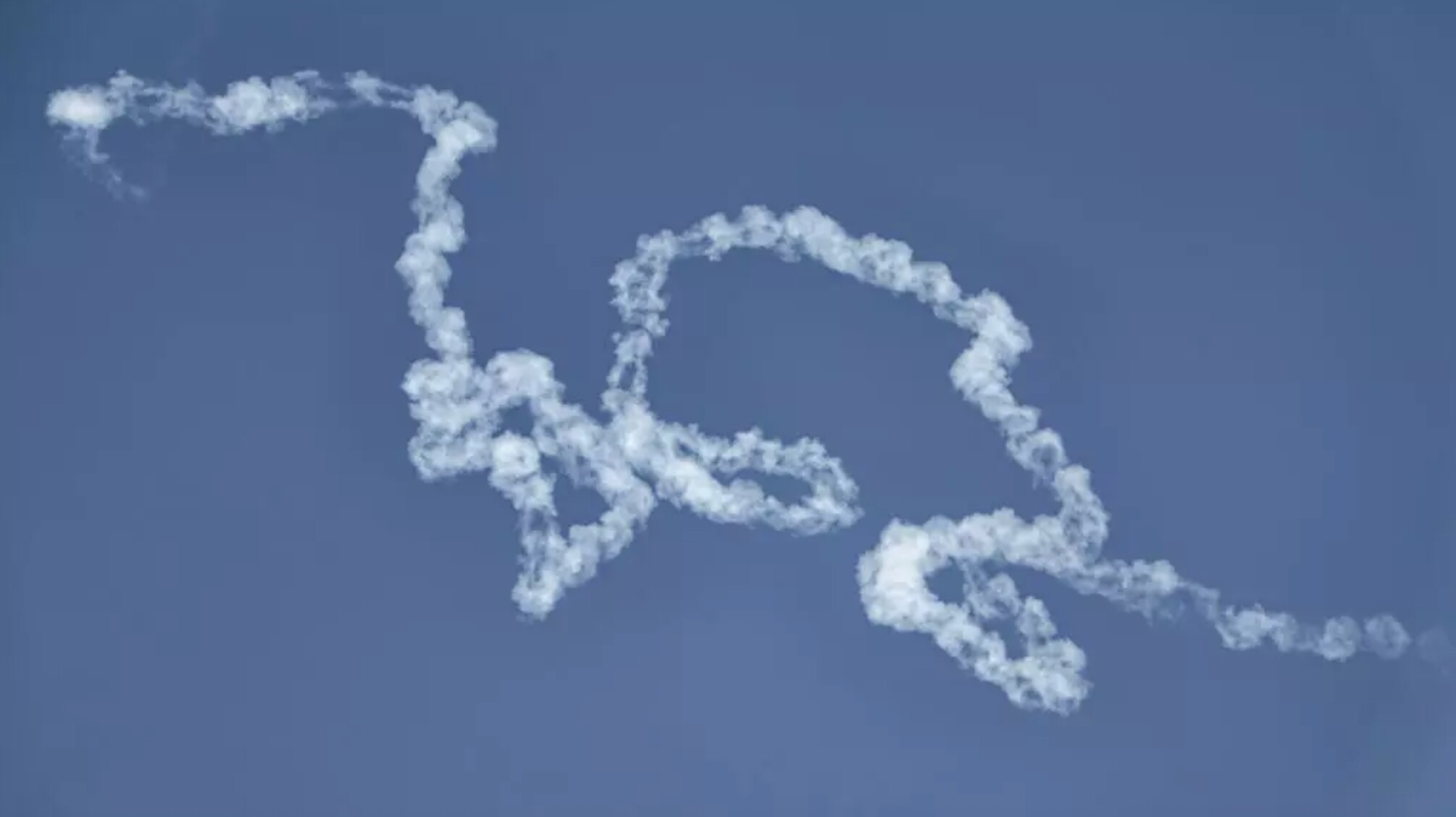
Traces left by air defense systems and penetrating missiles in the skies over Israel. Source: AFP
The Iranian Revolutionary Guard also fired missiles at the Al Udeid Air Base in Qatar. Simultaneously, Yemen's Houthi rebels announced they would resume attack operations in the Red Sea. Iran blockaded the Strait of Hormuz, with the Revolutionary Guard announcing via radio broadcast a ban on all vessel traffic. The airspace over the Middle East region subsequently became paralyzed, with Iran, Israel, Iraq, the UAE, Jordan, Qatar, and other countries closing their airspace, leading to the cancellation of about 24% of flights to and from the Middle East.
Dubai's Palm Jumeirah Hit by Missile Debris, Burj Khalifa Urgently Evacuated
In Iran's comprehensive retaliatory action, Dubai's iconic landmark, Palm Jumeirah, became a shocking global focus. Although Palm Jumeirah was not directly hit by an Iranian missile, after the UAE's air defense system successfully intercepted an Iranian missile in the waters near the Palm, debris from the destroyed missile scattered onto the Palm area, igniting a fire in a building at the five-star Fairmont The Palm hotel.
Eyewitnesses described the scene as extremely chaotic, with thick black smoke billowing from the direction of the hotel and multiple ambulances rushing to the scene with sirens blaring. Several Chinese individuals captured the scene on Xiaohongshu.
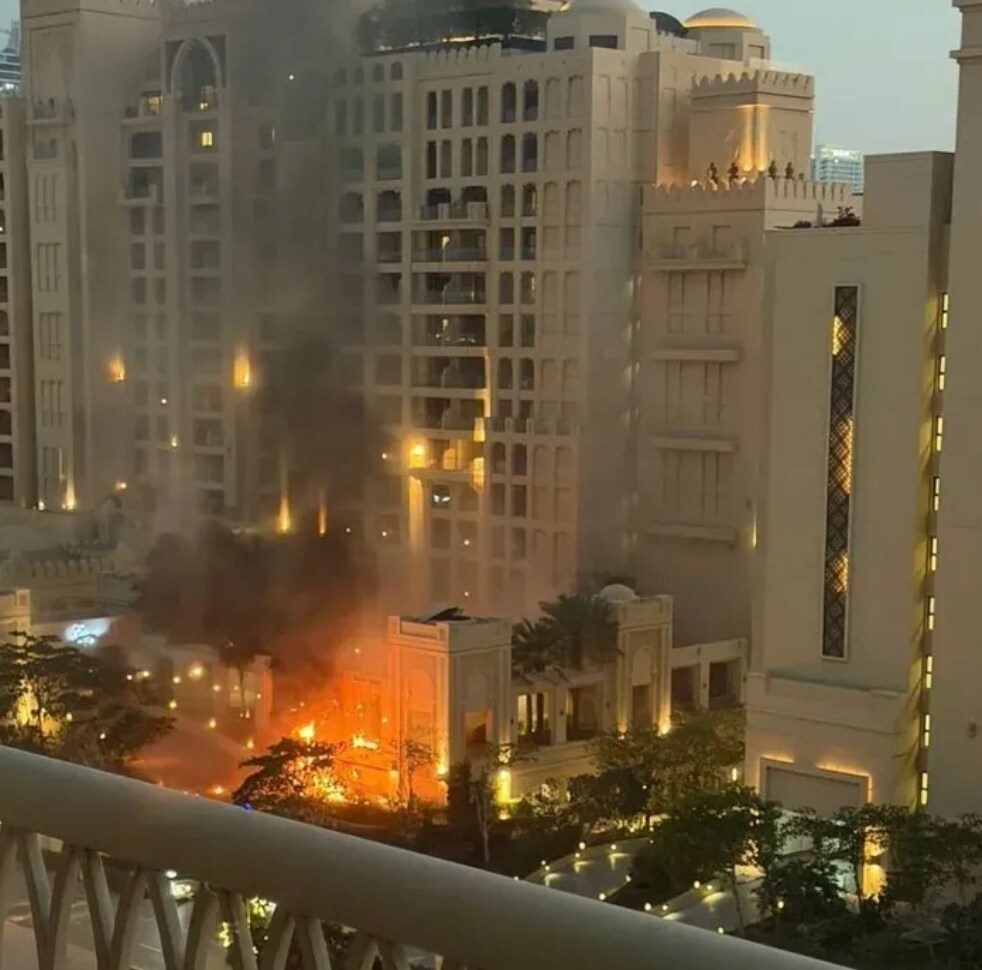
The hotel after the strike. Source: X
Earlier that day, the world's tallest building, the Burj Khalifa, was urgently evacuated due to security concerns. Residents in Abu Dhabi received emergency alerts on their phones instructing them to stay away from windows and immediately take shelter in a safe place, citing the presence of the US Al Dhafra Air Base within the emirate, making it a key target for Iranian strikes. The UAE Ministry of Defense announced that its air defense systems had intercepted "with high efficiency" multiple Iranian missiles and drones and condemned such attacks as "a blatant violation of national sovereignty and international law."
Polymarket Probabilities Skyrocket, Bets Exceed Thirty Million Dollars
The outbreak of this military action left an extremely rare historical trajectory on prediction markets. Multiple related markets on Polymarket saw an instant vertical surge following today's airstrike, with price curves nearly shooting straight to the top.
In the market for "Will Khamenei step down as Supreme Leader by March 31?", the probability, which had long hovered around 20% to 30%, suddenly soared to 95% following today's airstrike, a single-day increase of 87 percentage points. The total trading volume reached $29.31 million, indicating a massive influx of funds betting on regime change after the airstrike news broke.
Another longer-term market, "Will the Iranian regime fall by June 30?", also experienced剧烈波动, with the probability jumping from about 16% to 55%, a single-day increase of 39 percentage points, with a trading volume of $2.37 million.
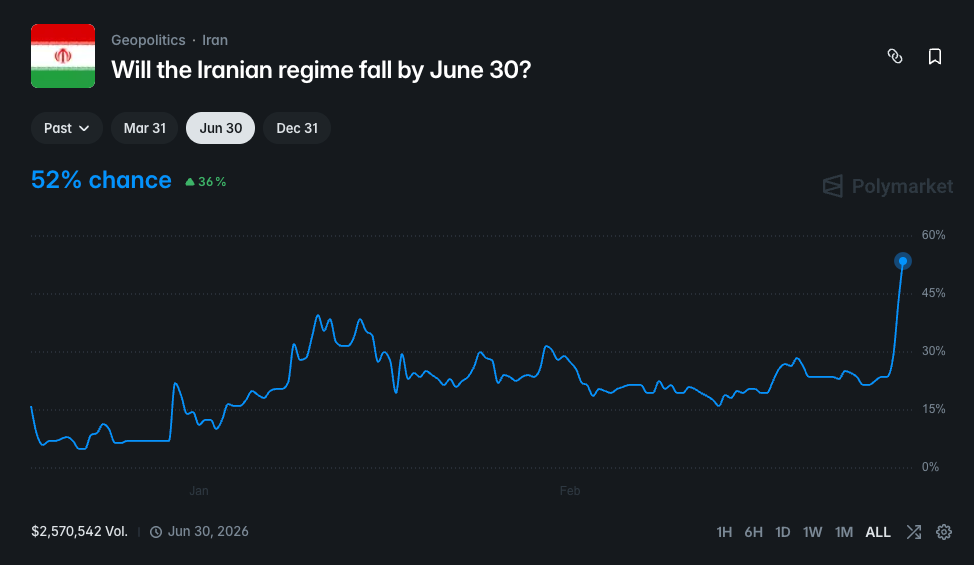
Polymarket market screenshot. Source: Polymarket
Meanwhile, the probability in the "Will the US strike Iran?" related market has risen to 100% and entered the settlement process, causing short positions betting against a strike to be completely liquidated.
Odaily Planet Daily will continue to track the latest developments and bring you reports as they happen.