比特币 vs. 山寨币:您应该看看这张显示另一轮山寨季即将开始的图表

bitcoinist2026-02-27 tarihinde yayınlandı2026-02-27 tarihinde güncellendi

Özet

根据加密货币分析师@CyrilXBT的分析,当前总加密货币市值(排除前十大资产)与比特币的比率已回落至0.129的历史关键水平,这一区域在过去曾多次成为山寨币季节(Alt Season)的起点。该比率在2017-2018年牛市期间突破0.3,在2021年更飙升至0.55以上,创下历史最高纪录。目前市场已从峰值回调,比特币主导地位也有所下降,但这一比率的回落至历史积累区间,可能预示着新一轮山寨币季节正在酝酿。分析师指出,若历史规律重演,本轮周期比率可能瞄准0.80至0.90的目标区间。尽管近期市场表现平淡,但这可能意味着市场已完成重置,并为山寨币的下一轮爆发创造条件。

尽管近期比特币(BTC)价格和主导地位下跌,但与本轮周期前几年相比,关于潜在山寨币季节的讨论已经平息。值得注意的是,一位加密货币分析师分享了一张新的长期图表,显示了山寨币总市值相对于比特币的水平,该水平在历史上曾预示着重大的山寨季。根据他的分析,山寨币市场已完全重置,如果历史趋势按预期发展,可能正在为新一轮山寨币季节做准备。

历史性山寨季格局形成,比特币比率触及基础区域

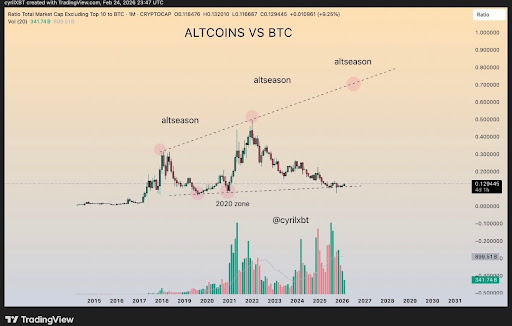
在X平台的最新分析中,市场专家@CyrilXBT分享了一张月度图表,追踪了除前10大资产外的加密货币总市值与比特币的比率。根据分析,该图表目前位于约0.129的水平,分析师称这是加密货币历史上每次重大山寨币季节启动的相同基础或积累区域。

@CyrilXBT指出,这个区域是所有山寨季的诞生地,每次过去的山寨币上涨都是在比率停止下跌并稳定在0.12至0.13美元区间时开始的。查看图表,分析师指出,在2015-2016周期,比率从接近零开始并保持平坦,波动极小。随后,在2017-2018牛市期间出现了戏剧性飙升,将山寨币对比特币的比率推高至0.3以上,标志着第一个重大山寨季。
来源:X

到2020年,该比率暴跌回0.129水平以下,抹去了大部分先前的涨幅,并在低范围的积累/基础区域附近 consolidation。值得注意的是,2021年标志着历史上最大的山寨季飙升,在牛市狂热中,该比率爆炸性上升至0.55以上。在此期间,交易量创下新高,柱状图远超往年。

新的山寨季条件正在形成

与2020年的暴跌类似,2022-2024周期出现了见顶后的修正,随着比特币重获主导地位,该比率呈下降趋势。在当前2025-2026周期中,山寨币对比特币的比率终于回到了历史上重要的0.129积累区域,BTC.D下跌至年度低点57.9%。

@CyrilXBT认为,当前的定位反映了前几年导致山寨币爆炸性增长的山寨季前格局。他指出,图表上连接连续山寨季峰值的上升趋势线指向大约0.80至0.90的比率,作为本轮周期的下一个潜在目标。

随着比率的稳定和历史趋势的重演,@CyrilXBT认为近期的市场表现并不表明山寨币已死。相反,它显示市场已完全重置,并可能正在悄然为其下一个山寨季创造条件

山寨币总市值仍低于1万亿美元 | 来源:Tradingview.com的除BTC外加密货币总市值

Trend Kriptolar

İlgili Sorular

Q根据文章,当前总山寨币市值与比特币的比率处于什么水平?

A当前总山寨币市值与比特币的比率约为0.129,处于历史上多次引发山寨季的积累/基础区域。

Q分析师@CyrilXBT认为当前市场状况与历史上的哪个时期相似?

A分析师认为当前市场状况与2015-2016周期及2020年的积累阶段相似,都是比率稳定在0.12-0.13范围后引发了大规模山寨季。

Q历史上最大的山寨季爆发发生在什么时候?比率达到了多少?

A历史上最大的山寨季爆发发生在2021年,当时山寨币对比特币的比率飙升至0.55以上。

Q文章中提到比特币主导地位(BTC.D)目前处于什么水平?

A比特币主导地位(BTC.D)已降至年度低点57.9%。

Q根据趋势线分析,本轮周期山寨币对比特币比率的下一个潜在目标是多少?

A根据连续山寨季峰值连接形成的上升趋势线,下一个潜在目标比率约为0.80至0.90。

İlgili Okumalar

Crypto Miners' Big AI Gamble: Valuations Enter Differentiation Stage, Comeback Fight Proves Tough

Crypto Mining Firms' AI Bet: Valuation Divergence and a Challenging Transformation Facing declining profitability in crypto mining, mining companies are pivoting to AI infrastructure, capitalizing on their existing power resources, land, and data center expertise to offer GPU compute power. This transition narrative has boosted their stock prices significantly, with firms like Hut 8 and Bitfarms seeing gains over 100% year-to-date, far outpacing Bitcoin. This has led to a market valuation split, with pioneers like CoreWeave reaching a $62.8B market cap, while others remain below $5B. The market currently prioritizes growth potential over short-term profits, which remain under pressure due to heavy capital expenditures for AI build-outs and crypto asset volatility. However, the transformation is a high-stakes gamble. Bitcoin mining profitability is shrinking, with the average production cost around $63,707 and miner margins contracting. While AI offers a more lucrative long-term path, it requires massive investment—estimated at a $500B near-term funding gap. Success now hinges on execution: delivering on contracted power capacity, securing quality tenants like major cloud providers, and managing the immense financial burden. The valuation focus is shifting from mere power capacity to project delivery, future cash flows, and tenant quality, making this a difficult but critical turnaround attempt.

链捕手7 dk önce

Crypto Miners' Big AI Gamble: Valuations Enter Differentiation Stage, Comeback Fight Proves Tough

链捕手7 dk önce

Analysis of the Latest Portfolio Adjustment by the "Top Player" in the U.S. Stock Market: $9 Billion Short on NVIDIA, Shifting Focus to Power and Memory Sectors

AI investor Leopold Aschenbrenner has made a significant portfolio shift, taking a $9 billion nominal short position against top AI infrastructure stocks like NVIDIA, ASML, and Oracle. Simultaneously, he is redirecting capital towards what he sees as the next critical bottlenecks in the AI boom: power, memory, and data center networking, alongside private investments in AI model companies like Anthropic. This move is interpreted not as a call that the AI bubble has burst, but as a rotation within the infrastructure stack. The analysis highlights NVIDIA's recent $25 billion bond issuance as a potential signal, questioning why a cash-rich company would seek external debt despite high profits and increased dividends/buybacks. The core investment thesis is that the initial, crowded "picks and shovels" trade in semiconductors is maturing. The next wave of capital is expected to flow into the physical and logistical constraints of AI expansion: electricity supply, memory chip capacity, data center construction, and enabling technologies like optical networking (fiber) for high-bandwidth communication, where copper remains crucial for short distances. Aschenbrenner's substantial (approx. 20% of fund) private stake in Anthropic is noted as a key part of his strategy—investing directly in the "mine" (AI models) rather than just the "shovels." The discussion concludes that while certain segments may be overvalued, the overarching AI infrastructure demand driven by real product usage remains robust. The most promising long-term investments are seen in essential, non-sexy infrastructure—particularly energy and power companies—whose demand is viewed as a global constant irrespective of AI's cyclicality.

marsbit28 dk önce

Analysis of the Latest Portfolio Adjustment by the "Top Player" in the U.S. Stock Market: $9 Billion Short on NVIDIA, Shifting Focus to Power and Memory Sectors

marsbit28 dk önce

BIT Research: Liquidity is Disappearing, Will Bitcoin Replay the Bottoming Pattern of 2022?

The crypto market is currently in an adjustment phase driven by policy expectations and liquidity shifts. Despite a brief rebound fueled by geopolitical easing and SpaceX's strong IPO performance, unexpectedly hawkish signals from new Fed Chair Kevin Warsh have removed anticipated easing support. Concurrently, stablecoin liquidity is shrinking, with insufficient new capital inflows, pushing the market into a typically quiet summer period. Pricing lacks catalysts for a sustained rally. Daily trading volume has significantly contracted, stablecoin growth has slowed markedly, and the supportive effect of Strategy's (formerly MicroStrategy) STRC preferred stock-financed Bitcoin purchases is fading. Amid policy uncertainty, seasonal weakness, and liquidity contraction, Bitcoin faces near-term downward pressure. Warsh's hawkish pivot and refusal to provide a clear policy outlook have increased risk premiums, historically unfavorable for Bitcoin. Technically, the trend remains bearish below $73,700, with $62,446 as critical support. A break below could accelerate declines, though a prolonged consolidation phase, similar to 2022's bottoming process, is possible. Liquidity is a core constraint. Current daily volume is around $500 billion, roughly 25% of the peak during the July-Oct 2025 rally. The 12-month growth rates for USDT and USDC have fallen to ~20%, with 6-month growth near zero, indicating weak new inflows. Bitcoin ETF and Strategy-driven inflows have also weakened, with a 30-day rolling net outflow. With inflation at 4.2% above the Fed's target, combined hawkish policy, seasonal factors, and liquidity shortages challenge Bitcoin's ability to hold above $60,000. However, this adjustment phase may be forming a cyclical low this summer, potentially setting the stage for the next bull cycle.

marsbit57 dk önce

BIT Research: Liquidity is Disappearing, Will Bitcoin Replay the Bottoming Pattern of 2022?

marsbit57 dk önce

Who Makes the Best Use of Claude Code? The Answer Might Not Be Programmers

Claude Code Usage Report Summary (Based on ~400k sessions) Core Finding: In agentic programming with Claude Code, a clear division of labor has emerged: humans primarily decide *what* to build (planning decisions), while Claude decides *how* to build it (execution decisions). Key Insights: 1. **Effectiveness is not limited to programmers.** In code-generation tasks, success rates for users in non-technical fields (law, finance, management, research) are nearing those of software engineers. What matters most is the user's domain expertise and understanding of the problem to be solved. 2. **Domain expertise drives success and efficiency.** Sessions where users exhibited "expert" proficiency in the task's domain saw verified success rates double compared to "novice" sessions. Experts also delegated more work per instruction, with Claude executing more actions and producing more output. 3. **AI is amplifying, not replacing, domain knowledge.** Claude Code lowers the *implementation* barrier, not the *judgment* barrier. The value of knowing the "what" and "why" is increasing relative to just knowing the "how" to code. 4. **Usage is evolving.** Over a 7-month period (Oct '25 - Apr '26), the share of sessions for debugging halved, while use for software operations, data analysis, and non-code writing roughly doubled. The estimated economic value of typical tasks increased by ~25%. Conclusion: The data suggests coding agents are making programming background less critical for completing technical tasks. However, they reward and amplify deep domain understanding. The ability to successfully direct an AI agent stems more from mastery of a specific field than from coding skill itself. The primary gains come from being competent in a domain; deep specialization adds only marginal additional advantage. This may signal a shift where software creation becomes integrated into various professions.

marsbit1 saat önce

Who Makes the Best Use of Claude Code? The Answer Might Not Be Programmers

marsbit1 saat önce

İşlemler

Spot
Futures

Popüler Makaleler

ALT Nasıl Satın Alınır

HTX.com’a hoş geldiniz! AltLayer (ALT) satın alma işlemlerini basit ve kullanışlı bir hâle getirdik. Adım adım açıkladığımız rehberimizi takip ederek kripto yolculuğunuza başlayın. 1. Adım: HTX Hesabınızı OluşturunHTX'te ücretsiz bir hesap açmak için e-posta adresinizi veya telefon numaranızı kullanın. Sorunsuzca kaydolun ve tüm özelliklerin kilidini açın. Hesabımı Aç2. Adım: Kripto Satın Al Bölümüne Gidin ve Ödeme Yönteminizi SeçinKredi/Banka Kartı: Visa veya Mastercard'ınızı kullanarak anında AltLayer (ALT) satın alın.Bakiye: Sorunsuz bir şekilde işlem yapmak için HTX hesap bakiyenizdeki fonları kullanın.Üçüncü Taraflar: Kullanımı kolaylaştırmak için Google Pay ve Apple Pay gibi popüler ödeme yöntemlerini ekledik.P2P: HTX'teki diğer kullanıcılarla doğrudan işlem yapın.Borsa Dışı (OTC): Yatırımcılar için kişiye özel hizmetler ve rekabetçi döviz kurları sunuyoruz.3. Adım: AltLayer (ALT) Varlıklarınızı SaklayınAltLayer (ALT) satın aldıktan sonra HTX hesabınızda saklayın. Alternatif olarak, blok zinciri transferi yoluyla başka bir yere gönderebilir veya diğer kripto para birimlerini takas etmek için kullanabilirsiniz.4. Adım: AltLayer (ALT) Varlıklarınızla İşlem YapınHTX'in spot piyasasında AltLayer (ALT) ile kolayca işlemler yapın.Hesabınıza erişin, işlem çiftinizi seçin, işlemlerinizi gerçekleştirin ve gerçek zamanlı olarak izleyin. Hem yeni başlayanlar hem de deneyimli yatırımcılar için kullanıcı dostu bir deneyim sunuyoruz.

197 Toplam GörüntülenmeYayınlanma 2024.12.10Güncellenme 2026.06.02

ALT Nasıl Satın Alınır

Tartışmalar

HTX Topluluğuna hoş geldiniz. Burada, en son platform gelişmeleri hakkında bilgi sahibi olabilir ve profesyonel piyasa görüşlerine erişebilirsiniz. Kullanıcıların ALT (ALT) fiyatı hakkındaki görüşleri aşağıda sunulmaktadır.

活动图片