Gagnants et perdants hebdomadaires du marché crypto – PIPPIN, ZEC, MYX, APT

ambcrypto2026-02-15 tarihinde yayınlandı2026-02-15 tarihinde güncellendi

Özet

Après des semaines de lourdes pertes, le marché crypto a finalement vu une embellie. Bitcoin et Ethereum ont affiché des performances mitigées, mais l’ambiance globale s’est nettement améliorée grâce à un rapport d’inflation américain montrant une hausse des prix plus lente (inflation à 2,4%) et un marché du travail solide, alimentant les espoirs d’une baisse prochaine des taux d’intérêt. Parmi les gagnants hebdomadaires, PIPPIN a réalisé une percée massive, grimpant de plus de 280% en une semaine pour dépasser 0,72 $. ZCash (ZEC) a gagné 33% après des déclarations optimistes du PDG de Digital Currency Group, et Humanity Protocol (H) a atteint de nouveaux sommets avec une hausse de près de 90%, soutenue par son intégration avec Fireblocks. D’autres comme Dogecoin, Shiba Inu et Pi ont également enregistré des gains notables. Côté perdants, MYX Finance (MYX) a chuté de près de 70%, victime d’une forte pression vendeuse et d’indicateurs techniques en territoire oversold. Memecore (M) a reculé de plus de 10%, et Aptos (APT) a perdu du terrain, luttant pour se stabiliser. Story (IP), Bitget Token (BGB) et DoubleZero (2Z) ont également clôturé en baisse. La semaine rappelle que les situations peuvent basculer rapidement : le meilleur performant peut devenir le plus grand perdant la semaine suivante. Restez curieux, prudent et effectuez toujours vos propres recherches avant de succomber à l’engouement.

Après des semaines de lourdes pertes, le marché crypto a finalement vu une lueur d'espoir.

Bitcoin [BTC] et Ethereum [ETH] ont affiché des performances faibles, mais l'humeur générale s'est considérablement améliorée. Ceci est survenu après qu'un rapport sur l'inflation américaine a montré une hausse des prix plus lente, l'inflation tombant à 2,4%.

Le marché du travail est également resté solide, suscitant l'espoir que la Fed pourrait baisser les taux d'intérêt bientôt. Cela aide souvent la crypto.

Alors que les plus grandes pièces sont restées calmes, plusieurs jetons plus petits ont enregistré des gains majeurs… et des pertes. Alors, prenez vos cafés et thés ! Voici un aperçu rapide des plus grands mouvements de cette semaine.

Gagnants hebdomadaires

Des achats soutenus propulsent pippin [PIPPIN] dans une rupture mammouth

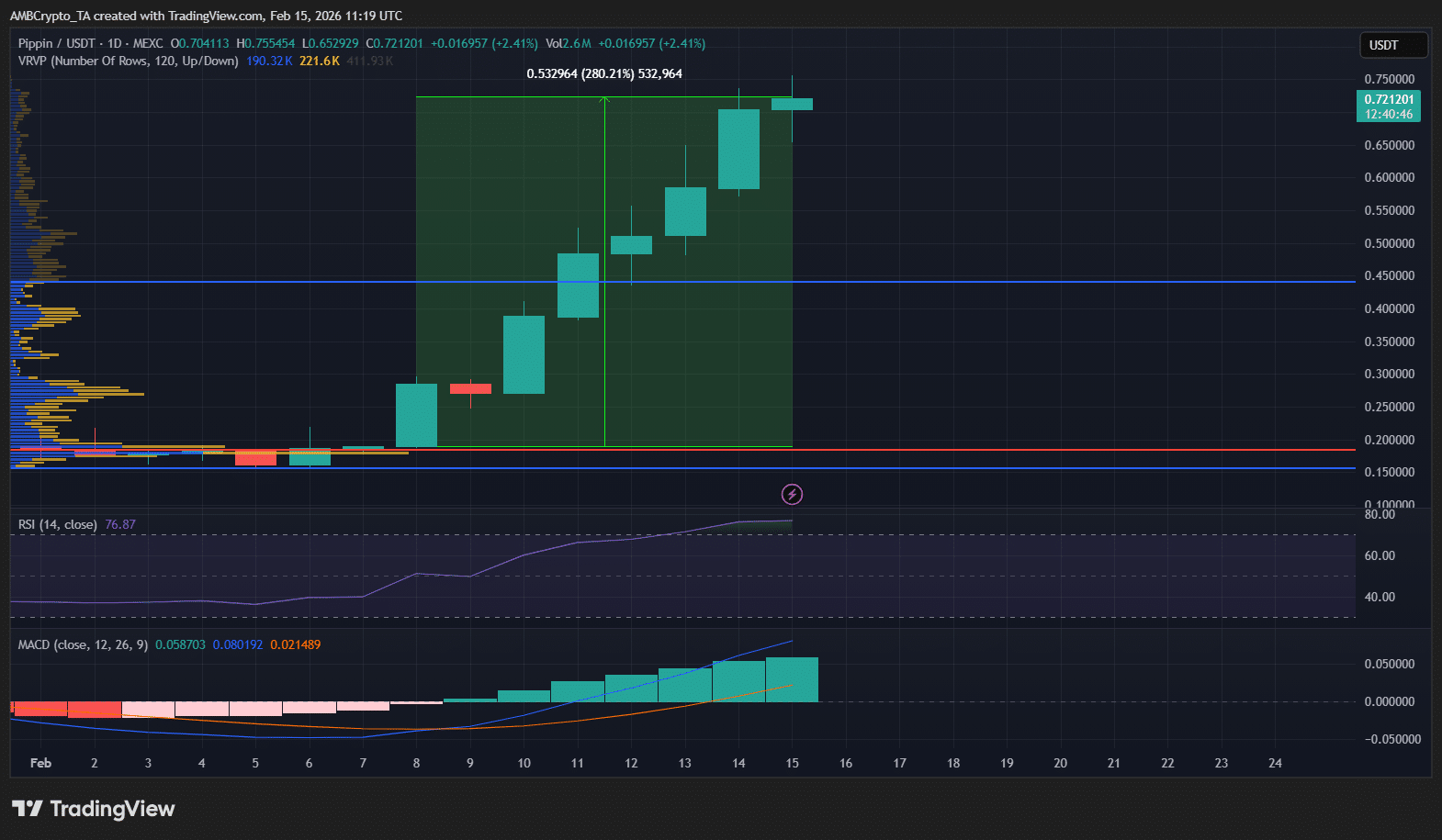
pippin [PIPPIN] a grimpé de la zone d'accumulation de 0,16 $ - 0,20 $ à plus de 0,72 $, un gain de plus de 280 % en un peu plus d'une semaine !

La plupart des activités de trading étaient concentrées près de la fourchette basse, ce qui signifiait que les acheteurs ont construit des positions solides avant la rupture.

Une fois que le prix a dépassé cette zone à fort volume, la résistance s'est amincie et le mouvement à la hausse s'est produit plus rapidement.

Le RSI a montré de la demande mais n'a montré aucun signe d'inversion. Le MACD était également haussier.
Source : TradingView

Avec un nombre croissant de portefeuilles et des incitations actives, la rallye de PIPPIN a été poussée par des achats graduels. La tendance pourrait encore avoir de la marge pour continuer.

ZCash [ZEC] dynamisé par les déclarations du PDG de DCG

Zcash [ZEC] a bondi de 33 % cette semaine après que Barry Silbert, PDG de Digital Currency Group, a déclaré que 5 % à 10 % des investissements en Bitcoin [BTC] pourraient aller vers les pièces de confidentialité dans les années à venir.

Il a également qualifié Zcash de projet capable de générer des rendements de 500x !

ZEC est passé d'environ 230 $ à plus de 330 $ avant de se stabiliser à 307 $. Ceci est survenu après des jours de consolidation, donc les investisseurs achetaient avant le mouvement. Le RSI était à 51, se redressant de niveaux faibles.

Humanity Protocol [H] atteint de nouveaux sommets

Humanity Protocol [H] a négocié près de 0,23 $ après avoir gagné près de 90 % par rapport à sa base récente autour de 0,12 $. La série régulière de plus hauts et de plus bas plus élevés prouve que le pic était soutenu par des achats.

Le RSI est resté au-dessus de 70, tandis que le MACD est resté haussier.

Cette croissance est intervenue parallèlement à l'intégration de Humanity Protocol avec Fireblocks. Ce développement ouvre l'accès à plus de 2 000 institutions financières, permettant aux investisseurs professionnels de garder et d'interagir avec H.

Dans le même temps, son mainnet axé sur la confidentialité et son infrastructure d'identité décentralisée suscitent l'intérêt.

Autres gagnants notables

Dogecoin [DOGE] est monté de 18 % au moment de la rédaction. Shiba Inu [SHIB] a suivi avec une hausse de 12 %, soutenue par l'activité des particuliers. Pendant ce temps, Pi [PI] a mené le groupe avec une rallye de 30 % !

Perdants hebdomadaires

MYX Finance [MYX] baisse avec la pression de vente

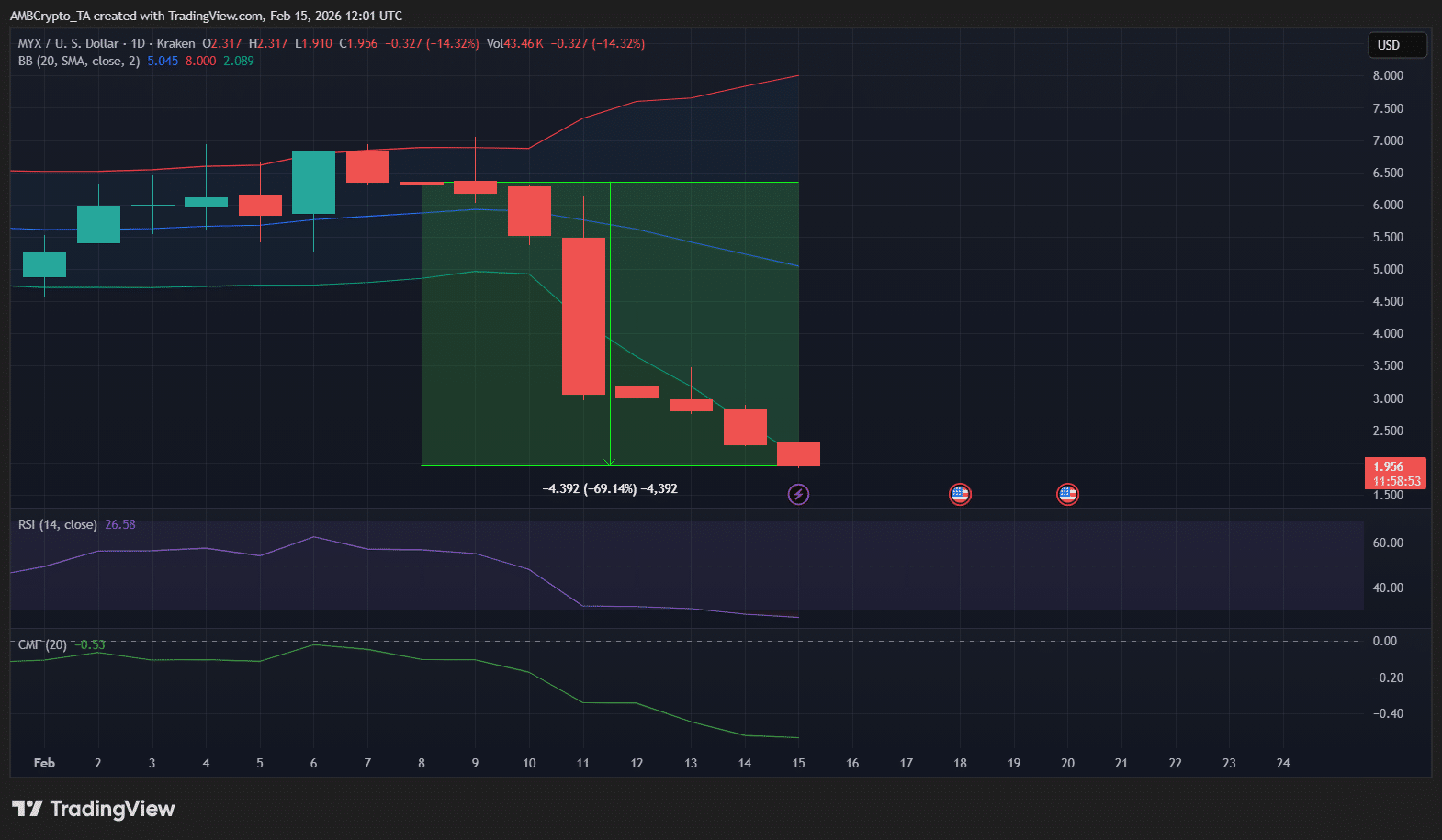
MYX Finance [MYX] a chuté de près de 70 %, passant d'environ 6,30 $ à moins de 2,00 $, selon le graphique quotidien.

Le déclin a suivi une période de consolidation près de la bande de Bollinger supérieure, après quoi le prix a cassé et a continué à former des plus bas.
Source : TradingView

Le RSI est tombé à 26, mettant MYX profondément en territoire de survente. En même temps, le CMF était négatif, donc le capital sortait.

À moins que les acheteurs n'interviennent pour défendre les niveaux actuels, MYX pourrait continuer à faire face à une pression baissière à court terme.

Memecore [M] s'affaiblit avec un rythme qui s'estompe

Memecore [M] a été sous pression après avoir échoué à maintenir ses sommets de début février près de 1,85 $. Il y a eu un rejet suivi d'un déclin régulier, le prix étant d'environ 1,27 $ au moment de la rédaction.

C'est une baisse de plus de 10 % lors des dernières sessions.

Le jeton a tenté de se stabiliser entre 1,30 $ et 1,45 $, mais des plus hauts répétés plus bas ont prouvé le manque de confiance des acheteurs. Le RSI est tombé à 41.

La rallye précédente a été accueillie par de fortes ventes à des niveaux plus élevés, forçant M dans une phase de consolidation.

Aptos [APT] perd pied

Aptos [APT] est passé d'environ 1,10 $ à moins de 1,00 $, une tendance baissière régulière avant de trouver un faible support près de 0,90 $. Bien qu'il y ait eu un petit rebond depuis, la reprise n'a pas été assez forte pour retourner la situation.

Le RSI était proche du territoire de survente à 29. Pendant ce temps, l'OBV était faible, donc les acheteurs n'étaient pas revenus en force.

APT tente de se stabiliser, mais la confiance semble encore fragile. À moins qu'il ne puisse reconquérir de manière convaincante la fourchette 1,00 $ - 1,10 $, le jeton pourrait être coincé dans une phase de reprise fragile.

Autres perdants notables

Story [IP] a chuté de 6 %, tandis que Bitget Token [BGB] a baissé de 7 % avec un rythme qui s'estompe. Pendant ce temps, DoubleZero [2Z] a enregistré la pire baisse du groupe, glissant de 13 % alors que les vendeurs prenaient le contrôle.

Et voilà la semaine en crypto !

S'il y a toujours un enseignement à retenir, c'est celui-ci. Les choses peuvent basculer rapidement ; le meilleur gagnant d'aujourd'hui peut facilement devenir le plus grand perdant de la semaine prochaine. Alors, restez curieux, restez prudents et faites toujours votre propre recherche (DYOR) avant de courir après le battage médiatique.

Nous surveillerons les graphiques, et nous vous verrons la semaine prochaine !


Résumé final

  • PIPPIN a bondi de 280 %, Humanity Protocol a augmenté de 90 % et Zcash a gagné 33 %.
  • L'élan du marché va bien au-delà des pièces majeures.
Suivant : BONK bondit de 11 % après une rupture de canal : Inversion ou configuration de squeeze haussier ?
Partager
  • Partager
  • Tweeter

İlgili Okumalar

Dalio's Latest Warning: Don't Get Carried Away by AI, Real Returns on US Stocks in the Next 5-10 Years Could Be -5% to -10%

Ray Dalio, founder of Bridgewater Associates, warns investors against excessive concentration in AI stocks. He argues the current market, dominated by a few AI giants, mirrors historical patterns where revolutionary new technologies lead to high risk, volatility, and uncertainty. While acknowledging AI's transformative potential, Dalio emphasizes that most investors fail at this stage of the cycle by over-concentrating in a handful of leading companies. He cites inherent risks: companies cannot accurately forecast investment needs or external shocks (e.g., monetary policy, geopolitics, taxes), face potential disruption from future technologies and international competition (notably from China), and experience significant price swings. Dalio's core advice is diversification, calling it his "Holy Grail of Investing." He presents a mathematical case that a well-diversified portfolio of 15-20 uncorrelated, good bets offers a superior risk-adjusted return compared to a concentrated position. Dalio also offers a cautious outlook, suggesting U.S. stocks may deliver real returns of -5% to -10% over the next 5-10 years based on valuation and bubble indicators. He concludes that in the face of high uncertainty, the prudent strategy is not to avoid betting entirely, but to avoid large, concentrated bets where one lacks sufficient informational edge. Instead, investors should build a strategically balanced, diversified portfolio.

marsbit28 dk önce

Dalio's Latest Warning: Don't Get Carried Away by AI, Real Returns on US Stocks in the Next 5-10 Years Could Be -5% to -10%

marsbit28 dk önce

Rain Valuation Approaches $20 Billion: The Battle for U-Cards Extends to Rewards Systems

Rain, a stablecoin payments infrastructure company, is shifting the competitive focus for U Cards from simple issuance to user retention and repeated usage. On June 15, Rain launched "Rain Rewards," an embedded loyalty program capability within its card-issuing infrastructure. This allows partner businesses—like fintech platforms and neobanks—to configure branded loyalty points, earning rules, redemptions, and merchant promotions directly within their card products. The system, built from the 2025 acquisition of Uptop, ensures points are only issued upon final transaction settlement, preventing liabilities from refunds. Trials, such as with Avalanche Card, reportedly boosted spending by 25% among enrolled users. Founded by Farooq Malik and Charles Yoo-Naut, Rain evolved from a tool for managing Web3 company expenses into a full-stack enterprise platform. It is a Principal Member of Visa and Mastercard, enabling partners to issue stablecoin-backed cards and wallets while leveraging traditional payment networks. Notably, the popular U Card Plasma One is issued by Rain under Visa's authority. Rain also integrates with Visa's stablecoin settlement pilot, using USDC for network settlement. Rain's rapid funding reflects growing institutional interest in stablecoin payment infrastructure. It raised a $245 million Series A in March 2025, a $58 million Series B in August 2025, and a $250 million Series C in January of this year, reaching a $19.5 billion valuation. Annualized transaction volume exceeds $3 billion, serving over 200 partners including Western Union and Nuvei. Beyond cards, Rain is expanding into programmable payments. Its June 2026 "Agent Control Layer" allows businesses to set spending rules—like merchant categories, amounts, and frequency—for AI agents before transactions occur. This positions Rain not as a single product but as an operating system for stablecoin payments, handling everything from card issuance and wallet management to rewards, on/off-ramps, and automated compliance. The goal is to enable seamless, often invisible, real-world spending of on-chain assets.

Foresight News31 dk önce

Rain Valuation Approaches $20 Billion: The Battle for U-Cards Extends to Rewards Systems

Foresight News31 dk önce

Google TPU Shipments Revised Up by 50%

Recent industry research indicates a significant upward revision in the shipments of Google's TPU (Tensor Processing Unit) chips. Previous expectations for 2027 were set at around 10 million units, but new estimates now point to 15 million units, a 50% increase. This substantial boost directly translates to higher demand across the entire supporting supply chain. Google's TPU clusters utilize a standardized all-optical interconnect architecture. Consequently, key hardware components are deeply integrated and scaled in fixed ratios with the chips. The 15 million TPU target will drive corresponding demand increases for NPO optical engines (roughly a 1:1 match), 1.6T optical modules, OCS optical switches, high-end server power supplies, fiber optics & MPO connectors, and liquid cooling solutions. Among these, liquid cooling is highlighted as the sector experiencing the most significant transformation and offering the most stable potential for excess returns. As next-generation TPU chips reach power levels where traditional air cooling is insufficient, liquid cooling becomes essential. 2026 is forecasted as the first year of substantial adoption for Google's liquid cooling solutions. This shift, coupled with delivery and capacity bottlenecks faced by incumbent overseas manufacturers, is creating a prime window for domestic Chinese suppliers to enter and secure Google's core supply chain. The market size for Google-specific liquid cooling is projected to potentially triple from a baseline of hundreds of billions to around 300 billion units by 2028. The logic for the fiber optic sector is also being rewritten. Once considered a cyclical commodity tied to telecom operator procurement, fiber is now a strategic and scarce resource for AI Data Centers (AIDC). A severe supply-demand imbalance, driven by the long lead time for preform production (18-24 months) and surging demand from cloud giants, is supporting strong performance. Chinese fiber manufacturers are well-positioned to capture a significant share of global AIDC demand, with exports potentially reaching 200-300 million core kilometers in 2026. Overall, the investment focus within the AI computing industry is shifting from pure "chip performance speculation" towards the more certain incremental growth in computing infrastructure and its supporting ecosystem. The upward revision in Google TPU shipments, along with the potential for further doubling by 2028, is seen as solidifying performance visibility for the entire supporting supply chain over the next two years.

marsbit2 saat önce

Google TPU Shipments Revised Up by 50%

marsbit2 saat önce

What Wall Street Really Wants After the Crypto Story Recedes

The tide of speculative crypto narratives has receded, revealing Wall Street's true objective: building a controlled, yield-generating, and compliant financial pipeline on distributed ledgers. They are migrating core functions onto blockchains, not for decentralization, but for efficiency and new revenue streams. Key developments include BlackRock's BUIDL fund, a tokenized treasury fund acting as a foundational reserve asset, and the rise of Securitize, which is going public and partnering with the NYSE to build a 24/7 digital securities trading and settlement system. This signals a major shift of securities clearing to blockchain technology. To make volatile assets like Bitcoin palatable for institutional investors, firms like BlackRock and Goldman Sachs are creating "covered call" ETFs (e.g., BITA). These products systematically sell options on Bitcoin holdings, transforming price volatility into stable monthly income, effectively repackaging crypto as a yield-bearing asset. Stablecoins are being positioned not as speculative tools but as efficient payment rails. Companies like Stripe and Mastercard are integrating them for instant, low-cost merchant settlements and cross-border card payments, respectively. Critically, new legislation like the GENIUS Act shapes them as non-interest-bearing, heavily regulated extensions of the US dollar system. In summary, Wall Street is quietly constructing a parallel, blockchain-based financial infrastructure featuring tokenized traditional assets, structured crypto yields, and programmable dollar pipelines—all under its control and fully integrated with existing regulatory and credit frameworks.

marsbit2 saat önce

What Wall Street Really Wants After the Crypto Story Recedes

marsbit2 saat önce

İşlemler

Spot
Futures

Popüler Makaleler

ZEC Nasıl Satın Alınır

HTX.com’a hoş geldiniz! Zcash (ZEC) satın alma işlemlerini basit ve kullanışlı bir hâle getirdik. Adım adım açıkladığımız rehberimizi takip ederek kripto yolculuğunuza başlayın. 1. Adım: HTX Hesabınızı OluşturunHTX'te ücretsiz bir hesap açmak için e-posta adresinizi veya telefon numaranızı kullanın. Sorunsuzca kaydolun ve tüm özelliklerin kilidini açın. Hesabımı Aç2. Adım: Kripto Satın Al Bölümüne Gidin ve Ödeme Yönteminizi SeçinKredi/Banka Kartı: Visa veya Mastercard'ınızı kullanarak anında Zcash (ZEC) satın alın.Bakiye: Sorunsuz bir şekilde işlem yapmak için HTX hesap bakiyenizdeki fonları kullanın.Üçüncü Taraflar: Kullanımı kolaylaştırmak için Google Pay ve Apple Pay gibi popüler ödeme yöntemlerini ekledik.P2P: HTX'teki diğer kullanıcılarla doğrudan işlem yapın.Borsa Dışı (OTC): Yatırımcılar için kişiye özel hizmetler ve rekabetçi döviz kurları sunuyoruz.3. Adım: Zcash (ZEC) Varlıklarınızı SaklayınZcash (ZEC) satın aldıktan sonra HTX hesabınızda saklayın. Alternatif olarak, blok zinciri transferi yoluyla başka bir yere gönderebilir veya diğer kripto para birimlerini takas etmek için kullanabilirsiniz.4. Adım: Zcash (ZEC) Varlıklarınızla İşlem YapınHTX'in spot piyasasında Zcash (ZEC) ile kolayca işlemler yapın.Hesabınıza erişin, işlem çiftinizi seçin, işlemlerinizi gerçekleştirin ve gerçek zamanlı olarak izleyin. Hem yeni başlayanlar hem de deneyimli yatırımcılar için kullanıcı dostu bir deneyim sunuyoruz.

570 Toplam GörüntülenmeYayınlanma 2024.12.12Güncellenme 2026.06.02

ZEC Nasıl Satın Alınır

Tartışmalar

HTX Topluluğuna hoş geldiniz. Burada, en son platform gelişmeleri hakkında bilgi sahibi olabilir ve profesyonel piyasa görüşlerine erişebilirsiniz. Kullanıcıların ZEC (ZEC) fiyatı hakkındaki görüşleri aşağıda sunulmaktadır.

活动图片