In-Depth Report on the Privacy Coin Sector: A Paradigm Shift from Anonymous Assets to Compliant Privacy Infrastructure

HTX Learn2026-01-22 tarihinde yayınlandı2026-04-22 tarihinde güncellendi

Özet

As institutional capital continues to account for a rising share of the crypto market, privacy is evolving from a marginalized demand for anonymity into a core infrastructure capability required for blockchain’s integration into the real financial system. Public transparency was once regarded as blockchain’s most fundamental value proposition. However, as institutional participation becomes the dominant force, this very feature is revealing structural limitations. For enterprises and financial institutions, the full exposure of transactional relationships, position structures, and strategic timing constitutes a material commercial risk in itself. Privacy is therefore no longer an ideological choice, but a prerequisite for blockchain’s transition toward scalable and institutionalized adoption. Competition in the privacy sector is also accordingly shifting from a race for “maximum anonymity” to a test of “institutional compatibility”.

I. The Institutional Ceiling of Full Anonymity: Strengths and Constraints of the Monero Model

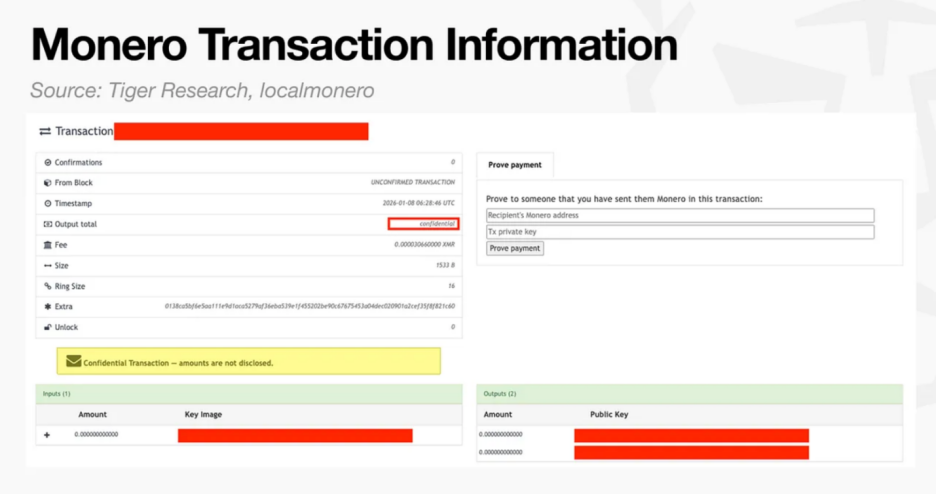
Fully anonymous privacy models, represented by Monero, constitute the earliest and “purest” technical path within the privacy sector. Their core objective is not to strike a balance between transparency and privacy, but to minimize observable on-chain information to the greatest extent possible, severing the ability of third parties to extract transactional semantics from a public ledger. In pursuit of this goal, Monero employs mechanisms such as ring signatures, stealth addresses, and Ring Confidential Transactions (RingCT), simultaneously obscuring the three key elements of a transaction: sender, recipient, and amount. External observers can verify that “a transaction has occurred”, but are unable to deterministically reconstruct transaction paths, counterparties, or value. For individual users, this “privacy by default, privacy without conditions” experience is highly compelling. It turns privacy from an optional feature into a system-wide norm, significantly reducing the risk that financial behavior is persistently tracked by data analytics tools, and granting users a level of anonymity and unlinkability in payments, transfers, and asset holdings that closely resembles cash.

At a technical level, the value of full anonymity lies not merely in “concealment”, but in its systematic resistance to on-chain analysis. The greatest externality of transparent blockchains is “composable surveillance”: Public information from individual transactions is continuously pieced together through address clustering, behavioral pattern recognition, and cross-referencing with off-chain data, gradually linking on-chain activity to real-world identities and ultimately forming monetizable and potentially abusive “financial profiles”. Monero’s significance lies in raising the cost of this process to prohibitively high levels that discourage such behavior. When large-scale, low-cost attribution analysis is no longer reliable, both the deterrent effect of surveillance and the feasibility of fraud are reduced. In this sense, Monero is not designed solely for “bad actors”; it also responds to a more fundamental reality: In a digital environment, privacy is an integral component of security. However, the fundamental limitation of full anonymity is that it is irrevocable and unconditional. For financial institutions, transaction information is not only essential for internal risk management and auditing, but also a legally mandated carrier of compliance obligations. Institutions must retain traceable, explainable, and submit-ready evidence under frameworks such as KYC/AML, sanctions compliance, counterparty risk management, anti-fraud controls, taxation, and accounting audits. Fully anonymous systems permanently “lock away” this information at the protocol level, rendering institutions structurally incapable of compliance even if they are subjectively willing to comply. When regulators require explanations of fund sources, proof of counterparty identity, or disclosure of transaction amounts and purposes, institutions cannot reconstruct critical information from the chain, nor can they provide verifiable disclosures to third parties. This is not a case of “regulators failing to understand technology”, but a direct collision between institutional objectives and technical design. The baseline of modern finance is “auditability when necessary”, whereas the baseline of full anonymity is “non-auditability under any circumstances”.
The external manifestation of this conflict is the systematic exclusion of strongly anonymous assets from mainstream financial infrastructure: exchange delistings, lack of support from payment and custody providers, and the inability of compliant capital to integrate into the infrastructure. Importantly, this does not mean that genuine demand for anonymity disappears. Instead, demand often migrates to more opaque, higher-friction channels, fostering “compliance vacuums” and the proliferation of gray intermediaries. In Monero’s case, instant exchange services have, at times, absorbed substantial purchasing and conversion demand. Users pay higher spreads and fees for accessibility, while bearing risks related to fund freezes, counterparty exposure, and lack of transparency. More critically, such intermediaries can introduce persistent structural sell pressure. When service providers rapidly convert collected Monero fees into stablecoins and cash out, the market experiences continuous passive selling unrelated to organic buy demand, suppressing price discovery over the long term. A paradox thus emerges: The more excluded an asset is from compliant channels, the more demand concentrates in high-friction intermediaries; the stronger these intermediaries become, the more distorted price formation becomes; and the more distorted prices are, the harder it is for mainstream assets to assess and enter the market through “normal” channels. This vicious cycle is not evidence that “the market rejects privacy”, but rather the outcome of institutional constraints and channel structures.

Therefore, any assessment of the Monero model should move beyond moralized debate and return to the realities of institutional compatibility. Fully anonymous privacy is “secure by default” in the individual realm, but “unviable by default” in the institutional realm. The more absolute its advantages, the more rigid its constraints. Even if the privacy narrative gains renewed momentum, fully anonymous assets will likely remain concentrated in non-institutional use cases and specific communities. In the institutional era, mainstream finance is far more likely to adopt models of “controlled anonymity” and “selective disclosure”: protecting commercial confidentiality and user privacy while enabling authorized auditability and regulatory evidence when required. In other words, Monero is not a technological failure, but a solution locked into a use case that institutions cannot accommodate. It proves that strong anonymity is technically feasible, while equally demonstrating that, in a compliance-driven financial era, the competitive focus of privacy will shift from “hiding everything” to “proving everything when necessary”.


II. The Rise of Selective Privacy

As fully anonymous privacy approaches its institutional ceiling, the privacy sector is undergoing a directional shift. “Selective privacy” is emerging as a new technological and institutional compromise. Its core objective is not to oppose transparency, but to introduce controllable, authorizable, and disclosable privacy layers on top of a verifiable ledger. The underlying logic of this transition fundamentally lies in that privacy is no longer framed as a tool to evade regulation, but redefined as an infrastructure capability that can be leveraged by institutional systems. Zcash represents the most prominent early implementation of the selective privacy approach. By allowing transparent addresses (t-addresses) and shielded addresses (z-addresses) to coexist, it gives users the freedom to choose between public and private transactions. When shielded addresses are used, the sender, recipient, and amount are encrypted on-chain; when compliance or audit needs arise, users can disclose full transaction details to designated third parties via view keys. Conceptually, this architecture is a milestone. It was among the first mainstream privacy projects to explicitly demonstrate that privacy does not have to come at the expense of verifiability, and that compliance does not necessarily require full transparency.

From an institutional evolution perspective, Zcash’s value lies less in adoption metrics than in its role as a proof of concept. It demonstrates that privacy can be optional rather than a system default, and that cryptographic tools can reserve technical interfaces for regulatory disclosure. This is particularly relevant in today’s regulatory environment where major jurisdictions have not rejected privacy per se, but have firmly opposed “unauditable anonymity”. Zcash’s design directly addresses this core concern. However, as selective privacy moves from “personal transfer tools” to “institutional transaction infrastructure”, Zcash’s structural limitations become apparent. Its privacy model remains fundamentally a transaction-level binary choice: A transaction is either fully public or fully private. For real-world financial scenarios, this binary structure is overly simplistic. Institutional transactions involve not just “two counterparties”, but a variety of participants and responsibility holders. Counterparties need to verify contractual performance, clearing and settlement institutions require visibility into amounts and timing, auditors must validate complete records, and regulators may only be concerned with fund provenance and compliance attributes. These stakeholders have asymmetric and partially overlapping information requirements.

In such contexts, Zcash cannot modularize transaction data or support differentiated authorization. Institutions cannot disclose only “necessary information”, but must choose between full disclosure and full concealment. As a result, once integrated into complex financial workflows, Zcash either exposes excessive commercially sensitive information or fails to meet baseline compliance requirements. Its privacy capabilities therefore struggle to embed into real institutional processes, remaining largely peripheral or experimental. By contrast, the Canton Network represents a fundamentally different selective privacy paradigm. Rather than originating from “anonymous assets”, Canton is designed from the outset around institutional workflows and regulatory constraints. Its core philosophy is not “hiding transactions”, but “managing access to information”. Through the smart contract language Daml, Canton decomposes transactions into multiple logical components, ensuring that each participant can only view the data segments relevant to their authorized role, while all other information is isolated at the protocol level. This design produces a fundamental shift. Privacy is no longer an after-the-fact attribute of transactions, but an embedded feature of contract architecture and permission systems, forming an integral part of compliant processes. 

From a broader perspective, the contrast between Zcash and Canton highlights the divergence within the privacy sector. The former remains rooted in the crypto-native world, seeking a balance between individual privacy and compliance. The latter actively embraces the real financial system, engineering privacy into workflows, processes, and institutions. As institutional capital continues to gain share in the crypto market, the primary battleground of privacy will move accordingly. The future will not be defined by who can conceal the most, but by who can be regulated, audited, and adopted at scale without exposing unnecessary information. Under this standard, selective privacy is no longer merely a technical route, but an inevitable path toward mainstream finance.


III. Privacy 2.0: From Transaction Obfuscation to Privacy-Computing Infrastructure Upgrade

Once privacy is redefined as a prerequisite for institutional blockchain participation, the technical boundaries and value scope of the privacy sector expand accordingly. Privacy is no longer merely understood as “whether a transaction is visible”, but instead evolves toward a deeper question: Whether a system can perform computation, collaboration, and decision-making without exposing the underlying data. This shift marks the transition of the privacy sector from the “privacy assets / private transfers” 1.0 phase to a 2.0 phase centered on privacy computing, upgrading privacy from an optional feature to a general infrastructure capability. In the Privacy 1.0 era, technical focus was primarily on “what to hide” and “how to hide”—that is, how to obscure transaction paths, amounts, and identity linkages. In the Privacy 2.0 era, the focus turns to “what can still be done under conditions of concealment”. This distinction is critical. Institutions do not merely require private transfers; they need to execute complex operations such as trade matching, risk computation, clearing and settlement, strategy execution, and data analytics while preserving privacy. If privacy only covers the payment layer and cannot extend to the business logic layer, its value to institutions remains limited.

The Aztec Network represents one of the earliest manifestations of this shift within the blockchain ecosystem. Aztec does not treat privacy as a tool for resisting transparency, but instead embeds it as a programmable attribute of the smart contract execution environment. Through a rollup architecture built on zero-knowledge proofs, Aztec allows developers to define, at the contract layer, which states should remain private and which should be publicly visible. This enables a hybrid logic of “selective privacy and selective transparency”, allowing privacy to extend beyond simple value transfers to support complex financial structures such as lending, trading, treasury management, and DAO governance. However, Privacy 2.0 does not stop at the blockchain-native world. With the rise of AI, data-intensive finance, and cross-institution collaboration requirements, relying solely on on-chain zero-knowledge proofs is increasingly insufficient to cover the full range of scenarios. Consequently, the privacy sector has begun evolving toward a broader class of “privacy computing networks”. Projects like Nillion and Arcium emerge against this backdrop. Rather than attempting to replace blockchains, these platforms function as privacy collaboration layers between blockchains and real-world applications—a common feature among them. By combining multi-party computation (MPC), fully homomorphic encryption (FHE), and zero-knowledge proofs (ZKP), data can be stored, accessed, and computed while remaining encrypted throughout the process; and participants can jointly complete model inference, risk assessment, or strategy execution without ever accessing the raw data. This approach upgrades privacy from a “transaction-layer attribute” to a "computation-layer capability", expanding its potential market into areas such as AI inference, institutional dark pool trading, RWA data disclosure, and enterprise data collaboration.

Compared with traditional privacy coins, the value logic of privacy-computing projects changes significantly. These projects do not rely on a “privacy premium” as the core narrative. Instead, their value lies in functional indispensability. When certain computations simply cannot be performed in a public environment, or doing so on plaintext would create severe commercial risk or security issues, privacy computing ceases to be a question of “whether it is needed”, and becomes one of “whether operations are even possible without it”.This shift gives the privacy sector, for the first time, the potential for a fundamental moat: Once data, models, and workflows are entrenched in a given privacy computing network, migration costs are significantly higher than with ordinary DeFi protocols. Another notable feature of the Privacy 2.0 stage is the engineering, modularization, and invisibility of privacy. Privacy no longer exists in the explicit forms of “privacy coins” or “privacy protocols”, but is deconstructed into reusable modules embedded into wallets, account abstraction, Layer 2 solutions, bridges, and enterprise systems. End users may not even realize they are “using privacy”, yet their asset balances, trading strategies, identity linkages, and behavioral patterns are protected by default. This kind of “invisible privacy” is paradoxically more aligned with the realistic path to large-scale adoption.

At the same time, regulatory concerns also shift. In the Privacy 1.0 era, the core regulatory question was whether anonymity existed. However, in the Privacy 2.0 era, the question becomes whether compliance can be verified without exposing raw data. Zero-knowledge proofs, verifiable computation, and rule-level compliance thus become the key interfaces between privacy computing projects and institutional environments. Privacy is no longer viewed as a source of risk, but is redefined as a technical means to achieve compliance. Taken together, Privacy 2.0 is not a simple upgrade of privacy coins, but a systematic solution to how blockchains can integrate with the real economy. It signifies that the competitive dimensions of the privacy sector are shifting from asset layer to execution layer, from payment layer to computation layer, and from ideological discourse to engineering capability. In the institutional era, truly valuable long-term privacy projects are not those that are the “most mysterious”, but those that are the "most usable". Privacy computing is the concentrated embodiment of this logic at the technological level.


IV. Conclusion

In summary, the core dividing line in the privacy sector is no longer whether privacy exists, but how privacy can be used under compliant conditions. Fully anonymous models have irreplaceable security value at the individual level, but their institutional non-auditability makes them unsuitable for institutional finance; selective privacy, through designs that enable disclosure and authorization, provides a feasible technical interface between privacy and regulation; and the rise of Privacy 2.0 further upgrades privacy from an asset attribute to an infrastructure capability for computation and collaboration. In the future, privacy will no longer be an explicit feature, but will be embedded as a default system assumption across various financial and data workflows. Privacy projects with long-term value are not necessarily the most “secretive”, but those that are the most usable, verifiable, and compliant. This shift marks a key milestone in the maturation of the privacy sector.


İlgili Okumalar

Hong Kong Web3 Carnival: The Watershed Moment for Web3 Entering the Execution Phase

The 2026 Hong Kong Web3 Carnival marked a significant shift from previous industry discussions, signaling that Web3 has moved beyond theoretical validation into a phase of institutional and structural implementation. Hong Kong is not merely building a "Web3 industry cluster" but developing an operating system for the next-generation financial infrastructure. Key developments include the expansion of asset tokenization beyond cryptocurrencies to encompass bonds, real estate, and future income rights. This transition represents a fundamental restructuring of financial logic—shifting from institution-dominated asset control to rule-driven, programmable asset流动性 and distribution. Tokenization enables lower-friction participation and broader access to financial resources. Concurrently, AI is evolving from a tool into an autonomous economic agent. The proposed Decentralized Agentic Economy (DAE) framework suggests AI agents, empowered by blockchain-based identity and programmable money, will independently execute transactions and strategies—redefining market dynamics and reducing intermediation. Regulatory progress has been systematic: Hong Kong has expanded oversight to include exchanges, custody, staking, and derivatives, while gradually approving products like tokenized funds and stablecoins. The "same risk, same regulation" principle, combined with sandbox mechanisms, provides stability and transparency—key advantages in a globally fragmented regulatory landscape. Hong Kong’s approach integrates three core elements: real-world asset (RWA) tokenization, stablecoin settlement networks, and AI-driven economic agents. This systemic build-up positions Hong Kong not just as a participant but as a potential rule-maker in the next-era financial system, where asset flow, rules, and participants are simultaneously transformed.

marsbit47 dk önce

Hong Kong Web3 Carnival: The Watershed Moment for Web3 Entering the Execution Phase

marsbit47 dk önce

ENI Officially Announces Completion of Strategic Brand Upgrade: Evolving from Underlying Protocol to Global Institutional-Grade Financial Infrastructure

ENI Announces Strategic Brand Upgrade: Evolving from Underlying Protocol to Global Institutional-Grade Financial Infrastructure At the Hong Kong Web3 Festival on April 20, 2026, ENI founder and CEO Arion Ho announced the completion of a comprehensive brand, website, and visual system upgrade. This marks a significant shift from being an "underlying public chain" to an enterprise-grade Blockchain-as-a-Service (BaaS) platform, positioning ENI as a key infrastructure provider bridging traditional finance (TradFi) and Web3. The rebranding emphasizes precision and professionalism, reflected in a refined visual identity featuring a 25-degree tilt and a 1:4 golden ratio in its design elements. This aesthetic upgrade, led by a top-tier design team with experience from Hermès and ByteDance, underscores ENI’s commitment to institutional-grade trust and global sophistication. ENI now functions as a bridge between technological innovation and real-world business applications. It offers tailored architecture solutions for large institutions and standardized, low-friction BaaS tools for SMEs, enabling seamless integration of Web3 capabilities into existing business models. The announcement in Hong Kong, a global financial hub, signals ENI’s matured, global-ready approach to supporting the commercial adoption of Web3. By providing a stable, standardized platform, ENI aims to facilitate the secure migration of real-world assets and operations into the digital economy.

marsbit1 saat önce

ENI Officially Announces Completion of Strategic Brand Upgrade: Evolving from Underlying Protocol to Global Institutional-Grade Financial Infrastructure

marsbit1 saat önce

İşlemler

Spot
Futures

Popüler Makaleler

ETH 2.0 Nedir

ETH 2.0: Ethereum için Yeni Bir Dönem Giriş ETH 2.0, Ethereum 2.0 olarak da bilinir, Ethereum blok zincirinde önemli bir yükseltmeyi işaret eder. Bu geçiş yalnızca bir yüz değiştirme değil; ağın ölçeklenebilirliğini, güvenliğini ve sürdürülebilirliğini temelinden geliştirmeyi hedeflemektedir. Enerji yoğun Proof of Work (PoW) konsensüs mekanizmasından daha verimli olan Proof of Stake (PoS) mekanizmasına geçişle birlikte, ETH 2.0 blok zinciri ekosistemine dönüştürücü bir yaklaşım vaat etmektedir. ETH 2.0 Nedir? ETH 2.0, Ethereum'un yeteneklerini ve performansını optimize etmeye odaklanmış özel, birbirine bağlı güncellemelerin bir derlemesidir. Yenileme, mevcut Ethereum mekanizmasının karşılaştığı kritik zorlukları, özellikle işlem hızı ve ağ tıkanıklığı ile ilgili sorunları ele almak üzere tasarlanmıştır. ETH 2.0'ın Amaçları ETH 2.0'ın ana amaçları, üç temel unsuru geliştirmeye odaklanmaktadır: Ölçeklenebilirlik: Ağın saniye başına işleyebileceği işlem sayısını önemli ölçüde artırmayı hedefleyen ETH 2.0, mevcut yaklaşık 15 işlem/saniye sınırlamasını aşmayı ve potansiyel olarak binlerce işleme ulaşmayı planlamaktadır. Güvenlik: Geliştirilmiş güvenlik önlemleri, özellikle siber saldırılara karşı daha iyi direnç sağlama ve Ethereum'un merkeziyetsiz görünümünü koruma açısından ETH 2.0 için hayati öneme sahiptir. Sürdürülebilirlik: Yeni PoS mekanizması, sadece verimliliği artırmakla kalmayıp aynı zamanda enerji tüketimini de önemli ölçüde azaltma hedefiyle tasarlanmış olup, Ethereum'un operasyonel çerçevesini çevresel kaygılarla uyumlu hale getirmektedir. ETH 2.0'ın Yaratıcısı Kimdir? ETH 2.0'ın yaratılması Ethereum Vakfı'na atfedilebilir. Ethereum'un gelişimini destekleme konusunda kritik bir rol oynayan bu kar amacı gütmeyen kuruluş, dikkat çekici kurucu ortağı Vitalik Buterin tarafından yönetilmektedir. Daha ölçeklenebilir ve sürdürülebilir bir Ethereum vizyonu, bu yükseltmenin arkasındaki itici güç olmuştur ve protokolü geliştirmek için kendini adamış küresel bir geliştici ve meraklı topluluğunun katkılarını içermektedir. ETH 2.0'ın Yatırımcıları Kimlerdir? ETH 2.0 yatırımcıları ile ilgili detaylar kamuoyuna açıklanmamış olsa da, Ethereum Vakfı'nın blok zinciri ve teknoloji alanında çeşitli kuruluşlar ve bireyler tarafından desteklendiği bilinmektedir. Bu ortaklar arasında merkeziyetsiz teknolojilerin ve blok zinciri altyapısının geliştirilmesine karşılıklı ilgi duyan girişim sermayesi şirketleri, teknoloji firmaları ve hayır kurumları yer almaktadır. ETH 2.0 Nasıl Çalışır? ETH 2.0, onu öncüsünden ayıran bir dizi önemli özelliği tanıtmasıyla dikkat çekmektedir. Proof of Stake (PoS) PoS konsensüs mekanizmasına geçiş, ETH 2.0'ın en belirgin değişikliklerinden biridir. İşlem doğrulama için enerji yoğun madenciliğe dayanmak yerine, PoS kullanıcıların ağa yatırdıkları ETH miktarına göre işlemleri doğrulayıp yeni bloklar oluşturmalarına olanak tanır. Bu, enerji verimliliğinin artırılmasına yol açarak tüketimi yaklaşık %99,95 oranında azaltmakta ve Ethereum 2.0'ı önemli ölçüde daha çevre dostu bir alternatif haline getirmektedir. Shard Zincirleri Shard zincirleri, ETH 2.0'ın diğer bir kritik yeniliğidir. Bu daha küçük zincirler, ana Ethereum zinciri ile paralel olarak çalışarak birden fazla işlemin aynı anda işlenmesine olanak tanır. Bu yaklaşım, ağın genel kapasitesini artırarak Ethereum'u rahatsız eden ölçeklenebilirlik sorunlarını ele alır. Beacon Zinciri ETH 2.0'ın temelinde, ağı koordine eden ve PoS protokolünü yöneten Beacon Zinciri yer almaktadır. Bu, bir tür organizatör olarak işlev görür: doğrulayıcıları denetler, shard'ların ağa bağlı kalmasını sağlar ve blok zinciri ekosisteminin genel sağlığını izler. ETH 2.0 Zaman Çizelgesi ETH 2.0'ın yolculuğu, bu önemli yükseltmenin evrimini gösteren birkaç önemli dönüm noktası ile tanımlanmıştır: Aralık 2020: Beacon Zinciri'nin başlatılması, PoS'un tanıtımını işaret etmiş ve ETH 2.0’a geçiş için sahneyi hazırlamıştır. Eylül 2022: "The Merge" tamamlanması, Ethereum ağının başarılı bir şekilde PoW'den PoS çerçevesine geçiş yaptığı kritik bir anı temsil etmekte ve Ethereum için yeni bir dönemi müjdelemektedir. 2023: Shard zincirlerinin beklenen dağıtımı, Ethereum ağının ölçeklenebilirliğini daha da artırmayı hedeflemekte ve ETH 2.0'ı merkeziyetsiz uygulamalar ve hizmetler için sağlam bir platform haline getirmeyi pekiştirmektedir. Ana Özellikler ve Faydalar Geliştirilmiş Ölçeklenebilirlik ETH 2.0'ın en önemli avantajlarından biri, geliştirilmiş ölçeklenebilirliğidir. PoS ve shard zincirlerinin kombinasyonu, ağın kapasitesini artırarak, eski sistemle kıyaslandığında çok daha fazla işlem hacmi karşılayabilmesini sağlamaktadır. Enerji Verimliliği PoS'un uygulanması, blok zinciri teknolojisinde enerji verimliliği yönünde büyük bir adım teşkil etmektedir. Enerji tüketimini ciddi şekilde azaltarak, ETH 2.0 yalnızca işletme maliyetlerini düşürmekle kalmaz, aynı zamanda küresel sürdürülebilirlik hedefleriyle daha yakın bir uyum sağlar. Geliştirilmiş Güvenlik ETH 2.0'ın güncellenmiş mekanizmaları, ağ genelinde güvenliğin artırılmasına katkıda bulunmaktadır. PoS'un uygulanması ve shard zincirleri ile Beacon Zinciri aracılığıyla geliştirilen yenilikçi kontrol önlemleri, potansiyel tehditlere karşı daha yüksek bir koruma sağlar. Kullanıcılar için Düşük Maliyetler Ölçeklenebilirlik geliştikçe, işlem maliyetleri üzerindeki etkiler de belirgin hale gelecektir. Artan kapasite ve azalan tıkanıklığın, kullanıcılar için düşük ücretler anlamına gelmesi beklenmekte ve Ethereum'u günlük işlemler için daha erişilebilir hale getirmektedir. Sonuç ETH 2.0, Ethereum blok zinciri ekosisteminde önemli bir evrimi işaret etmektedir. Ölçeklenebilirlik, enerji tüketimi, işlem verimliliği ve genel güvenlik gibi temel sorunları ele alırken, bu güncellemenin önemi abartılamaz. Proof of Stake'e geçiş, shard zincirlerinin tanıtımı ve Beacon Zinciri'nin altyapı çalışmaları, Ethereum'un merkeziyetsiz piyasalarının artan taleplerini karşılayabileceği bir geleceği göstermektedir. Yenilik ve ilerleme ile şekillenen bir sektörde, ETH 2.0, blok zinciri teknolojisinin daha sürdürülebilir ve verimli bir dijital ekonomi için yol açmadaki yeteneklerinin bir kanıtıdır.

170 Toplam GörüntülenmeYayınlanma 2024.04.04Güncellenme 2024.12.03

ETH 2.0 Nedir

ETH 3.0 Nedir

ETH3.0 ve $eth 3.0: Ethereum'un Geleceği Üzerine Derinlemesine Bir İnceleme Giriş Hızla evrilen kripto para ve blok zinciri teknolojisi ortamında, ETH3.0, sıklıkla $eth 3.0 olarak adlandırılmakta, önemli bir ilgi ve spekülasyon konusu haline gelmiştir. Bu terim, netleştirilmesi gereken iki temel kavramı kapsamaktadır: Ethereum 3.0: Bu, mevcut Ethereum blok zincirinin yeteneklerini artırmayı hedefleyen olası bir gelecekteki güncellemeyi temsil eder, özellikle ölçeklenebilirlik ve performansı iyileştirmeye odaklanmaktadır. ETH3.0 Meme Token: Bu ayrı kripto para projesi, Ethereum blok zincirini kullanarak meme merkezli bir ekosistem oluşturmayı amaçlamakta ve kripto para topluluğu içinde etkileşimi artırmaktadır. ETH3.0'ün bu yönlerini anlamak, yalnızca kripto meraklıları için değil, aynı zamanda dijital alandaki daha geniş teknolojik trendleri gözlemleyenler için de hayati öneme sahiptir. ETH3.0 Nedir? Ethereum 3.0 Ethereum 3.0, zaten kurulmuş olan Ethereum ağına önerilen bir güncelleme olarak duyurulmaktadır; bu ağ, kuruluşundan bu yana birçok merkeziyetsiz uygulamanın (dApp'ler) ve akıllı sözleşmelerin belkemiği olmuştur. Tasarlanan iyileştirmeler, esasen ölçeklenebilirlik üzerine yoğunlaşmakta – shardlama ve sıfır bilgi kanıtları (zk-proofs) gibi ileri teknolojileri entegre etmektedir. Bu teknolojik yenilikler, saniyede eşi benzeri görülmemiş sayıda işlem (TPS) gerçekleştirmeyi kolaylaştırmayı amaçlamakta olup, muhtemelen milyonlara ulaşarak mevcut blok zinciri teknolojisinin karşılaştığı en büyük sınırlamalardan birine çözüm getirmektedir. İyileştirme yalnızca teknik değil, aynı zamanda stratejiktir; Ethereum ağını, merkeziyetsiz çözümlere olan artan talep ile belirginleşen bir geleceğe hazırlamak için tasarlanmıştır. ETH3.0 Meme Token Ethereum 3.0'ın aksine, ETH3.0 Meme Token, internet meme kültürünü kripto para dinamikleriyle birleştirerek daha hafif ve eğlenceli bir alanda hareket etmektedir. Bu proje, kullanıcıların Ethereum blok zincirinde meme alım, satım ve ticaret yapmalarına izin vererek, yaratıcılık ve ortak ilgi alanları aracılığıyla topluluk etkileşimini teşvik eden bir platform sunmaktadır. ETH3.0 Meme Token, blok zinciri teknolojisinin dijital kültürle nasıl kesişebileceğini göstererek, hem eğlenceli hem de finansal olarak sürdürülebilir kullanım senaryoları oluşturmayı hedeflemektedir. ETH3.0'un Yaratıcısı Kimdir? Ethereum 3.0 Ethereum 3.0'a yönelik girişim, esas olarak Ethereum topluluğundaki bir geliştirici ve araştırmacı konsorsiyumu tarafından yönlendirilmektedir ve bunlar arasında Justin Drake de bulunmaktadır. Ethereum'un evrimine yönelik içgörüleri ve katkılarıyla tanınan Drake, Ethereum'u “Beam Chain” olarak adlandırılan yeni bir konsensüs katmanına geçirme konusundaki tartışmalarda öne çıkan bir figür olmuştur. Geliştirmeye yönelik bu iş birliği yaklaşımı, Ethereum 3.0'ın tek bir yaratıcının ürünü olmadığını, aksine blok zinciri teknolojisini ilerletmeye odaklanmış kolektif bir dehanın tezahürü olduğunu göstermektedir. ETH3.0 Meme Token ETH3.0 Meme Token'ın yaratıcısına dair detaylar şu anda izlenemez durumdadır. Meme tokenların doğası, genellikle daha merkeziyetsiz ve topluluk odaklı bir yapıya yol açmakta olup, bu da spesifik bir atıf eksikliğini açıklayabilir. Bu durum, yeniliğin genellikle iş birliği yerine bireysel çabalardan ortaya çıktığı kripto topluluğunun genel felsefesiyle uyumludur. ETH3.0 Yatırımcıları Kimlerdir? Ethereum 3.0 Ethereum 3.0'a olan destek, esasen Ethereum Vakfı ve hevesli bir geliştirici ve yatırımcı topluluğu tarafından sağlanmaktadır. Bu temel birliktelik, yıllar süren ağ operasyonlarıyla inşa edilen güven ve itibarından yararlanarak önemli bir meşruiyet sağlamaktadır. Kripto para dünyasının hızla değişen ikliminde, topluluk desteği, gelişim ve benimsemeyi yönlendirmede kritik bir rol oynamakta ve Ethereum 3.0'ı gelecekteki blok zinciri ilerlemeleri için ciddi bir rakip haline getirmektedir. ETH3.0 Meme Token Mevcut kaynaklar, ETH3.0 Meme Token'ı destekleyen yatırım temelleri veya kuruluşları hakkında net bilgiler sağlamasa da, bu durum meme tokenlar için tipik olan finansman modelini göstermektedir; bu model genellikle tabandan destek ve topluluk katılımına dayanır. Bu tür projelerdeki yatırımcılar genellikle toplum odaklı yenilik potansiyeli ve kripto topluluğunda bulunan iş birliği ruhuyla motive olmuş bireylerden oluşmaktadır. ETH3.0 Nasıl Çalışır? Ethereum 3.0 Ethereum 3.0'ın ayırt edici özellikleri, önerilen shardlama ve zk-proof teknolojisinin uygulanmasında yatmaktadır. Shardlama, blok zincirini daha küçük, yönetilebilir parçalara veya “parçalara” ayırma yöntemidir; bu parçalar işlemleri ardışık değil, eşzamanlı olarak işleyebilir. Bu işlem yükünün merkeziyetsizliği, tıkanıklığı önlemeye yardımcı olur ve ağın yoğun yük altında bile yanıt verebilir olmasını sağlar. Sıfır bilgi kanıtı (zk-proof) teknolojisi, işleme katılan temel verileri ifşa etmeden işlem doğrulaması sağlamasıyla başka bir sofistike katman ekler. Bu yön, sadece gizliliği artırmakla kalmaz, aynı zamanda ağın genel verimliliğini de artırır. Bu güncellemeye, ağın yeteneklerini ve faydasını daha da artırarak sıfır bilgi Ethereum Sanal Makinesi (zkEVM) entegrasyonunun da eklenmesi gündeme gelmektedir. ETH3.0 Meme Token ETH3.0 Meme Token, meme kültürünün popülaritesinden yararlanarak kendini farklılaştırmaktadır. Kullanıcıların sadece eğlence için değil, aynı zamanda potansiyel ekonomik kazançlar için meme ticareti yapmalarına olanak tanıyacak bir pazar yeri oluşturur. Stake etme, likidite sağlama ve yönetim mekanizmaları gibi özelliklerin entegrasyonu sayesinde, proje topluluk etkileşimini ve katılımını teşvik eden bir ortam oluşturur. Eğlence ve ekonomik fırsatların eşsiz bir karışımını sunarak, ETH3.0 Meme Token, kripto tutkunlarından gündelik meme meraklılarına kadar çeşitli bir kitleyi çekmeyi hedeflemektedir. ETH3.0 Zaman Çizelgesi Ethereum 3.0 11 Kasım 2024: Justin Drake, ölçeklenebilirlik iyileştirmeleri etrafında şekillenen yaklaşan ETH 3.0 güncellemesine işaret ediyor. Bu duyuru, Ethereum'un gelecekteki mimarisi hakkında resmi tartışmaların başlangıcını simgeliyor. 12 Kasım 2024: Ethereum 3.0'a yönelik beklenen önerinin, Bangkok'taki Devcon'da açıklanması planlanıyor ve bu, daha geniş topluluk geri bildirimi ve gelişim için olası sonraki adımların zeminini hazırlıyor. ETH3.0 Meme Token 21 Mart 2024: ETH3.0 Meme Token, CoinMarketCap'ta resmi olarak listeleniyor, bu da kamusal kripto alanına adım atarak meme merkezli ekosisteminin görünürlüğünü artırıyor. Ana Noktalar Sonuç olarak, Ethereum 3.0, gelişmiş teknolojiler aracılığıyla ölçeklenebilirlik ve performansla ilgili sınırlamaların üstesinden gelmeye odaklanan Ethereum ağındaki önemli bir evrimi temsil etmektedir. Önerilen güncellemeleri, gelecekteki talepler ve kullanılabilirlik için proaktif bir yaklaşımı yansıtmaktadır. Öte yandan, ETH3.0 Meme Token, kripto para alanındaki topluluk odaklı kültürün özünü kapsamakta, meme kültürünü kullanarak kullanıcı yaratıcılığını ve katılımını teşvik eden etkileşimli platformlar oluşturmayı hedeflemektedir. ETH3.0 ve $eth 3.0'un farklı amaçlarının ve işlevlerinin anlaşılması, kripto alanındaki gelişmeleri takip eden herkes için hayati öneme sahiptir. Her iki girişim de benzersiz yollar çizerek, blok zinciri yeniliğinin dinamik ve çok yönlü doğasını birlikte vurgulamaktadır.

171 Toplam GörüntülenmeYayınlanma 2024.04.04Güncellenme 2024.12.03

ETH 3.0 Nedir

ETH Nasıl Satın Alınır

HTX.com’a hoş geldiniz! Ethereum (ETH) satın alma işlemlerini basit ve kullanışlı bir hâle getirdik. Adım adım açıkladığımız rehberimizi takip ederek kripto yolculuğunuza başlayın. 1. Adım: HTX Hesabınızı OluşturunHTX'te ücretsiz bir hesap açmak için e-posta adresinizi veya telefon numaranızı kullanın. Sorunsuzca kaydolun ve tüm özelliklerin kilidini açın. Hesabımı Aç2. Adım: Kripto Satın Al Bölümüne Gidin ve Ödeme Yönteminizi SeçinKredi/Banka Kartı: Visa veya Mastercard'ınızı kullanarak anında Ethereum (ETH) satın alın.Bakiye: Sorunsuz bir şekilde işlem yapmak için HTX hesap bakiyenizdeki fonları kullanın.Üçüncü Taraflar: Kullanımı kolaylaştırmak için Google Pay ve Apple Pay gibi popüler ödeme yöntemlerini ekledik.P2P: HTX'teki diğer kullanıcılarla doğrudan işlem yapın.Borsa Dışı (OTC): Yatırımcılar için kişiye özel hizmetler ve rekabetçi döviz kurları sunuyoruz.3. Adım: Ethereum (ETH) Varlıklarınızı SaklayınEthereum (ETH) satın aldıktan sonra HTX hesabınızda saklayın. Alternatif olarak, blok zinciri transferi yoluyla başka bir yere gönderebilir veya diğer kripto para birimlerini takas etmek için kullanabilirsiniz.4. Adım: Ethereum (ETH) Varlıklarınızla İşlem YapınHTX'in spot piyasasında Ethereum (ETH) ile kolayca işlemler yapın.Hesabınıza erişin, işlem çiftinizi seçin, işlemlerinizi gerçekleştirin ve gerçek zamanlı olarak izleyin. Hem yeni başlayanlar hem de deneyimli yatırımcılar için kullanıcı dostu bir deneyim sunuyoruz.

3.3k Toplam GörüntülenmeYayınlanma 2024.12.10Güncellenme 2025.03.21

ETH Nasıl Satın Alınır

Tartışmalar

HTX Topluluğuna hoş geldiniz. Burada, en son platform gelişmeleri hakkında bilgi sahibi olabilir ve profesyonel piyasa görüşlerine erişebilirsiniz. Kullanıcıların ETH (ETH) fiyatı hakkındaki görüşleri aşağıda sunulmaktadır.

活动图片