Bitcoin [BTC] manages to float above $20K despite recent liquidations and heavy outflows

Ambcrypto2022-07-24 tarihinde yayınlandı2022-07-24 tarihinde güncellendi

Özet

If you have been closely watching the crypto, or even invested in it, chances are that you are wondering whether the latest bear cycle is over. The truth is that the market remains unpredictable especially in the long-term.

If you have been closely watching the crypto, or even invested in it, chances are that you are wondering whether the latest bear cycle is over. The truth is that the market remains unpredictable especially in the long-term. Despite this, here are some opinions and observations will help you to better understand the current market state.

We recently witnessed heavy liquidations in the Bitcoin [BTC] space. Some investment companies that dabbled in Bitcoin, such as Celsius went bankrupt during the latest crash. The bear market liquidated many highly leveraged positions. Companies such as Tesla that had recently invested in BTC dumped their holdings.

Assessing the market outlook

Despite the heavy outflows, Bitcoin still managed to promptly recover above $20,000. The recovery demonstrated Bitcoin’s strength despite being stress tested against highly volatile and unfavorable market conditions. Could this outcome be a sign that the market is ready for a bigger recovery?

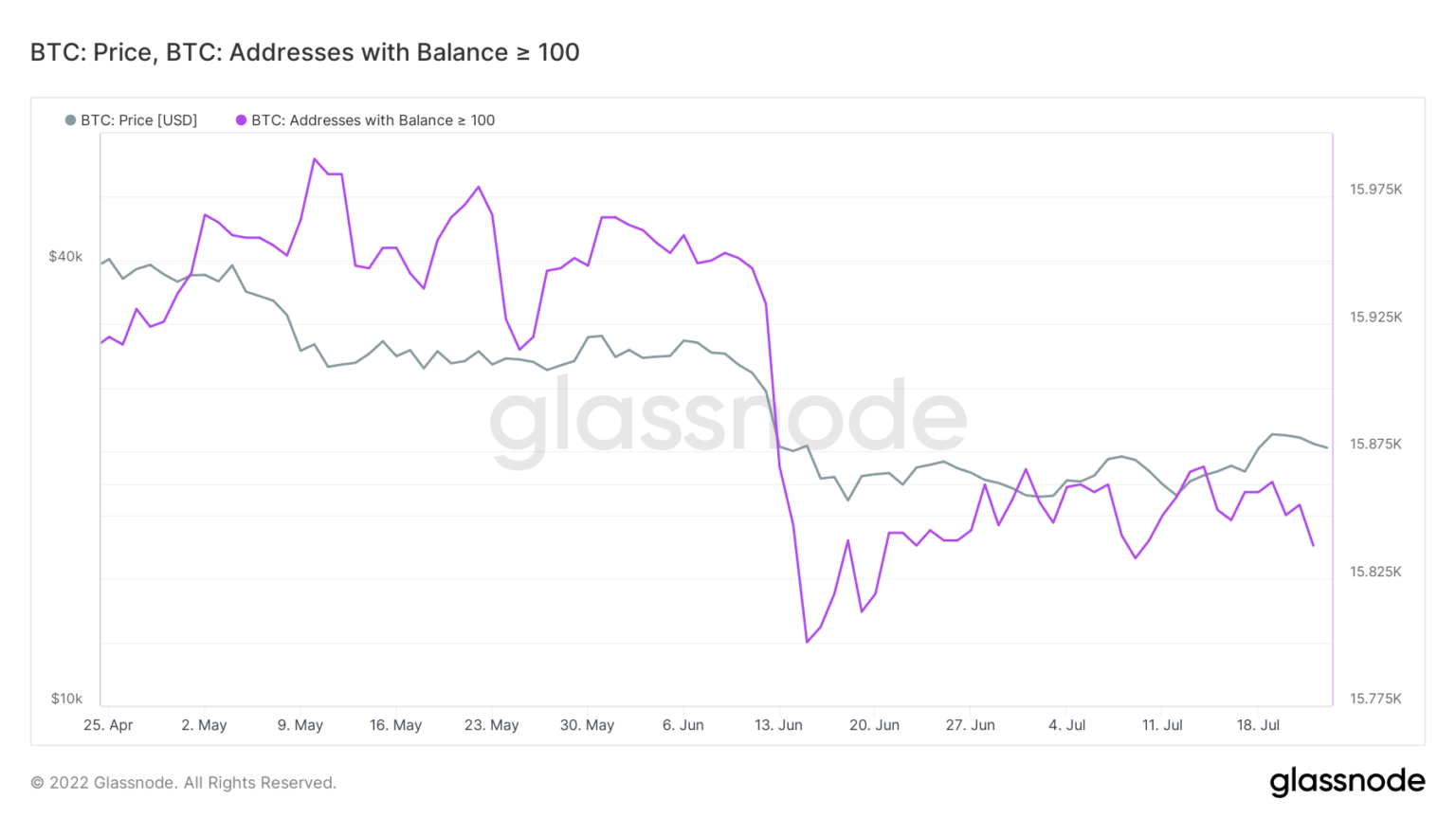
A look at some metrics may help provide a clearer picture of BTC’s current position. For example, addresses holding more than 100 BTC have drastically reduced their selloff. The number of such addresses increased substantially since mid-June, thus supporting Bitcoin’s bullish performance.
Source: Glassnode

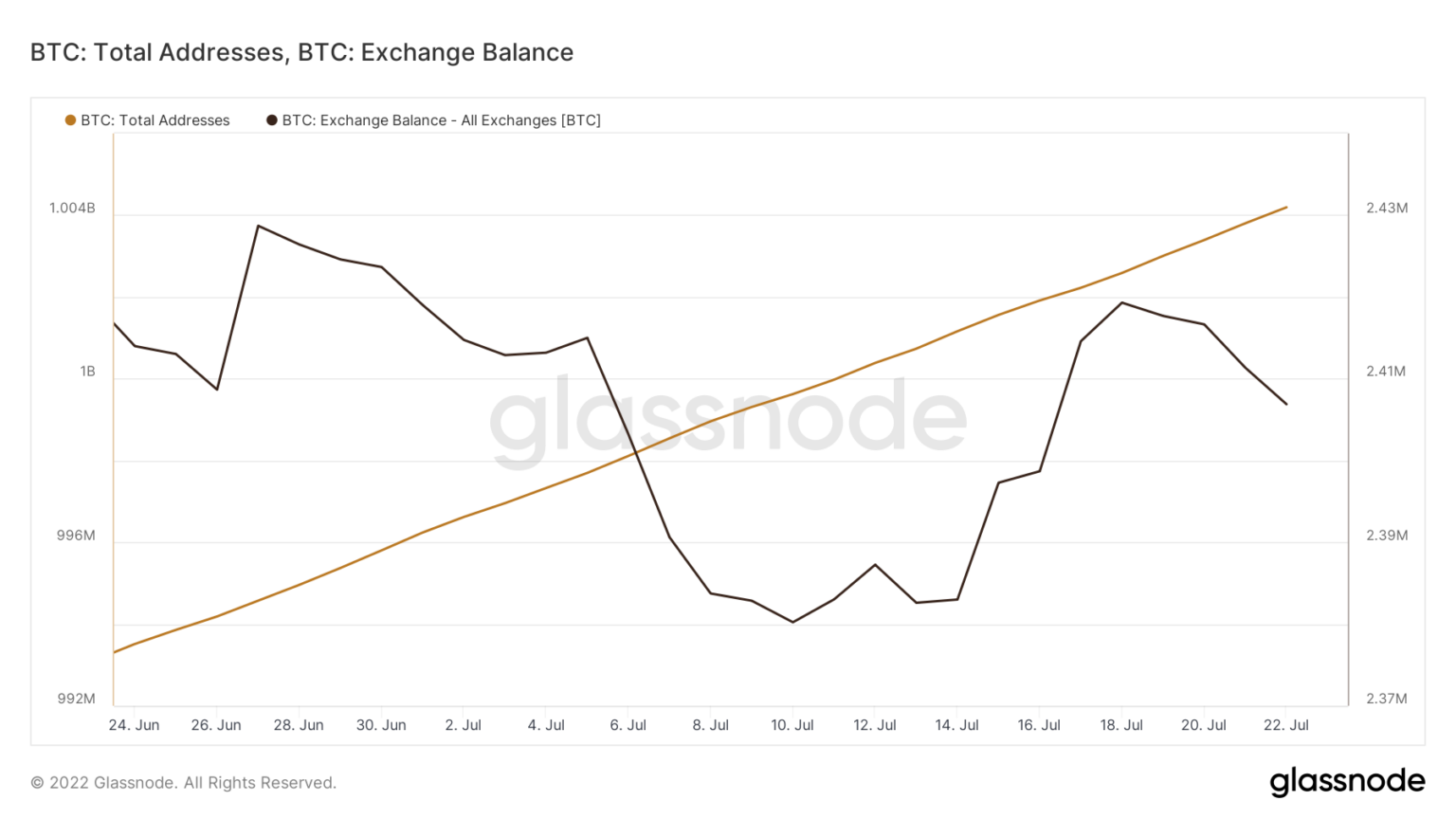
A slight drop in the same metric in the last few days suggests the likelihood that increased selling pressure may prevent more upside in the short-term. BTC balances on exchanges have been all over the place during the month but outflows and inflows have relatively balanced out. However, the total addresses metric indicates that the number of addresses has grown steadily during the last 30 days.
Source: Glassnode

However, the balance on exchanges has notably reduced in the last few months. This is a healthy sign as far as Bitcoin’s long-term performance is concerned. It highlights strong demand at lower price levels. Investors have thus been taking advantage of the lower prices. However, some exchanges might experience higher balances because of long-term increases in trading volumes.

Bitcoin’s risk-on nature and the FED

It is no secret that most of the top investors in Bitcoin have been holding it as a risk-on asset. This means they have been selling or avoiding BTC when the U.S Federal Reserve started raising rates. If this trend continues, then we will likely continue to see more selling pressure in on Bitcoin. A softer approach on interest rates may support more upside.

While the FED holds a chip over BTC’s shoulder, other factors will influence its short-term and long-term performance. Regulations and investor sentiment still have a substantial impact on BTC’s performance. For instance, favorable crypto laws from the SEC might favor crypto bulls. The fact that the market recently bottomed out is also a healthy sign and improved investor sentiment since June may encourage more buyers.


İlgili Okumalar

Ethereum Q1 2026 Review: On-chain Activity Hits New Highs, Tokenized Assets Lead the Industry

Ethereum Q1 2026 Review: Chain Activity Hits Record High, Tokenized Assets Lead the Industry In Q1 2026, the Ethereum ecosystem displayed a dual narrative: record-high on-chain activity coincided with declining USD-denominated metrics. User adoption surged, with monthly active addresses reaching 13.2 million (up 53.5% QoQ) and layer-1 transactions hitting 200.4 million (up 38% QoQ). However, the total value locked (TVL) decreased 11% to $316.2B, and protocol revenue fell 16.9% to $2.0B, largely due to a broader crypto market downturn. Tokenized assets emerged as a key strength. Their total market cap reached $203.4B, with significant growth in tokenized funds (+73.1% YoY) and commodities (+325.9% YoY). Ethereum dominated cross-chain comparisons, holding over 61% of stablecoin value and 84% of tokenized commodities value among top chains. A major development was the impact of network scaling. The "Blob" upgrade significantly increased data capacity, causing average transaction fees on layer-1 to plummet 47.9% QoQ despite higher usage. This demonstrates the "Jevons Paradox" in action: cheaper block space stimulates demand. The report highlights Ethereum's established position as the primary settlement layer for institutional tokenization, evidenced by new fund launches from giants like BlackRock and JPMorgan in May. Analysts draw parallels between Ethereum's current stage and the internet in the mid-1990s, suggesting its open, neutral network is poised to become the foundational infrastructure for global finance, outcompeting closed, private alternatives.

Foresight News7 dk önce

Ethereum Q1 2026 Review: On-chain Activity Hits New Highs, Tokenized Assets Lead the Industry

Foresight News7 dk önce

Gate Research Institute: ETF Outflows Suppress Risk Appetite, Two-Way System Navigates Weak Market

Gate Institute Research Report: May 2026 Crypto Market Review & Strategy Analysis In May 2026, the crypto market shifted from an early-month rally to a mid-month correction, concluding with low-volatility consolidation. BTC, ETH, and SOL peaked in early May before declining. The primary market dynamic was a divergence between weakening spot ETF inflows and persistently high leverage-driven perpetual trading volume. A dual-direction moving average cluster breakout strategy outperformed, returning +2.11% for an equally-weighted BTC/ETH/SOL portfolio. This contrasted with a -6.09% return for buy-and-hold and -3.65% for a long-only version of the strategy. Profits were primarily generated from short positions on ETH and SOL during the mid-to-late May downtrend, demonstrating the month's suitability for two-way trend trading. Market structure evolved in three phases: an initial surge (May 1-6), a failure and reversal (starting May 7), and low-volatility compression (May 22 onward). While stablecoin supply remained stable, significant outflows from mainstream BTC and ETH ETFs created selling pressure. Concurrently, high correlation with the S&P 500 (~0.6) and stronger performance from AI equities like Nvidia highlighted crypto's position as a high-beta risk asset within a broader risk-budget framework, lacking independent momentum. The successful strategy employed a 4-hour chart system using a cluster of six moving averages (EMA6,12,24 & SMA6,12,24). A breakout signal was triggered after the cluster width compressed below 2.2%. Trades were managed with a 2.5% fixed stop-loss, a 3:1 Risk/Reward (7.5%) take-profit, and an EMA12-based exit rule to control losses from false breakouts. The strategy's low win rate but high payoff from a few large trend moves was effective in May's conditions. The report concludes that for June, a disciplined, bidirectional approach remains superior to subjective directional bets. The framework should adapt signal weighting based on BTC's position relative to key EMAs, ETF flow trends, and the relative strength of the Nasdaq, prioritizing risk management and trend preservation.

marsbit37 dk önce

Gate Research Institute: ETF Outflows Suppress Risk Appetite, Two-Way System Navigates Weak Market

marsbit37 dk önce

Anthropic CEO's Latest Interview: On Technological Explosion, Safety Red Lines, and the Civilization Contract

Interview with Anthropic CEO Dario Amodei covers the intense pressures and ethical dilemmas of leading AI development. He describes the experience as "exponential growth," feeling constant acceleration akin to relativistic time dilation. The discussion delves into his departure from OpenAI, rooted in a fundamental loss of trust and divergent values rather than mere technical disagreements. Amodei emphasizes Anthropic's enterprise-focused business model, arguing it aligns better with safety and responsible deployment than consumer-facing, ad-driven models. He addresses critical issues like AI's impact on employment, advocating for proactive macroeconomic policies and a shift towards "doing more with the same resources" to avoid widespread job displacement. On safety and governance, he details Anthropic's cautious approach, including delaying the release of the powerful "Mythos" model due to its advanced cyber capabilities. He stresses the need for "human-in-the-loop" principles in military applications, setting red lines against autonomous weapons and mass surveillance. Amodei calls for industry collaboration among trustworthy actors to establish standards and advocates for a balanced regulatory framework with checks and balances, such as Anthropic's Long-term Benefit Trust, rather than corporate or government monopoly over the technology. He expresses geopolitical concerns, particularly regarding China, and a belief that AI should bolster liberal democracies. While acknowledging a non-zero risk of civilizational catastrophe from advanced AI, he asserts Anthropic's actions are aimed at significantly reducing that probability. The interview concludes with Amodei arguing that trust must be earned through concrete actions, like sacrificing commercial gain for safety, to distinguish Anthropic in a Silicon Valley landscape he criticizes for eroded public trust.

marsbit40 dk önce

Anthropic CEO's Latest Interview: On Technological Explosion, Safety Red Lines, and the Civilization Contract

marsbit40 dk önce

İşlemler

Spot
Futures
活动图片