346% Surge vs 20.8% Decline, CoinGecko: DEX Perpetuals Are Taking Market Share from CEX

marsbit2026-03-04 tarihinde yayınlandı2026-03-04 tarihinde güncellendi

Özet

CoinGecko's 2025 report highlights a dramatic shift in the crypto derivatives market, with DEX perpetual contract volume surging 346% to $6.7 trillion, while CEX open interest declined by 20.8%. This signals a systemic capital migration from centralized to decentralized platforms, driven by superior capital efficiency, mature market mechanisms, and enhanced DEX usability. Key factors include the ability to trade with leverage, hedge positions, and profit in both bull and bear markets. Hyperliquid, ranking as the seventh-largest global exchange with $2.9 trillion in volume—surpassing Coinbase International—exemplifies this trend. Its custom L1 blockchain enables high-speed, low-cost trading, while HIP-3’s permissionless listing mechanism allows trading of commodities, equities, and alternative assets, transforming DEXs into 24/7 global financial infrastructure. The data confirms perpetual contracts are reshaping crypto market structure, with DEXs becoming competitive in performance, fees, and user experience, positioning them as the future of decentralized finance.

Author: CoinGecko

Compiled by: Deep Tide TechFlow

Guide: The core data from CoinGecko's annual report is telling enough: DEX perpetual contract trading volume surged by 346% year-on-year, while CEX open interest fell by 20.8% during the same period. Capital is systematically migrating from centralized to decentralized platforms.

This article is not just about numbers; it clearly explains why this migration is happening, how Hyperliquid managed to surpass Coinbase International, and what these platforms are evolving into post-HIP-3.

Full Text Below:

In 2025, perpetual contract exchanges—especially decentralized platforms—experienced explosive growth, with total trading volume reaching $92.9 trillion (a 64.6% year-on-year increase), fundamentally shifting the crypto market from spot trading to a derivatives-led price discovery mechanism.

Key Points:

  • DEX perps grew by 346%, reaching $6.7 trillion; meanwhile, CEX open interest declined by 20.8%. This represents a massive capital migration from centralized to decentralized infrastructure, driven by platforms like Hyperliquid (ranked 7th globally with $2.9 trillion in volume).
  • Capital efficiency drives adoption: Perps allow traders to gain exposure with less capital through leverage, profit in both directions (crucial during the Q4 2025 downturn), and avoid the friction of physical settlement.
  • HIP-3 enables permissionless listing of any asset with a price feed, transforming platforms like Hyperliquid from "crypto exchanges" into 24/7 global financial infrastructure capable of trading everything from commodities to pre-IPO equity.

Why Perps Are Outpacing Spot Trading
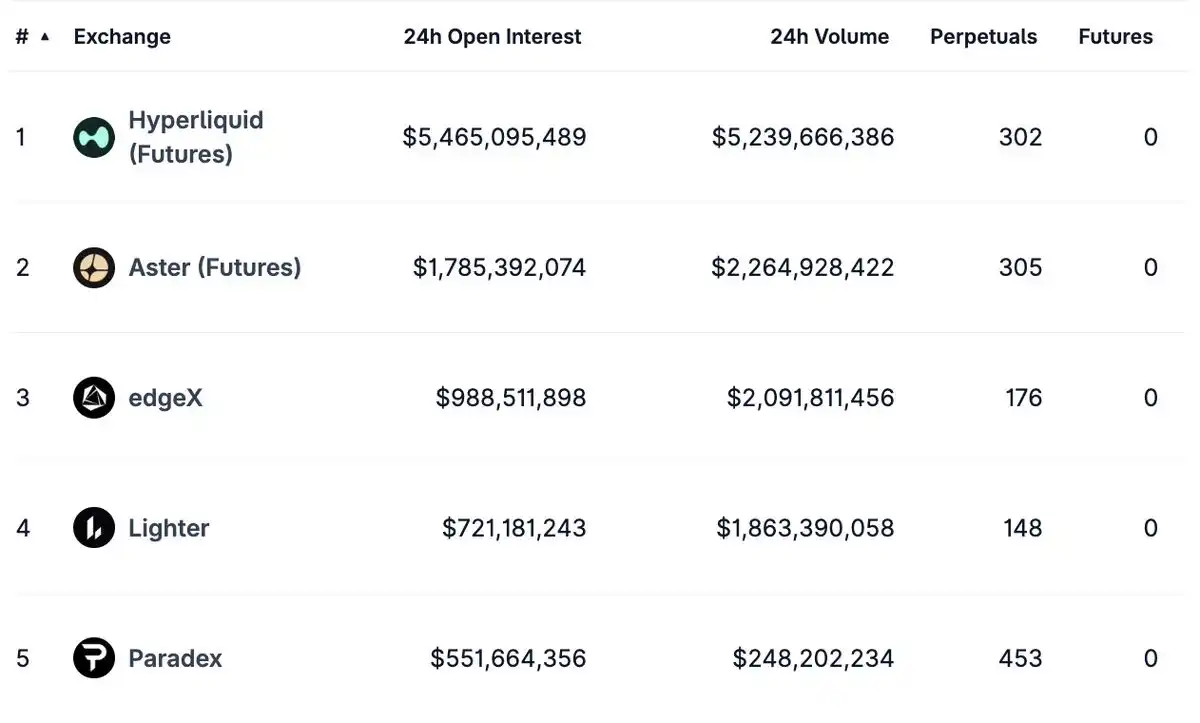
Figure: Top 5 Decentralized Perpetual Exchanges by 24h Trading Volume on CoinGecko as of March 2, 2026

Capital Efficiency: Doing More with Less

The fundamental advantage of perpetual contracts is capital efficiency. In the spot market, buying $10,000 worth of Bitcoin requires $10,000 in capital, which is locked up during the holding period. In the perpetual market, leverage allows for the same exposure with only a fraction of the capital, freeing up liquidity for other positions or strategies.

Beyond speculation, perpetual contracts enable market participants to:

Hedge existing positions without selling the underlying asset (thus avoiding taxable events); arbitrage price differences across trading venues; express directional views without the friction of physical settlement; deploy capital across multiple opportunities simultaneously.

Every dollar in the perpetual market works harder than a dollar in spot. For traders, funds, and institutions optimizing capital returns, the scale is tipping toward perps.

Market Maturation: Following the Path of Traditional Finance

The explosive growth of crypto derivatives mirrors a pattern seen in every mature financial market. In traditional finance, the derivatives market size far exceeds the underlying spot market, often by 10 to 50 times. Take the interest rate swap market, for example, with a notional value exceeding $400 trillion, compared to the bond market's ~$130 trillion.

The crypto market is just catching up. As the market matures and more experienced participants flood in, the derivatives-to-spot trading volume ratio continues to expand. The top ten exchanges alone generated $92.9 trillion in perpetual contract volume, far exceeding the total spot trading volume across all crypto exchanges.

The Hedging Factor: Resilience in a Downturn

Perhaps the most compelling evidence of the perpetual contract value proposition emerged during the Q4 2025 downturn. While spot markets contracted and investor sentiment soured, trading volume at the top ten perpetual exchanges grew 64.6% year-on-year.

Why? Because perpetual contracts allow traders to profit in both directions. When prices fall, short positions profit significantly, and hedging activity intensifies. The market's ability to express bearish views keeps capital active, volumes high, even as spot buying dries up.

In traditional, spot-only markets, price declines mean reduced activity. This is evident from the drop in CEX spot volume from $2.21 trillion in January 2025 to a low of $0.95 trillion in December.

In the perpetual market, however, volatility in any direction means opportunity. The 2025 data proves this dynamic has fundamentally altered crypto market structure.
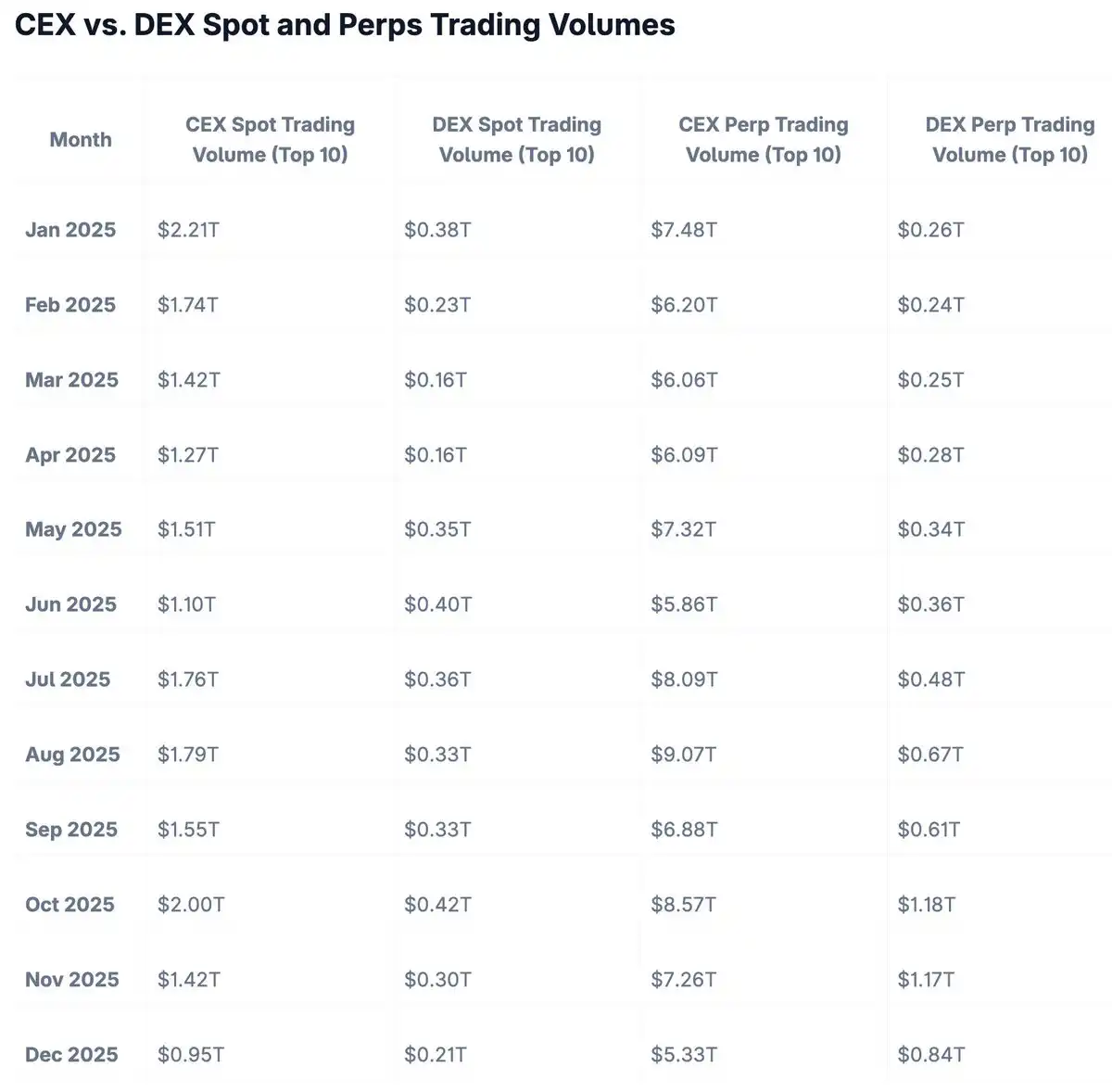
Figure: CEX vs. DEX Spot and Perpetual Contract Trading Volume Comparison

The Great Migration: DEX vs. CEX
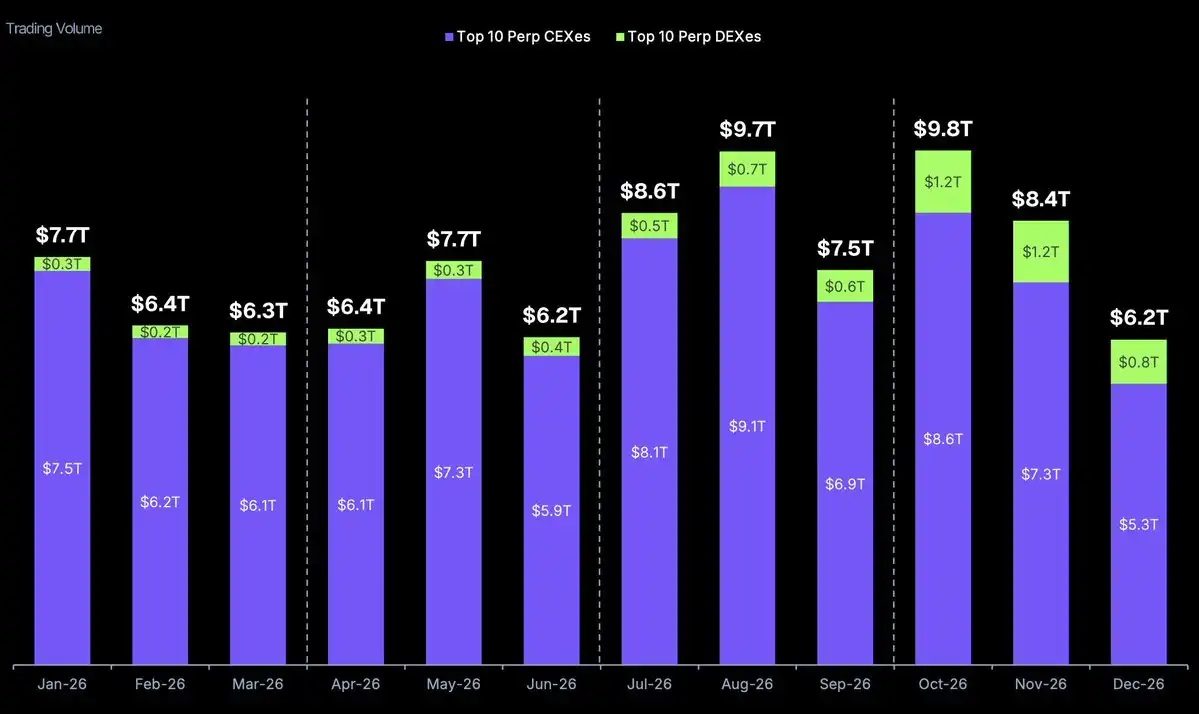
Figure: Top 10 Perp CEX and Perp DEX Trading Volume

Source: CoinGecko 2025 Crypto Industry Annual Report

Although centralized exchanges still dominate in absolute size, the real story of 2025 is the meteoric rise of decentralized perpetual exchanges. Perp DEX volume surged 346%, reaching a record $6.7 trillion for the year.

To put this leap into perspective: In the peak month of October 2025 alone, Perp DEXs processed $1.18 trillion in volume, more than four times the volume of January 2025.

DEX's Breakthrough

By 2025, Perp DEXs had solved the fundamental usability issues that previously kept users on centralized platforms:

  1. User Experience Parity: The narrative of "clunky DEX operation" ended in 2025. Hyperliquid and Lighter offered interfaces nearly indistinguishable from Binance or Coinbase's. Order book depth was sufficient, execution near-instantaneous—the average trader could no longer tell they were on a decentralized platform.
  2. Competitive Fee Structures: Early DEXs charged a premium for decentralization. By 2025, competition and technological advancement pushed Perp DEX fees to match or undercut CEX rates. Platforms like Hyperliquid even began offering up to 90% taker rebates, rivaling the most competitive CEX fee structures.
  3. Scaled Performance: Early blockchain-based DEXs couldn't handle the volume required for serious derivatives trading. The emergence of dedicated Layer 1 chains and optimized rollups solved this. Hyperliquid's custom L1, for example, processes thousands of transactions per second with sub-second confirmation times—performance comparable to centralized infrastructure.

The Divergence in Open Interest
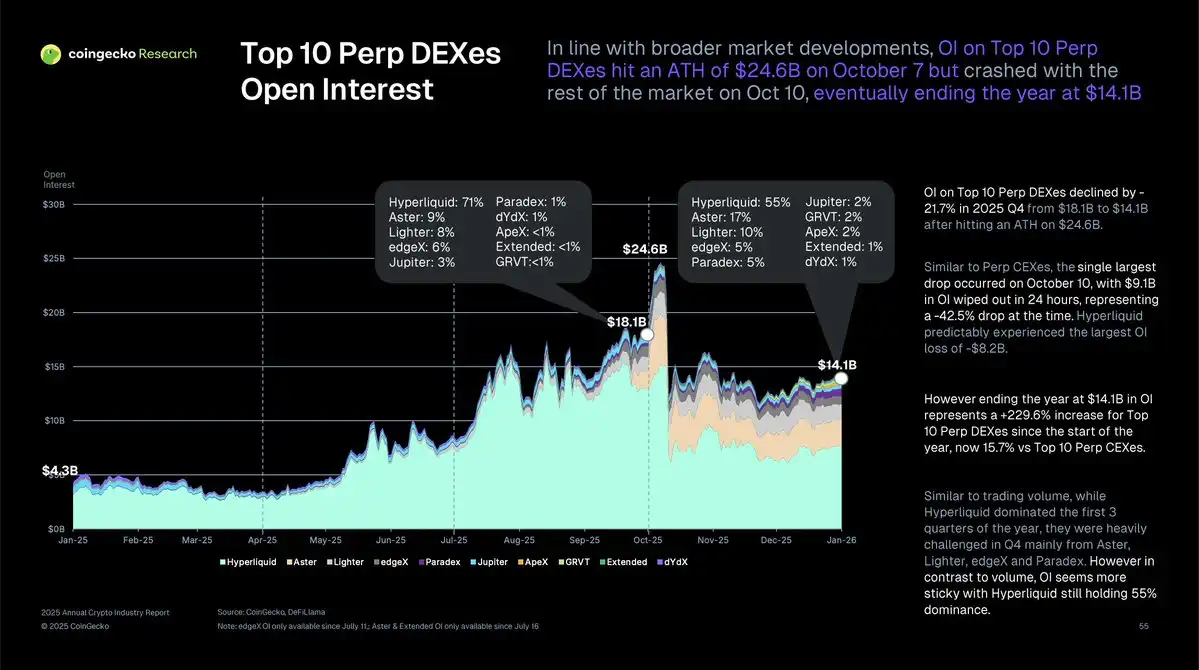
According to CoinGecko's "2025 Annual Crypto Industry Report," CEX open interest declined 20.8% in 2025, while DEX open interest surged 229.6%.

Open interest—the total value of outstanding derivative contracts—represents committed capital and conviction. This divergence tells us traders aren't just "trying out" DEXs for quick trades; they are establishing substantial long-term positions on-chain.

This shift represents a reallocation of capital from centralized to decentralized infrastructure. Once this migration begins, network effects accelerate it. More liquidity attracts more traders, which attracts more market makers, further deepening liquidity.

The Rise of Hyperliquid and Lighter

The 2025 perpetual exchange rankings reveal a significant shift in market structure. Two decentralized platforms forcefully entered the top ten, displacing established centralized players:

  • @HyperliquidX: Ranked 7th globally, with annual volume of $2.9 trillion;
  • @Lighter_xyz: Ranked 10th globally, with annual volume of $1.3 trillion.

In 2025, Hyperliquid's volume surpassed that of Coinbase International. This decentralized platform, less than two years old, overtook a publicly-listed, institutionally-backed exchange with billions in capital and years of operational history.

Coinbase International processed approximately $1.4 trillion in 2025. Hyperliquid reached $2.9 trillion—more than double.

Winning with Infrastructure

Hyperliquid's secret to success isn't clever marketing or token incentives, but infrastructure. The platform built its own Layer 1 blockchain (HyperCore) specifically optimized for perpetual contract trading.

This architectural decision彻底 (thoroughly) ended the "DEXs are slow" narrative. By controlling the full technology stack from consensus mechanism to matching engine, Hyperliquid achieved: sub-second trade confirmation; zero gas fees for market makers; throughput of 20,000+ orders per second; 100% uptime throughout 2025.

In contrast, Ethereum-based DEXs suffered from network congestion and variable gas costs, and other L2 solutions relied on external infrastructure. Hyperliquid's vertical integration delivered a user experience indistinguishable from centralized exchanges, while retaining the security guarantees of full decentralization.

Lighter followed a similar path, albeit with different technical implementation. The conclusion is clear: to compete with CEXs, DEXs must control their own infrastructural destiny.

Beyond Crypto: Hyperliquid's HIP-3 Revolution

In late 2025, Hyperliquid implemented HIP-3 (Hyperliquid Improvement Proposal 3), fundamentally altering its market structure.

Permissionless Listings

Previously, opening a new perpetual market required validator approval—a semi-centralized process. HIP-3 introduced a mechanism for permissionless perpetual market deployment.

Any builder can now create a perpetual market for any asset with a reliable price feed. No token required, no permission needed, no listing fees.

The immediate impact was explosive. Within weeks, perpetual markets for assets never before traded on-chain appeared on the platform.

A Bridge to Traditional Finance

By February 2026, the impact of HIP-3 became increasingly clear. Platforms like Hyperliquid are no longer just "crypto derivatives exchanges"; they are becoming global financial market infrastructure.

Perpetual markets now on Hyperliquid include:

  • Commodities: Gold and Silver perpetuals tracking COMEX futures; Crude Oil and Natural Gas; Agricultural products (Wheat, Corn, Soybeans).
  • Equity-like: Pre-IPO companies like SpaceX and OpenAI; Synthetic exposure to major tech stocks; Index perpetuals (S&P 500, Nasdaq 100).
  • Alternative Assets: Prediction markets (election outcomes, economic indicators); Sports betting derivatives; Weather derivatives.

This expansion means Perp DEXs are becoming the infrastructure for 24/7 global price discovery.

Markets That Never Close

Traditional financial markets close—the NYSE closes at 4 PM ET, CME futures markets halt Sunday evening. This creates friction, information gaps, and opportunity costs.

Blockchain-based perpetual markets never close. While traditional markets are offline, on-chain markets continue operating, incorporating new information in real-time.

Imagine: Major news hits on a Sunday evening—a geopolitical crisis, a corporate bankruptcy, an unexpected central bank move. Traditional markets cannot price this information until Monday morning, creating potential gaps and mispricing.

Perpetual contracts on platforms like Hyperliquid price the information immediately. As liquidity in these markets deepens, they may begin to influence traditional market opening prices—the 24/7 on-chain price becoming the reference point traditional markets catch up to on Monday morning.

Conclusion: The New Frontier of Perpetuals

The 2025 data tells an unmistakable story: Perpetual contracts have become the dominant force in crypto trading, and decentralized platforms are rapidly closing the gap with their centralized counterparts.

The numbers speak for themselves: $92.9 trillion volume from the top 10 perpetual exchanges; 346% DEX perpetual trading growth; 229.6% surge in DEX open interest; Leading DEXs have displaced major CEXs in the rankings.

With permissionless market creation enabled, blockchain infrastructure achieving performance parity with centralized systems, the line between "crypto exchange" and "global financial market" is blurring. These platforms are evolving into "on-chain financial markets"—where any asset with a price feed can be traded 24/7, fully self-custodied, with transparent settlement.

The spot trading model—buying and physically settling assets—will persist. But for price discovery, hedging, and capital-efficient speculation, perpetual contracts will dominate.


Trend Kriptolar

İlgili Sorular

QAccording to the CoinGecko report, what was the percentage growth in DEX perpetual contract trading volume in 2025, and what was the corresponding change in CEX open interest?

ADEX perpetual contract trading volume surged by 346% in 2025, while CEX open interest declined by 20.8%.

QWhat are the three main reasons cited for the explosive growth of perpetual contracts over spot trading?

AThe three main reasons are: 1) Capital efficiency (using leverage to get more exposure with less capital), 2) Market maturity (mirroring the pattern in traditional finance where derivatives markets are much larger than spot markets), and 3) The ability to hedge and profit in both rising and falling markets, which provided resilience during the Q4 2025 downturn.

QWhich two DEX perpetual platforms broke into the top 10 global rankings in 2025, and what were their respective trading volumes?

AHyperliquid (ranked 7th globally with $2.9 trillion in annual volume) and Lighter (ranked 10th globally with $1.3 trillion in annual volume) broke into the top 10.

QWhat key infrastructure feature was fundamental to Hyperliquid's success, allowing it to overcome the 'DEX' narrative and achieve performance comparable to CEXs?

AHyperliquid built its own purpose-built Layer 1 blockchain (HyperCore) optimized for perpetual trading. This allowed for sub-second trade confirmations, zero gas fees for market makers, throughput of 20,000+ orders per second, and 100% uptime.

QWhat was the significance of Hyperliquid's HIP-3 implementation, and how did it change the nature of the platform?

AHIP-3 introduced permissionless perpetual market deployment. This allowed any builder to create a perpetual market for any asset with a reliable price feed, transforming Hyperliquid from a crypto exchange into a 24/7 global financial infrastructure for trading assets like commodities, pre-IPO equities, and indices.

İlgili Okumalar

After Three Consecutive Quarters of Decline, Can the Crypto Market Find a Window for Stabilization in Q3?

The cryptocurrency market has just concluded its worst-performing quarter since 2022, with total capitalization dropping 12.6% to $2.1 trillion. All core metrics indicate capital is leaving the sector, not just rotating within it. Bitcoin fell 14.2% and Ethereum dropped 25.4% in Q2, breaking their previous correlation with US tech stocks. A key driver is the reversal in US spot Bitcoin ETF flows, which saw a net outflow of approximately $4.67 billion in Q2, including a record monthly outflow near $4.5 billion in June. While recent data suggests long-term holders are accumulating again, sustained ETF outflows mean continued selling pressure. Market focus is now singularly on the Federal Reserve. The upcoming July FOMC meeting is seen as the most critical event for Q3. A dovish signal could support Bitcoin reclaiming a $68,000-$84,000 range, while a hawkish stance might establish a new trading band around $50,000-$56,000. Additionally, regulatory uncertainty persists, with the progress of the crucial *CLARITY Act* stalling in the Senate, reducing its perceived 2026 passage probability to 40-45%. Despite the broad downturn, a few sectors showed growth. Prediction markets saw nominal volume surge 48.7% year-over-year to $113.8 billion, and tokenized collectibles transaction volume rose 143% quarterly to $1.4 billion. The Real-World Asset (RWA) tokenization sector also continued steady growth, now representing ~$28.1 billion in on-chain value. The market's foundation for an extreme crash appears limited, with Bitcoin price hovering near its 200-week moving average. However, the trading paradigm has shifted from narrative-driven speculation to decisions based on price action, policy developments, and interest rate expectations, making a broad sentiment-driven rally unlikely in the near term.

marsbit10 saat önce

After Three Consecutive Quarters of Decline, Can the Crypto Market Find a Window for Stabilization in Q3?

marsbit10 saat önce

BIT Trading Moment: BTC Still Suppressed by Weekly 200 EMA, Rejection May Restart Decline; Storage and Semiconductors that Surged Last Night Begin Falling in Evening Trading

**Crypto & Stock Market Wrap: Bitcoin Tests Resistance, Stocks Retreat After AI Surge** Bitcoin consolidates around $66,000, facing key resistance near $68,000—an area seen as a major psychological and technical hurdle where previous rallies have failed. Analysts note the cryptocurrency is caught between its 200-week moving average (~$63,333) and 200-week EMA (~$68,328). A clear break above $68k is needed to signal a stronger bullish trend, while a rejection could lead to a retest of $63k support. Market sentiment remains cautious, with low futures open interest pointing to a low-liquidity rebound rather than a full bull market. Bitcoin spot ETFs saw another $203 million inflow. US stock futures pointed lower after a strong Tuesday session led by a massive rebound in semiconductors and memory stocks. The rally was fueled by renewed optimism about AI-driven hardware demand, with Micron, SanDisk, and SK Hynix surging. However, those gains reversed in pre-market trading. Super Micro Computer (SMCI) soared over 20% after hours on strong guidance and a record backlog. Other standouts included Rocket Lab and nuclear energy plays Oklo and X-Energy. Rising oil prices (Brent above $91) and climbing Treasury yields (10-year near 4.64%), however, are reigniting inflation concerns and acting as a headwind for equities. In Asia, markets were mixed. South Korea's KOSPI pared early gains to close slightly higher as semiconductor stocks like SK Hynix gave back initial surges. Japan's Nikkei edged lower as the yen hit a fresh 38-year low against the dollar, raising fears of potential market intervention. Key events to watch include the Samsung Galaxy launch, AMD's AI event, and a slew of major tech earnings from Alphabet, Tesla, and IBM after the close on Wednesday, followed by the ECB meeting and Intel's earnings on Thursday.

marsbit10 saat önce

BIT Trading Moment: BTC Still Suppressed by Weekly 200 EMA, Rejection May Restart Decline; Storage and Semiconductors that Surged Last Night Begin Falling in Evening Trading

marsbit10 saat önce

Former CFTC Chairman, Circle President Tarbert: Preaching Long-Termism While Cashing Out $30 Million Himself

Former CFTC Chairman and Circle President Heath Tarbert has consistently advocated for a long-term vision in public, urging patience from investors as Circle’s stock price has fallen significantly from its peak. However, it has been revealed that since Circle’s IPO, Tarbert has continuously sold his CRCL shares through pre-arranged trading plans, cashing out approximately $30 million, without making any public market purchases. This contrast between his public messaging and personal actions has drawn criticism. Tarbert joined Circle in July 2023 as Chief Legal Officer, leveraging his regulatory experience to help guide the company through its IPO and expansion. Despite promoting stablecoins as long-term infrastructure, he established a 10b5-1 trading plan just before Circle went public, leading to substantial stock sales over the following year. In March 2026, he initiated another plan to sell more shares. His career trajectory highlights a pattern of moving between high-level regulatory roles and influential positions in the financial sector. After resigning as CFTC Chairman in early 2021, he joined Citadel Securities as Chief Legal Officer just 27 days later, during a period of intense regulatory scrutiny for the firm. He later joined Circle, aiding its efforts to navigate regulatory challenges for its public listing. While Tarbert's expertise in policy and compliance is valuable to companies like Circle, his actions—advocating long-term confidence while personally divesting—raise questions about the alignment between his public statements and his private financial decisions, leaving investors who followed his advice to bear the market risks.

marsbit10 saat önce

Former CFTC Chairman, Circle President Tarbert: Preaching Long-Termism While Cashing Out $30 Million Himself

marsbit10 saat önce

Gate Research Institute: The 'Wall Street-ization' Wave of Crypto Financial Products – Competition or Integration?

The article titled "Gate Research Institute: Are Crypto Financial Products Sparking a 'Wall Street' Wave—Competition or Convergence?" explores the evolving relationship between the crypto ecosystem and traditional finance (TradFi). The piece begins by reflecting on Bitcoin's original 2009 vision of decentralization, disintermediation, and moving away from banks. It then contrasts this with the 2024 landscape, where key crypto assets like Bitcoin are increasingly held through Wall Street products like ETFs issued by giants like BlackRock. The article questions whether this signifies that TradFi is systematically taking over the rights to issue, price, custody, and distribute crypto financial assets. The core argument is that this is not a zero-sum takeover but rather a bidirectional convergence where each side addresses the other's weaknesses. Crypto offers 24/7 global markets, programmable settlement, and open access but lacks compliant channels, institutional-grade custody, deep fiat liquidity, and mainstream distribution. TradFi possesses these but is constrained by legacy systems, limited operating hours, and slow settlement. Two primary convergence paths are highlighted: * **Path A (CEX to TradFi):** Exemplified by Gate, which has progressed from offering tokenized stocks and CFDs to providing direct, real stock trading (US, Hong Kong, South Korea) within its platform, using USDT. * **Path B (TradFi to Crypto):** Exemplified by Robinhood, which has integrated crypto trading, acquired exchanges like Bitstamp, and is moving traditional assets like stocks onto the blockchain via tokenization and its own Layer 2. Both paths are ultimately competing to become the next-generation, unified financial account—a "super account" where users can seamlessly trade cryptocurrencies, stocks, ETFs, RWA (Real World Assets), and tokenized treasury products in one interface. The growth of RWA and tokenized treasuries (e.g., BlackRock's BUIDL) is presented as the asset-layer fusion, providing stable, yield-bearing assets on-chain and acting as a bridge between the two worlds. In conclusion, the "Wall Street-ization" of crypto is framed as a mutual transformation. Decentralized ideals persist in the protocol layer, while at the application layer, a more efficient, global, and accessible unified capital market is emerging from this convergence. The future competition lies not between crypto exchanges and stockbrokers, but between platforms vying to offer the most comprehensive asset coverage, liquidity, and user experience within a single account.

marsbit10 saat önce

Gate Research Institute: The 'Wall Street-ization' Wave of Crypto Financial Products – Competition or Integration?

marsbit10 saat önce

İşlemler

Spot

Popüler Makaleler

CORE Nasıl Satın Alınır

HTX.com’a hoş geldiniz! CORE (CORE) satın alma işlemlerini basit ve kullanışlı bir hâle getirdik. Adım adım açıkladığımız rehberimizi takip ederek kripto yolculuğunuza başlayın. 1. Adım: HTX Hesabınızı OluşturunHTX'te ücretsiz bir hesap açmak için e-posta adresinizi veya telefon numaranızı kullanın. Sorunsuzca kaydolun ve tüm özelliklerin kilidini açın. Hesabımı Aç2. Adım: Kripto Satın Al Bölümüne Gidin ve Ödeme Yönteminizi SeçinKredi/Banka Kartı: Visa veya Mastercard'ınızı kullanarak anında CORE (CORE) satın alın.Bakiye: Sorunsuz bir şekilde işlem yapmak için HTX hesap bakiyenizdeki fonları kullanın.Üçüncü Taraflar: Kullanımı kolaylaştırmak için Google Pay ve Apple Pay gibi popüler ödeme yöntemlerini ekledik.P2P: HTX'teki diğer kullanıcılarla doğrudan işlem yapın.Borsa Dışı (OTC): Yatırımcılar için kişiye özel hizmetler ve rekabetçi döviz kurları sunuyoruz.3. Adım: CORE (CORE) Varlıklarınızı SaklayınCORE (CORE) satın aldıktan sonra HTX hesabınızda saklayın. Alternatif olarak, blok zinciri transferi yoluyla başka bir yere gönderebilir veya diğer kripto para birimlerini takas etmek için kullanabilirsiniz.4. Adım: CORE (CORE) Varlıklarınızla İşlem YapınHTX'in spot piyasasında CORE (CORE) ile kolayca işlemler yapın.Hesabınıza erişin, işlem çiftinizi seçin, işlemlerinizi gerçekleştirin ve gerçek zamanlı olarak izleyin. Hem yeni başlayanlar hem de deneyimli yatırımcılar için kullanıcı dostu bir deneyim sunuyoruz.

373 Toplam GörüntülenmeYayınlanma 2024.12.13Güncellenme 2026.06.02

CORE Nasıl Satın Alınır

Tartışmalar

HTX Topluluğuna hoş geldiniz. Burada, en son platform gelişmeleri hakkında bilgi sahibi olabilir ve profesyonel piyasa görüşlerine erişebilirsiniz. Kullanıcıların CORE (CORE) fiyatı hakkındaki görüşleri aşağıda sunulmaktadır.

活动图片












