Crypto Morning Brief: Flow Protocol Hacked, Major Unlocks for HYPE, SUI, EIGEN Tokens This Week

深潮2025-12-29 tarihinde yayınlandı2025-12-29 tarihinde güncellendi

Özet

Crypto Morning Brief: Flow Protocol was hacked, with approximately $3.9 million exploited due to an execution layer flaw, though user deposits remain secure. The network is temporarily halted, with a target restart in 4-6 hours. Meanwhile, several tokens, including HYPE, SUI, and EIGEN, are set for significant unlocks this week, totaling hundreds of millions of dollars. In other news, Uniswap’s treasury burned 100 million UNI tokens ($596 million) following a passed proposal. Michael Saylor hinted at potential Bitcoin accumulation by MicroStrategy, while former Alameda CEO Caroline Ellison is scheduled for early release in January. Japan’s central bank emphasized the need for steady interest rate hikes in the coming months. Additionally, the SEC is shifting from enforcement to a "compliance" model starting in 2026.

Author: Deep Tide TechFlow

Yesterday's Market Dynamics

Bank of Japan Meeting Opinion: Need to Maintain a Steady Pace of Interest Rate Hikes in the Coming Months

Bank of Japan meeting opinion summary: One member stated that the Bank of Japan must raise interest rates at a pace of about once every few months for some time. Even if the policy rate is raised to 0.75%, Japan's real interest rates will still be in deeply negative territory.

Lighter AMA: 50% of Total Token Supply to be Allocated to Community, Token Buyback Mechanism Planned

Lighter team's Head of Marketing @Pilla_eth shared some TGE details in an AMA themed "Lighter TGE" today,主要包括:

1. TGE and airdrop will take place in 2025, with the airdrop amount being 25% of the total supply, with no lock-up restrictions. The airdrop does not require claiming and will be directly deposited into the Lightner wallets of points holders.

2. 50% of the token supply will be provided to the community. More tokenomics details will be gradually released. There will be token buybacks, but the specific amount is undecided. "Therefore, value will flow to the token."

3. LIT tokens will initially only be tradable on the Lighter platform. Coinbase and Bybit have added LIT to their roadmaps. They will not pay for exchange listings.

4. There will be no official Lighter NFT, but some community NFTs, like Fuego, are acknowledged. Meme coin airdrops are just rumors.

Additionally, @Pilla_eth revealed that Lighter is developing "a mobile app that can rival CEX apps."

Trust Wallet: Over 2,630 Claim Tickets Received, Amounts Ranging from $1.05M to $3.5M

Trust Wallet CEO Eowync.eth issued a security incident update. Trust Wallet has received over 2,630 claim tickets, with claim amounts ranging from $1.05 million to $3.5 million. The customer support team is doing its best to process claims as quickly as possible.

Flow: User Existing Balances Not Accessed in This Hack, All User Deposits Safe

Flow official posted on X platform stating that on December 27, 2025, attackers exploited a vulnerability in the Flow execution layer to transfer approximately $3.9 million in assets before the network went down. This attack did not access users' existing balances; all user deposits are safe.

Currently, approximately $3.9 million in funds have been primarily bridged out via bridges like Celer, Debridge, Relay, Stargate, etc. The attacker's wallet has been identified and flagged, and their money laundering activities through Thorchain and Chainflip are being tracked in real-time.

The Flow Foundation has submitted freeze requests to Circle, Tether, and major exchanges. The network is currently stopped to cut off all exit paths. A fix is undergoing final validation. The confirmed amount of funds outflow is manageable and does not threaten the network's solvency or user fund safety.

The target restart time is within 4 to 6 hours, depending on testnet validation results. FindLabs is releasing forensic data including transaction hashes and the attacker's Ethereum wallet address.

Uniswap Treasury Has Burned 100 Million UNI Worth $596 Million

According to on-chain analyst Yu Jian monitoring, following the passage of the Uniswap fee burn proposal the day before yesterday, 100 million $UNI ($596 million) was burned from the Uniswap treasury at 4:30 AM today.

According to the proposal, subsequent fees collected by Uniswap will also be used for UNI burns.

Huma Responds to Some Users' Vanguard Badges Being Revoked: Plans to Extend Staking Requirement Grace Period to January 5th

PayFi protocol Huma Finance posted on X platform stating that some users reported their Vanguard badges were revoked after the Season 2 airdrop event went live. In reality, holders need to continuously meet the relevant staking requirements to retain their badges, including holding 10,000 HUMA tokens or staking 100% of the airdropped tokens received. However, some users did not fully understand this ongoing requirement. Huma Finance has temporarily restored Vanguard badges and set a grace period until January 5, 2026, 00:00 (UTC).

Bit.com Announces Orderly Wind-Down of Existing Business, Launches "User Asset Migration Plan"

According to an official announcement, due to business adjustments, crypto exchange Bit.com will conduct an orderly wind-down of its existing business and simultaneously launch a "User Asset Migration Plan".

Bit.com承诺将在明确的时间窗口内,完成所有透明、可追溯的用户资产迁移工作。(Bit.com commits to completing all transparent and traceable user asset migration work within a clear timeframe.)

Effective immediately, Bit.com will suspend new user registration. Existing users can log in normally, view assets, and participate in the migration process.

All spot assets will remain queryable. Spot trading functionality will cease on January 31, 2026.

All users holding contract account balances, positions, or unsettled P&L on Bit.com, effective immediately, are prohibited from opening new contract positions, only closing is allowed.

Former Alameda CEO Caroline Ellison to Be Released Next Month, About 10 Months Early

According to Theblock, U.S. Federal Bureau of Prisons records show that former Alameda Research co-CEO Caroline Ellison will be released from federal supervision on January 21, 2026.

The 31-year-old Ellison has been transferred from a federal prison in Connecticut to a community confinement facility since October 2025. She pleaded guilty in December 2022 to fraud and conspiracy charges related to the collapse of the cryptocurrency exchange FTX, which caused customers to lose billions of dollars.

Ellison was sentenced to two years in prison and ordered to forfeit $11 billion in September 2024, but due to good behavior and cooperation in the FTX investigation, she will be released about 10 months earlier than her original sentence. Earlier this month, she also agreed to a 10-year ban from serving as an executive at public companies or cryptocurrency exchanges.

Meanwhile, FTX founder Sam Bankman-Fried is currently actively seeking a pardon from the U.S. President and is expected to be released in September 2044.

Supreme Court's Academic Journal Publishes Article: Commercial Law Reform for Digital Transactions, Electronic Money, and Virtual Property

The Supreme People's Court's official account published an article from its affiliated academic journal "Digital Rule of Law" titled "Commercial Law Reform for Digital Transactions, Electronic Money, and Virtual Property". It pointed out: The revised Uniform Commercial Code by the U.S. Uniform Law Commission and the American Law Institute was formally passed in 2022 and subsequently widely adopted by state legislatures in the U.S. It incorporates diverse transaction methods including electronic forms, clarifies the relationship between physical currency, central bank digital currency, and other virtual currencies, creates a new property type called "controllable electronic records," and defines the rules for controlling and transferring such property.

China's civil and commercial norms should also be practice-oriented and improved in response to the development of digital transactions, electronic money, and virtual property, thereby incentivizing economic and technological development and gaining an advantage in international institutional competition.

Michael Saylor Again Posts Bitcoin Tracker Information, May Increase Bitcoin Holdings Next Week

Michael Saylor posted Bitcoin Tracker information on the X platform again and said, "Back to Orange".

Based on previous patterns, MicroStrategy (note: Saylor's company) always discloses Bitcoin acquisition information the day after related messages are posted.

Major Unlocks for HYPE, SUI, EIGEN and Other Tokens This Week

According to Token Unlocks data, major unlocks for HYPE, SUI, EIGEN and other tokens are scheduled for this week;

HYPE will unlock 9.92 million tokens on December 29th at 3:30 PM, worth approximately $251 million, accounting for 2.87% of circulating supply;

SUI will unlock 43.69 million tokens on January 1st at 8:00 AM, worth approximately $63.36 million, accounting for 1.17% of circulating supply;

EIGEN will unlock 36.82 million tokens on January 1st at 12:00 PM, worth approximately $14.44 million, accounting for 9.74% of circulating supply;

KMNO will unlock 229 million tokens on December 30th at 8:00 PM, worth approximately $11.71 million, accounting for 5.35% of circulating supply;

OP will unlock 31.34 million tokens on December 31st at 8:00 AM, worth approximately $8.60 million, accounting for 1.65% of circulating supply;

ENA will unlock 40.63 million tokens on January 2nd at 3:00 PM, worth approximately $8.60 million, accounting for 0.56% of circulating supply;

SVL will unlock 234 million tokens on December 30th at 8:00 AM, worth approximately $6.80 million, accounting for 2.96% of circulating supply;

ZORA will unlock 166 million tokens on December 30th at 8:00 AM, worth approximately $6.70 million, accounting for 4.17% of circulating supply.

Market Trends
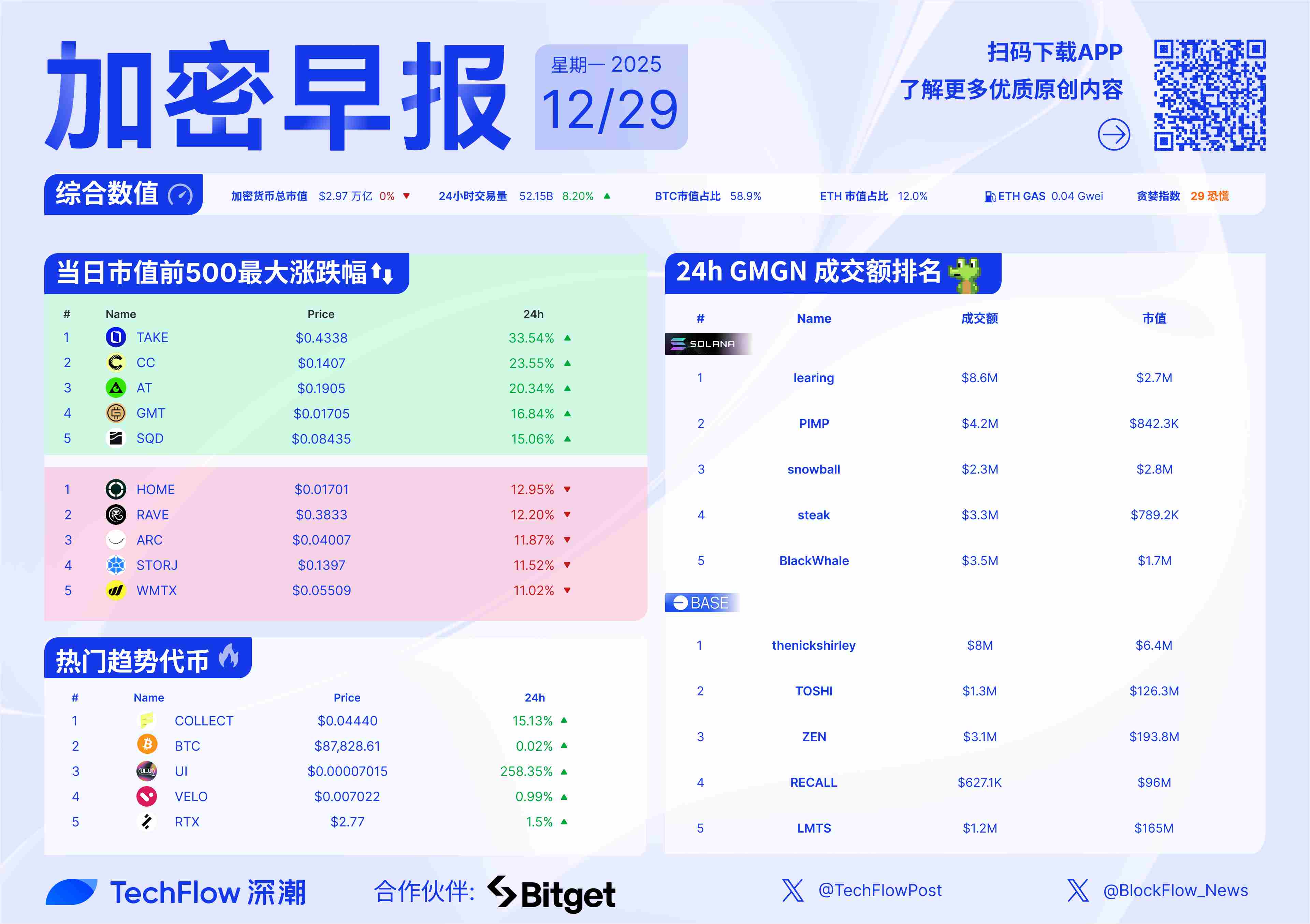
Recommended Reading

Conversation with Xie Jiayin: I Have Ambition, Bitget Also Has Ambition

This article, through an interview with Bitget exchange's Chinese language负责人 (responsible person) Xie Jiayin, explores in detail his career experience in the cryptocurrency industry, leadership philosophy, Bitget's development history, and future strategic planning. The article also covers the current state and future trends of the crypto market.

Web3 Recruitment & Job Hunting 2025 Year-End Review: Who's Making Money, Who's Paying to Work?

This article provides a comprehensive review and analysis of the Web3 industry's recruitment and job market in 2025, revealing the industry's current state, hiring trends, salary distribution, and the real experiences of practitioners. It delves into the opportunities and challenges of the Web3 industry while uncovering the difficulties and hopes faced by practitioners.

2025 Crypto Industry Workplace Survey: 70% Earn Less Than $4K Monthly, N+1 Severance a Luxury

This article, through a questionnaire survey in the crypto industry workplace, reveals the real situation of Web3 practitioners regarding income, work environment, career choices, etc., analyzes the current state of the industry and future development trends, lists popular and unpopular crypto companies, and explores hot careers in the crypto industry.

IOSG Founder: 2025 Was a Dark Year for the Crypto Market, So What About 2026?

This article discusses how 2025 was called a "dark year" for the crypto market, but it was actually a transition period from retail-driven to institution-driven dominance. Although crypto asset prices performed poorly, institutional investor participation increased significantly, and the market structure underwent fundamental changes. Meanwhile, policy environment support for the crypto market is also strengthening, laying the foundation for future growth.

SEC 2026 New Rules Detailed: Farewell to "Regulation by Enforcement", New Compliance Paradigm for Stablecoin Payments

This article analyzes the U.S. Securities and Exchange Commission (SEC)'s announcement to end the "regulation by enforcement" era for the crypto industry starting January 2026 and shift to a "compliance sandbox" model. The SEC introduced an "innovation exemption" policy, providing a 12 to 24-month compliance buffer period for eligible entities and simplifying information submission processes. The SEC's new rules mark the crypto industry's entry into an "embedded compliance" phase, where the integration of technology and compliance will be key to future survival.


İlgili Sorular

QWhat was the amount of assets stolen in the Flow protocol attack and how did the attacker move the funds?

AApproximately $3.9 million in assets were stolen. The attacker moved the funds primarily through cross-chain bridges like Celer, Debridge, Relay, and Stargate. Their wallet has been identified and marked, and their money laundering activities through Thorchain and Chainflip are being tracked in real-time.

QWhich tokens are scheduled for significant unlocks this week according to the article?

AThe tokens scheduled for significant unlocks this week are HYPE, SUI, EIGEN, KMNO, OP, ENA, SVL, and ZORA.

QWhat major action did Uniswap take regarding its treasury and UNI tokens?

AUniswap burned 100 million UNI tokens, worth $596 million, from its treasury. This action was taken after a fee burn proposal was passed, and future fees collected by Uniswap will also be used to burn UNI.

QWhat is the new regulatory approach the SEC is adopting for the crypto industry starting in 2026?

AThe SEC is ending the 'regulation by enforcement' era and moving to a 'compliance sandbox' model. It is introducing an 'Innovation Exemption' policy that offers a 12 to 24-month compliance buffer for qualified entities and simplifies the information submission process, marking an entry into an 'embedded compliance' phase.

QWhen is the former Alameda CEO Caroline Ellison scheduled to be released and why is it earlier than her original sentence?

ACaroline Ellison is scheduled to be released from federal supervision on January 21, 2026. She is being released approximately 10 months early due to good behavior and her cooperation in the investigation into the collapse of FTX.

İlgili Okumalar

Fed's Internal Doves Flock to Hawkish Stance, Warsh's Debut "Between a Rock and a Hard Place"

U.S. Federal Reserve officials who previously advocated for rate cuts, including Governor Christopher Waller, have recently shifted their stance, with many now not ruling out the possibility of future rate hikes. This sets a challenging stage for new Fed Chair Kevin Warsh's first policy meeting. Appointed by President Trump based on his dovish views, Warsh now faces a committee where the debate has pivoted from "when to cut" to "whether to hike," driven by persistent inflation above 3%, a strong labor market, and supply-side pressures from AI infrastructure demands and geopolitical tensions. Key figures illustrate the shift. Governor Waller, once concerned about employment, now says data has pushed him toward considering rate increases. Even moderate voices like Governor Lisa Cook, while expecting inflation to ease, have indicated readiness to hike if it fails to do so. Long-time hawks such as regional Fed presidents Beth Hammack, Lorie Logan, and Neel Kashkari have grown more vocal, arguing that the real policy rate is effectively falling and that action may soon be needed. The upcoming Fed meeting is expected to keep rates steady but will likely remove the "easing bias" from its statement, signaling a neutral stance between cuts and hikes. The quarterly "dot plot" is anticipated to show most officials projecting no cuts this year, with some potentially indicating hikes. Chair Warsh, a critic of the Fed's reliance on forward guidance like the dot plot, must navigate communicating this pivot using tools he has questioned, all while steering policy in a direction counter to the preferences of the president who appointed him. The consensus suggests the Fed's next move could well be a rate increase.

marsbit8 dk önce

Fed's Internal Doves Flock to Hawkish Stance, Warsh's Debut "Between a Rock and a Hard Place"

marsbit8 dk önce

The Trillion-Yuan Market Cap 'Yi Zhong Tian': Who is the True Value King?

The article analyzes the three leading Chinese optical module companies, collectively nicknamed "Yi Zhong Tian": Xinyisheng, Zhongji Innolight, and TFC Optical Communication. It evaluates their "cost-performance" not by current stock price, but through three lenses: PEG ratio (growth vs. valuation), earnings quality, and premium/discount for certainty. Xinyisheng shows the most attractive PEG ratio and high profitability, but its valuation reflects discounts for risks like high customer concentration and reliance on overseas markets. Zhongji Innolight, the most expensive, commands a premium for its market leadership, dominant share in key products like 800G/1.6T modules, and higher earnings certainty, though it faces geopolitical risks. TFC Optical, as an upstream component supplier ("water seller"), has the highest gross margin and bets on the long-term CPO/NPO architecture trend, but trades at a high valuation with more stable, less explosive growth. The core argument is that while these companies dominate module assembly, the true profit pool and technological moat lie upstream in laser and switch chips, currently controlled by U.S. firms like Lumentum and Coherent. The long-term "cost-performance" for these Chinese leaders hinges on whether the domestic industry, exemplified by companies like Yuanjie Technology, can successfully move up the value chain into high-power laser chips. Otherwise, their high growth may remain confined to the lower-margin assembly segment.

marsbit18 dk önce

The Trillion-Yuan Market Cap 'Yi Zhong Tian': Who is the True Value King?

marsbit18 dk önce

Has the Crypto Market Bottomed? Here's What Institutions Think

The crypto market is in a period of significant debate, with leading institutions offering differing views on whether a bottom has been reached. Three prominent firms have published detailed analyses: * **Galaxy Digital** argues Bitcoin has **not yet bottomed**. Their analysis of 13 historical indicators across six dimensions (valuation, profit-taking, miner pressure, etc.) shows only four are fully met. They project a potential bottom range between $30k and $54k. * **NYDIG** states a bottom is **possible but not likely**. While metrics are close to historic bear market extremes, they note the absence of a classic panic-selling event. They also suggest increased institutional adoption may have structurally altered the market cycle, potentially leading to a shallower downturn. * **Standard Chartered Bank** asserts the **bottom has already occurred** at around $59k. They cite two key factors: potential US-Iran diplomatic progress and the anticipated SpaceX IPO, which they believe absorbed capital and caused ETF selling pressure that is now subsiding. They forecast a year-end price target of $100k. Despite the surface-level disagreement, the reports share critical common ground more valuable for long-term investors: 1. All three believe the market bottom will form **within this year**. 2. All agree the current price is **closer to the bottom than to previous highs**. 3. All maintain a **bullish long-term outlook** for Bitcoin and a new cycle. The core takeaway is that while the exact bottom price ($40k, $50k, or $60k) is debated, the consensus is that a bottom is imminent. For long-term holders, the primary focus should not be pinpointing the absolute low, but on the future potential for prices to reach $100k, $200k, or higher. The fundamental thesis for Bitcoin—sovereign debt accumulation, inflation, declining trust in centralized institutions, global digitization, and improved accessibility—remains intact and is arguably strengthening. The overall landscape is viewed as more favorable than in previous crypto winters.

marsbit28 dk önce

Has the Crypto Market Bottomed? Here's What Institutions Think

marsbit28 dk önce

The 'Chip' Challenge and Breakthroughs in China's Optical Industry Chain

China's Photonics Industry: Bottlenecks and Breakthroughs In the global AI race, computing chips dominate the narrative, but the underlying bottleneck increasingly defining the scale of AI clusters is light—or more specifically, optical connectivity. Optical modules, which translate electrical signals to light and vice versa, are crucial for connecting thousands of GPUs in AI data centers, preventing data congestion and ensuring efficient model training. High-speed modules (800G, 1.6T) are now standard, with performance hinging on advanced DSP (Digital Signal Processor) chips. This is where a critical dependency lies. Two US giants—Marvell and Broadcom—collectively dominate over 90% of the high-end DSP chip market. Chinese optical module leaders like Zhongji Innolight and Eoptolink rely on these chips to manufacture modules for overseas AI customers, primarily in North America. While this creates a supply chain vulnerability, complete decoupling is difficult. Marvell derives over half its revenue from Greater China, and the US firms depend on Chinese partners for chip packaging and optical components. The risk from laser chips (e.g., from Lumentum), another key component, is considered more manageable due to multiple global suppliers and faster progress in domestic alternatives from companies like YOFC and Accelink. To mitigate risks, China's industry is pursuing a multi-pronged strategy: diversifying supply chains and locking in long-term orders; fostering a domestic market ecosystem to adopt homegrown DSPs from firms like Huawei HiSilicon and CETC; accelerating R&D in high-speed DSPs and advanced packaging; and investing in next-gen technologies like silicon photonics and Co-Packaged Optics (CPO) to reduce reliance on discrete DSPs. The ultimate solution lies not in short-term博弈 but in persistent advancement of domestic high-end chip R&D and manufacturing. While challenges remain in performance, certification, and ecosystem building, China's vast domestic market and manufacturing base provide a crucial buffer, buying time for the industry to achieve greater technological independence.

marsbit41 dk önce

The 'Chip' Challenge and Breakthroughs in China's Optical Industry Chain

marsbit41 dk önce

Behind SpaceX's $2 Trillion Market Cap: Why Does Musk Always Have the Next Move Planned?

On June 12th, SpaceX debuted on the Nasdaq, reaching a valuation that briefly touched $2 trillion. This marked the culmination of a 24-year journey from its founding in 2002, driven by Elon Musk's frustration at the high cost of buying rockets. The company's path was defined by early failures, with its first three Falcon 1 launches ending in explosions before a successful 2008 flight opened the era of commercial spaceflight. Key to its model was a fixed-price NASA contract, incentivizing cost reduction. SpaceX mastered rocket reusability, first achieving a Falcon 9 landing in 2015, which drastically cut launch costs. This enabled its profitable Starlink satellite internet constellation, envisioned years before reusability was proven, to create an internal market for frequent launches. Similarly, the next-generation Starship rocket was in development long before its first flight, with its business case evolving from Mars colonization to supporting the emerging concept of in-orbit data centers for AI—a story now central to its valuation. The company's recent IPO, a reversal of its long-standing "no IPO" stance, is funding this ambitious "space-based compute" vision. While major tech players like Google, Blue Origin, and others are investing heavily, significant technical and cost hurdles remain. Ultimately, SpaceX's history is one of creating its own demand: first with Starlink and now with space-based AI compute, betting that its next rocket will enable its next giant market.

marsbit44 dk önce

Behind SpaceX's $2 Trillion Market Cap: Why Does Musk Always Have the Next Move Planned?

marsbit44 dk önce

İşlemler

Spot
Futures

Popüler Makaleler

FLOW Nasıl Satın Alınır

HTX.com’a hoş geldiniz! Flow (FLOW) satın alma işlemlerini basit ve kullanışlı bir hâle getirdik. Adım adım açıkladığımız rehberimizi takip ederek kripto yolculuğunuza başlayın. 1. Adım: HTX Hesabınızı OluşturunHTX'te ücretsiz bir hesap açmak için e-posta adresinizi veya telefon numaranızı kullanın. Sorunsuzca kaydolun ve tüm özelliklerin kilidini açın. Hesabımı Aç2. Adım: Kripto Satın Al Bölümüne Gidin ve Ödeme Yönteminizi SeçinKredi/Banka Kartı: Visa veya Mastercard'ınızı kullanarak anında Flow (FLOW) satın alın.Bakiye: Sorunsuz bir şekilde işlem yapmak için HTX hesap bakiyenizdeki fonları kullanın.Üçüncü Taraflar: Kullanımı kolaylaştırmak için Google Pay ve Apple Pay gibi popüler ödeme yöntemlerini ekledik.P2P: HTX'teki diğer kullanıcılarla doğrudan işlem yapın.Borsa Dışı (OTC): Yatırımcılar için kişiye özel hizmetler ve rekabetçi döviz kurları sunuyoruz.3. Adım: Flow (FLOW) Varlıklarınızı SaklayınFlow (FLOW) satın aldıktan sonra HTX hesabınızda saklayın. Alternatif olarak, blok zinciri transferi yoluyla başka bir yere gönderebilir veya diğer kripto para birimlerini takas etmek için kullanabilirsiniz.4. Adım: Flow (FLOW) Varlıklarınızla İşlem YapınHTX'in spot piyasasında Flow (FLOW) ile kolayca işlemler yapın.Hesabınıza erişin, işlem çiftinizi seçin, işlemlerinizi gerçekleştirin ve gerçek zamanlı olarak izleyin. Hem yeni başlayanlar hem de deneyimli yatırımcılar için kullanıcı dostu bir deneyim sunuyoruz.

276 Toplam GörüntülenmeYayınlanma 2024.12.10Güncellenme 2026.06.02

FLOW Nasıl Satın Alınır

Tartışmalar

HTX Topluluğuna hoş geldiniz. Burada, en son platform gelişmeleri hakkında bilgi sahibi olabilir ve profesyonel piyasa görüşlerine erişebilirsiniz. Kullanıcıların FLOW (FLOW) fiyatı hakkındaki görüşleri aşağıda sunulmaktadır.

活动图片












