Bitcoin Ends Q4 In The Red, Bear Market May Persist For 2–3 Months

bitcoinist2025-12-27 tarihinde yayınlandı2025-12-27 tarihinde güncellendi

Özet

Bitcoin concludes Q4 2025 with a 19.15% decline, having fallen 30% from its October high of $126,200 to around $87,400. Analyst GugaOnChain warns the bearish trend may persist for 2-3 months into early 2026, citing multiple negative indicators. Key metrics include SOPR below 1, signaling investors are selling at a loss; MVRV-STH at 0.87, indicating short-term holders are underwater; and 35.66% of Bitcoin supply in loss. The Fear & Greed Index reflects extreme fear at 20. Institutional outflows from US spot ETFs and a negative Coinbase Premium Gap further confirm weak demand. Market cap growth is negative at -11.65%, reinforcing the expectation of continued corrections until capitulation signals ease.

Bitcoin is closing the fourth quarter of 2025 on a weak note, reinforcing concerns that the market’s correction phase is far from over. After peaking at around $126,200 in early October, the flagship cryptocurrency has slipped into a sustained downturn, losing 30% of its market value at press time.

Since that peak, Bitcoin has struggled to decisively reclaim the $92,000 level, with repeated rejection at higher prices highlighting fading demand and growing caution among investors. Notably, crypto analyst GugaOnChain warns that the poor quarterly close could extend downside pressure into early 2026, as both on-chain data and sentiment indicators point to a continuation of bearish conditions.

Capitulation Indicators Signal Market Stress To Remain In 2026

According to GugaOnChain in the QuickTake post on Friday, the BTC: Quarterly Price Performance indicator reports a negative Q4 performance of -19.15%, which serves as the foundation of this bearish outlook. Furthermore, several key capitulation indicators also suggest that the market is unprepared for any form of bullish revival.

For example, the Spent Output Profit Ratio (SOPR) currently sits below 1 at 0.99, indicating that investors are selling Bitcoin at a loss, a common feature of bear market phases. Similarly, the Short-Term Holder MVRV (MVRV-STH) remains below 1 at 0.87, signaling that short-term holders are deeply underwater and more prone to capitulation at the moment.

Further reinforcing this narrative, GugaOnChain points to the elevated percentage of Bitcoin supply in loss, currently standing at 35.66%, pushing more BTC holders into significant loss positions, thereby reducing confidence and driving market stress. In addition to these metrics, the Fear & Greed Index has dropped into the “extreme fear” zone at 20, suggesting widespread pessimism and risk aversion among participants.
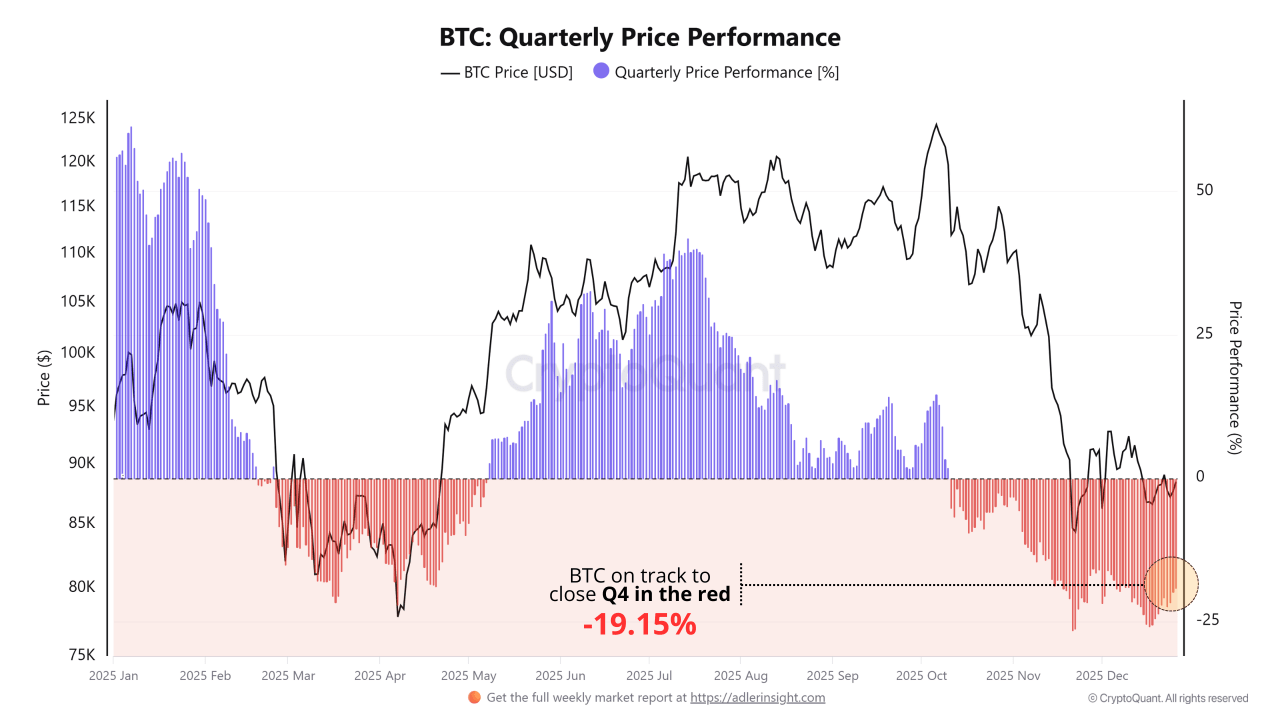
Source: CryptoQuant

Bear Market Confirmation Indicators

Beyond capitulation metrics, GugaOnChain highlights additional confirmation indicators that suggest that downside risks will remain dominant in the near term. One of these indicators, the Market Cap Growth Rate, measured by the 30-day versus 365-day moving average gap ratio, is firmly negative at -11.65%, pointing to contracting market growth rather than expansion.

Institutional flows also reflect waning confidence. US Bitcoin spot ETFs recorded $825.7 million in net outflows between December 18 and December 24, 2025, highlighting reduced institutional appetite as the Q4 price struggles persist. Meanwhile, the Coinbase Premium Gap has remained negative at –66.11, signaling weaker demand from US-based investors compared to offshore markets.

In assessing these several metrics together, GugaOnChain concludes the crypto market is likely to remain in a bear phase for the next two to three months. Therefore, investors should anticipate further corrections in the first quarter of 2026 until the capitulation signals ease and demand is stabilized.

At press time, Bitcoin trades at $87,436, reflecting a slight market loss of 0.42% in the last day.

BTC trading at $87,660 on the daily chart | Source: BTCUSDT chart on Tradingview.com

İlgili Sorular

QWhat was Bitcoin's peak price in early October 2025, and what is its current percentage loss from that peak?

ABitcoin peaked at around $126,200 in early October 2025 and has lost 30% of its market value from that peak at press time.

QAccording to GugaOnChain, what is the two key capitulation indicators that signal investors are selling at a loss and are deeply underwater?

AThe two key capitulation indicators are the Spent Output Profit Ratio (SOPR) at 0.99, indicating selling at a loss, and the Short-Term Holder MVRV (MVRV-STH) at 0.87, signaling short-term holders are deeply underwater.

QWhat does the negative Market Cap Growth Rate of -11.65% indicate about the Bitcoin market?

AThe negative Market Cap Growth Rate of -11.65% indicates the market is contracting rather than expanding, pointing to dominant downside risks in the near term.

QHow did US Bitcoin spot ETFs perform in terms of net flows between December 18 and December 24, 2025, and what does this signify?

AUS Bitcoin spot ETFs recorded $825.7 million in net outflows during that period, highlighting reduced institutional appetite as the Q4 price struggles persist.

QWhat is the overall conclusion from the analyst regarding the expected duration of the current bear market phase?

AThe analyst concludes that the crypto market is likely to remain in a bear phase for the next two to three months, with further corrections expected in the first quarter of 2026.

İlgili Okumalar

AI Industry Welcomes a Cash-Rich Tether

Tether, the company behind the stablecoin USDT, reported a staggering $13 billion profit in 2024, significantly outperforming major AI companies like OpenAI and Anthropic, both of which incurred substantial losses. With only 150 employees, Tether achieved a per capita output 60 times greater than OpenAI’s. Its business model is simple: for every USDT issued, Tether holds one US dollar, primarily investing these reserves in U.S. Treasury bonds. It earns the interest income without paying any to USDT holders. In 2024, interest alone contributed $7 billion to its profits. Now, Tether is aggressively investing in AI. It loaned over $600 million to Northern Data, Europe’s largest GPU cloud provider, acquiring what is effectively an AI training base. It also released QVAC Genesis, a massive open-source AI training dataset. Furthermore, Tether invested $200 million in Blackrock Neurotech, a pioneering brain-computer interface company. Additional investments in robotics could bring its total AI-related spending to nearly $2 billion. Tether’s move into AI may be driven by both anxiety over declining Treasury yields and ambition to establish itself as a tech leader. Ironically, it promotes "decentralized AI" despite being a highly centralized company itself. While OpenAI and Anthropic struggle with profitability and continuous fundraising, Tether leverages its highly profitable stablecoin business to fund its AI ambitions risk-free, making a paradoxical case that the best business model in AI might be not to do AI at all.

marsbit5 dk önce

AI Industry Welcomes a Cash-Rich Tether

marsbit5 dk önce

İşlemler

Spot
Futures

Popüler Makaleler

Tartışmalar

HTX Topluluğuna hoş geldiniz. Burada, en son platform gelişmeleri hakkında bilgi sahibi olabilir ve profesyonel piyasa görüşlerine erişebilirsiniz. Kullanıcıların BTC (BTC) fiyatı hakkındaki görüşleri aşağıda sunulmaktadır.

活动图片