Hong Kong avanza con los regímenes de licencias para operadores y custodios de activos virtuales

cointelegraph2025-12-24 tarihinde yayınlandı2025-12-24 tarihinde güncellendi

Özet

Hong Kong avanza en su marco regulatorio para activos digitales al establecer licencias obligatorias para intermediarios y custodios de criptoactivos, tras concluir consultas públicas. Esta medida amplía la normativa existente, que ya exigía licencias para plataformas de trading (11 aprobadas hasta ahora) e incluyó en 2025 un régimen para emisores de stablecoins. La ciudad, que aspira a ser un centro cripto, también prueba iniciativas de tokenización. La CEO de la SFC, Julia Leung, destaca que esto fortalece un ecosistema "confiable y competitivo". Paralelamente, se lanzó una consulta sobre licencias para servicios de asesoría y gestión, vinculándolas a las normas antilavado.

Los reguladores de Hong Kong procederán a legislar regímenes de licencias para operadores y custodios de criptoactivos tras finalizar las consultas, como parte de un esfuerzo más amplio para reforzar la supervisión.

En un anuncio del miércoles, la Oficina de Servicios Financieros y del Tesoro (FSTB) de la ciudad y la Comisión de Valores y Futuros (SFC) declararon que habían concluido las consultas sobre los regímenes de licencias propuestos, que exigirían a las empresas que presten servicios de operación o custodia de criptoactivos en Hong Kong obtener licencias una vez que el marco entre en vigor.

Esta medida se suma al marco de licencias de criptoactivos en expansión de la ciudad. A principios de 2025, Hong Kong puso en vigor su Ordenanza de Stablecoins, abriendo un nuevo régimen de licencias para emisores de stablecoins.

Hong Kong ya exige que las plataformas de trading de criptoactivos estén licenciadas. El régimen obligatorio actual se basa en el marco opcional introducido en 2020, y hasta la fecha 11 empresas han recibido la aprobación de la SFC.
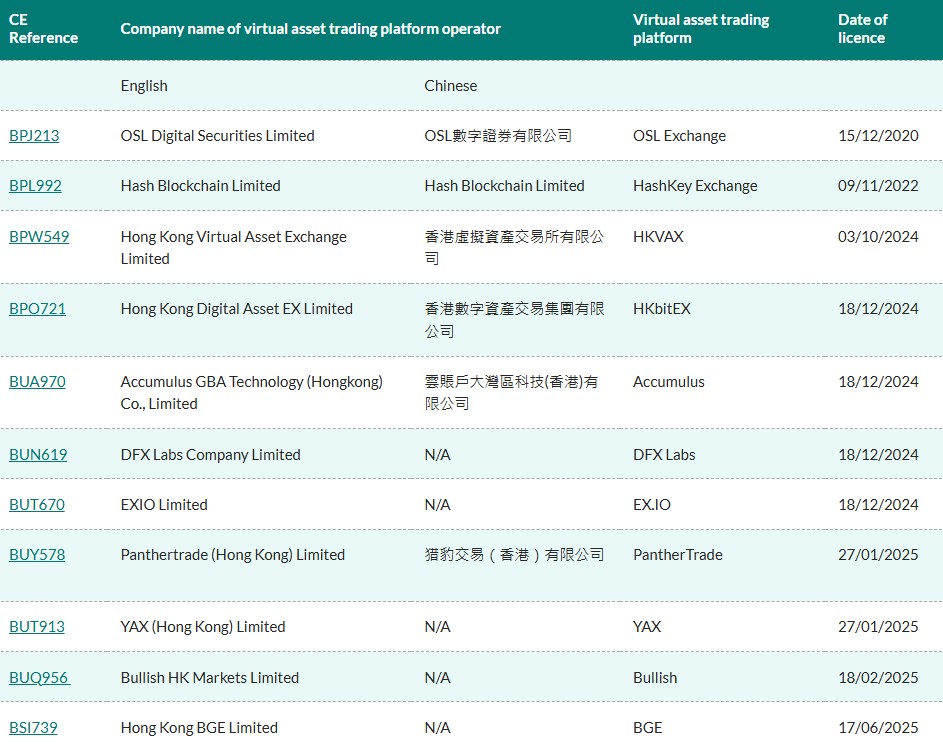
Hong Kong ha rechazado a más solicitantes para su licencia de exchange de criptoactivos de los que ha aprobado. Fuente: SFC

Relacionado: Las criptomonedas podrían entrar en las carteras de las aseguradoras mientras Hong Kong revisa las normas de capital

Iniciativas más amplias de Hong Kong en materia de criptoactivos

Hong Kong ha expresado desde hace tiempo sus ambiciones de convertirse en un centro de criptoactivos. La ciudad ya funciona como un centro financiero gracias a sus regímenes fiscales favorables a los negocios y su reputación como puerta de entrada financiera entre la China continental y los mercados de capitales globales.

Más allá de las normas de licencias para criptoactivos, Hong Kong también ha probado iniciativas de tokenización. En el anuncio del jueves, los reguladores añadieron que la próxima introducción de regímenes de licencias para operadores y custodios de criptoactivos es parte del esfuerzo de la ciudad por establecer un marco regulatorio integral para los activos digitales, junto con las stablecoins y la tokenización.

​Julia Leung, directora general de la SFC, declaró que el mayor desarrollo del marco regulatorio de criptoactivos de Hong Kong ayudaría a la ciudad a mantener su posición en los desarrollos del mercado global de activos digitales al "fomentar un ecosistema confiable, competitivo y sostenible".

Relacionado: Hong Kong lanza una consulta fiscal CARF sobre criptoactivos para combatir la evasión

Nueva consulta sobre asesoría y gestión

La SFC también publicó un documento de consulta el mismo día, solicitando comentarios públicos sobre propuestas para introducir regímenes de licencias para proveedores de servicios de asesoría y proveedores de servicios de gestión de criptoactivos.

La consulta vincula los regímenes propuestos con el marco existente contra el blanqueo de capitales (AML) y la Ordenanza contra la Financiación del Terrorismo de Hong Kong, y establece cómo las actividades de asesoría y gestión que involucren activos digitales se incorporarán al marco regulatorio.

También invita a comentar sobre asuntos como el alcance de las licencias, los poderes regulatorios, las sanciones y los acuerdos de apelación, que se tendrán en cuenta para finalizar las propuestas.


İlgili Sorular

Q¿Qué han anunciado los reguladores de Hong Kong en relación con los activos virtuales?

ALos reguladores de Hong Kong han anunciado que procederán a legislar regímenes de licencias para los distribuidores y custodios de criptoactivos, tras finalizar las consultas, como parte de un esfuerzo más amplio para reforzar la supervisión.

Q¿Qué requisito impondrá el nuevo marco regulatorio a las empresas de criptoactivos en Hong Kong?

AEl nuevo marco requerirá que las empresas que proporcionen servicios de negociación o custodia de criptoactivos en Hong Kong obtengan una licencia una vez que entre en vigor la normativa.

Q¿Qué otra iniciativa regulatoria relacionada con criptoactivos implementó Hong Kong a principios de 2025?

AA principios de 2025, Hong Kong puso en vigor su 'Stablecoin Ordinance', abriendo un nuevo régimen de licencias para los emisores de stablecoins.

Q¿Cuál es el objetivo más amplio de Hong Kong con estas regulaciones de activos digitales?

AEl objetivo más amplio de Hong Kong es establecerse como un centro de criptoactivos, fomentando un ecosistema confiable, competitivo y sostenible para mantener su posición en el desarrollo del mercado global de activos digitales.

Q¿Sobre qué publicó la SFC una consulta adicional el mismo día?

ALa SFC también publicó un documento de consulta buscando comentarios públicos sobre propuestas para introducir regímenes de licencias para proveedores de servicios de asesoramiento y proveedores de servicios de gestión de criptoactivos.

İlgili Okumalar

Focus: Five Leading AI Stocks on Nasdaq

The report analyzes five Nasdaq-listed AI infrastructure stocks—Micron (MU), MaxLinear (MXL), AMD, Lumentum (LITE), and Vicor (VICR)—as distinct plays within the AI capital expenditure chain, rather than a single "AI trade." While all benefit from AI data center spending, they differ in their specific roles (e.g., memory, computing, optics, power, connectivity), financial resilience, and risk profiles. The author argues that the key question is not whether the AI narrative remains intact, but whether capital expenditure translates into real orders, earnings justify valuations, and portfolios can withstand high volatility. Historical data shows these stocks have significantly outperformed benchmarks but also experienced deeper drawdowns (~28% to -32%), highlighting their high-beta, high-volatility nature. An investment framework is proposed: core positions (e.g., MU, AMD) for stocks with stronger fundamental evidence; satellite positions (e.g., LITE, VICR) for high-potential, high-volatility names; and cautious observation (e.g., MXL) for smaller-cap ideas with unproven financials. The emphasis is on disciplined, phased buying during pullbacks—only when price corrections align with intact fundamentals and available risk budget—rather than emotional "buy-the-dip" strategies. Overall, AI infrastructure offers long-term potential, but success requires strict position sizing, role definition for each holding, and preparedness for significant volatility.

marsbit41 dk önce

Focus: Five Leading AI Stocks on Nasdaq

marsbit41 dk önce

Will UNI Reach $100 in Four Years? Will Standard Chartered's Prediction Come True?

TL;DR: - According to reports, Standard Chartered Bank has published a research report on Uniswap, setting a 2030 price target of $100 for the UNI token. - The bank's core logic is that the tokenization of assets will drive demand for open DeFi liquidity, and Uniswap could capture significant trading volume and fee revenue. - However, most institutional-grade tokenized products are permissioned, and the example of BlackRock's BUIDL shows that DeFi still faces significant access barriers. Standard Chartered's $100 target for UNI by 2030 is based on the hypothesis that tokenized assets will grow massively and a significant portion will flow into open DeFi markets, requiring decentralized exchange platforms like Uniswap for liquidity. The bank forecasts tokenized assets could reach $4 trillion by 2028, with up to 30% in DeFi by 2030. The key question is whether tokenized assets like treasuries and funds will trade in open, decentralized markets or remain within closed, permissioned institutional systems. This directly impacts Uniswap's potential growth. A real-world example is BlackRock's BUIDL fund, which, while using UniswapX for trading, is strictly limited to pre-approved, whitelisted institutional participants. This highlights the current trend: institutions may leverage DeFi infrastructure but maintain strict control over access and transfers. Furthermore, for UNI's value to rise significantly, Uniswap must establish a clear value-capture mechanism, such as the approved fee switch and token burn proposal. Regulatory and interoperability hurdles also persist, as noted by bodies like the Financial Stability Board. In summary, Standard Chartered's bold prediction hinges on the future flow of tokenized asset liquidity. While it signals institutional recognition of DeFi's potential, the path to $100 depends on overcoming current permissioned models and enabling truly open, cross-asset liquidity pools on platforms like Uniswap.

Foresight News44 dk önce

Will UNI Reach $100 in Four Years? Will Standard Chartered's Prediction Come True?

Foresight News44 dk önce

Odaily Editorial Team Tea Talk (June 17)

Odaily Editorial Team Casual Chat (June 17) This is an informal column sharing real-time thoughts from Odaily's editorial team on industry news, data, and events. The content is based on actual investment and observations, does not constitute investment advice, and aims to expand perspectives. Azuma shared recent operations: small-scale buys in crypto (mainly BTC) at relatively high levels, a small addition to HOOD stock, and participation in World Cup prediction markets. He also discussed Hyperliquid, noting that while its token HYPE has performed well, its high price may hinder the expansion of its HIP-3 ecosystem by making market creation cost-prohibitive, potentially limiting the platform to just one major market (trade.xyz). Suzz emphasized the importance of a calm mindset in investing, stating that markets offer perpetual opportunities. He warned against "hindsight bias," where past opportunities seem obvious, and stressed that the present always holds new chances for those with the right knowledge and temperament. Golem analyzed SpaceX's acquisition of AI tool Cursor's parent company, Anysphere, for $60 billion paid entirely in SpaceX stock. He speculated whether Musk's interests might work to keep SpaceX's trading volume and market cap high in the short term to reduce the actual equity cost of the deal, noting current high retail investor enthusiasm. Wenser shared a market outlook: cautiously bullish on BTC, monitoring SpaceX stock post-IPO for a potential rise, observing World Cup trends favoring strong teams, and noting the continued strength of Japanese and Korean stocks. He highlighted Anthropic's potential for a massive future IPO and the defensive investment logic in "picks and shovels" AI infrastructure. Qin Xiaofeng discussed trading HYPE around $56-$70, viewing the $50-$60 range as long-term support due to Hyperliquid's dominance in on-chain traditional asset trading and its substantial fee revenue used to buy back HYPE. On ETH, he noted a divide between disappointed crypto natives and bullish traditional investors like Tom Lee, personally viewing current ETH prices as undervalued.

Odaily星球日报55 dk önce

Odaily Editorial Team Tea Talk (June 17)

Odaily星球日报55 dk önce

İşlemler

Spot
Futures

Popüler Makaleler

VIRTUAL Nasıl Satın Alınır

HTX.com’a hoş geldiniz! Virtuals Protocol (VIRTUAL) satın alma işlemlerini basit ve kullanışlı bir hâle getirdik. Adım adım açıkladığımız rehberimizi takip ederek kripto yolculuğunuza başlayın. 1. Adım: HTX Hesabınızı OluşturunHTX'te ücretsiz bir hesap açmak için e-posta adresinizi veya telefon numaranızı kullanın. Sorunsuzca kaydolun ve tüm özelliklerin kilidini açın. Hesabımı Aç2. Adım: Kripto Satın Al Bölümüne Gidin ve Ödeme Yönteminizi SeçinKredi/Banka Kartı: Visa veya Mastercard'ınızı kullanarak anında Virtuals Protocol (VIRTUAL) satın alın.Bakiye: Sorunsuz bir şekilde işlem yapmak için HTX hesap bakiyenizdeki fonları kullanın.Üçüncü Taraflar: Kullanımı kolaylaştırmak için Google Pay ve Apple Pay gibi popüler ödeme yöntemlerini ekledik.P2P: HTX'teki diğer kullanıcılarla doğrudan işlem yapın.Borsa Dışı (OTC): Yatırımcılar için kişiye özel hizmetler ve rekabetçi döviz kurları sunuyoruz.3. Adım: Virtuals Protocol (VIRTUAL) Varlıklarınızı SaklayınVirtuals Protocol (VIRTUAL) satın aldıktan sonra HTX hesabınızda saklayın. Alternatif olarak, blok zinciri transferi yoluyla başka bir yere gönderebilir veya diğer kripto para birimlerini takas etmek için kullanabilirsiniz.4. Adım: Virtuals Protocol (VIRTUAL) Varlıklarınızla İşlem YapınHTX'in spot piyasasında Virtuals Protocol (VIRTUAL) ile kolayca işlemler yapın.Hesabınıza erişin, işlem çiftinizi seçin, işlemlerinizi gerçekleştirin ve gerçek zamanlı olarak izleyin. Hem yeni başlayanlar hem de deneyimli yatırımcılar için kullanıcı dostu bir deneyim sunuyoruz.

380 Toplam GörüntülenmeYayınlanma 2024.12.23Güncellenme 2026.06.02

VIRTUAL Nasıl Satın Alınır

Tartışmalar

HTX Topluluğuna hoş geldiniz. Burada, en son platform gelişmeleri hakkında bilgi sahibi olabilir ve profesyonel piyasa görüşlerine erişebilirsiniz. Kullanıcıların VIRTUAL (VIRTUAL) fiyatı hakkındaki görüşleri aşağıda sunulmaktadır.

活动图片












