Willy Woo says Bitcoin OGs will buy Satoshi's stash if a quantum hack occurs

cointelegraph2025-12-14 tarihinde yayınlandı2025-12-14 tarihinde güncellendi

Özet

A debate emerged on social media regarding the potential scenario of a quantum computer hacking and dumping Satoshi Nakamoto’s 1 million BTC. YouTuber Josh Otten suggested this could crash Bitcoin's price to $3, but long-term holder Willy Woo countered that many original Bitcoin investors (OGs) would buy such a flash crash, ensuring the network's survival. Woo noted that around 4 million BTC in older "pay-to-public-key" (P2PK) addresses, including Satoshi's, are vulnerable because they expose public keys onchain, which a powerful quantum computer could use to derive private keys. Newer wallet types are more secure as they don’t reveal public keys. While some fear quantum computing could destroy crypto, experts like Blockstream’s Adam Back believe the threat is decades away, allowing time to adopt quantum-resistant cryptography. Analyst James Check added that the bigger risk is to Bitcoin’s market price, as the community is unlikely to preemptively freeze Satoshi’s coins before a quantum attack.

A debate broke out on social media on Saturday about the potential effects of a quantum computer hacking Satoshi Nakamoto’s Bitcoin (BTC) stash and then dumping those coins onto the market.

The debate began when YouTuber Josh Otten shared a price chart of BTC crashing to $3.00 and said that this could happen if a sufficiently powerful quantum computer emerges and steals pseudonymous Bitcoin creator Satoshi Nakamoto’s 1 million BTC and sells them.

“Many OGs would buy the flash crash. The Bitcoin network would survive; most coins are not immediately vulnerable,” long-term Bitcoin holder Willy Woo said.
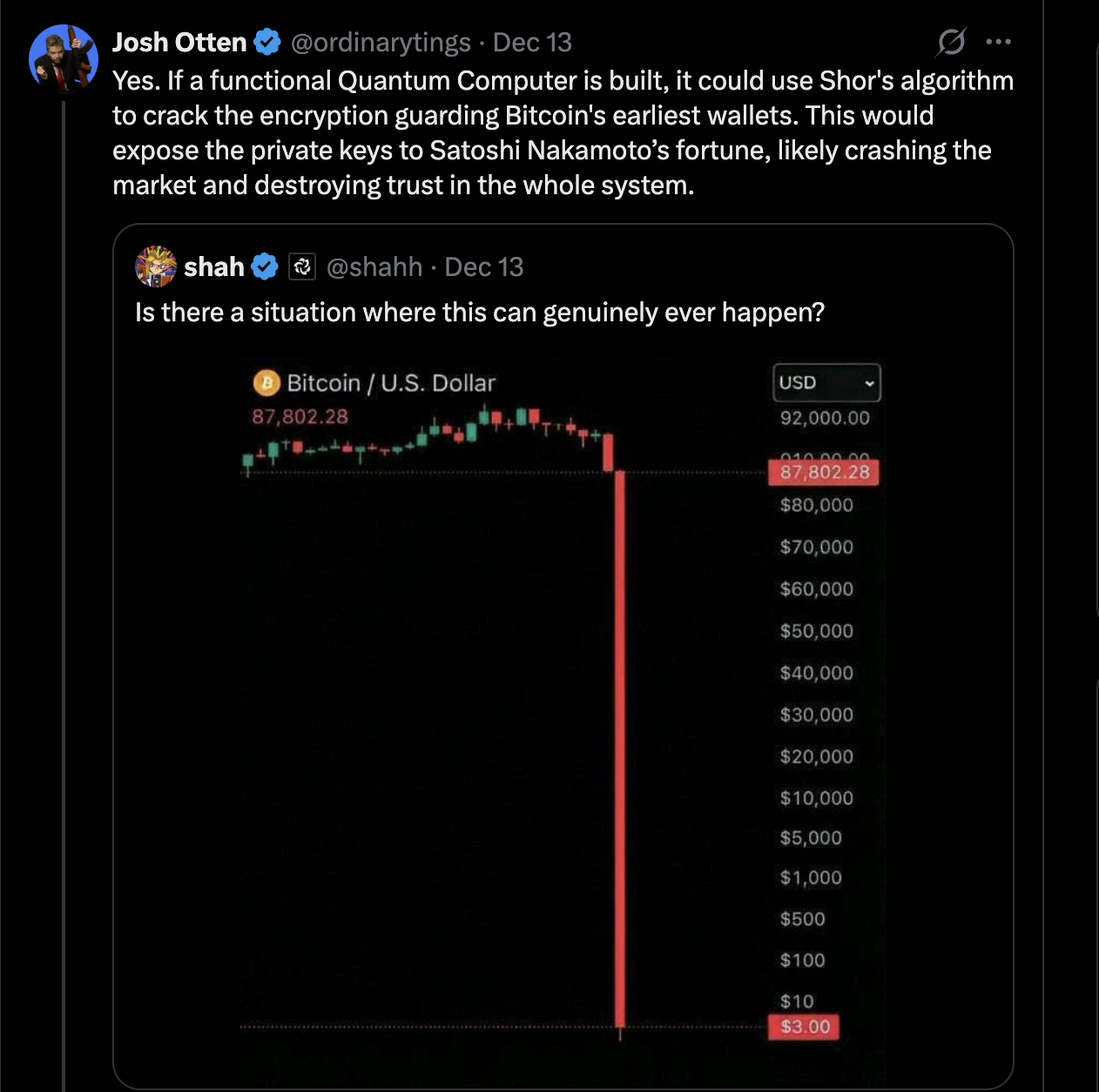
Source: Josh Otten

However, there are about 4 million BTC held in pay-to-public-key (P2PK) addresses, including Satoshi’s coins, which show the full public key onchain when coins are spent, making them vulnerable to quantum attacks, Woo added.

Exposing a Bitcoin wallet’s full public key onchain exposes these wallets to quantum attacks in the future because a sufficiently powerful quantum computer could theoretically derive the private key from the public key in the future

Newer types of BTC wallet addresses are not as vulnerable to quantum attacks because they do not expose the full public keys onchain, and if the public key is not known, then a quantum computer cannot generate the paired private key from that data.
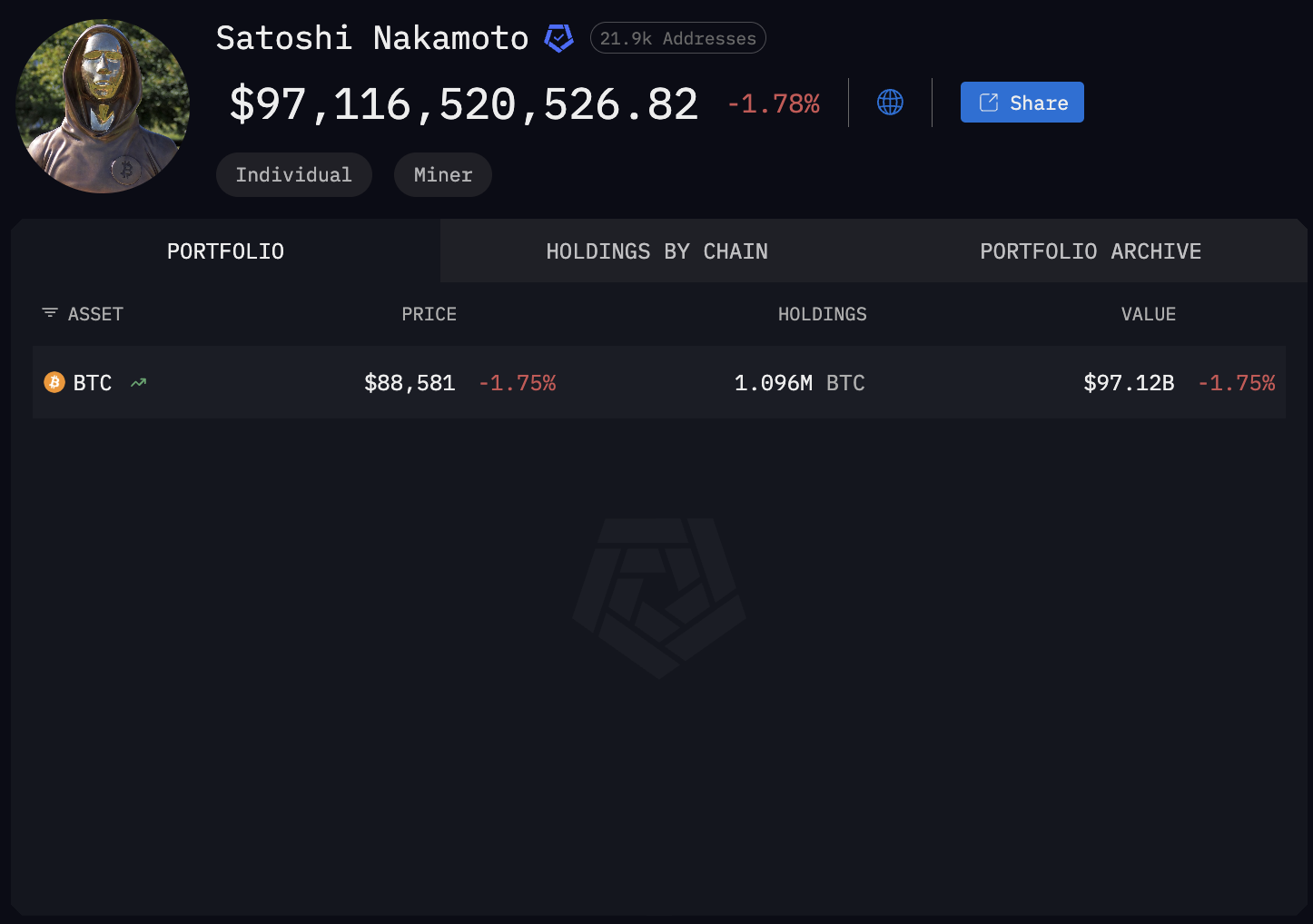
Satoshi Nakamoto’s Bitcoin holdings. Source: Arkham Intelligence

The Bitcoin and crypto communities continue to debate the potential effects of quantum computing on Bitcoin and the encryption technology that underpins cryptocurrencies, with some arguing that quantum computing will be the death of the industry.

Related: VanEck boss questions Bitcoin’s privacy, encryption against quantum tech

Bitcoin OG Adam Back says the threat of quantum computers is decades away

Adam Back, an early Bitcoin holder, cypherpunk and co-founder of Bitcoin technology company Blockstream, said that BTC will not face a quantum threat in the next 20-40 years.

Back argued that there is plenty of time to adopt post-quantum cryptography standards, which already exist, before a quantum computer powerful enough to crack modern encryption and cybersecurity standards is built.

Market analyst James Check said that quantum computing does not threaten Bitcoin’s technology because users will migrate to quantum-resistant addresses by the time a viable quantum computer emerges.

The quantum threat poses more of a threat to Bitcoin’s market price because there is “no chance” that the Bitcoin community will agree to freeze Satoshi’s coins before a quantum computer hacks his wallets and puts the coins back into circulation, Check said.

Magazine: Quantum attacking Bitcoin would be a waste of time: Kevin O’Leary

Trend Kriptolar

İlgili Okumalar

ChangXin's "Peer": The Fate of Fujian Jinhua Integrated Circuit Co., Ltd. Is Regrettable

China's DRAM industry saw a pivotal moment with ChangXin's (CXMT) successful IPO. However, the fate of its 2016 counterpart, Fujian Jinhua Integrated Circuit, offers a stark contrast. Both were founded the same year with similar missions, massive investment, and 12-inch wafer fab goals to break into the DRAM market dominated by Samsung, SK Hynix, and Micron. Fujian Jinhua initially progressed faster by partnering with Taiwan's United Microelectronics Corporation (UMC) for 32nm DRAM technology. This strategy, however, led to a protracted legal battle. In 2017, Micron sued UMC and Jinhua for trade secret theft. The situation escalated in October 2018 when the U.S. Commerce Department added Fujian Jinhua to its Entity List, citing its imminent mass production as a threat. This resulted in an immediate halt of equipment, software, and technical support from American suppliers, followed by UMC suspending cooperation. Although Jinhua was eventually cleared of criminal charges in late 2023 after a nearly six-year legal saga, it missed the critical industry growth window. In contrast, ChangXin took a different path from the start, focusing on building its own R&D system and securing intellectual property, notably through a license for former Qimonda patents. While also facing U.S. scrutiny and initial heavy losses, ChangXin benefited from a more mature domestic supply chain when it reached mass production. It achieved profitability in 2025 and represents the rise of China's DRAM industry. Jinhua's story is a crucial lesson. It was the first Chinese DRAM company to confront the complex realities of international IP disputes, export controls, and supply chain vulnerabilities. Today, it has resumed operations with a 40,000 wafers-per-month capacity, aiming for 60,000. While it missed its initial opportunity, its experience informed the strategic evolution of later Chinese semiconductor firms.

marsbit22 dk önce

ChangXin's "Peer": The Fate of Fujian Jinhua Integrated Circuit Co., Ltd. Is Regrettable

marsbit22 dk önce

Crypto Fear and Greed Index Rises Over Last 24 Hours! Has It Exited the Fear Zone? Here are the Details

The Crypto Fear and Greed Index, a key indicator measuring investor sentiment in the cryptocurrency market, showed a limited recovery over the past 24 hours. According to data from CoinMarketCap, the index rose by 2 points to reach 37. Despite this increase, the indicator remains in the "Fear" zone, reflecting a continued cautious approach among investors. The index, which ranges from 0 (extreme fear) to 100 (extreme greed), suggests that while there is a slight improvement in investor confidence, market participants are still largely risk-averse. CoinMarketCap calculates the index by considering factors such as the price movements of the top 10 cryptocurrencies, overall market volatility, derivatives market data (like put/call ratios), stablecoin supply ratios, and user search data. Analysts note that the modest index rise points to a slight easing of market panic. However, its persistence in the fear zone indicates ongoing investor caution due to macroeconomic events, interest rate policies, and regulatory uncertainty. Experts suggest that for a sustained improvement in sentiment, increased trading volumes and stronger institutional capital inflows are necessary. Key factors expected to influence market mood in the coming period include capital flows into spot Bitcoin and Ethereum ETFs and developments in global monetary policy. While the index alone is not a sufficient tool for investment decisions, its potential to exit the fear zone is seen as a significant signal for the future direction of the crypto market.

cryptonews.ru23 dk önce

Crypto Fear and Greed Index Rises Over Last 24 Hours! Has It Exited the Fear Zone? Here are the Details

cryptonews.ru23 dk önce

Playing the "Decoupling" Card Again? Domestic Optical Modules Face a Stress Test

The U.S. Federal Communications Commission (FCC) is reportedly drafting a ban on importing new models of Chinese-made optical transceiver modules, with a potential implementation target of 2026. This "decoupling" move comes as Chinese firms, led by industry leaders like Zhongji Innolight and Eoptolink, dominate the global optical module market with over 60% share, and hold an even larger position in the high-speed 800G and 1.6T segments critical for AI data centers. Market reactions were mixed: U.S. optical module stocks initially rose, while Chinese A-shares opened lower but largely recovered by the close. Analysis suggests a complete U.S. decoupling from Chinese modules faces significant hurdles. North American cloud giants (Meta, Google, Microsoft, Amazon) and NVIDIA have massive demand for high-speed modules, estimated at around 40 million units in 2026. U.S. manufacturers' combined monthly production capacity for these modules is less than one-fifth that of a single major Chinese player like Zhongji Innolight, which reported production of 23.76 million units in 2025. Chinese companies are heavily reliant on the U.S. market, with over 90% of revenue for top firms coming from overseas, primarily the U.S. However, they have begun mitigating risks by establishing assembly plants in Southeast Asia and Mexico. Industry observers note the final impact depends on whether any potential U.S. restrictions target specific companies or products based on origin. Past U.S. sanctions on Chinese tech firms have often spurred increased domestic R&D and market diversification. Despite initial stock volatility, shares of major Chinese optical module companies pared losses, indicating market belief in the sector's resilience and the practical difficulties of abruptly replacing Chinese supply.

marsbit1 saat önce

Playing the "Decoupling" Card Again? Domestic Optical Modules Face a Stress Test

marsbit1 saat önce

İşlemler

Spot

Popüler Makaleler

WOO Nasıl Satın Alınır

HTX.com’a hoş geldiniz! WOO (WOO) satın alma işlemlerini basit ve kullanışlı bir hâle getirdik. Adım adım açıkladığımız rehberimizi takip ederek kripto yolculuğunuza başlayın. 1. Adım: HTX Hesabınızı OluşturunHTX'te ücretsiz bir hesap açmak için e-posta adresinizi veya telefon numaranızı kullanın. Sorunsuzca kaydolun ve tüm özelliklerin kilidini açın. Hesabımı Aç2. Adım: Kripto Satın Al Bölümüne Gidin ve Ödeme Yönteminizi SeçinKredi/Banka Kartı: Visa veya Mastercard'ınızı kullanarak anında WOO (WOO) satın alın.Bakiye: Sorunsuz bir şekilde işlem yapmak için HTX hesap bakiyenizdeki fonları kullanın.Üçüncü Taraflar: Kullanımı kolaylaştırmak için Google Pay ve Apple Pay gibi popüler ödeme yöntemlerini ekledik.P2P: HTX'teki diğer kullanıcılarla doğrudan işlem yapın.Borsa Dışı (OTC): Yatırımcılar için kişiye özel hizmetler ve rekabetçi döviz kurları sunuyoruz.3. Adım: WOO (WOO) Varlıklarınızı SaklayınWOO (WOO) satın aldıktan sonra HTX hesabınızda saklayın. Alternatif olarak, blok zinciri transferi yoluyla başka bir yere gönderebilir veya diğer kripto para birimlerini takas etmek için kullanabilirsiniz.4. Adım: WOO (WOO) Varlıklarınızla İşlem YapınHTX'in spot piyasasında WOO (WOO) ile kolayca işlemler yapın.Hesabınıza erişin, işlem çiftinizi seçin, işlemlerinizi gerçekleştirin ve gerçek zamanlı olarak izleyin. Hem yeni başlayanlar hem de deneyimli yatırımcılar için kullanıcı dostu bir deneyim sunuyoruz.

134 Toplam GörüntülenmeYayınlanma 2024.12.12Güncellenme 2026.06.02

WOO Nasıl Satın Alınır

Tartışmalar

HTX Topluluğuna hoş geldiniz. Burada, en son platform gelişmeleri hakkında bilgi sahibi olabilir ve profesyonel piyasa görüşlerine erişebilirsiniz. Kullanıcıların WOO (WOO) fiyatı hakkındaki görüşleri aşağıda sunulmaktadır.

活动图片