When Curators Become a Risk Variable in DeFi Lending, How Can Algorithms Reshape the Market?

比推2025-12-10 tarihinde yayınlandı2025-12-10 tarihinde güncellendi

Özet

The article argues that the current "Curator" model in DeFi lending, as seen in protocols like Morpho and Euler, reintroduces human moral risk and inefficiency. It traces the evolution of lending markets, highlighting that early pooled models (e.g., Compound, Aave) sacrificed lender risk control for borrower convenience, while isolated markets (e.g., Morpho Blue) fragmented liquidity. Curator vaults attempted to bridge this gap but reintroduced trust assumptions and discretionary decision-making. The author proposes a new paradigm inspired by traditional order books: a two-tier architecture separating risk definition from order matching. In this model (exemplified by Avon), lenders deposit into isolated, parameter-defined "strategies" (retaining full risk control), while a shared order book algorithmically aggregates and routes borrower requests across compatible strategies atomically. This eliminates the need for human curators, enhances transparency, and improves liquidity utilization. The approach also benefits RWA by allowing compliance at the strategy level while pooling global liquidity. Built on high-performance chains like MegaETH, this CLOB-based system aims to automate lending coordination without sacrificing lender autonomy or borrower experience.

Original Author: @0xJaehaerys, Gelora Research

Original Compilation: EeeVee, SpecialistXBT, BlockBeats

Original Title: Lending Markets Do Not Need the Curator Model


Editor's Note: After the successive blowups of Stream Finance and USDX, the DeFi community is undergoing a painful disenchantment. The "Curator" model introduced by protocols like Morpho and Euler was originally intended to solve liquidity fragmentation but inadvertently reintroduced the moral hazard of "human" factors on-chain. The author of this article points out that current lending protocols mistakenly bundle "risk definition" with "order matching." By drawing on the order book model from traditional finance, this article constructs a new paradigm that eliminates the need for curators and relies on algorithmic automatic routing.

The Evolutionary Logic of Lending Markets

Reviewing the evolution of on-chain trading provides a reference for understanding lending market.

AMMs based on constant functions (like Uniswap) solved a fundamental problem: how to create a market without active market makers? The answer was to use an invariant function to preset the "shape" of liquidity. Liquidity providers pre-agree to a set of strategies, and the protocol handles execution automatically.

This works well in trading because trading is relatively simple: buyers and sellers meet at a price. But lending is much more complex. A loan involves multiple dimensions:

Interest rate

Collateral type

Loan-to-Value ratio (LTV)

Term (fixed vs. demand)

Liquidation mechanism

Matching a loan requires satisfying constraints across all these dimensions simultaneously.

Early DeFi lending directly adopted solutions similar to AMMs. Protocols like Compound and Aave preset interest rate curves, with lenders joining a shared pool. This allowed lending markets to function without active lenders.

But this analogy has a fatal flaw. In DEX trading, the shape of the constant function curve affects execution quality (slippage, depth); in lending, the shape of the interest rate curve directly determines risk. When all lenders share a single pool, they also share the risk of all collateral accepted by the pool. Lenders cannot express their desire to bear only specific types of risk.

In the trading space, order books solved this problem: they allow market makers to define their own "curve shape." Each market maker quotes at their preferred price, the order book aggregates these quotes into a unified market, but each market maker still controls their own risk exposure.

Can lending adopt the same approach? A project named Avon attempts to answer this question.

The Liquidity Fragmentation Problem

To give lenders control, DeFi's first attempt was market isolation.

Protocols like Morpho Blue and Euler allow anyone to create lending markets with specific parameters: designated collateral, borrowed asset, fixed liquidation LTV, and interest rate curve. Lenders deposit into markets that match their risk preferences. Bad debt in one market never spills over to another.
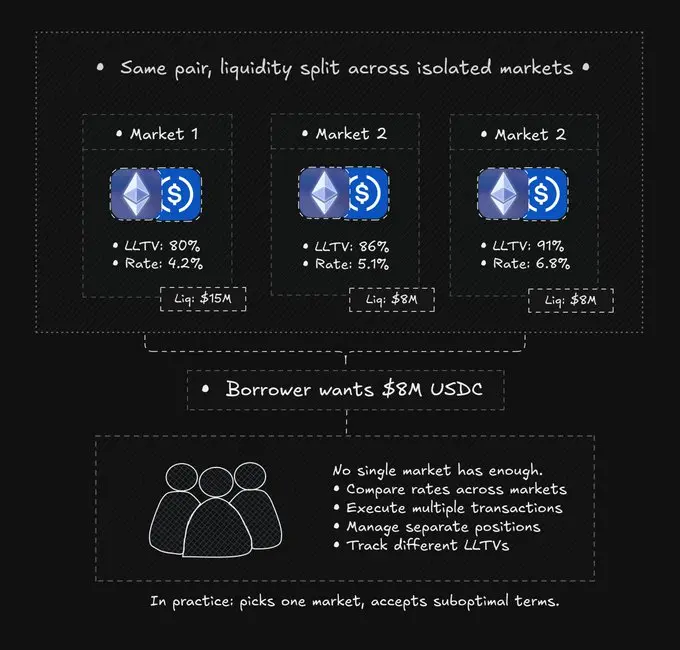
This is perfect for lenders; they get the risk isolation they want.

But for borrowers, this creates fragmentation.

Take ETH-USDC lending as an example. There might be a dozen different markets:

Market B: $3M liquidity, 86% LTV, 5.1% interest rate

Market C: $2M liquidity, 91% LTV, 6.8% interest rate

... and 9 other markets with lower liquidity

A user wanting to borrow $8 million cannot be satisfied from a single market. They must manually compare prices, execute multiple transactions, manage分散的头寸, and track different liquidation thresholds. The theoretical optimal solution requires splitting the loan across four or more markets.

In practice, no one does this. Borrowers typically just pick one market. Capital utilization is low in fragmented pools.

Market risk isolation solved the lender's problem but created a borrower's problem.

The Limitations of Curator Vaults

The curator vault model attempts to bridge this gap.
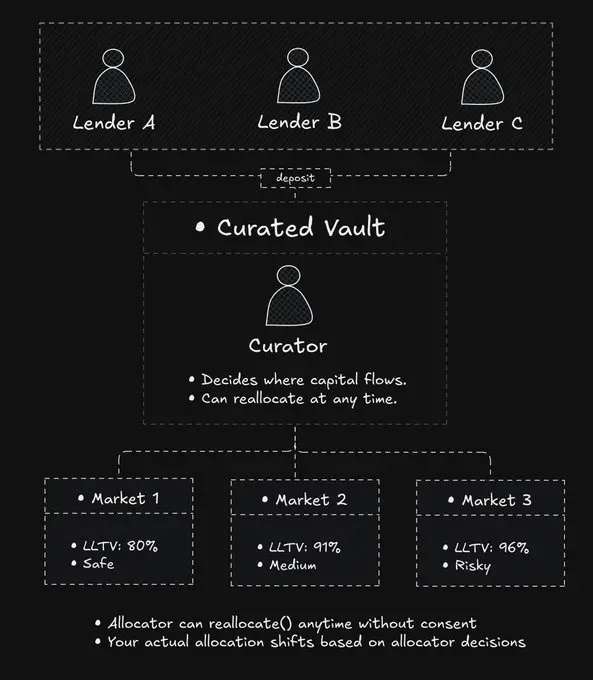
The idea is: professional curators manage capital allocation. Lenders deposit into vaults, and curators allocate funds to underlying markets, optimizing yield and managing risk. Borrowers still face fragmented markets, but at least lenders don't have to manually rebalance.

This helps lenders who want to "set and forget," but it introduces something DeFi aimed to eliminate: discretionary power.
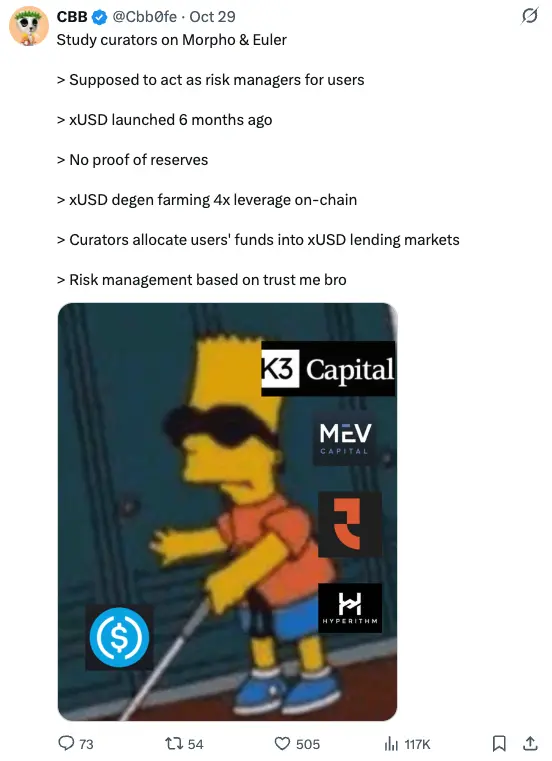
Curators decide which markets get capital and can reallocate at any time. The lender's risk exposure changes with the curator's decisions, unpredictably and uncontrollably. As one Twitter user put it: "The curator is PvPing the borrower, but the borrower doesn't even know they are being farmed."

This asymmetry is not only in strategy but also in the accuracy of the basic interface. Morpho's UI sometimes shows "$3 million available liquidity," but in practice, funds at low interest rates are scarce, with most capital located in higher rate tiers.

When liquidity coordination relies on human decisions, transparency suffers.

Capital allocators adjust market liquidity on their schedule, not based on the market's immediate needs. Vaults try to solve borrower fragmentation through "rebalancing," but rebalancing requires gas fees, depends on the curator's willingness, and often lags. Borrowers still face suboptimal rates.

Separating Risk from Matching

Lending protocols conflate two distinct modules.

User definition of risk: Different lenders have different views on collateral quality, leverage ratios.

The protocol's method of matching loans: This is mechanical. It doesn't require user subjectivity, just efficient routing.

The pooled model bundles these two, lenders lose control.

The isolated pool model separates risk definition but abandons matching, forcing borrowers to manually find the optimal path.

The curator vault model adds matching back through the curator role but introduces a trust assumption in the curator.

Can matching be automated without introducing discretion (human intervention)?

Order books in trading did this. Market makers define quotes, the order book aggregates depth, matching is deterministic (best price first). No one decides where orders go, the mechanism decides everything.

CLOB lending applies the same principle to credit markets:

Lenders define risk through isolated strategies.

Strategies post quotes to a shared order book.

Borrowers interact with unified liquidity.

Matching happens automatically, without curator intervention.

Risk stays with the lender, coordination becomes mechanical. No trust in a third party is needed at any point.

Two-Tier Architecture

Avon implements order book lending through two unique tiers.
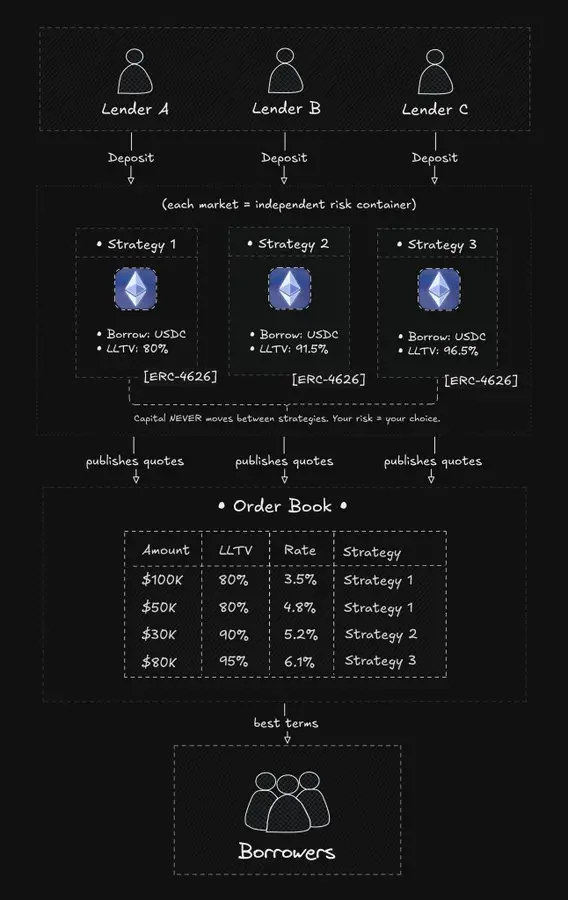
Strategy Layer

A "Strategy" is an isolated lending market with fixed parameters.

The strategy creator defines the following parameters: Collateral/Borrowed Asset, Liquidation LTV, Interest Rate Curve, Oracle, Liquidation Mechanism.

Once deployed, the shape of the interest rate curve cannot be changed. Lenders know the rules exactly before depositing.

Funds never move between strategies.

If you deposit into Strategy A, your money stays in Strategy A until you withdraw. No curators, no rebalancing, no sudden changes in risk exposure.

Although someone (the strategy manager) sets the parameters, they are fundamentally different from a curator: Curators are capital allocators (deciding where money goes), strategy managers are true risk managers (defining rules but not moving money), analogous to Aave DAO. The decision-making power for capital allocation always remains with the lender.

How does the system adapt to market changes? Through competition, not parameter modification. If the risk-free rate soars, this forces old strategies to become obsolete (funds flow out), and new strategies are created (funds flow in). "Discretion" shifts from "where should capital go?" (curator's decision) to "which strategy should I choose?" (lender's decision).

Matching Layer

Strategies do not serve borrowers directly; instead, they post quotes to a shared order book.

The order book aggregates quotes from all strategies into a unified view. Borrowers see the combined depth of all strategies that accept their collateral.

When a borrower places an order, the matching engine:

Filters quotes by compatibility (collateral type, LTV requirements).

Sorts by interest rate.

Executes starting from the cheapest.

Settles within an atomic transaction.

If one strategy can fulfill the entire order, it takes it all; if not, the order is automatically split across multiple strategies. The borrower only perceives one transaction.

Important note: The order book only reads strategy states; it cannot modify them. It is only responsible for coordinating access, not allocating capital.

A Boon for RWA

DeFi has always faced a structural contradiction in institutional adoption: compliance requires isolation, but isolation kills liquidity.
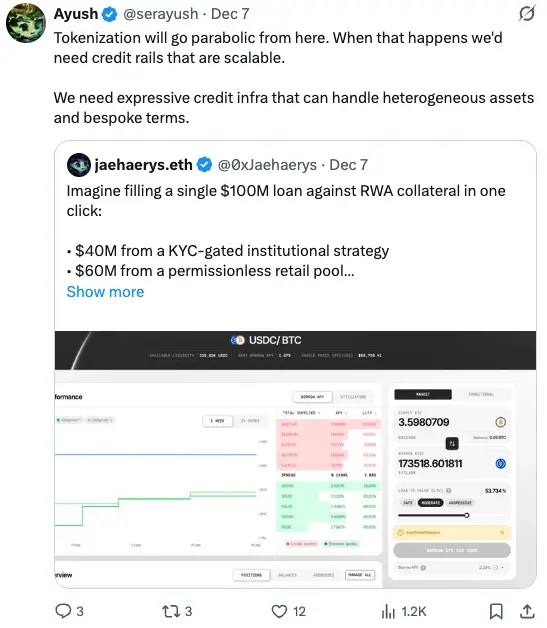
Aave Arc tried the "walled garden" model, where compliant participants have their own pool. The result was shallow liquidity and poor rates. Aave Horizon tried a "semi-open" model (RWA issuers require KYC, but lending is permissionless). This is progress, but institutional borrowers still cannot access the $32 billion liquidity in Aave's main pool. Some projects explored permissioned rollups. The KYC process is completed at the infrastructure level. This approach works for some use cases but fragments liquidity at the network layer. Compliant users on Chain A cannot access liquidity on Chain B.

The order book model offers a third way.

The strategy layer can enforce any access control (KYC, geographic restrictions, accredited investor checks). The matching engine is only responsible for matching.

If a compliant strategy and a permissionless strategy both offer compatible terms, they can simultaneously fill the same loan.

Imagine a corporate treasury抵押代币化国债 borrowing $100 million:

$30 million from a strategy requiring institutional KYC (pension fund LPs)

$20 million from a strategy requiring accredited investor certification (family office LPs)

$50 million from a completely permissionless strategy (retail LPs)

Funds are never mixed at the source, institutions remain compliant, but liquidity is unified globally. This breaks the deadlock of "compliance equals isolation."

Mechanisms for Multi-Dimensional Matching

Order books match on only one dimension: price. The highest bid and lowest ask match.
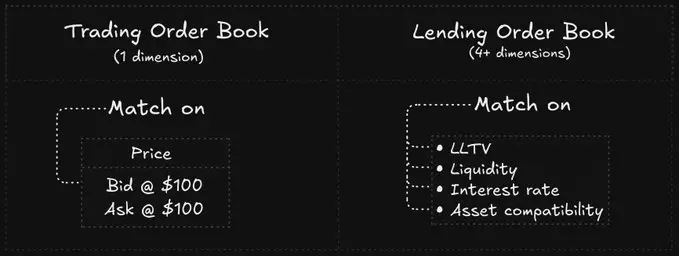
Lending order books must match across multiple dimensions simultaneously:

Interest Rate: Must be below the borrower's acceptable上限.

LTV: The borrower's collateral ratio must meet the strategy's requirements.

Asset Compatibility: Currency match.

Liquidity: Sufficient market liquidity.

Borrowers who provide more collateral (lower LTV) or accept higher interest rates can match with more strategies. The engine finds the cheapest path within this constraint space.

A note for large borrowers. In Aave, $10 billion in liquidity is a monolithic pool. In order book lending, $10 billion might be分散在数百种策略中. A $100 million loan would quickly consume the entire order book, filling from the cheapest strategies first, progressively moving to the most expensive ones. Slippage is visible.

Pool-based systems also have slippage, just manifested differently: a surge in utilization pushes up interest rates. The difference is transparency. In the order book, slippage is visible upfront. In the pool, slippage only becomes apparent after the trade executes.

Floating Rates and Re-quoting

DeFi lending uses floating rates. As utilization changes, so does the interest rate.

This creates a synchronization challenge: if the strategy utilization changes but the quote on the order book isn't updated, the borrower executes at the wrong price.

Solution: Continuous re-quoting.

As soon as the strategy state changes, immediately post a new quote to the order book. This requires extremely high infrastructure performance:

Very fast block times.

Extremely cheap transaction costs.

Atomic state reads.

This is why Avon chose to build on MegaETH. On Ethereum Mainnet, this architecture is prohibitively expensive due to gas fees.

Existing friction:

If market rates move but the strategy's fixed curve doesn't adapt, a "Dead Zone" appears – borrowers find it too expensive to borrow, and lenders earn no yield. In Aave, the curve adjusts automatically, whereas in CLOB mode, this requires lenders to manually withdraw and migrate to new strategies. This is the price paid for control.

Multi-Strategy Position Management

When a loan is filled by multiple strategies, the borrower effectively holds a multi-strategy position.

Although it looks like one loan on the interface, the underlying components are independent:

Independent Interest Rates: Component A's rate might rise due to increased utilization in Strategy A, while Component B remains unchanged.

Independent Health Ratios: When the token price drops, components with stricter LTV limits are liquidated first locally. You don't get liquidated all at once but experience a series of partial liquidations, like being "nibbled away."

To simplify the experience, Avon provides unified position management (one-click add collateral, automatically distributed by weight) and one-click refinancing功能 (automatically borrow new to repay old via flash loans, always locking in the market's best rate).

Conclusion

DeFi lending has gone through several stages:

Pooled Protocols: Gave borrowers depth but剥夺了放贷人的控制权.

Isolated Markets: Gave lenders control but fragmented the borrower experience.

Curator Vaults: Attempted to bridge the two but introduced human decision-making risk.

Order Book Lending (CLOB): Decouples the above models. Risk definition rights return to lenders; matching is achieved through an order book engine.

The design principle is clear: when matching can be achieved through code, human intervention is no longer needed. Markets can self-regulate.


Twitter:https://twitter.com/BitpushNewsCN

Bitpush TG Discussion Group:https://t.me/BitPushCommunity

Bitpush TG Subscription: https://t.me/bitpush

Original Link:https://www.bitpush.news/articles/7594633

İlgili Sorular

QWhat is the core problem with the 'Curator' model in DeFi lending protocols like Morpho and Euler?

AThe Curator model reintroduces human discretion and moral risk into the system. Curators decide where capital is allocated, which can change lenders' risk exposure unpredictably and create information asymmetry, undermining the trustless and transparent ideals of DeFi.

QHow does the proposed CLOB (Central Limit Order Book) model for lending separate risk from matching?

AThe CLOB model separates risk definition and order matching into two distinct layers. The Strategy Layer allows lenders to define risk in isolated, fixed-parameter markets. The Matching Layer is a shared order book that automatically and deterministically routes borrower orders to the best available strategies without any human intervention.

QWhat advantage does the order book model offer for Real-World Assets (RWA) in DeFi?

AIt allows for compliance at the strategy level (e.g., KYC, accreditation checks) while aggregating liquidity at the matching layer. This enables compliant and permissionless strategies to simultaneously serve the same borrower, unifying global capital without mixing it at the source and breaking the 'compliance equals isolation' dilemma.

QWhat is a key infrastructural requirement for a CLOB lending system to function effectively?

AIt requires extremely high-performance infrastructure with fast block times, very low transaction costs, and atomic state reads. This is necessary for strategies to continuously re-quote their rates on the order book in response to market changes, ensuring borrowers get accurate, up-to-date pricing.

QHow does the CLOB model change the experience for a large borrower compared to a pooled model like Aave?

AIn a pooled model, a large borrower interacts with a single pool, and slippage manifests as a sharp increase in the interest rate due to higher utilization. In a CLOB model, liquidity is fragmented across many pools (strategies). Slippage for a large loan is visible upfront as the order is filled progressively from the cheapest to the most expensive strategies, offering more predictable execution.

İlgili Okumalar

Google's 2026 Roadmap is Hidden in This Keynote Speech

Google I/O 2026 was not merely a product launch, but a strategic unveiling of the company's decade-long roadmap. The core signal is that Google is evolving its AI, Gemini, from a feature within products into a foundational operating layer that integrates and reshapes its entire ecosystem—Search, Android, Chrome, YouTube, Workspace, XR, and developer tools. The traditional paradigms of digital interaction are being redefined. Search is shifting from finding links to understanding intent and completing tasks. Android is transforming from an app-centric OS into an AI-native platform that orchestrates workflows across services. Chrome is becoming an AI reasoning layer over the web, while YouTube is evolving into a conversational knowledge engine. Google is heavily investing in Agentic AI, aiming for AI to act as a digital operator that executes tasks autonomously. Underlying this vision is the integration of Gemini across all products, making it the central nervous system. Key developments include Gemini Omni for multimodal generation, deeper product integrations, and a push into XR glasses for contextual, ambient computing. Google is positioning AI not as an optional feature but as essential infrastructure, akin to electricity. The broader implication is a competition for the next computing interface. Google's goal is not just to win in chatbots or models, but to become the operating system for the AI era by controlling the primary entry points—search, assistant, OS, and browser—and weaving them into a unified, intelligent layer. This represents a fundamental shift in computing paradigms that will impact creators, developers, businesses, and how all users interact with technology.

marsbit34 dk önce

Google's 2026 Roadmap is Hidden in This Keynote Speech

marsbit34 dk önce

‘Withdraw Insurance to Buy Stocks’: South Koreans Over 60 Are Borrowing to Bet on Samsung

South Korea's stock market has seen a frenzy, with the KOSPI nearly doubling in six months. This boom is fueled by a surge in retail investors borrowing to buy stocks, with outstanding margin loans hitting a record high. A significant portion of this debt is held by people over 50, with the 60+ age group seeing the fastest growth. Many are reportedly cashing out savings-type life insurance policies—even at a loss—to fund their stock investments. They are heavily concentrated in major semiconductor stocks like Samsung Electronics and SK Hynix, which have driven most of the market's gains. This trend is particularly risky for older investors, who are leveraging their limited retirement savings. While a market correction in March caused significant losses for leveraged accounts, the swift recovery and continued rally have reinforced risky behavior. Stories of quick profits on platforms like Blind further fuel the speculative rush. The phenomenon is partly driven by economic anxiety. With South Korea having a high elderly poverty rate and a low public pension replacement rate, some seniors see the booming market as a last chance to improve their finances. This "FOMO" (fear of missing out) sentiment is palpable, even in public parks where retirees gather and now discuss stock tips alongside their usual activities. Despite regulatory warnings and the inherent risks of leverage—especially for those with little time to recover from losses—the borrowing binge continues. The market's heavy reliance on a few tech stocks and its cyclical nature pose a substantial threat to these elderly investors, for whom a downturn could be catastrophic.

marsbit39 dk önce

‘Withdraw Insurance to Buy Stocks’: South Koreans Over 60 Are Borrowing to Bet on Samsung

marsbit39 dk önce

Deconstructing Anthropic: The Best AI Company Might Also Be an 'Organizational Invention'

Anthropic has emerged as one of the most compelling and fastest-growing AI companies. Its core strengths lie in strategic focus and unique organizational culture. Strategically, Anthropic concentrated early on coding as the critical path to AGI and commercial success, a focus driven by resource constraints and validated by market results. This contrasts with OpenAI's more expansive, multi-pronged approach. Co-founder Dario Amodei's technical conviction and low FOMO personality fostered this decisive focus. Organizationally, Anthropic has cultivated a distinctive culture characterized by: 1. **Deep Mission-Orientation:** A genuine, almost religious commitment to AI safety as the primary goal, even above corporate success. 2. **High Trust, Low Ego:** An environment where brilliant researchers collaborate effectively without internal politics or status battles. 3. **Strong Humanistic Values:** A bookish, idealistic ethos reflected in its hiring and model naming. This culture is maintained through rigorous cultural screening in hiring, extreme transparency and context-sharing from leadership (like Dario's frequent all-hands), a unique seven-cofounder equal-equity structure that disperses cultural influence, and a "one team" philosophy that minimizes silos. The culture stems partly from business necessity—excelling at the "dirty work" of data engineering for coding/agentic AI—and partly from Dario's negative experiences with political infighting at previous companies, motivating him to build Anthropic as an antithesis. While OpenAI remains a formidable competitor with greater resources and exploratory zeal, Anthropic demonstrates that success in the AI era can also come from focused bets, cohesive culture, and a steadfast mission, offering a distinct model of organizational invention.

marsbit52 dk önce

Deconstructing Anthropic: The Best AI Company Might Also Be an 'Organizational Invention'

marsbit52 dk önce

İşlemler

Spot
Futures

Popüler Makaleler

HPP Nasıl Satın Alınır

HTX.com’a hoş geldiniz! House Party Protocol (HPP) satın alma işlemlerini basit ve kullanışlı bir hâle getirdik. Adım adım açıkladığımız rehberimizi takip ederek kripto yolculuğunuza başlayın. 1. Adım: HTX Hesabınızı OluşturunHTX'te ücretsiz bir hesap açmak için e-posta adresinizi veya telefon numaranızı kullanın. Sorunsuzca kaydolun ve tüm özelliklerin kilidini açın. Hesabımı Aç2. Adım: Kripto Satın Al Bölümüne Gidin ve Ödeme Yönteminizi SeçinKredi/Banka Kartı: Visa veya Mastercard'ınızı kullanarak anında House Party Protocol (HPP) satın alın.Bakiye: Sorunsuz bir şekilde işlem yapmak için HTX hesap bakiyenizdeki fonları kullanın.Üçüncü Taraflar: Kullanımı kolaylaştırmak için Google Pay ve Apple Pay gibi popüler ödeme yöntemlerini ekledik.P2P: HTX'teki diğer kullanıcılarla doğrudan işlem yapın.Borsa Dışı (OTC): Yatırımcılar için kişiye özel hizmetler ve rekabetçi döviz kurları sunuyoruz.3. Adım: House Party Protocol (HPP) Varlıklarınızı SaklayınHouse Party Protocol (HPP) satın aldıktan sonra HTX hesabınızda saklayın. Alternatif olarak, blok zinciri transferi yoluyla başka bir yere gönderebilir veya diğer kripto para birimlerini takas etmek için kullanabilirsiniz.4. Adım: House Party Protocol (HPP) Varlıklarınızla İşlem YapınHTX'in spot piyasasında House Party Protocol (HPP) ile kolayca işlemler yapın.Hesabınıza erişin, işlem çiftinizi seçin, işlemlerinizi gerçekleştirin ve gerçek zamanlı olarak izleyin. Hem yeni başlayanlar hem de deneyimli yatırımcılar için kullanıcı dostu bir deneyim sunuyoruz.

168 Toplam GörüntülenmeYayınlanma 2026.04.29Güncellenme 2026.04.29

HPP Nasıl Satın Alınır

GENIUS Nedir

I. Proje Tanıtımı1. Genius Nedir?Genius (GENIUS), “nihai on-chain terminal” olarak konumlandırılan, gizlilik ve hız odaklı merkeziyetsiz bir ticaret platformudur. En üst düzey gizlilik teknolojilerini entegre ederek, BNB Chain gibi ağlar üzerinde, kullanıcıların merkezi borsalara benzer kesintisiz bir deneyimle on-chain etkileşimde bulunmalarını sağlayacak bir sonraki nesil gizlilik ticaret altyapısını inşa etmeyi hedeflemektedir.2. Genius Nasıl Çalışır?Genius'un temel teknik mimarisi şu şekilde yapılandırılmıştır:(1) Zincir-görünmez: Kullanıcıların, çapraz zincir işlemleri, varlık sarmalama veya karmaşık gaz yönetimi için çok adımlı onayları manuel olarak yönetmelerine gerek yoktur.(2) İmzasız Ticaret: Turnkey gibi entegrasyonlar aracılığıyla, Genius, pop-up onayları veya işlem başına yetkilendirme olmadan anlık ticareti mümkün kılar.(3) Agregatörlerin Agregatörü: Genius, 150'den fazla DEX ile entegre edilmiş en iyi sınıf bir agregasyon yığını ile desteklenmektedir ve rakip ürünlere kıyasla üstün teklif verimliliği iddia etmektedir.(4) Hesap Yönetimi: Platform, saklama dışı bir mimari benimsemekte ve anahtar yönetimi için Turnkey ve Lit Protocol'ü kullanarak, kullanıcıların hesaplarına güvenli bir şekilde geçiş anahtarları aracılığıyla erişmelerini sağlamaktadır.3. Genius'u Kim Yarattı?Resmi Hizmet Şartlarına göre, Genius, Shuttle Labs, Inc. tarafından geliştirilmiştir. Projenin resmi X hesabına göre, Ryan Myher, Ghost protokolünün piyasaya sürülmesi gibi ürün iterasyonunu yönlendiren ana katkı sağlayıcılardan biridir ve daha geniş topluluk katılımını sağlamaktadır.Binance kurucusu CZ, ekibin daha hızlı ve gizliliği koruyan bir on-chain ticaret deneyimi inşa etmesine yardımcı olmak amacıyla resmi olarak projeye danışman olarak katılmıştır.Ayrıca, proje, Genius ve Genius Bridge Protocol (GBP) temelini korumaktan sorumlu Genius Vakfı ile birlikte çalışan YZi Labs'dan güçlü destek almıştır.4. Genius TokenomisiGENIUS, Genius ekosisteminin yerel token'ıdır. Şu anda, proje tam bir tokenomi belgesi yayınlamamıştır.Son resmi açıklamalara göre, Genius, deflasyonist bir mekanizma içermekte ve toplam token arzının %4.6'sı, erken lansman aşamasında zaten yakılmıştır.Genius Puanları (GP) Sistemi:(1) Ticaretle Kazan: Platform, 200 milyon Genius Puanı ödül havuzu oluşturmuş ve kullanıcılar terminal aracılığıyla gerçekleştirilen her ticaret için GP kazanmaktadır.(2) Seviye ve Rozetler: Genius, Akıllı'dan Tanrı'ya kadar uzanan bir ilerleme tabanlı rozet sistemi sunmakta olup, daha yüksek seviyeler ek avantajlar ve faydalar sunmaktadır.(3) Yerel Getiri: Gösterge panelinde usdGG gibi belirlenen varlıklara sahip kullanıcılar, karmaşık staking süreçlerine girmeden doğrudan yerel getiri kazanabilirler.(4) Yönlendirme Teşvikleri: Yönlendirenler, USDC cinsinden %45'ten fazla ücret iadesi kazanabilir ve ek GP alabilirler.5. Zaman Çizelgesi & Ana Dönüm NoktalarıMart 2020: Projenin resmi X hesabı oluşturuldu ve erken hazırlık aşamasının başlangıcını işaret etti.13 Ocak 2026: Genius, YZi Labs'tan çok milyon dolarlık bir yatırım aldığını duyurdu ve aynı zamanda gizlilik ticaret altyapısının inşasını hızlandırmak için CZ'yi danışman olarak onayladı.18 Nisan 2026: Proje, Ghost gizlilik protokolünün yakında piyasaya sürüleceğini duyurdu.29 Nisan 2026: Ghost protokolü, ilk 50 testçisine resmi olarak açıldı ve BNB Chain'de gizlilik ticareti için yeni bir dönemin başlangıcını işaret etti. Aynı zamanda, ekip %4.6'lık token'ın yakıldığını doğruladı.​II. Token Bilgileri1) Temel BilgilerToken adı: GENIUS (Genius)III. İlgili BağlantılarWeb sitesi:https://www.tradegenius.com/homeKeşif Araçları:https://bscscan.com/address/0x1f12b85aac097e43aa1555b2881e98a51090e9a6Sosyal Medya:https://x.com/GeniusTerminalNot: Proje tanıtımı, resmi proje ekibi tarafından yayınlanan veya sağlanan materyallerden gelmektedir ve yalnızca referans amaçlıdır, yatırım tavsiyesi niteliğinde değildir. HTX, herhangi bir doğrudan veya dolaylı kayıptan sorumluluk kabul etmemektedir.

258 Toplam GörüntülenmeYayınlanma 2026.04.29Güncellenme 2026.05.12

GENIUS Nedir

GENIUS Nasıl Satın Alınır

HTX.com’a hoş geldiniz! Genius (GENIUS) satın alma işlemlerini basit ve kullanışlı bir hâle getirdik. Adım adım açıkladığımız rehberimizi takip ederek kripto yolculuğunuza başlayın. 1. Adım: HTX Hesabınızı OluşturunHTX'te ücretsiz bir hesap açmak için e-posta adresinizi veya telefon numaranızı kullanın. Sorunsuzca kaydolun ve tüm özelliklerin kilidini açın. Hesabımı Aç2. Adım: Kripto Satın Al Bölümüne Gidin ve Ödeme Yönteminizi SeçinKredi/Banka Kartı: Visa veya Mastercard'ınızı kullanarak anında Genius (GENIUS) satın alın.Bakiye: Sorunsuz bir şekilde işlem yapmak için HTX hesap bakiyenizdeki fonları kullanın.Üçüncü Taraflar: Kullanımı kolaylaştırmak için Google Pay ve Apple Pay gibi popüler ödeme yöntemlerini ekledik.P2P: HTX'teki diğer kullanıcılarla doğrudan işlem yapın.Borsa Dışı (OTC): Yatırımcılar için kişiye özel hizmetler ve rekabetçi döviz kurları sunuyoruz.3. Adım: Genius (GENIUS) Varlıklarınızı SaklayınGenius (GENIUS) satın aldıktan sonra HTX hesabınızda saklayın. Alternatif olarak, blok zinciri transferi yoluyla başka bir yere gönderebilir veya diğer kripto para birimlerini takas etmek için kullanabilirsiniz.4. Adım: Genius (GENIUS) Varlıklarınızla İşlem YapınHTX'in spot piyasasında Genius (GENIUS) ile kolayca işlemler yapın.Hesabınıza erişin, işlem çiftinizi seçin, işlemlerinizi gerçekleştirin ve gerçek zamanlı olarak izleyin. Hem yeni başlayanlar hem de deneyimli yatırımcılar için kullanıcı dostu bir deneyim sunuyoruz.

223 Toplam GörüntülenmeYayınlanma 2026.04.29Güncellenme 2026.05.12

GENIUS Nasıl Satın Alınır

Tartışmalar

HTX Topluluğuna hoş geldiniz. Burada, en son platform gelişmeleri hakkında bilgi sahibi olabilir ve profesyonel piyasa görüşlerine erişebilirsiniz. Kullanıcıların A (A) fiyatı hakkındaki görüşleri aşağıda sunulmaktadır.

活动图片