В Nasdaq назвали токенизированные акции главным приоритетом

cryptonews.ru2025-12-29 tarihinde yayınlandı2025-12-29 tarihinde güncellendi

Получение одобрения от SEC на внедрение токенизированных ценных бумаг является основным приоритетом Nasdaq. Об этом заявил глава цифрового подразделения биржи Мэтт Саварезе в интервью CNBC.

«Мы будем двигаться [в этом направлении] так быстро, как только сможем. Нам нужно внимательно изучить комментарии общественности, а затем отвечать на вопросы регуляторов по мере их поступления», — отметил он.

По его словам, в сентябре Nasdaq отправила предложение Комиссии, которое содержало просьбу разрешить клиентам покупать и продавать биржевые токены в виде цифровых аналогов акций публичных компаний.

Платформа стремится стать новатором в экосистеме, но не пытается пересмотреть способ инвестирования, добавил Саварезе. Он указал, что Nasdaq первой перенесла «бумажные» торги в электронный вид.

«Мы не собираемся менять систему. Мы хотим, чтобы все присоединились к этому процессу и сделали токенизацию более популярной», — подчеркнул топ-менеджер.

Направление стало одной из самых обсуждаемых тем среди крупных игроков в последние годы. В Standard Chartered ожидают, что к 2028 году совокупная рыночная стоимость токенизированных активов реального мира, исключая стейблкоины, вырастет до $2 трлн.

На момент написания общая капитализация сектора составляет $36 млрд.
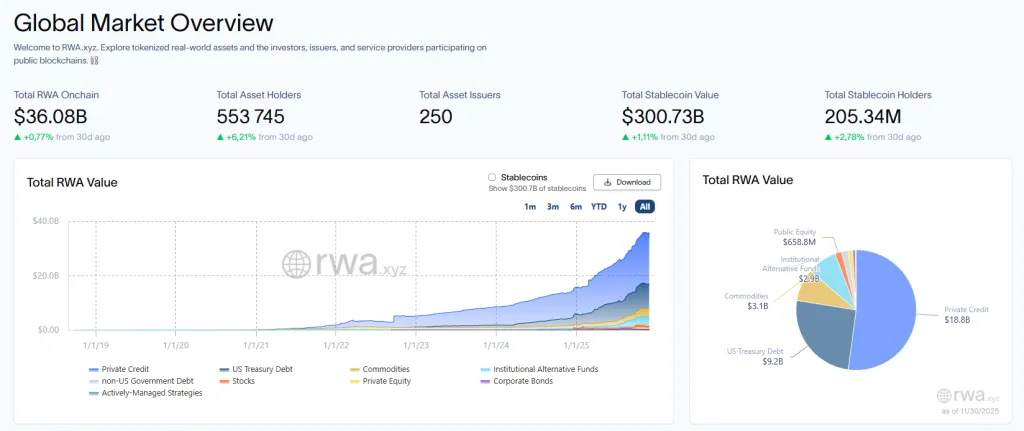
Источник: RWA.xyz.

Наибольшую долю рынка занимают цифровые частные кредиты и казначейские гособлигации США. Остальное приходится на товары, альтернативные фонды и различные ценные бумаги.

Напомним, в ноябре крупнейшая управляющая компания Европы — Amundi — запустила свои первые токенизированные акции фонда денежного рынка на блокчейне Ethereum.

Galaxy Digital токенизирует собственные акций на Solana

İlgili Okumalar

How Can Bitcoin Resist Quantum Computers? A Comparative Analysis of Three Lattice-Based Signature Schemes

This report from Blockstream Research analyzes three lattice-based signature schemes as quantum-resistant candidates for Bitcoin, focusing on Dilithium, Falcon, and the now-withdrawn Hawk. Core evaluation criteria include on-chain costs (combined size of public key and signature), implementation complexity, deployment risks, and potential for integration with Bitcoin's existing infrastructure like BIP-32 hierarchical deterministic wallets. Key Findings: * **Dilithium** is praised for its design simplicity, using only integer operations, making secure implementation easier. However, it has the largest size (5,261 bytes for security level 3). * **Falcon** offers the most compact signatures and the fastest verification. Its main drawback—platform-dependent floating-point operations in signing—can be mitigated with a slower, deterministic integer-based implementation. The report recommends **Falcon-1024** (security level 5) for its safety margin. * **Hawk**, which aimed for a better balance, was withdrawn after a cryptographic attack revealed a structural flaw that halved its estimated security. The report concludes that Falcon-1024 is the most suitable lattice-based choice for Bitcoin, pending the finalization of its NIST FN-DSA standard. In the short term, it still recommends hash-based signatures (like SPHINCS+) as a lower-risk transitional solution, with future hybrid deployments as a possibility.

marsbit42 dk önce

How Can Bitcoin Resist Quantum Computers? A Comparative Analysis of Three Lattice-Based Signature Schemes

marsbit42 dk önce

Ripple (XRP) Company Announces Plans for Major Future Update

Ripple (XRP) has announced a four-phase plan to prepare the XRP Ledger (XRPL) for future security threats posed by quantum computers. The company's senior director of engineering stated the goal is to build necessary infrastructure before quantum computers become a direct threat, aiming to minimize impact on existing systems, user assets, and network operations. The plan begins with identifying potential quantum vulnerabilities within XRPL, followed by testing quantum-resistant cryptographic methods. The next phase involves parallel testing of existing security mechanisms and new quantum-resistant solutions to ensure reliability and prevent disruption for users and applications. The final phase would involve transitioning the XRPL to more comprehensive, quantum-resistant security standards if the technology matures. Ripple is also developing contingency plans for a faster-than-expected advancement of quantum computing, which could accelerate the transition timeline. A current XRPL feature allowing users to change the keys controlling their accounts without altering the accounts themselves is seen as a potential advantage in any future migration. However, Ripple cannot unilaterally change transaction validation rules or network-wide cryptographic standards; such updates require coordination and approval from independent validators via XRPL's governance process. While quantum computers are not yet capable of breaking the cryptography used by major blockchains like Bitcoin or XRPL, developers across the industry are already evaluating transition scenarios to quantum-resistant algorithms due to the long-term risks they pose to public-key cryptography.

cryptonews.ru1 saat önce

Ripple (XRP) Company Announces Plans for Major Future Update

cryptonews.ru1 saat önce

İşlemler

Spot
活动图片