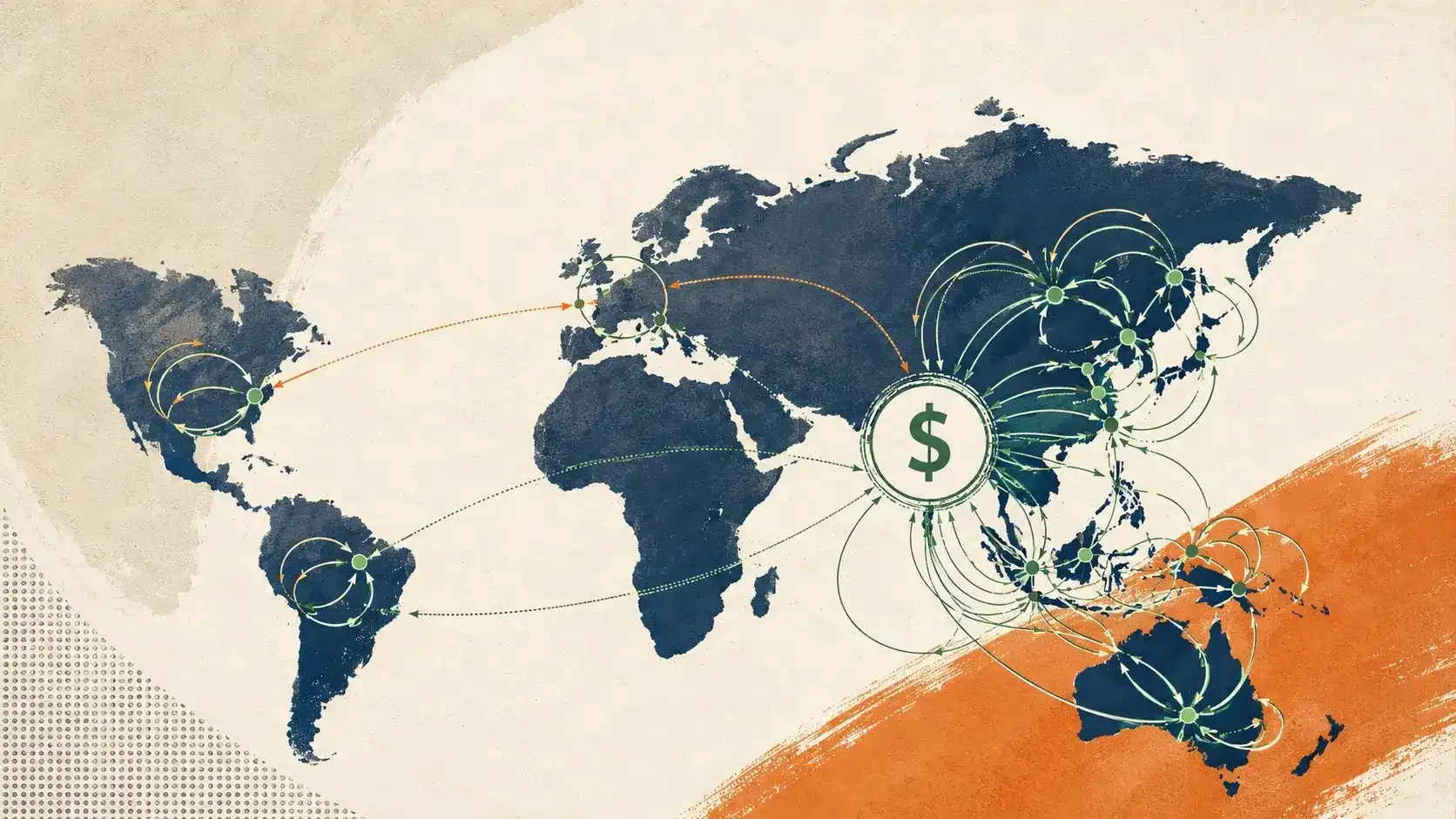
Will Ripple Replace Banks Soon? Why XRP Is At The Center Of It All

bitcoinist2025-11-24 tarihinde yayınlandı2025-11-24 tarihinde güncellendi

Özet

Growing speculation around whether Ripple could one day replace certain functions of traditional banking using XRP intensified last week after...

Trusted Editorial content, reviewed by leading industry experts and seasoned editors. Ad Disclosure

Growing speculation around whether Ripple could one day replace certain functions of traditional banking using XRP intensified last week after Paul Barron, the founder of the Paul Barron Network, outlined why XRP is positioned at the center of global finance. His statements highlight XRP’s potential to reshape the future financial infrastructure and increase its role in payments and digital money movement. 

Why Ripple Could Replace Banks With XRP

On November 22, Barron sparked a debate on X by breaking down why he believes XRP may be engineered to take over core elements of traditional finance. According to his report, XRP stands out as one of the few digital assets that can operate without a counterparty, allowing it to serve as a neutral settlement layer across global institutions

Barron highlighted that banks and blockchain applications are converging rapidly, creating a system in which lending, settlement, and cross-border transfers can occur on-chain instantly. He claimed that XRP is at the center of this shift, enabling seamless value flow between systems operating on different technical standards. 

He believes XRP plays this central role because it serves as a bridge asset, routing transactions behind the scenes in high-volume environments where speed and reliability are critical. He also argued that every new stablecoin and tokenized Real-World Asset (RWA) deployed on blockchains inherently increases the need for a frictionless asset like XRP, which can move value across networks. 

Barron’s statements suggest a future in which traditional finance rails operate less visibly as blockchain networks handle global money flows. He believes this transition is already underway, with XRP positioned as the connective mechanism capable of replacing legacy settlement workflows that are typically slow, limited, and dependent on multiple intermediaries. 

Crypto Analyst Fires Back Against XRP Claims

Pseudonymous crypto analyst ‘Fishy Catfish’ has challenged and criticized Barron’s claims, arguing that XRP is unlikely to replace any traditional banking functions. He dismissed XRP as a “bank-themed meme coin” with minimal real-world use, citing low adoption metrics on the XRP Ledger (XRPL), limited developer activity, and negligible DEX volume. 

Fishy Catfish emphasized that banks operate through established systems like SWIFT, which are controlled by thousands of financial institutions, leaving little room for XRP to take over core banking functions. He noted that SWIFT is not a third-party middleman to the banks—it represents the banks themselves. As a result, XRP could face significant barriers in displacing a legacy system like SWIFT

The crypto analyst framed XRP’s role as overhyped on social media, stressing that the network “isn’t cheaper and solves nothing.” He also emphasized that XRP’s real-world activity remains far below levels needed to support institutional use. According to him, the low on-chain activity and the minor revenue generated from user fees highlight a fundamental mismatch between XRP’s current utility and Barron’s prediction that the cryptocurrency will replace traditional finance. 

XRP price chart from Tradingview.com
Price struggles to hold support at $2 | Source: XRPUSDT on Tradingview.com
Featured image created with Dall.E, chart from Tradingview.com
Editorial Process for bitcoinist is centered on delivering thoroughly researched, accurate, and unbiased content. We uphold strict sourcing standards, and each page undergoes diligent review by our team of top technology experts and seasoned editors. This process ensures the integrity, relevance, and value of our content for our readers.

I'm Sandra White, a writer at Bitcoinist, and I provide the latest updates on the world of cryptocurrencies. I believe crypto a gateway to a new order and I have made it my life's mission to help educate as much people as possible. When I'm not at work, I love listening to music, learning new things, and dream of traveling around the world.

Trend Kriptolar

İlgili Okumalar

$2 Trillion: Countdown to AI's Largest IPO in History

The countdown for the largest IPO in AI history, a potential $2 trillion listing for Anthropic, is underway for October. The staggering valuation, reportedly projected by several investors, contrasts with the company's own internal restraint on setting a public target. Founded five years ago by former OpenAI core members, Anthropic's growth has been meteoric. Annual recurring revenue (ARR) surged from ~$9B in late 2025 to $47B by May 2026, with Q2 2026 revenue of $11.5B marking a 14x year-over-year increase. Bank valuations are even based on internal 2028 revenue forecasts of $190-200B. A key growth driver is Claude Code, its AI coding assistant. Its ARR quintupled in five months to $2.5B by February 2026, now constituting nearly 20% of total revenue. Surveys indicate Anthropic commands roughly 40% of enterprise LLM spending, doubling OpenAI's share in programming-specific use. However, alongside this explosive growth, reports detail significant internal cultural strife. Critics describe a divisive "priesthood" of PhD executives, led by CEO Dario Amodei, who promote a "save humanity" narrative that some employees find cult-like and alienating. This has reportedly created a demoralized workforce and a covert "underground network" of dissent among engineers torn between lucrative pre-IPO equity and a toxic work environment. Anthropic now faces a pivotal paradox: pursuing its mission of "safe" AI requires immense capital for compute, yet that capital demands relentless commercial growth. As it approaches its historic IPO, the company must navigate intense regulatory scrutiny, soaring operational costs, and internal tensions—any of which could destabilize its post-listing trajectory, much like SpaceX's significant post-IPO stock drop. The stage is set for a defining moment in tech history.

marsbit2 saat önce

$2 Trillion: Countdown to AI's Largest IPO in History

marsbit2 saat önce

AI Boosting Efficiency and Cutting Costs Makes VC Increasingly Expensive

"AI for Cost Reduction Makes VC Funding More Expensive" Despite the "cost-reduction and efficiency" narrative of AI, venture capital (VC) investment in the AI sector is becoming increasingly costly. While AI tools lower the initial costs for many startups—with team sizes shrinking across funding stages—the market is polarizing. For top-tier AI teams, especially those from leading companies like Google and OpenAI, funding rounds are now larger and valuations are higher than ever at the seed and early stages. For example, new ventures by prominent researchers are securing billions in funding with valuations reaching tens of billions before having a mature product. This creates a "barbell" market: lightweight startups need less capital, while elite AI firms attract massive investments early on. This dynamic raises the cost for VCs to acquire and maintain meaningful ownership stakes. As valuations soar early, securing the same equity percentage requires significantly larger capital commitments. VCs must now invest more upfront and reserve substantial funds for follow-on rounds to avoid dilution, prompting large firms like Accel and a16z to raise massive new funds. Consequently, capital is concentrating intensely in a few perceived winners like OpenAI and Anthropic, widening the gap between large and small VC funds. While high valuations bake in future growth expectations, they also compress potential returns, demanding that portfolio companies achieve unprecedented scale. For major VCs, the core strategy is clear: secure early positions in potential winners and maintain the capital to keep investing as valuations rapidly escalate.

marsbit3 saat önce

AI Boosting Efficiency and Cutting Costs Makes VC Increasingly Expensive

marsbit3 saat önce

İşlemler

Spot

Popüler Makaleler

SOON Nasıl Satın Alınır

HTX.com’a hoş geldiniz! SOON (SOON) satın alma işlemlerini basit ve kullanışlı bir hâle getirdik. Adım adım açıkladığımız rehberimizi takip ederek kripto yolculuğunuza başlayın. 1. Adım: HTX Hesabınızı OluşturunHTX'te ücretsiz bir hesap açmak için e-posta adresinizi veya telefon numaranızı kullanın. Sorunsuzca kaydolun ve tüm özelliklerin kilidini açın. Hesabımı Aç2. Adım: Kripto Satın Al Bölümüne Gidin ve Ödeme Yönteminizi SeçinKredi/Banka Kartı: Visa veya Mastercard'ınızı kullanarak anında SOON (SOON) satın alın.Bakiye: Sorunsuz bir şekilde işlem yapmak için HTX hesap bakiyenizdeki fonları kullanın.Üçüncü Taraflar: Kullanımı kolaylaştırmak için Google Pay ve Apple Pay gibi popüler ödeme yöntemlerini ekledik.P2P: HTX'teki diğer kullanıcılarla doğrudan işlem yapın.Borsa Dışı (OTC): Yatırımcılar için kişiye özel hizmetler ve rekabetçi döviz kurları sunuyoruz.3. Adım: SOON (SOON) Varlıklarınızı SaklayınSOON (SOON) satın aldıktan sonra HTX hesabınızda saklayın. Alternatif olarak, blok zinciri transferi yoluyla başka bir yere gönderebilir veya diğer kripto para birimlerini takas etmek için kullanabilirsiniz.4. Adım: SOON (SOON) Varlıklarınızla İşlem YapınHTX'in spot piyasasında SOON (SOON) ile kolayca işlemler yapın.Hesabınıza erişin, işlem çiftinizi seçin, işlemlerinizi gerçekleştirin ve gerçek zamanlı olarak izleyin. Hem yeni başlayanlar hem de deneyimli yatırımcılar için kullanıcı dostu bir deneyim sunuyoruz.

280 Toplam GörüntülenmeYayınlanma 2025.05.23Güncellenme 2026.06.02

SOON Nasıl Satın Alınır

Tartışmalar

HTX Topluluğuna hoş geldiniz. Burada, en son platform gelişmeleri hakkında bilgi sahibi olabilir ve profesyonel piyasa görüşlerine erişebilirsiniz. Kullanıcıların SOON (SOON) fiyatı hakkındaki görüşleri aşağıda sunulmaktadır.

活动图片