Arcade Tokens - «важнейший строительный блок» в развитии криптовалют

cryptonews.ru2025-04-17 tarihinde yayınlandı2025-11-18 tarihinde güncellendi

По мнению руководителей венчурной компании a16z, большему числу криптовалютных проектов следует рассмотреть возможность использования блокчейн-аналога миль авиакомпаний для расширения своей пользовательской базы и стимулирования своей экономики.

В отчете, опубликованном в четверг, a16z заявила, что один из самых недооцененных типов криптовалютных токенов - это «аркадные токены».

Эти токены сохраняют относительно стабильную стоимость в рамках определенной экосистемы программного обеспечения или продукта, подобно бонусным милям авиакомпаний, баллам по кредитным картам или внутриигровым валютам. Они позволяют пользователям выполнять определенные функции в рамках этой экосистемы, а не являются спекулятивными.

«Хотя аркадные токены подходят не для всех случаев применения, они представляют собой важнейший строительный блок в развитии сетей криптовалют. Точно так же, как стейблкоины открывают новые формы торговли, а сетевые токены обеспечивают децентрализованное распределение ценностей и управление, аркадные токены могут стать движущей силой масштабной цифровой экономики», - заявили исследователь a16z Скотт Дьюк Комимерс, главный технический директор Эдди Лаззарин и другие.

Использование токена Arcade

Одним из таких проектов, по данным a16z, является стартап Blackbird в сфере гостиничных технологий и его собственный токен FLY. В середине 2024 года проект запустил платформу платежей Web3 для ресторанов, при этом FLY предназначен для вознаграждения пользователей и стимулирования внедрения сервиса.

«Токен FLY от Blackbird позволяет использовать его в любом участвующем ресторане, а управление процессом погашения осуществляется на специально разработанном блокчейн-уровне, который работает на основе сетевого токена, - говорится в отчете, где также упоминаются другие варианты использования: децентрализованная вычислительная сеть может, например, использовать сетевой токен для обеспечения безопасности и стимулирования поставщиков вычислительных услуг, а токен Arcade - для создания сетевого эффекта в клиентской базе».

Например, бонусные мили и баллы лояльности для часто летающих пассажиров могут стимулировать лояльность к бренду и использоваться для оплаты авиабилетов и повышения класса обслуживания; цифровое золото позволяет покупать или продавать предметы в видеоигре. Вместо того, чтобы предоставлять владельцам права собственности на базовую экосистему, токены Arcade предоставляют владельцам возможность доступа к определенным приложениям или сервисам или их использования; что особенно важно, их рыночная стоимость ограничена программными средствами».
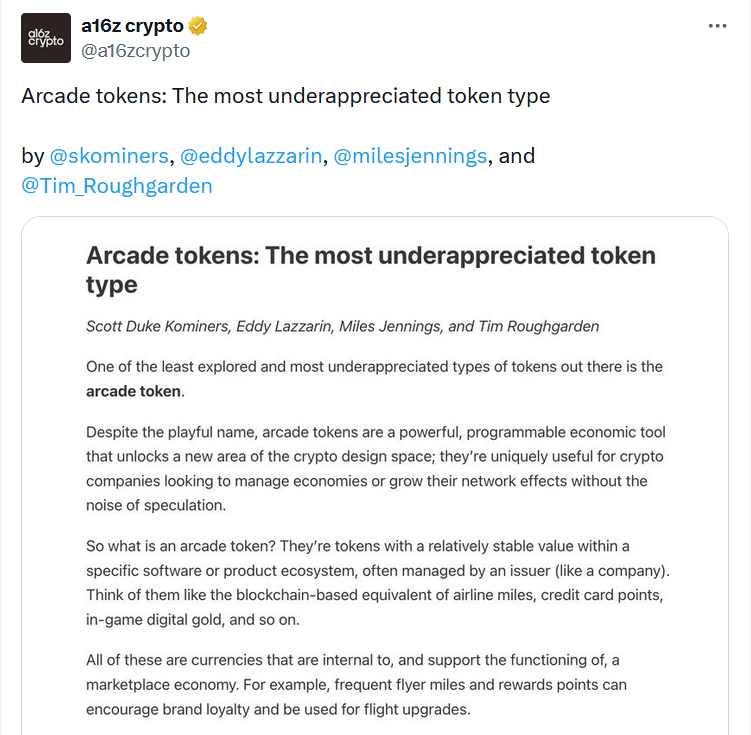
Источник: a16z.

В отчете также утверждается, что игровые токены могут стать важным инструментом для «экономики, ориентированной на траты, или интеграции с физическим миром».

К преимуществам использования токенов Arcade относятся ценовая стабильность и удобство использования, что позволяет пользователям легко понимать, на что они тратят деньги, упрощает учет и токеномику для эмитентов.

Стейблкоины и другие активы против токенов аркад

В отчете также подчеркивается, что, хотя стейблкоины можно использовать для аналогичных целей, гибкая динамика токенов аркад открывает другие возможности.

Например, эмитенты могут, по сути, «печатать токены аркад по запросу» для поддержки роста экосистемы, например, в виде грантов, субсидий пользователям и разработчикам, одновременно поощряя пользователей оставаться в экономике, а не тратить средства где-либо еще.

Однако в отчете отмечается, что не каждому проекту необходимо их использовать, поскольку они неэффективны в спекулятивной среде или когда сеть или платформа уже имеет устоявшийся токен и экосистему.

«Например, блокчейн-сети уровня 1, имеющие собственные сетевые токены, как правило, не нуждаются в аркадных токенах для функционирования», - утверждают они.

İlgili Okumalar

Deep Insight: Decentralized Inference is Not Hype, but a Key Track for AI to Break Through Centralized Monopoly

Decentralized Reasoning: Beyond the Hype, a Key to Breaking AI's Centralized Monopoly A future scenario where a powerful AI model is banned by a major government illustrates the core value proposition of decentralized AI: resistance to censorship. The core bet of decentralized inference networks is mitigating this risk, with other benefits like cost being secondary. The path is extremely difficult, involving four key challenges: 1. **Running Massive Models:** Distributing a single model across a decentralized GPU swarm requires sophisticated techniques like pipeline and speculative decoding to overcome crippling network latency, aiming for usable speeds (e.g., 30-40 tokens/second). 2. **Proving Model Integrity:** Verifying that a node runs the correct model is critical. Solutions range from cryptographically secure but slow ZKML to faster, economically-secure methods like statistical fingerprints, deterministic re-execution, or live-weight proofs, each involving trade-offs between integrity, latency, and cost. 3. **Ensuring Prompt Privacy:** Simply sharding a model does not protect user inputs from nodes. Robust solutions currently require trusted hardware (TEEs) or advanced cryptography (FHE), which are not yet widely deployed in consumer swarms. 4. **Building a Real Market:** Identifying the ideal customer is tough. Beyond speculative AI agents, the viable market currently consists of startups embedding AI and projects needing batch processing (e.g., synthetic data generation), where decentralized aggregation can be an advantage over low-latency needs. The article analyzes several projects tackling these problems, such as Dolphin Network (live-weight proofs), Inference.net (statistical verification), Morpheus (TEE-based), and Darkbloom (Apple Secure Enclave). It provides a framework: decentralization is a "tax" for latency-sensitive applications (e.g., chat) but a potential supply-side advantage for throughput-oriented tasks (e.g., batch processing). The long-term vision is a closed data loop where decentralized inference generates valuable data (traces, preferences) to feed decentralized training networks, which in turn produce better open-weight models for the inference networks. A due diligence checklist advises focusing on projects that: are truly decentralized at specific layers; have a credible integrity method; offer real cost benefits; ensure genuine privacy; handle node reliability; have paying users; and are built by teams with deep AI expertise. The ultimate goal should be products that appeal beyond the crypto-native audience, using crypto mechanisms invisibly to deliver better cost, performance, or privacy.

Foresight News30 dk önce

Deep Insight: Decentralized Inference is Not Hype, but a Key Track for AI to Break Through Centralized Monopoly

Foresight News30 dk önce

The Final Piece of Franklin Templeton's Crypto Ambition

Franklin Templeton Completes Crypto Ambition with Acquisition of 250 Digital On June 22, Franklin Templeton announced the acquisition of 250 Digital and established Franklin Crypto, a new division focused on actively managed cryptocurrency strategies for institutional investors. The unit is led by Christopher Perkins and Seth Ginns. This acquisition marks a key piece in Franklin Templeton's multi-year crypto strategy, which began in 2018 with a digital assets team. The firm's crypto product suite now spans three layers: tokenized funds like the blockchain-based money market fund BENJI (~$831M AUM); a series of passive ETFs including Bitcoin (EZBC, ~$368M), Ethereum (EZET), XRP (XRPZ, ~$252M), Solana (SOEZ), and a multi-crypto index fund (EZPZ); and the newly added active management strategies from Franklin Crypto. The company has also expanded its crypto ecosystem through investments in projects like Ethena and Crossmint, and collaborations with blockchains such as Aptos and Sui. With approximately $18B in digital asset AUM and a total firm AUM of ~$1.78T, Franklin Templeton is positioning itself as a comprehensive crypto asset manager for pensions and sovereign wealth funds. In contrast, competitor Fidelity Investments has taken a different path, focusing early on building its own custody and trading infrastructure. Fidelity's Bitcoin ETF (FBTC) holds over $11B, significantly larger than Franklin Templeton's equivalent offering. Both giants' moves underscore the deepening trend of traditional finance entering the crypto space.

Foresight News53 dk önce

The Final Piece of Franklin Templeton's Crypto Ambition

Foresight News53 dk önce

İşlemler

Spot
Futures
活动图片