Биткоин опустился ниже $94 000. Рынки ожидают торговой сделки США и Китая

cryptonews.ru2025-05-16 tarihinde yayınlandı2025-11-17 tarihinde güncellendi

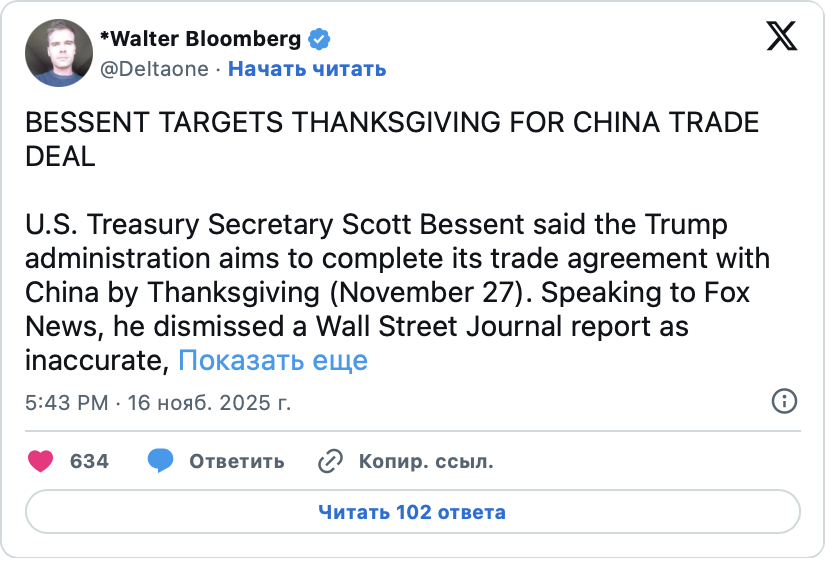
В воскресенье цена биткоина опустилась ниже отметки $94 000. Снижение за последние 24 часа составило более 2%. Трейдеры отреагировали на новую волну макроэкономических новостей. Наиболее значимым стало заявление министра финансов США Скотта Бессента. Он допустил, что торговое соглашение между США и Китаем может быть заключено ко Дню благодарения (27 ноября).

Эти заявления привнесли новую неопределенность на и без того нестабильные рынки. Для криптовалют наступает потенциально волатильный период. Политические дедлайны совпадают со снижением ликвидности в преддверии праздников.

Падение биткоина и реакция рынка

На момент написания материала биткоин торговался по цене $93 987, что на 2,08% ниже, чем сутки назад. На фоне этого снижения за последний час были ликвидированы длинные позиции на сумму $100 млн.

💥BREAKING:

$100,000,000 WORTH OF CRYPTO LONGS LIQUIDATED IN THE PAST 60 MINUTES. pic.twitter.com/zvAPRdBfSZ

— Crypto Rover (@cryptorover) November 16, 2025

Важно отметить, что в последний раз биткоин торговался ниже $94 000 5 мая 2025 года. Аналитики связывали то падение с чрезмерным использованием кредитного плеча. Текущее снижение, вероятно, обусловлено возможным урегулированием торговой напряженности между США и Китаем.

«Биткоин также продемонстрировал сильное падение после завершения последней приостановки работы правительства США», – отметил аналитик Crypto Rover. Он подчеркнул, как завершение периода неопределенности может повлиять на рынок.
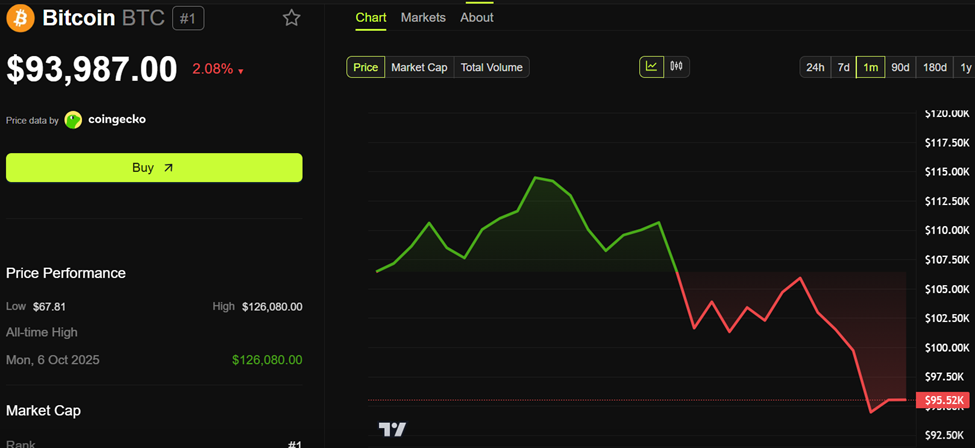
Динамика цен на биткоин (BTC)
Динамика цен на биткоин (BTC). Источник: BeInCrypto

Снижение курса и связанные с ним ликвидации последовали за комментариями Бессента в эфире Fox News. Министр финансов США заявил, что администрация Трампа намерена финализировать торговое соглашение с Китаем к 27 ноября.

Он опроверг сообщение одного из СМИ традиционного финансового сектора о возможных задержках. Бессент назвал эту информацию неточной и настоял, что сделка по-прежнему находится в стадии разработки.

Что еще более важно для крипторынков, Бессент выразил уверенность в том, что Китай будет соблюдать соглашение. Оно должно быть заключено после предстоящей встречи Трампа и Си. Он предупредил, что если Пекин не выполнит обязательства, у Вашингтона останется «множество рычагов». Традиционно этот язык интерпретируется как давление с помощью тарифов или правоприменительных мер.
Значение Дня благодарения для рынков

Сроки заключения потенциального торгового соглашения (непосредственно перед крупным праздником в США) имеют большое значение. Трейдеры ожидают низкой ликвидности и повышенной волатильности. Эти элементы характерны для праздничных сезонов.

Исторически биткоин резко реагировал на неожиданные геополитические новости в периоды низких обьемов торгов. Подобные случаи происходили в выходные дни, когда неожиданные заявления Трампа двигали рынки, вызывая усиленные ценовые колебания.

Momentum in Crypto market on Sunday Evening after $2000 stimulus announcement by Trump.$BTC touch $104000, and $ETH jump above $3500 https://t.co/3ohgbAKVWr pic.twitter.com/QQgIIO3Liu

— Nilesh Rohilla (@nilesh_rohilla) November 9, 2025

Существует мнение, что время для этих событий выбрано неслучайно. Оно может быть рассчитано так, чтобы защитить традиционные рынки от волатильности. Однако в таких случаях криптовалютные трейдеры часто принимают на себя основной удар, ощущая полное влияние новостей.

Любой признак прогресса в переговорах США и Китая может стабилизировать отношение к риску и поддержать восстановление биткоина. И наоборот, намеки на задержку или дополнительные тарифные угрозы могут спровоцировать новую волну продаж. Это особенно вероятно, учитывая, что позиционирование с использованием кредитного плеча остается высоким.

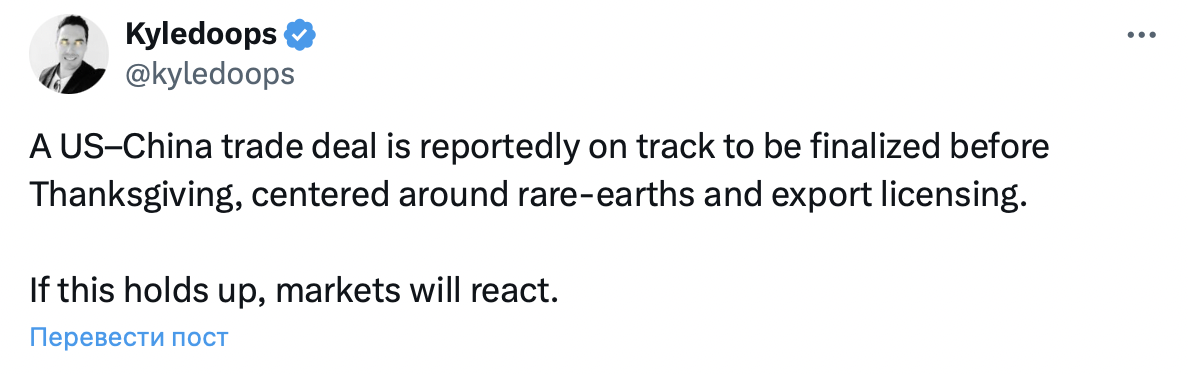
«Сообщается, что торговая сделка между США и Китаем будет финализирована до Дня благодарения. Она сосредоточена на лицензировании экспорта и редкоземельных металлах. Если это подтвердится, рынки отреагируют», – отметил аналитик Кайл Дупс.
Биткоин уже торгуется на более низких уровнях, а ширина рынка (рыночный охват) ослабевает. На этом фоне макроэкономическая повестка вновь втягивает криптовалюты в сферу глобальной политики.
İlgili Okumalar

WeChat AI Card Hands-On Guide: Has the AI Shopping Era Arrived?

**"WeChat AI Card" Practical Test Guide: Has the Era of AI Shopping Arrived?** WeChat has officially launched the "AI Exclusive Card," a feature integrated into its Workbuddy AI assistant. This card is designed to handle payments for AI-initiated purchases. Our hands-on test reveals it's not yet a tool for fully autonomous AI shopping, but rather a controlled payment layer for AI agents. The AI Card functions as an isolated sub-wallet within WeChat Pay. Users must bind the card and transfer funds into it from their main wallet. Crucially, every transaction requires explicit user confirmation via smartphone scan; AI cannot spend autonomously. Currently accessible through the Workbuddy agent, the card targets specific digital consumption scenarios: purchasing paid content (reports, data), calling paid APIs/tools, and subscribing to services. Its design prioritizes security and control by separating funds and mandating approval for each payment. We tested a real-world scenario: ordering bubble tea via Workbuddy using a "Meituan Life Assistant" skill. The process encountered multiple hurdles: high "skill" usage costs (exceeding daily free credits), and most importantly, while a payment was successfully initiated, the AI purchased an incorrect product (a mismatched group-buy coupon instead of the desired drink). This highlights the current limitation: the **AI Card only solves the payment step**. The broader challenge lies in the **AI agent's execution chain**—accurately understanding intent, navigating third-party platforms, selecting the right product, and ensuring proper fulfillment. The payment succeeded, but the purchase failed to meet the user's need. In conclusion, the WeChat AI Exclusive Card is a cautious, early-step experiment in AI commerce. It provides a secure, user-controlled payment method for agent interactions but is not yet capable of reliable, end-to-end complex purchases. For now, it's best used for low-value, low-risk digital services with careful user verification at each step. The vision of AI handling complete shopping tasks remains a work in progress.

marsbit28 dk önce

WeChat AI Card Hands-On Guide: Has the AI Shopping Era Arrived?

marsbit28 dk önce

Deconstructing Notion's Growth: From a Note-taking Tool to 100 Million Users—How Notion Built a Triple Growth Flywheel Through Product, Templates, and Community

Notion's growth from a niche note-taking tool to a platform with 100 million users is powered by three interconnected flywheels: Product-Led Growth (PLG), a Template Economy, and Community-Driven Growth. First, Notion's PLG strategy relies on a highly flexible, "plastic" product that users can adapt to countless personal and team workflows. Its freemium model lowers the barrier to entry, while features like page sharing and collaboration drive organic, usage-based viral growth as users naturally invite others. Second, the Template Economy solves the "blank page" problem. Templates, created by both Notion and its community, transform abstract product capabilities into concrete, copyable solutions for specific scenarios (e.g., project management, content calendars). This dramatically lowers activation costs for new users and fuels SEO-driven discovery. Third, a vibrant Community acts as a distributed growth engine. Users and official Ambassadors create tutorials, share use cases, and host local events. This community not only educates users but also fosters a sense of identity around pursuing "better ways of working," strengthening loyalty and enabling global, low-cost expansion. Together, these flywheels create a self-reinforcing ecosystem: a great product attracts users who create templates and community content, which in turn attracts more users and deepens engagement. This system allowed Notion to scale from individuals to teams and enterprises through a bottom-up adoption path. Looking ahead, AI integration promises to accelerate these flywheels further by making templates smarter and the platform a potential AI-native work operating system. Ultimately, Notion's defensible advantage is not just its features, but this deeply entrenched network of user assets, creators, and community trust.

marsbit29 dk önce

Deconstructing Notion's Growth: From a Note-taking Tool to 100 Million Users—How Notion Built a Triple Growth Flywheel Through Product, Templates, and Community

marsbit29 dk önce

$10 Billion, Qualcomm to Acquire Chip Legend Jim Keller's Company

Global mobile chip giant Qualcomm is in advanced talks to acquire AI chip startup Tenstorrent in a deal valued between $8-10 billion, according to media reports. This potential acquisition would be one of the largest in the AI chip sector in recent years. Tenstorrent, led by legendary chip architect Jim Keller, has gained prominence for its RISC-V architecture and AI accelerator designs. The move highlights Qualcomm's strategic push to diversify beyond its core smartphone chip business. As the smartphone market matures, Qualcomm is aggressively targeting growth in automotive, data center, and cloud AI. Acquiring Tenstorrent would allow Qualcomm to rapidly enter the high-end AI computing market, bypassing lengthy in-house development cycles. Tenstorrent's cost-effective system architecture, which avoids expensive HBM memory and relies on standard Ethernet for clustering, offers a potential alternative to Nvidia's costly solutions. Furthermore, Tenstorrent's high-performance RISC-V CPU technology and its focus on the automotive and edge computing segments align with Qualcomm's strategic goals, including its "Snapdragon Digital Chassis" platform. Despite the strategic rationale, the high valuation has sparked some investor caution. The successful integration of Tenstorrent's open-source culture and independent team into Qualcomm's organization, along with the commercialization of its technology, remains a key challenge.

marsbit1 saat önce

$10 Billion, Qualcomm to Acquire Chip Legend Jim Keller's Company

marsbit1 saat önce

CARDS' Brutal Truth of $535M FDV: Only $43M Net Revenue, Profit Margin Halved

The article deconstructs Collector Crypt (CC), a blockchain-based platform for trading tokenized collectible cards, revealing a significant disparity between its high volume and actual business fundamentals. Key findings include: * CC's cumulative revenue of $635M is misleading; 90.6% is instantly returned to users via card buybacks, leaving only $43M in net revenue (6.7% retention). * Trading activity is minimal, with real secondary market trading below $5M. eBay sales as a percentage of volume have declined for six consecutive quarters. * The platform's user base is highly concentrated, with a few dozen high-frequency wallets driving most of the volume, resembling a "casino" with ~420 daily active players. * As volume shifts to higher-priced card packs, the net profit margin has halved from 11.2% to 5.8%. * Token value capture (via burns and buybacks) totals only $1.4M, just 3.4% of net revenue. Meanwhile, operational wallets have off-ramped $45.7M in USDC. * With a Fully Diluted Valuation (FDV) of ~$535M, the token trades at 7.3x net revenue. The float is only 20.5%, with 72% of the supply allocated to insiders and locked until November 2027. The analysis concludes that while CC has found product-market fit as a high-speed gacha machine, it shows little evidence of evolving into a sustainable collector's marketplace, with minimal value accruing to its CARDS token.

marsbit1 saat önce

CARDS' Brutal Truth of $535M FDV: Only $43M Net Revenue, Profit Margin Halved

marsbit1 saat önce

İşlemler

Spot
Futures
活动图片