Эксперты объяснили падение биткоина ниже $100 000

cryptonews.ru2025-02-13 tarihinde yayınlandı2025-11-14 tarihinde güncellendi

Цена биткоина упала ниже психологически важной отметки в $100 000 и вернулась к пятимесячным минимумам мая. Аналитики Bitfinex объясняют произошедшее потерей терпения крупными инвесторами.

Обозреватель Сoinmarketcap показывает, что рыночная стоимость первой криптовалюты продолжает падать. За последний календарный месяц, с октября по ноябрь, она снизилась более чем на 20% — с исторического максимума $124 000 до $97 300 за монету. На недельном таймфрейме биткоин потерял около 4%.
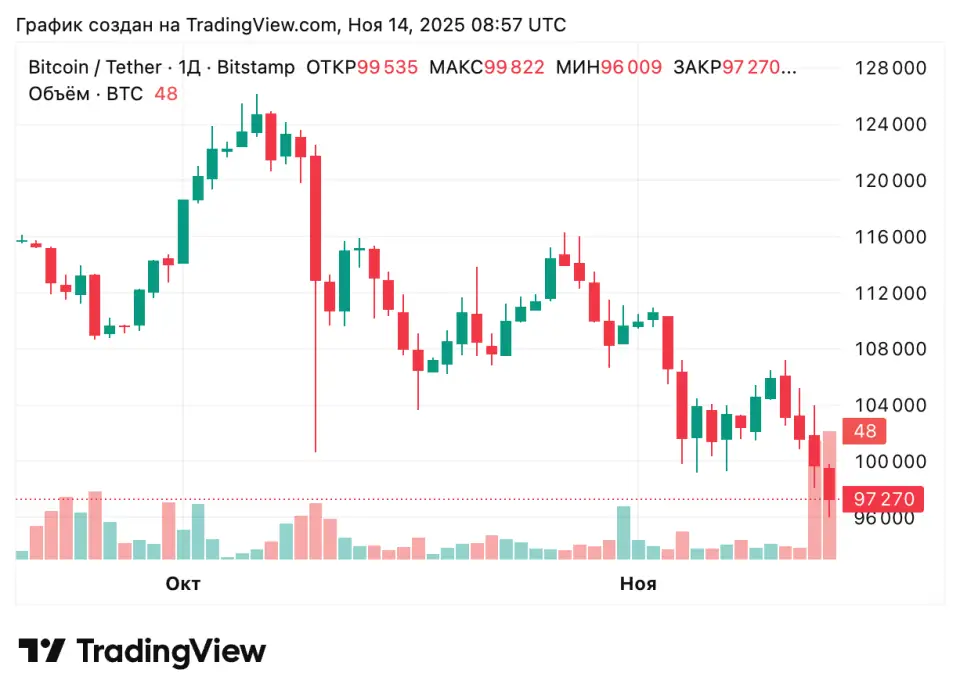
BTCUSDT_2025-11-14_11-57-58.png

Аналитики Bitfinex отметили, что цена биткоина падает на фоне крупных распродаж актива и выхода корпоративных инвесторов из ETF на биткоин. Аналитики считают, что на протяжении большей части года именно эта категория инвесторов была основой роста биткоина. Некоторые профессиональные инвесторы стали терять терпение после неутешительного роста биткоина всего на 10% с начала года — темпы значительно отстают от динамики стоимости золота или акций технологических компаний. Теперь подобные инвесторы фиксируют прибыль и распродают криптоактивы, создавая давление на крипторынок и негативно влияя на стоимость биткоина, объяснили эксперты Bitfinex.

Откат стоимости биткоина подчеркивает высокую зависимость криптовалютного рынка от макроэкономических событий, в том числе американских импортных пошлин и колебаний процентной ставки Федеральной резервной системы США, считает директор компании Wincent Пол Ховард (Paul Howard).

Ранее инвестиционные стратеги Morgan Stanley Wealth Management предупредили о возможном завершении фазы роста крипторынка и рекомендовали инвесторам ограничить объемы криптовалютных вложений, а также подумать о фиксации прибыли.


İlgili Okumalar

In Such a Crowded Cross-border Payment Track, Where Does the Next Stop Lie in the Future?

The crowded cross-border payments industry faces a paradox: intense competition above water with financing and narratives, while beneath, price wars and shrinking margins in basic PSP services are common. The path forward lies not in simple "cross-border" solutions but in deep **localization**. Success requires mastering the fragmented and tightening regulations of fiat currencies in each market—the "last mile" of compliance, banking, and settlement. Many Chinese PSPs have succeeded by following Chinese merchants overseas but have not deeply penetrated mainstream local merchant ecosystems abroad. Their strong product capabilities need to be applied to new, complex markets. The future belongs to companies that evolve from single-channel providers to **cross-border capital network operators**. This means moving beyond competing on transaction fees to creating internal networks that optimize capital efficiency through multi-directional matching, netting, and position reuse across countries and currencies. For Web3 and stablecoins, the key is integration, not replacement. Stablecoins offer efficiency gains but cannot bypass the foundational trust, compliance, and legal frameworks of traditional finance. The realistic path is the gradual adoption and "taming" of Web3 technologies by established financial institutions. The ultimate solution is a **dual clearing infrastructure** combining deep local fiat capabilities (local accounts, compliance, banking) with lightweight stablecoin-native capabilities (on-chain settlement, wallets). The biggest opportunity lies not in oversaturated mainstream corridors but in complex, underserved regional corridors (e.g., specific CIS, Middle East-Southeast Asia, or Latin American trade pairs). The winners will be those who build hard-to-replicate, deep capabilities in these areas—acting as the essential "clearing shovels" or infrastructure providers. The future keywords are **more local, more networked, and more stablecoin-native**. High-profit opportunities remain in the non-standardized, difficult-to-replicate deep waters of the industry, requiring genuine on-the-ground presence and long-term patience.

链捕手1 saat önce

In Such a Crowded Cross-border Payment Track, Where Does the Next Stop Lie in the Future?

链捕手1 saat önce

Lightning Fast Five-Whip Combo! Strategy's Self-Rescue Plan Officially Released

Strategy, amidst the STRC de-pegging crisis, has unveiled its "Digital Credit Capital Framework" self-rescue plan. The five-part framework includes: 1) **Cash Reserves**: Management of ~$2.55B in USD reserves, dedicated solely to covering ~17.4 months of preferred stock dividends and debt interest, with a 12-month minimum coverage floor. 2) **Dividend Policy**: STRC's dividend yield rises to 12% from July 1st, with monthly reviews. Strategy clarifies de-pegging does not automatically trigger further hikes. 3) **Preferred Stock Buyback**: A $1B authorization, prioritizing STRC repurchases to support its price, reduce future dividend obligations, and signal commitment, using funds separate from dividend reserves. 4) **Common Stock Buyback**: A separate $1B authorization for MSTR stock, aimed at creating shareholder value when the stock is deemed undervalued, establishing a two-way capital management mechanism. 5) **Bitcoin Monetization**: Formal authorization to sell BTC (up to $1.25B earmarked) to build USD reserves, cover dividends/interest, or fund buybacks, marking a strategic shift where BTC becomes a managed asset rather than a strictly "hold-only" reserve. Market reaction saw MSTR and STRC shares rise pre-market, while BTC remained stable. The plan aims to restore confidence in STRC, ensure dividend sustainability, and reopen Strategy's funding channels.

Odaily星球日报3 saat önce

Lightning Fast Five-Whip Combo! Strategy's Self-Rescue Plan Officially Released

Odaily星球日报3 saat önce

İşlemler

Spot
活动图片