Отчет QCP Capital: биткоин под давлением укрепления доллара и оттока капитала из ETF

cryptonews.ru2025-11-05 tarihinde yayınlandı2025-11-05 tarihinde güncellendi

Биткоин протестировал критический уровень $100 000, возглавив глобальное снижение рискованных активов. Об этом сообщает трейдинговая фирма QCP Capital в своем свежем отчете. Падение первой криптовалюты было вызвано укреплением доллара и сохраняющейся неопределенностью вокруг политики ФРС, что снизило аппетит к риску по всем классам активов.

Четыре дня оттока из ETF

Макроэкономическое давление напрямую повлияло на криптовалютный рынок через четыре последовательные сессии с оттоком примерно $1,3 млрд из американских спотовых биткоин-ETF. Этот разворот превратил один из сильнейших попутных ветров 2025 года в краткосрочный встречный.
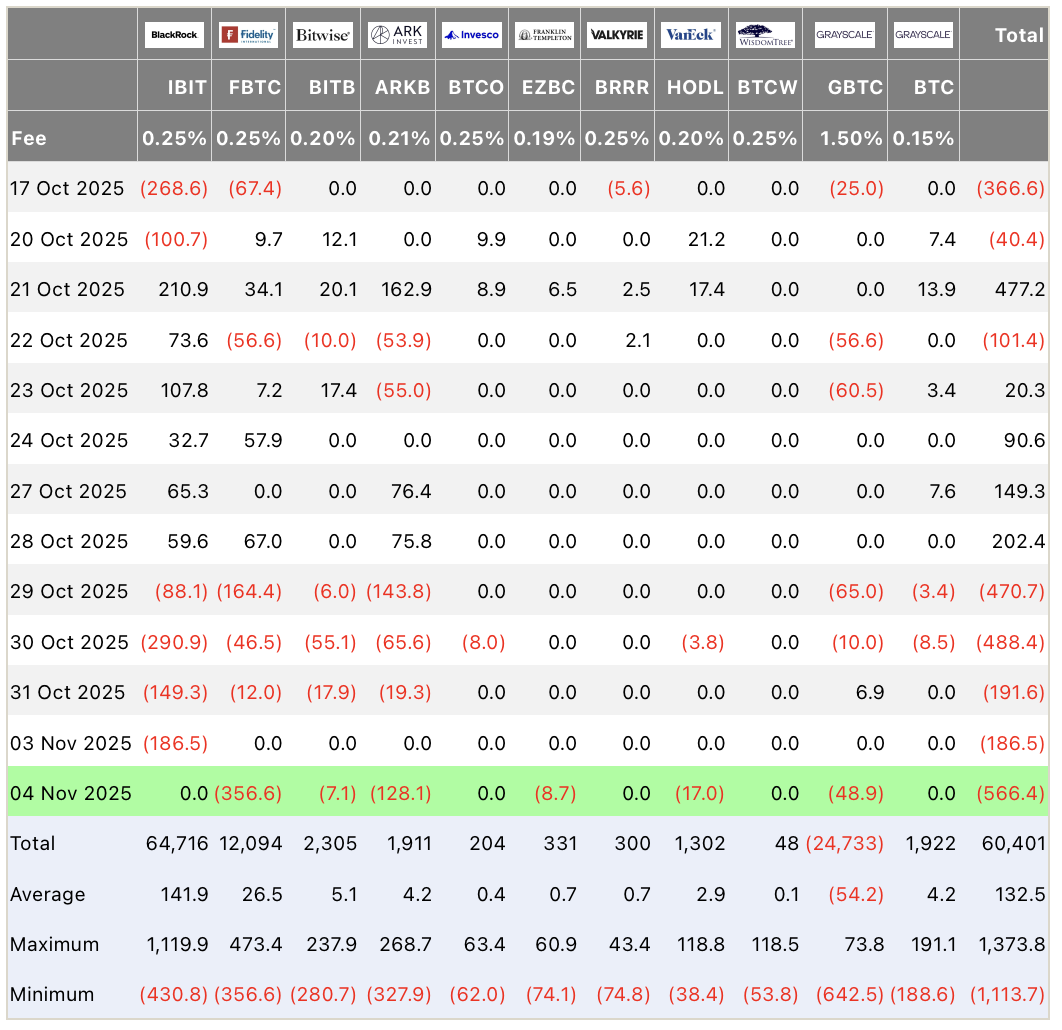
Движение капитала в биткоин-ETF США. Источник: Farside Investors

Ослабление спотового спроса столкнулось с принудительным закрытием позиций — более $1 млрд длинных позиций было ликвидировано. Цена кратковременно пробила поддержку на дневном таймфрейме, однако затем вмешались покупатели.

Опционная торговля усилила движение. Дилеры, которые остаются в чистом коротком гамма-хеджировании вокруг страйков $100 000, ускорили хеджирующую активность, что усугубило волатильность около этого уровня. Психологический порог $100 000 теперь представляет ключевую линию обороны — любая стабилизация потоков капитала в ETF может быстро изменить настроения, при условии отсутствия новых макроэкономических шоков.

Макроэкономика

Макроэкономический фон остается конструктивным, но затуманен продолжающимся правительственным шатдауном в Вашингтоне. Поскольку официальные данные по занятости за октябрь задержаны, для оценки динамики рынки полагаются на лоскутное одеяло частных индикаторов.

Финальные предшатдаунные публикации нарисовали смешанную картину: ВВП за второй квартал был пересмотрен вверх до 3,8%, в то время как рост фонда заработной платы замедлился в среднем до ~29 000 в месяц, подчеркнув устойчивый рост производительности. Финальная оценка GDPNow за третий квартал составила 4,0% в годовом исчислении, поддержанная стабильными данными ISM и потребления. GDPNow — это модель Федерального резервного банка Атланты, которая отслеживает ВВП в режиме реального времени. ISM (Institute for Supply Management) публикует индексы деловой активности в производственном и сервисном секторах.

Высокочастотные показатели этой недели — Redbook (индекс розничных продаж), ISM, ADP (отчет по частной занятости), Challenger (данные о сокращениях рабочих мест) и заявки по безработице около 218 000 — должны подтвердить экономику, расширяющуюся умеренными, но позитивными темпами.

Неопределенность политики укрепляет доллар

Ясность политики остается неуловимой. Снижение ставки ФРС на 25 базисных пунктов в октябре, сопровождавшееся редкими несогласными голосами, было подкреплено осторожным тоном, который отодвинул ожидания очередного снижения в декабре. Рынки сейчас закладывают 60–65% вероятности последующего шага, но чем дольше продлится блэкаут, тем комфортнее политики могут себя чувствовать с паузой, что, в свою очередь, поддерживает доллар и держит кредитные условия жесткими.
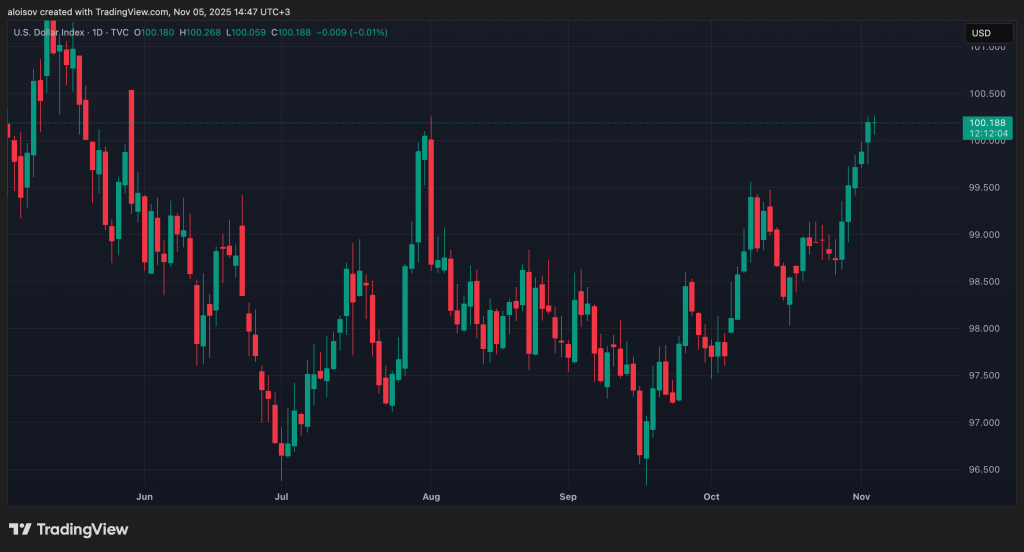
1-дневный график индекса доллара

По мнению аналитиков QCP Capital, для возвращения биткоина к устойчивому росту необходимы разворота оттока капитала из ETF и возобновление доверия к рискованным активам. Психологическая отметка $100 000 стала своего рода барометром настроений — если она удержится как поддержка, криптовалютный рынок сможет восстановить восходящий импульс.


İlgili Okumalar

The Illusion of a Prodigy

The Illusion of the "Genius Youth" The article discusses the recent interview incident involving Li Bojie, a former "Huawei Genius Youth," and AI company DeepSeek. It highlights the core conflict not as a simple case of suspected cheating during a coding test, but as a profound mismatch in expectations. Li, with an impressive background including entrepreneurship, a role at Huawei, and a position as a chief scientist, was deeply affected by a standard remote interview where the interviewer questioned his actions. The key point is his stated view of DeepSeek as the "pinnacle of the Chinese tech world." For him, the interview was a quest for identity validation—proof he belonged at the center of the new AI era. For DeepSeek, it was a routine skills assessment. The article argues that Li, while publicly rejecting the "genius" label, subconsciously expected to be treated as a peer for discussion, a courtesy extended by other companies like MiniMax and Xiaomi. DeepSeek, however, adhered strictly to its standardized process, prioritizing consistent, merit-based evaluation over individual prestige. This clash symbolizes a larger shift in the tech industry. The core thesis is that the AI era is dismantling the old system where past titles, companies, and accumulated experience guaranteed status. Now, with rapid knowledge obsolescence, "excellence is calculated in real-time." Li's anxiety—waiting weeks for the DeepSeek interview despite other offers—stems from the fear that rejection means being left behind by technological progress. The article concludes that this incident is a harbinger; soon, everyone will face a constant, implicit "interview" with the AI age itself, asking: "You were excellent yesterday. What about today?"

marsbit12 dk önce

The Illusion of a Prodigy

marsbit12 dk önce

Vanguard Group Enters the Arena, Opening a New Crypto Portal for 50 Million Traditional Investors

Vanguard Group, the world's second-largest asset manager with $12 trillion in assets under management and over 50 million investors, has signaled a significant strategic shift by posting a job opening for a "Head of Digital Assets, Personal Wealth." The role entails developing a comprehensive digital asset strategy, establishing long-term plans, and overseeing the full integration of digital assets into Vanguard's wealth management platform, covering areas like custody, settlement, asset tokenization, and stablecoins. This move marks a notable reversal from the firm's previous stance. In 2024, Vanguard refused to list spot Bitcoin ETFs and removed Bitcoin futures products. By late 2025, it allowed some third-party crypto ETF trading but reiterated it would not create its own crypto funds. The new hire represents a third step: building an internal team to integrate digital assets into its core infrastructure, moving beyond merely listing products. The initiative focuses on foundational financial infrastructure—how tokenized assets and digital settlement systems can connect to Vanguard's existing platform, which primarily serves long-term, conservative investors. While Vanguard maintains it will not launch proprietary crypto ETFs, it is proactively preparing its systems for a future involving tokenized assets and stablecoins, which Citigroup projects could reach a $5.5 trillion market by 2030. Vanguard's scale means its chosen standards for custody, settlement, and compliance could set de facto rules for the broader wealth management industry. The firm is acting despite regulatory uncertainty and cautious market sentiment (e.g., Citi recently lowered crypto price targets). Analysts suggest even a minimal 0.01% allocation from Vanguard's asset base would bring ~$12 billion into digital assets, forcing the development of robust risk and operational frameworks. Ultimately, Vanguard's focus is on building the plumbing for digital assets to potentially serve its vast client base, an effort whose impact may extend far beyond any single market cycle.

Foresight News26 dk önce

Vanguard Group Enters the Arena, Opening a New Crypto Portal for 50 Million Traditional Investors

Foresight News26 dk önce

Paradigm's New Playbook: Crypto in One Hand, AI and Robotics in the Other

Title: Paradigm's New Strategy: Crypto in One Hand, AI and Robotics in the Other On July 8, 2026, top-tier venture capital firm Paradigm announced the successful $12 billion close of its fourth fund, marking a strategic evolution beyond its pure-play crypto roots. While remaining committed to cryptocurrency, the firm is now formally extending its investment focus to include artificial intelligence, robotics, and other frontier technologies. This shift was foreshadowed by a subtle but significant change to its official social media description earlier in March, from "A research-driven crypto investment firm" to a broader "We build and invest in the companies and ideas shaping the frontier." The move is driven by the firm's recognition of transformative technological waves beyond crypto, particularly in AI and robotics, and a response to the shifting capital allocation landscape. Despite significant AI sector fundraising, Paradigm emphasizes its commitment remains grounded in deep technical rigor. A key intersection for Paradigm lies in AI Agents, where decentralized blockchain networks and stablecoins are seen as a natural financial infrastructure for autonomous digital operations. The firm is active in promoting open-source, decentralized AI (e.g., investing in Nous Research) and building agent-friendly blockchains (e.g., incubating Tempo). It is also developing tools like EVMbench (with OpenAI) and the Centaur AI Agent platform. Within its crypto stronghold, Paradigm will continue focusing on core infrastructure areas. These include derivatives and new liquidity layers (e.g., Hyperliquid), prediction markets (with plans for a proprietary trading terminal), and developer tools (continuing development of Reth and Foundry). In summary, Paradigm's expansion reflects a broader realignment in venture capital, where the intense capital concentration in AI and the search for exponential growth compel even crypto-native funds to broaden their narratives. However, this does not signify an abandonment of crypto; instead, the focus is sharpening on real-world financial applications like stablecoins, RWA, on-chain derivatives, prediction markets, and the convergence of Crypto and AI Agents.

Foresight News1 saat önce

Paradigm's New Playbook: Crypto in One Hand, AI and Robotics in the Other

Foresight News1 saat önce

The Preferred Stock Domino Effect: Strive Incurs a 7.08 Million Dollar Loss, Strategic Risk Spreading in a Chain Reaction

"Priority Stock Domino Effect": Strive's $7.08 Million Loss Reveals Chain-Reaction Risk in Bitcoin Reserve Sector Bitcoin reserve company-issued preferred shares are no longer just yield assets but a credit test for balance sheet health. While focus remains on Strategy, Strive, the 7th largest public Bitcoin holder, disclosed a tangible spillover effect: its holding of Strategy's (STRC) preferred shares lost $7.08 million in fair value over eight days, despite no change in share count. This exposes a clear cross-company risk transmission channel within the sector. Strive's filing shows its 505,000 STRC shares fell from ~$88.59 to ~$74.57 per share. While Strive remains solvent with 19,864 BTC and $141.7M cash, the loss signals that preferred stock risks can spread via inter-company holdings, shifting their perception from stable income to credit-like, high-risk assets dependent on issuer liquidity and dividend sustainability. In response, Strategy unveiled a "Digital Credit Capital Framework," raising STRC's annual dividend to 12%, mandating a 12-month cash reserve for dividends, and authorizing up to $1B each for STRC/common stock buybacks and a $1.25B Bitcoin sale plan to bolster reserves. This marks a shift to active credit risk management, formally incorporating potential Bitcoin sales to stabilize its capital structure. Third-party valuation tools, like Farside's calculator estimating STRC's net present value at ~$49.89, highlight that pricing now hinges critically on perpetual dividend sustainability and the issuer's ability to pay amid market volatility. Bitcoin's price (~$62k) remains below Strategy's average cost basis ($75,651), intensifying focus on reserve policies. The market faces two scenarios: 1) Contained risk, where STRC's discount narrows and stress is limited to Strategy; or 2) Systemic risk, where deep STRC discounts persist, dividend hikes fail, Bitcoin sales commence, and pressure spreads to other issuers like Strive's SATA shares. Key indicators to watch are STRC/SATA discount levels, dividend coverage credibility, equity issuance rates, and any actual Bitcoin divestment. Strive's future reports will be crucial in determining if its loss is an isolated event or the first sign of sector-wide credit risk contagion via preferred shares.

marsbit1 saat önce

The Preferred Stock Domino Effect: Strive Incurs a 7.08 Million Dollar Loss, Strategic Risk Spreading in a Chain Reaction

marsbit1 saat önce

İşlemler

Spot
活动图片