One crypto analyst is comparing Bitcoin’s price action to one traditional stock to predict what’s next for BTC after a rocky last two months.
In a new strategy session, the anonymous host of InvestAnswers highlights automaker Tesla while telling his 442,000 YouTube subscribers about the significance of mean reversion, a metric that posits an asset’s price will eventually return to its long-term average.
“Let’s look at the pair. This is the Tesla-divided-by-Bitcoin pair, and you can see the price now is about 0.036. We are back at late 2020 levels. It’s like a big huge U.
Is mean reversion overdue? Looking at this chart, you’ll see the blue line, that’s the 200-day moving average. That’s about 0.024 and we’re currently trading at 0.036. While Tesla has remained flat over the last 12 months, Bitcoin has gotten clobbered down 70%.
That is where we are, that is the situation and that’s why there’s parallax like this.”
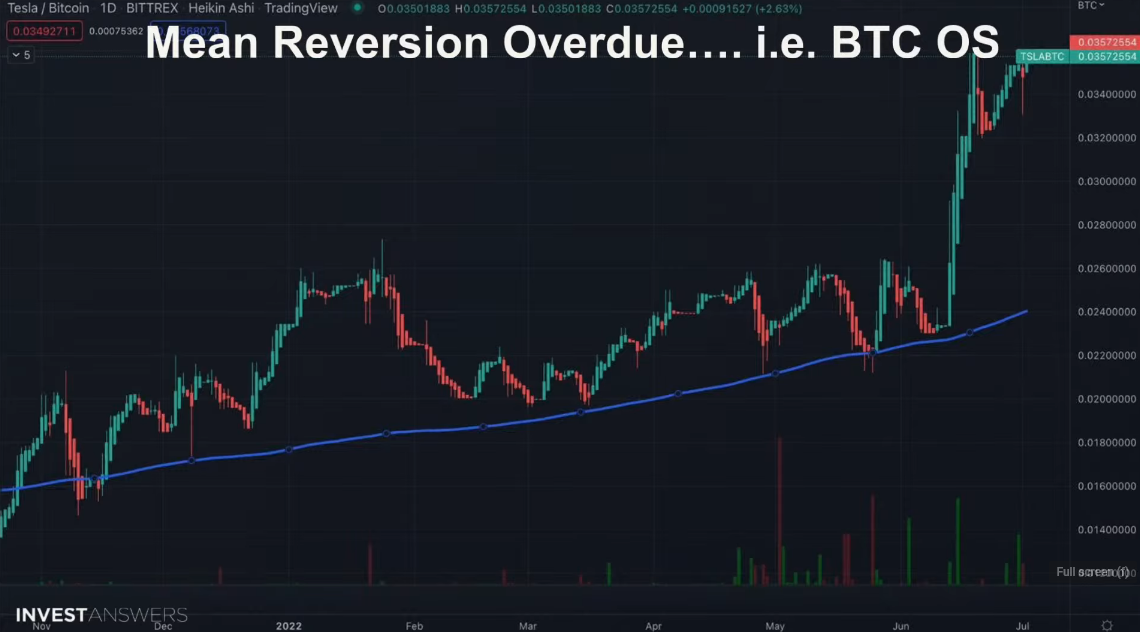
Source: InvestAnswers/YouTube
The analyst says most assets with true underlying utility and value will revert to their mean, which is why he expects both Tesla and Bitcoin to post rallies starting in about half a year.
“Short and succinct, not financial advice, of course, everything mean reverts unless it’s a piece of crap or it’s broken.
Tesla has held up well during the correction and recession incredibly well. While I believe Tesla will hit $1,200 in the next six to 12 months, which is slightly less than double, I also believe Bitcoin could potentially triple in the same timeframe. Six to 12 months, which takes out to summer 2023 and that’s very, very conservative.
The Tesla /Bitcoin pair right now is 0.036. [The] 200-day moving average is 0.024, so technically we are here. I do not expect the pair to go higher than this 0.036 level.”
Regarding Tesla’s future earnings, the chart guru mentions the company will incur a hefty on-paper loss for its current Bitcoin holdings.
“They’re going to get hit hard. They’re gonna have an impairment charge of maybe $450 million dollars. A lot of stuff is hitting them, but they had the worst quarter-over-quarter performance in over two years.
I think that pair will come down, and I think once the bids start coming back… it’s more likely that Bitcoin gets bought up at this level and Tesla could come down, so watch that level 0.036.”
At time of writing, Bitcoin is up 6.02% on the day and priced at $20,258.