Почему биткоин падает после решения ФРС по ставке

cryptonews.ru2025-04-29 tarihinde yayınlandı2025-10-30 tarihinde güncellendi

Вечером 29 октября 2025 года Федеральная резервная система США снизила ставку на 0,25% — до диапазона 3,75–4% — и объявила о завершении программы количественного ужесточения с 1 декабря. Решение совпало с прогнозами рынка

Несмотря на позитивные ожидания, биткоин отреагировал на новость падением. Рассказываем, почему так вышло.

Как купить биткоин с карты: инструкция

Что происходит с биткоином

Биткоин начал снижаться на фоне решения ФРС о снижении ставки. В моменте криптовалюта упала до уровня $108 000, на котором BTC в последний раз находился 23 октября 2025 года. Глубина снижения за несколько часов достигла почти 3,5%. На момент написания обзора, биткоин торгуется по $108 761.
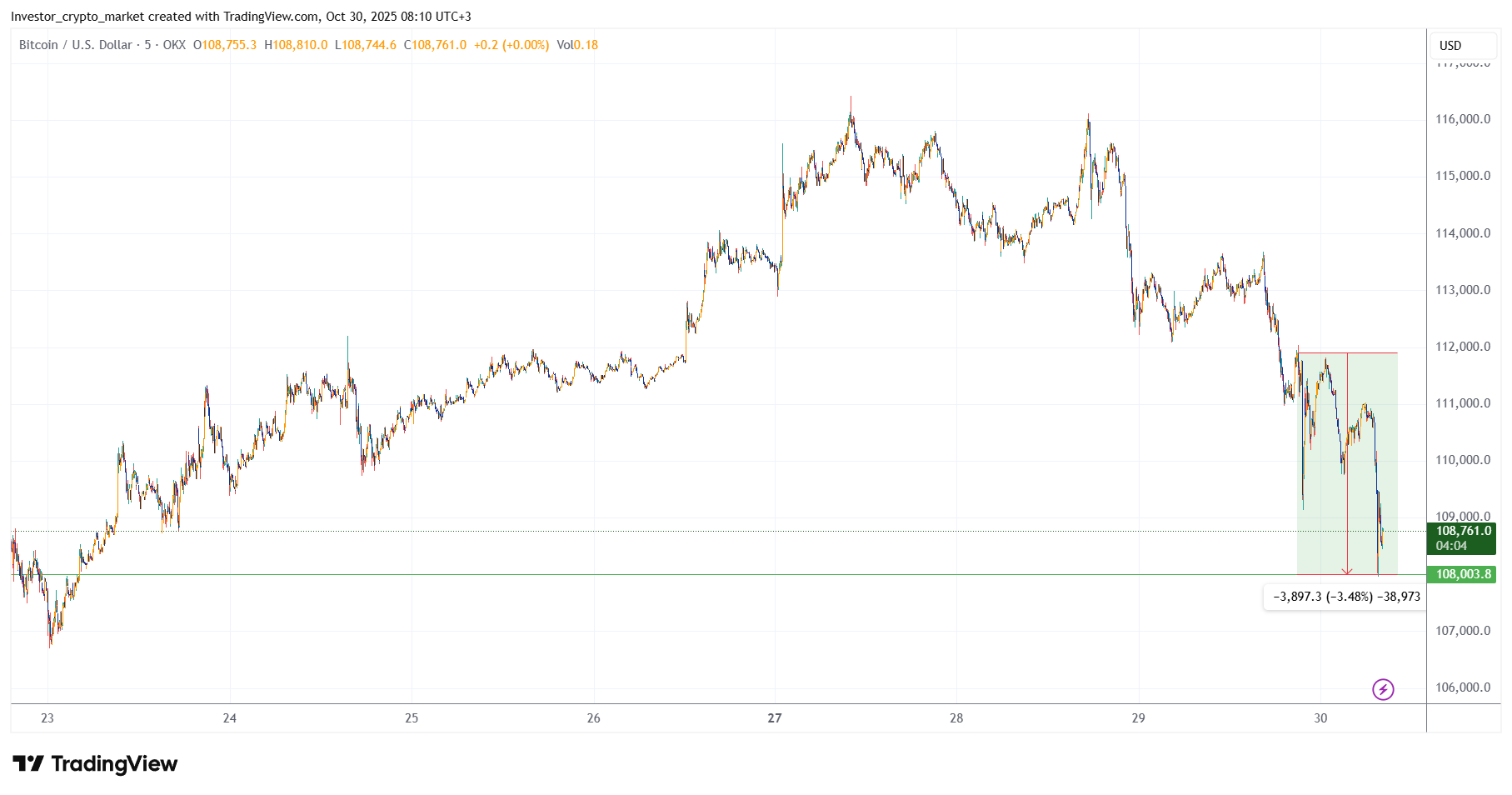
реакция биткоина на решение ФРС
График биткоина. Источник: TradingView

Читайте также: Кто придумал биткоин и что такое криптовалюта простыми словами

На фоне падения биткоина индекс страха и жадности опустился до 34 пунктов. Еще вчера он находился на уровне 51. Изменения говорят об усилении страха среди биткоин-инвесторов и снижении готовности участников рынка рисковать ради покупки BTC.
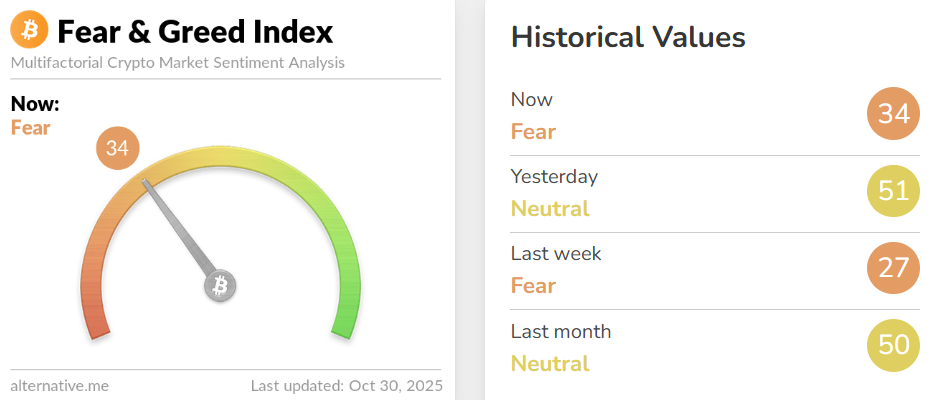
Индекс страха и жадности биткоина. Источник: alternative.me

Почему криптовалюта падает

Многие аналитики и участники рынка предполагали, что биткоин вырастет после заседания ФРС, потому что снижение ставок обычно поддерживает интерес к рисковым активам, включая криптовалюты. Завершение программы количественного ужесточения воспринимают как сигнал возможного увеличения ликвидности. Кроме того, ноябрь традиционно считается удачным месяцем для биткоина. Инвесторы рассчитывали, что смягчение политики создаст условия для движения к новым историческим максимумам. К сожалению, этого не произошло.

Вот основные причины падения биткоина:

  • Решение уже было учтено рынком. Снижение ставки ожидалось заранее, поэтому новость не привела к новому притоку капитала.
  • Неопределенность внутри ФРС. Комментарии Джерома Пауэлла показали, что среди членов Комитета нет единого мнения по поводу дальнейших шагов, и инвесторы восприняли это как сигнал, что политика смягчения может продвигаться медленнее, чем ждут.
  • Слабые экономические ожидания. Рынок насторожен из-за признаков охлаждения рынка труда, роста цен и торговых споров с Китаем.
  • Сомнения в росте ликвидности. Хотя ФРС прекращает сокращение баланса, участники рынка не ждут быстрого притока денег в рисковые активы.
  • Фиксация прибыли. После недавнего роста BTC до $116 400 часть инвесторов решила зафиксировать прибыль, что усилило падение.

Чего дальше ждать от биткоина

Положение BTC по просьбе редакции BeInCrypto прокомментировал Ян Пинчук, заместитель начальника отдела биржевой торговли WhiteBird.

В целом прогноз позитивный. На выходных стало известно, что американская и китайская переговорные группы согласовали структуру торгового соглашения, и на предстоящей неделе Трамп и Си Цзиньпин подпишут документ. На этом фоне рынки вернулись в состояние риск-он.

Еще одним испытанием может стать конец этой недели, свои финансовые отчеты опубликуют компании из так называемой «великолепной семерки», которые составляют около 50% индекса Nasdaq. А поскольку биткоин обладает высокой корреляцией с этим индексом, можно ожидать, что хорошие отчеты поддержат и крипторынок.

Поэтому я бы сказал так: если отчеты выйдут сильными, а это очень вероятно, и рынки удержатся на текущих уровнях к началу ноября, у нас есть все шансы увидеть позитивный для биткоина ноябрь.

Мы еще в начале года указывали, что цель по биткоину в этом цикле — около $130 тыс., и пока все, что происходит на рынке, подтверждает этот таргет.

İlgili Okumalar

Vitalik's Algorithmic Stablecoin Vision: Interpreting the Mechanism and Challenges from an Options Perspective

Vitalik Buterin's recent algorithmic stablecoin proposal envisions using an option-like mechanism to create a stablecoin without the liquidation risks inherent in traditional collateralized debt position (CDP) models. The design splits one unit of ETH into two components: a 'stable' leg (P) that maintains value up to a certain strike price, and an 'upside' leg (N) that captures any appreciation above that price. Together, they always sum to one ETH, eliminating the need for debt or liquidation mechanisms. From an options perspective, the stable leg essentially functions as a synthetic, covered call position. However, significant challenges exist. For the stable asset to maintain its peg, it must continuously roll deep in-the-money call options, leading to potential rollover slippage, predictable trading paths vulnerable to front-running, and liquidity issues. Crucially, the system's scalability depends on a constant demand for the upside leg—a form of leveraged ETH long position without funding rates or liquidation risk. It's unclear if such persistent, specific demand will materialize from speculators or market makers who have simpler alternatives like perpetual swaps. The author, drawing from experience with Rysk, argues that DeFi options have struggled as standalone trading products due to complexity and fragmented liquidity. Their potential lies instead as foundational infrastructure underpinning more complex financial primitives like stablecoins, structured yields, or index products—transforming from a direct product into a core pricing and risk distribution engine for the next generation of on-chain finance.

marsbit46 dk önce

Vitalik's Algorithmic Stablecoin Vision: Interpreting the Mechanism and Challenges from an Options Perspective

marsbit46 dk önce

GPT-5.6 Countdown: Abandon the Illusion of a Single API, Computational Iteration Can't Outpace a Single Page of Compliance

In mid-June, three seemingly independent industry events—the compliance-driven throttling of Fable 5, the open-sourcing of GLM-5.2, and the leaked release timeline for GPT-5.6—are pushing the global AI industry toward a watershed moment. These shifts signal a fundamental restructuring of the industry's underlying logic. First, **"usability" has substantially overtaken "advanced capabilities"** as the primary weight, pushing the global large language model (LLM) supply chain into a "dual-track" phase of controlled closed-source and local open-source coexistence. Second, **the competitive moats of closed-source giants are shifting**. Their technical focus is moving from "language intelligence" toward "spatial intelligence (world models)"—a domain heavily reliant on computing power. Third, faced with常态化 transnational compliance risks, **a "model-agnostic" decoupled design has become a survival necessity for application-layer developers to maintain business continuity.** The article details how Anthropic's Fable 5, despite its advanced engineering feats, was restricted for non-U.S. citizens within 72 hours of launch, highlighting how geopolitical compliance can instantly limit even the most advanced models. In response, the open-source camp, exemplified by Zhipu AI's MIT-licensed GLM-5.2, is gaining market share by offering stable performance improvements and significant cost advantages (up to 70% savings for enterprises), while achieving full adaptation with domestic semiconductor platforms. Meanwhile, closed-source leaders like OpenAI are pivoting. The anticipated GPT-5.6 reportedly shifts focus from language to spatial intelligence and world models, aiming to rebuild a generational gap in areas like 3D understanding, simulation, and industrial design that demand immense compute. The core conclusion is that the LLM supply chain's logic has changed. Enterprises must now evaluate infrastructure based on a composite of technical performance and policy compliance. For developers, complete reliance on a single closed-source API poses unacceptable risk. Implementing a truly model-agnostic architecture—enabling swift switches to compliant, locally deployable open-source alternatives—is no longer just good practice but a fundamental baseline for business continuity.

marsbit3 saat önce

GPT-5.6 Countdown: Abandon the Illusion of a Single API, Computational Iteration Can't Outpace a Single Page of Compliance

marsbit3 saat önce

Is the 'Token Subsidy War' Among AI Giants Almost Over?

The article discusses the ongoing "token subsidy war" among AI giants like OpenAI and Anthropic, questioning whether it's nearing its end. It reveals that current AI subscription prices are heavily subsidized, with some plans offering tokens at up to 70 times the actual cost to attract and retain heavy users, especially developers and enterprises. This strategy mirrors past internet-era subsidy battles, but with a key difference: AI tokens lack "lock-in" effects. Unlike ride-hailing or food delivery apps, users can easily switch between AI providers as APIs become standardized, making it difficult for companies to raise prices post-subsidy. The piece highlights a structural asymmetry in the competition. Giants like Google, with massive advertising revenue, can afford to subsidize tokens indefinitely, akin to using "tokens as a weapon." In contrast, venture-backed companies like OpenAI and Anthropic face pressure to become profitable, especially as they approach IPO. The article cites Google Ventures founder Bill Maris, who suggests Google could slash token prices by 80%, putting immense pressure on competitors. Two potential endgames are presented: the "internet service" model (subsidize, monopolize, then raise prices) and the "utility" model (tokens become a standardized, low-margin commodity like electricity). Given the low switching costs, the latter seems more likely. The competition may not have a single winner but could instead accelerate AI's evolution into a foundational, infrastructure-level technology, akin to a public utility. For now, users continue to benefit from heavily subsidized token costs.

marsbit3 saat önce

Is the 'Token Subsidy War' Among AI Giants Almost Over?

marsbit3 saat önce

İşlemler

Spot
Futures
活动图片



