Ethereum Will Impose Gas Limit In Fusaka Upgrade

bitcoinist2025-10-23 tarihinde yayınlandı2025-10-23 tarihinde güncellendi

Özet

The Ethereum Foundation has confirmed that the upcoming Fusaka hard fork will introduce a protocol-level ceiling on how much gas...

Trusted Editorial content, reviewed by leading industry experts and seasoned editors. Ad Disclosure

The Ethereum Foundation has confirmed that the upcoming Fusaka hard fork will introduce a protocol-level ceiling on how much gas a single transaction may consume, formally codified as EIP-7825. The cap is set at 2²⁴ gas—16,777,216 units—marking the first time Ethereum enforces a per-transaction limit distinct from the block gas limit. The change is already active on Holesky and Sepolia and will go live on mainnet when Fusaka activates.

In a post published October 21, Toni Wahrstätter framed the rationale in direct terms: “Starting with the upcoming Fusaka hard fork, EIP-7825 introduces a per-transaction gas limit cap of 2²⁴ (≈ 16.78 million gas).” The Foundation’s note emphasizes that while the cap bounds individual transactions, it does not alter the block gas limit; instead, it is designed to mitigate denial-of-service vectors where a single oversized call monopolizes an entire block and to improve block packing predictability as the network prepares for parallel execution.

EIP-7825 draws a clean line between transaction-level complexity and system-level throughput. Previously, exceptionally large calls could approach the full block gas target (around 45 million at times), creating timing and scheduling pathologies for builders and validators.

The new ceiling obliges workloads that would exceed 16.78 million gas to be broken into smaller, sequenced calls. The Foundation’s guidance is careful to note that “for most users, nothing changes,” since the statistical distribution of real-world transactions already sits well below the threshold; the risk surface primarily concerns batch-heavy contracts, deployment scripts, and specialized routers.

What This Means For Ethereum And Users

From a roadmap perspective, the cap is explicitly positioned as groundwork for parallel execution. The blog post connects the change to anticipated efforts such as EIP-7928 in the “Glamsterdam” era, where predictable, bounded transactions are a prerequisite for meaningful concurrency in the execution layer. By ensuring that at least several independent transactions can be packed per block—even under pathological mempool conditions—the cap reduces worst-case contention and simplifies scheduler design for builders experimenting with parallelizable execution paths.

The specification itself is spare and mechanical. EIP-7825’s abstract states the intent “to 16,777,216 (2^24) gas” per transaction, improving resilience against certain DoS vectors and making transaction processing more predictable as block limits rise. That simplicity has been part of its appeal in core-dev channels: a small, well-scoped constraint that preserves forward compatibility with more ambitious scaling work.

Debate on how to encode and communicate the ceiling has been active for months, including discussions over naming and parameterization on Ethereum Magicians and during AllCoreDevs calls. One thread summarized the core guarantee being targeted by several contributors: aligning block targets to multiples of 2²⁴ so builders can always include at least n transactions if the mempool has n eligible ones—an argument for predictability rather than raw throughput.

Operationally, the Foundation says all major clients—Geth, Erigon, Reth, Nethermind, and Besu—have implemented the change in Fusaka-ready releases, reducing cross-client divergence risk at activation. The post also stresses that eth_call semantics are unaffected and that pre-signed transactions whose gas limits exceed 2²⁴ will need to be re-signed below the cap. The upgrade path for developers is straightforward: test against Holesky or Sepolia, re-tool batch operations that flirt with the limit, and adjust gas-estimation logic and alerts so they fail fast when constructions exceed the new ceiling.

The policy context is worth parsing. Ethereum’s history has favored minimal, general-purpose constraints, deferring complexity to higher layers. EIP-7825 fits that pattern: it does not opine on what contracts should do, only that they respect an upper bound that protects liveness and prepares the execution layer for a multi-threaded future.

It also sidesteps fee-market alterations and leaves blob-space economics and block targets to other EIPs and forks. As the Foundation put it, the cap “establishes a safer and more predictable foundation for higher throughput in future forks,” a line that sums up the trade-off succinctly.

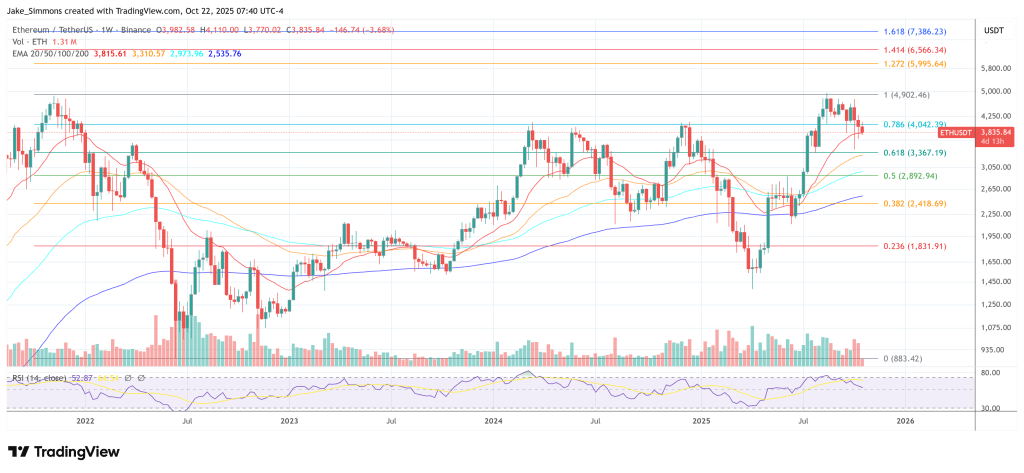
At press time, ETH traded at $3,835.
Ethereum price
ETH holds above the EMA20, 1-week chart | Source: ETHUSDT on TradingView.com
Featured image created with DALL.E, chart from TradingView.com
Editorial Process for bitcoinist is centered on delivering thoroughly researched, accurate, and unbiased content. We uphold strict sourcing standards, and each page undergoes diligent review by our team of top technology experts and seasoned editors. This process ensures the integrity, relevance, and value of our content for our readers.

Jake Simmons has been a Bitcoin enthusiast since 2016. Ever since he heard about Bitcoin, he has been studying the topic every day and trying to share his knowledge with others. His goal is to contribute to Bitcoin's financial revolution, which will replace the fiat money system. Besides BTC and crypto, Jake studied Business Informatics at a university. After graduation in 2017, he has been working in the blockchain and crypto sector. You can follow Jake on Twitter at @realJakeSimmons.

İlgili Okumalar

Bitroot Public Chain Invited to Attend Tencent Cloud Singapore AI Conference, Discussing the Future Alongside Solana

On May 19, Bitroot, an emerging Layer 1 blockchain, participated in the Tencent Cloud AI Summit in Singapore alongside key industry players like Solana Foundation. The event explored the intersection of AI infrastructure, enterprise applications, AI Agents, and Web3. Bitroot's invitation, despite being pre-mainnet, highlights industry interest in its focus on high-performance, AI-native architecture tailored for future AI Agent execution and verifiable on-chain automation. Bitroot CEO Juan Jose emphasized that AI competition is shifting from model performance to data, real-world application scenarios, and trust infrastructure. He argued that for AI Agents to evolve from assistants to autonomous executors managing transactions and assets, they require low-latency, low-cost, and high-throughput blockchain environments. Bitroot aims to address this through its EVM-compatible design, optimistic parallel execution, and a consensus mechanism targeting high scalability. Currently in its Testnet 5.0 phase, Bitroot reports metrics like over 50,000 peak TPS and sub-0.3 second average block time. Its narrative positions it within a growing landscape where next-generation Layer 1s like Monad and Aptos also compete on performance, while Bitroot differentiates by integrating AI computational capabilities natively across its stack. The summit underscored that the fusion of AI and Web3 is moving from concept to infrastructure competition, where networks balancing performance, security, and verifiability will be crucial for enabling scalable AI-driven applications.

marsbit4 dk önce

Bitroot Public Chain Invited to Attend Tencent Cloud Singapore AI Conference, Discussing the Future Alongside Solana

marsbit4 dk önce

Hedge Fund Q1 Interpretation: Everyone Is Selling Software, Buying Chips

Hedge Funds and Mutual Funds Aligned in Q1: Dumping Software, Buying Chips A clear consensus emerged among major U.S. hedge funds and mutual funds in Q1: they were simultaneously selling software stocks and pouring capital into the semiconductor sector. This aggressive rotation pushed semiconductor exposure in hedge fund long portfolios to a record high. Hedge funds delivered a 7% return year-to-date, while only 30% of large-cap active mutual funds outperformed their benchmarks. The average short interest for S&P 500 constituents rose to 3% of market cap, the highest since 2011. Within technology, the structural shift was stark. Hedge funds' semiconductor weighting hit an all-time high, while software fell to its lowest since 2019. Excluding Microsoft, mutual funds' relative overexposure to semis vs. software was the largest since 2012. Microsoft was among the most net-sold stocks by both groups. Hedge funds net purchased semiconductor names like LRCX and AMAT. Strategies diverged on leverage and cash. Hedge funds increased their net exposure to near a one-year high after an initial cut. Mutual funds raised their cash allocation, though it remains historically low at 1.4%. Sector alignment was high in Industrials (both overweight) but divergent in Tech: hedge funds increased their Tech net tilt by a record 853 basis points, while mutual funds reduced theirs. Clear splits also appeared in Financials and Consumer Discretionary. Four stocks appeared on both Goldman's hedge fund VIP and mutual fund overweight lists: BA, MA, MRVL, and V. This "shared favorites" basket has returned 10% YTD, outperforming the equal-weight S&P 500. Notably, all "Magnificent Seven" stocks are on the hedge fund VIP list but are uniformly underweighted by mutual funds.

marsbit14 dk önce

Hedge Fund Q1 Interpretation: Everyone Is Selling Software, Buying Chips

marsbit14 dk önce

The Evolution Path of Physical Bitcoin

The Evolution of Physical Bitcoin Bitcoin's digital nature is its core strength, enabling self-custody and rapid global transfers. However, its intangibility also hinders mainstream adoption. For over a decade, creators have attempted to materialize Bitcoin while preserving its cash-like properties, yielding notable results. Casascius Coins, launched in 2011, were the first and most iconic physical Bitcoin. Creator Mike Caldwell generated private keys offline, printed them on coins, and sealed them with tamper-evident holograms. This model relied on user trust in the centralized issuer. Production ceased in 2013 due to regulatory pressure from FinCEN. RavenBit Coins emerged in 2014 aiming to decentralize minting by letting users generate and apply their own keys. However, this led to trust issues with numerous untrusted minters and insecure key generation methods. In 2016, Coinkite introduced Opendimes—a breakthrough in bearer asset technology. These USB-shaped devices generate and store keys internally. Funds can be received by checking the public key, but spending requires physically breaking the device to extract the private key. While innovative and open-source, its cost (~$20) and form factor limit its use for small, everyday transactions. Satochip's Satodime, a card-shaped device using similar secure chip technology, followed. It supports NFC interaction and comes in various forms. While potentially cheaper in bulk (~13€), it remains a high-security hardware wallet, not a low-cost cash substitute. A fundamental cost barrier exists. For physical Bitcoin to achieve widespread commercial use, hardware costs must drop below $1 to match the production cost of fiat banknotes. Current secure chips capable of running Bitcoin's cryptographic algorithms (like secp256k1) are too expensive. Chips like NXP's NTAG X DNA (~$3) show cost-reduction potential but lack native Bitcoin curve support. Projects like OfflineCash embed chips in banknote-like paper, but face challenges with durability, the need for custom Bitcoin-enabled chips, and the inherent requirement for users to verify balances online—which conflicts with Bitcoin's trustless ideal. Coinkite's Tapsigner, a ~$20 card with a proprietary Bitcoin NFC chip, is seen as a more practical step forward. It functions as a reloadable hardware wallet for contactless payments, solving the "change" problem and focusing on real-world retail integration, a direction also pursued by companies like Cash App and Square. In summary, the journey to physical Bitcoin has progressed from trusted centralized mints (Casascius) to user-generated keys (RavenBit) and finally to self-contained secure hardware (Opendimes, Satodime, Tapsigner). The core challenge remains developing a sufficiently low-cost, durable, and truly trustless physical bearer asset that can function like cash in daily transactions. Current solutions are either too expensive or introduce new trust assumptions, keeping the ideal of ubiquitous physical Bitcoin just out of reach for now.

marsbit1 saat önce

The Evolution Path of Physical Bitcoin

marsbit1 saat önce

İşlemler

Spot
Futures

Popüler Makaleler

GAS Nasıl Satın Alınır

HTX.com’a hoş geldiniz! GAS (GAS) satın alma işlemlerini basit ve kullanışlı bir hâle getirdik. Adım adım açıkladığımız rehberimizi takip ederek kripto yolculuğunuza başlayın. 1. Adım: HTX Hesabınızı OluşturunHTX'te ücretsiz bir hesap açmak için e-posta adresinizi veya telefon numaranızı kullanın. Sorunsuzca kaydolun ve tüm özelliklerin kilidini açın. Hesabımı Aç2. Adım: Kripto Satın Al Bölümüne Gidin ve Ödeme Yönteminizi SeçinKredi/Banka Kartı: Visa veya Mastercard'ınızı kullanarak anında GAS (GAS) satın alın.Bakiye: Sorunsuz bir şekilde işlem yapmak için HTX hesap bakiyenizdeki fonları kullanın.Üçüncü Taraflar: Kullanımı kolaylaştırmak için Google Pay ve Apple Pay gibi popüler ödeme yöntemlerini ekledik.P2P: HTX'teki diğer kullanıcılarla doğrudan işlem yapın.Borsa Dışı (OTC): Yatırımcılar için kişiye özel hizmetler ve rekabetçi döviz kurları sunuyoruz.3. Adım: GAS (GAS) Varlıklarınızı SaklayınGAS (GAS) satın aldıktan sonra HTX hesabınızda saklayın. Alternatif olarak, blok zinciri transferi yoluyla başka bir yere gönderebilir veya diğer kripto para birimlerini takas etmek için kullanabilirsiniz.4. Adım: GAS (GAS) Varlıklarınızla İşlem YapınHTX'in spot piyasasında GAS (GAS) ile kolayca işlemler yapın.Hesabınıza erişin, işlem çiftinizi seçin, işlemlerinizi gerçekleştirin ve gerçek zamanlı olarak izleyin. Hem yeni başlayanlar hem de deneyimli yatırımcılar için kullanıcı dostu bir deneyim sunuyoruz.

176 Toplam GörüntülenmeYayınlanma 2024.12.12Güncellenme 2025.03.21

GAS Nasıl Satın Alınır

Tartışmalar

HTX Topluluğuna hoş geldiniz. Burada, en son platform gelişmeleri hakkında bilgi sahibi olabilir ve profesyonel piyasa görüşlerine erişebilirsiniz. Kullanıcıların GAS (GAS) fiyatı hakkındaki görüşleri aşağıda sunulmaktadır.

活动图片