Криптовалюта, которая обошла рыночный крах — что стоит за ростом TAO

cryptonews.ru2025-03-20 tarihinde yayınlandı2025-10-21 tarihinde güncellendi

Bittensor (TAO) стал одним из лидеров рынка. Монете удалось быстро восстановиться от недавнего краха на Черную пятницу. Результатам криптовалюты могут позавидовать даже такие лидеры рынка, как биткоин (BTC) и Ethereum (ETH)

Рост объемов торгов, усиление институционального интереса и сокращение предложения на фоне первого халвинга делают прогнозы для TAO все более благоприятными.

Что стоит за ростом Bittensor (TAO)

Согласно данным BeInCrypto Markets, большинство ведущих криптовалют дешевели на протяжении двух недель. В отличие от них, Bittensor (TAO) пошел против тренда, показав рост на 35,7% за тот же период.

Криптовалюта не только смогла восстановиться после октябрьского краха рынка, но и поднялась до многомесячных максимумов. Только за последний день стоимость альткоина увеличилась на 5,95% — до $435,65.
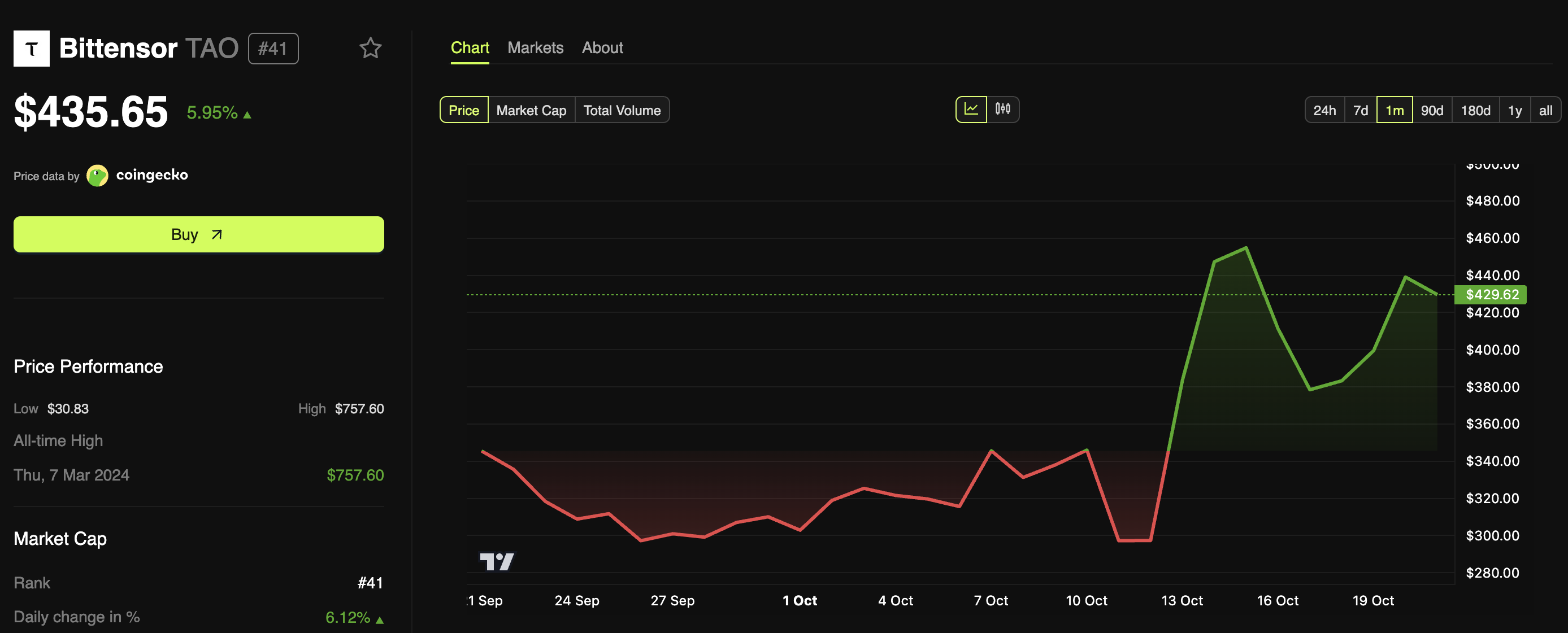
Динамика цены Bittensor (TAO). Источник: BeInCrypto Markets

Несколько факторов способствуют сильным показателям TAO. Данные CoinGecko показывают, что токен сохранял дневные объемы торгов выше $400 млн на протяжении последней недели. 15 октября объем достиг $943 млн, что свидетельствует о высоком интересе трейдеров к проекту.

Рост TAO также поддерживает интерес к стейкингу криптовалюты. Данные Taostats показывают, что более 70% монет TAO в обращении находятся в стейкинге. Такое положение ограничивает доступное для торговли предложение и поддерживает цену.

Институциональный интерес ускоряет динамику

Институциональное принятие расширило охват Bittensor. Децентрализованный AI фонд от Grayscale выделил более трети своих активов на TAO, что свидетельствует о возросшем доверии к монете как к ключевому игроку на децентрализованном рынке AI.

Кроме того, компания недавно подала заявку для Grayscale Bittensor Trust в SEC. Шаг может открыть путь для появления биржевых продуктов, аналогичных тем, что уже существуют для других крупных криптовалют, таких как BTC и ETH.

Запуск ETF может дополнительно повысить ликвидность, привлечь институциональных участников и улучшить положение TAO на рынке.

Bittensor в преддверии халвинга

Текущие катализаторы способствуют краткосрочным бычьим движениям. Дополнительные факторы могут стимулировать долгосрочный рост TAO. Декабрь 2025 года станет важной вехой для инвесторов Bittensor: в сети криптовалюты пройдет первый халвинг.

Как указано в официальной документации, халвинг Bittensor не следует хронологии блоков, как у биткоина. Вместо этого, триггером служит установленный порог. Планируемое сокращение нового предложения токенов может привести к росту цен, особенно когда стейкинг ограничивает ликвидность.

Хотя сроки халвинга могут немного измениться из-за переработки токенов, эффект сохранится — увеличение дефицита. Грядущее событие может вызвать повышенный спрос на монету.

Актив заручился поддержкой рыночных экспертов. Аналитик Квентин Франсуа недавно заявил, что TAO может стать активом стоимостью триллион долларов к 2030-2031 годам:

«Самое захватывающее в TAO то, что его путь должен следовать Закону Рида, а не Закону Меткалфа, как у биткоина. Биткоин достиг рыночной капитализации в триллион долларов в 2021 году. Это всего лишь через 12 лет после его создания. Теоретически, TAO должен сделать это менее чем за 12 лет».

Франсуа отметил конкурентную модель субсетей проекта и токеномику, схожую с биткоином, как ключевые сильные стороны. Он также описал модель TAO как «блестяще продуманную».

Таким образом, с высокими объемами, стейкингом и институциональным интересом TAO хорошо подготовлен к приближению декабря. Предстоящие месяцы станут испытанием для устойчивости Bittensor, поскольку он переходит в фазу сокращенного предложения.


İlgili Okumalar

The 'Saving U.S. Treasuries' Baton Pass: Bessent Fumbled Last Week, This Week It's Wash's Turn

"Rescuing US Treasuries" Relay: After Bessent's Miss, All Eyes Are on Walsh Last week, US Treasury Secretary Bessent's announcement to at least double long-term Treasury buybacks failed to sustainably lower yields, which quickly rebounded. The market response saw a drop in the dollar alongside surges in gold and Bitcoin, interpreted as a "pressure release valve" for anxiety. The focus now shifts to Fed Chairman Walsh's upcoming Jackson Hole speech. Markets are highly sensitive to his message, seeking clarity on the Fed's policy response to stubborn inflation and worsening fiscal conditions. Analysts warn that a lack of new guidance could disappoint markets and worsen the sell-off in long-dated bonds. Analysts question the scale of Bessent's operations, noting they are too small relative to the overall debt market and do not constitute quantitative easing. A key issue is the Fed's massive holdings of long-term bonds, which distorts the market. With the Fed holding low-yielding short-term bonds that are losing money relative to its policy rate, discussion is growing around a potential Fed-led "Operation Twist." This would involve selling short-term bonds to buy long-term ones, aiming to lower long-end yields without expanding the balance sheet. The upcoming PCE inflation data will set the stage for Walsh's speech. However, the window for action is narrowing amid political pressures. A critical threshold is the 30-year yield at 5%; holding above it could increase stress on the dollar and leveraged sectors. Overall, the article suggests that without coordinated Fed action to anchor inflation expectations, Treasury interventions may ultimately fail, with investors increasingly looking to assets like gold as hedges.

marsbit7 dk önce

The 'Saving U.S. Treasuries' Baton Pass: Bessent Fumbled Last Week, This Week It's Wash's Turn

marsbit7 dk önce

Hyperliquid's Compliance Journey: From Permissionless to Permissioned via HIP-3

Hyperliquid’s Compliance Path: From Permissionless to Permissioned HIP-3 Hyperliquid currently blocks U.S. access because its permissionless, on-chain infrastructure conflicts with U.S. market structure laws, which restrict futures trading to registered exchanges, clearinghouses, and brokers. Through its Hyperliquid Policy Center (HPC), the project is advocating for regulatory modernization, proposing that regulated entities be allowed to build products on HyperCore (its exchange and clearing layer) while fulfilling their compliance obligations. The platform’s modular stack separates roles like a traditional exchange (DCM), clearinghouse (DCO), and broker (FCM), but reconstructs them on-chain with code. This enables permissionless access, self-custody, and 24/7 global trading, but clashes with U.S. rules requiring KYC, specific margin models, and custodial arrangements. To resolve this, HPC is engaging with U.S. regulators (CFTC, SEC) to seek clarity that deploying on-chain software does not itself trigger licensing, and to establish exemptions allowing non-custodial wallets to route users to regulated derivatives. Recent political signals suggest openness to this approach. On the technical side, Hyperliquid Labs has introduced permissioned HIP-3 deployers on testnet. These allow regulated entities to launch markets, perform KYC, and whitelist compliant users. While these create separate order books, whitelisted market makers can bridge liquidity between them, ensuring deep, shared liquidity across the same L1. Features like payload-based “PA” permissions enable DEX-level account controls (e.g., reduce-only orders), mirroring traditional broker authorities. The strategy is not to open the native, permissionless front-end to U.S. users, but to position Hyperliquid as neutral infrastructure that U.S. regulated firms can use while meeting their legal duties. This paves a compliant path for U.S. investor access while preserving the protocol’s core, permissionless nature.

marsbit32 dk önce

Hyperliquid's Compliance Journey: From Permissionless to Permissioned via HIP-3

marsbit32 dk önce

Two Funding Rounds in Three Months: The Chinese Version of Palantir is on Fire

Investment Community AI has learned that Beijing Zhongshu Ruizhi Technology Co., Ltd., a domestic industrial-grade causal intelligence and high-reliability decision-making AI company, has recently completed a strategic financing round worth hundreds of millions of RMB. This round saw participation from China Internet Investment Fund, Suzhou Chuangtou National Social Security Fund, Financial Street Capital, ICBC Capital, Kunlun Capital, among others, with existing shareholders also increasing their investment. This follows a Series B funding round in the hundreds of millions completed just three months prior. The rapid succession of two major funding rounds signifies strong market recognition of the company's underlying original technology and scaled commercial implementation. Often referred to as the "Chinese version of Palantir," Zhongshu Ruizhi is entering a new phase of accelerated technological iteration, widespread scenario replication, and scaled performance release, mirroring the explosive growth of China's AI market. Founded in April 2020 by Dr. Han Han, a Tsinghua University Ph.D. and former core drafter of national AI policies, the company is mission-driven to "move AI from the digital world to the physical world." It focuses on the high-reliability, strong-decision industrial AI track and enterprise-grade AI Agent full-stack infrastructure. The team tackles the challenge of applying AI to China's vast and complex industrial and energy systems by developing a new intelligent operating system from scratch. Its core technological breakthrough lies in three proprietary底层 technologies: meta-causal cognitive theory, causal models, and a dynamic ontology engine. These address critical pain points of generative large models in industrial settings—such as AI hallucinations, insufficient reasoning, lack of temporal logic, unverifiable decisions, and multi-source rule conflicts—thereby providing trustworthy, explainable, and executable智能决策 capabilities. Commercially, Zhongshu Ruizhi has achieved scaled deployment, serving over 50 central state-owned enterprises and industrial groups in sectors like power, petroleum, and aerospace, with implementations in more than 800 highly complex production scenarios. The company reported doubled revenue in 2025, demonstrating strong self-sufficiency and a viable business model—a rarity among new-generation AI firms. The latest funds will be allocated towards advancing foundational theoretical research, replicating successful application models to expand market presence (including overseas), and attracting top-tier talent. Lead investor China Internet Investment Fund highlighted that in the current shift from general AI capability contests to deep industrial empowerment, industrial-grade causal intelligence is crucial for building China's modern digital foundation and fostering new quality productive forces. They expressed support for the company's efforts to define decision-making paradigms and trustworthy standards for industrial intelligence, aiming to secure a rule-making voice in the global physical AI arena.

marsbit42 dk önce

Two Funding Rounds in Three Months: The Chinese Version of Palantir is on Fire

marsbit42 dk önce

The Biggest Political Economy Question in the AI Era: As Robots Become More Capable, How Do Humans Share the Value?

In the AI era, the most pressing political economy question is: as machines become increasingly capable, how can humanity share in the value they create? An article originally critiquing China's tech focus has sparked a deeper debate on this global challenge. Historically, industrial progress improved efficiency but still relied on human labor for wealth creation and distribution. AI is fundamentally different—it is now replacing cognitive and knowledge work. As AI and robots take over more tasks, economic growth may continue while direct human participation in value creation shrinks, creating a core tension between productivity gains and widespread income generation. The issue is not unique to China. While leading tech companies amass enormous wealth, labor's share of income is declining globally. The core problem is a broken link: technological innovation and corporate profits are not translating into sufficient consumer income and demand. Three potential paths forward are outlined: a traditional capitalist model where profits primarily go to capital owners; a state-capitalist approach with public investment in AI; and more innovative models like digital sovereign wealth funds, universal shareholding, or AI-era basic income schemes to directly distribute AI-generated value. The future competitive advantage may lie not just in technological supremacy, but in which society can build a new, inclusive distribution system for the intelligent economy. The ultimate challenge is ensuring that as AI creates value, humans have a means to obtain income and share in the resulting widespread social benefits.

marsbit52 dk önce

The Biggest Political Economy Question in the AI Era: As Robots Become More Capable, How Do Humans Share the Value?

marsbit52 dk önce

Generating Profits for Seven Consecutive Quarters, Emerging Markets Carry Trade Outperforms Everything

For the seventh consecutive quarter, dollar-funded emerging market carry trades have delivered positive returns, marking the longest winning streak since 2008. According to Bloomberg's index, this strategy has gained approximately 22% since late 2024, outperforming U.S. Treasuries, emerging market sovereign, and corporate dollar debt. The core of the trade involves borrowing low-interest currencies like the U.S. dollar, euro, or yen to invest in high-yielding emerging market assets, such as Turkish lira bonds offering over 40% returns. Returns were amplified by favorable currency moves, with the dollar weakening against most emerging market currencies and other traditional funding currencies. For instance, the trade gained 48% on the Colombian peso in the past year. A key test came in August 2024 with a historic joint U.S.-Japan currency intervention, which caused only a modest 1% dip in the carry trade risk premium as investors shifted funding from the yen to the euro and Swiss franc. Looking ahead, the primary risk is the timing of Federal Reserve policy changes. While persistent inflation allows the Fed to hold rates, a rapid rise in long-term U.S. yields could threaten the trade. Another concern is crowding, as massive inflows increase vulnerability to a sudden reversal. High interest rates in regions like Latin America and Eastern Europe, supported by external factors like Middle East tensions and energy prices, continue to sustain the opportunity. Major investors remain engaged, favoring currencies like the Mexican peso, South African rand, and Turkish lira.

marsbit1 saat önce

Generating Profits for Seven Consecutive Quarters, Emerging Markets Carry Trade Outperforms Everything

marsbit1 saat önce

İşlemler

Spot
活动图片