Amid the global push for stablecoin adoption, recent reports claim that three major Japanese banks are preparing to issue a yen-pegged token for global settlements before the end of the year.
Japanese Megabanks To Rollout Stablecoin This Year
On Friday, news media outlet Nikkei Asia reported that Mitsubishi UFJ Financial Group (MUFG) Bank, Sumitomo Mitsui Banking Corp., and Mizuho Bank are preparing to jointly launch a stablecoin “to promote settlements made with pegged cryptocurrencies.”
According to the report, the three major banks, which serve over 300,000 clients combined, plan to establish a framework for the stablecoin utilizing the system of Tokyo-based fintech company Progmat.
Notably, MUFG launched the platform in 2023 to facilitate the issuance of bank-backed stablecoins after the enactment of a 2022 bill that prohibited non-banking institutions from issuing stablecoins.
The megabanks are set to standardize their token for payments within the companies and between them. Japanese trading house Mitsubishi Corp., which has over 240 major operating companies under its umbrella, will be the first institution to use the soon-to-be-launched token for internal financial settlements.
Nikkei noted that the company expects to reduce remittance fees and administrative burdens, both internally and externally, if the token becomes widely used.
The banks will initially focus on a yen-pegged stablecoin, but plan to issue a USD-pegged version in the future. Additionally, they anticipate a rollout before the end of the year following a proof-of-concept trial.
Regulatory Efforts Push Adoption In Asia
The megabanks’ rollout plan comes as the sector gains significant momentum in Japan and Asia. In August, Japan’s Financial Services Agency (FSA) was preparing to approve the first yen-backed stablecoin this fall. Under Japan’s framework, only licensed money transfer companies, trust companies, and banks are allowed to issue the tokens.
The token would be issued by Tokyo fintech company JPYC, which was in the process of registering as a money transfer company at the time. Additionally, it would be backed by Japanese yen reserves, including bank deposits and government debt.
Noritaka Okabe, CEO of JPYC, asserted that yen-pegged stablecoins could boost Japan’s bond market, as issuers would increase demand for government bonds. He highlighted that Tether and Circle have become major buyers of US Treasuries, also noted by the US Treasury Secretary, Scott Bessent, in August.
Meanwhile, Hong Kong has been working to establish itself as one of the leading crypto hubs worldwide, advancing crucial legislation to regulate the sector. Hong Kong’s Legislative Council passed the Stablecoin Ordinance in May, which was enacted on August 1, and is expected to issue the first batch of licenses at the start of next year.
Similarly, South Korea has seen multiple bills related to the issuance and distribution of KRW-pegged stablecoins introduced in the National Assembly. The highly anticipated regulatory framework is expected to be released this quarter. In September, digital assets custodian BDACS and financial giant Woori Bank launched the first KRW-pegged stablecoin, KRW1.
It’s worth noting that Japan emerged as the fastest-growing crypto market in the Asia-Pacific (APAC) region in 2025, according to Chainalysis. The report attributed the growth in the Japanese ecosystem to the favorable policy developments in recent years.
As a result, Japan surpassed other leading nations, including India, South Korea, and Vietnam, in terms of on-chain value received, which grew by 120% in the 12 months leading to June 2025.
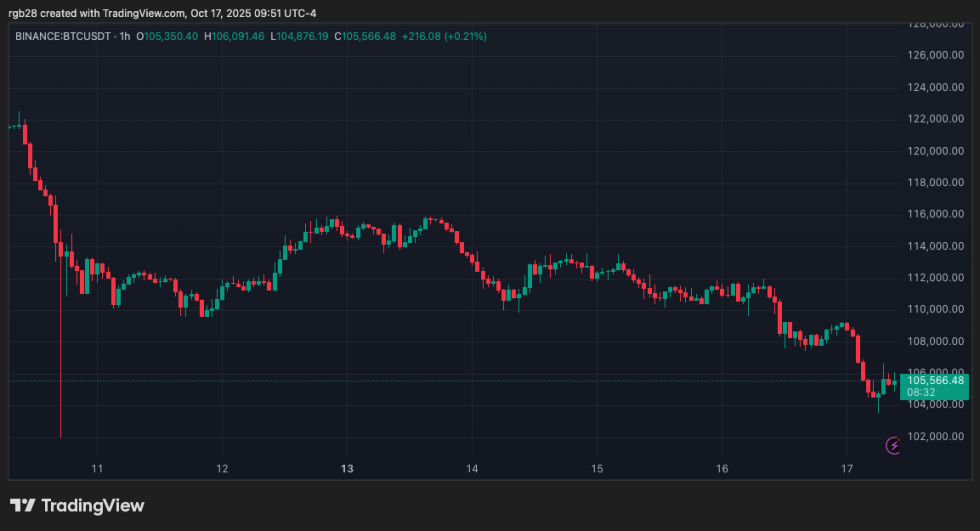
Bitcoin (BTC)'s performance in the one-week chart. Source: BTCUSDT on TradingView

Related Posts