押注现实世界,这8个预测市场在做怎样的生意?

marsbit2025-10-15 tarihinde yayınlandı2025-10-16 tarihinde güncellendi

近期,预测市场赛道热度骤增。10 月初,纽约证券交易所母公司 ICE 宣布向 Polymarket 投资高达 20 亿美元,投后估值约 90 亿美元;数日后,美国合规预测市场 Kalshi 亦完成 3 亿美元融资,估值攀升至 50 亿美元。

伴随巨额融资,Kalshi 和 Polymarket 等头部平台交易量激增,Kalshi 预计今年年化交易额将达 500 亿美元,全球市场份额已超 60%,首次反超 Polymarket。

在加密叙事逐渐冷却、监管风声趋紧的当下,预测市场为何被重新提起?它的产品形态是否真的发生了质变?又有哪些新一代项目试图走出「投机游戏」的老路?

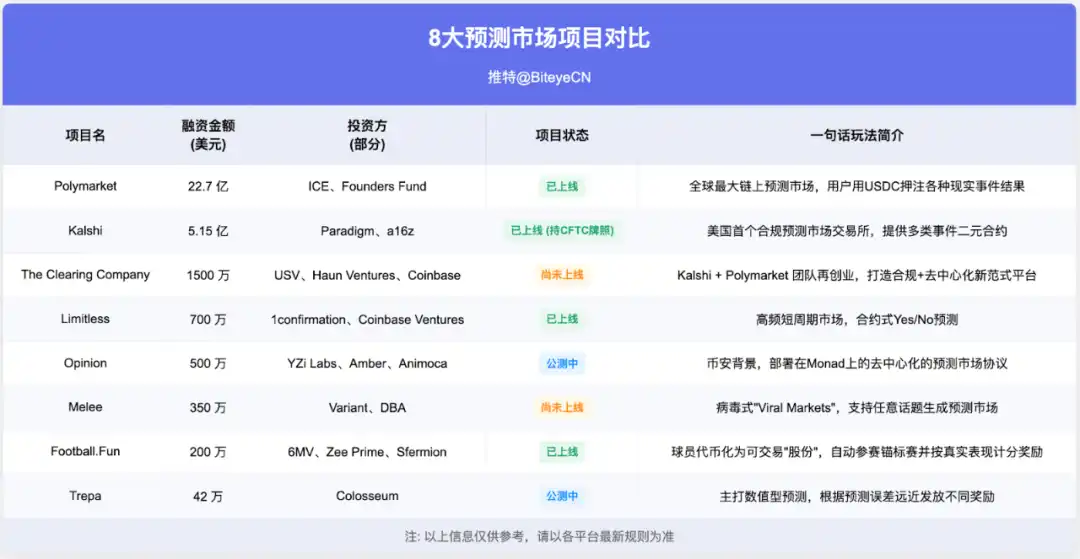
以下是 8 个具有代表性的项目样本,从中可以管窥这一赛道在产品设计、合规博弈和融资逻辑上的不同取向。
Polymarket

01 Ploymarket,@Ploymarket

Polymarket 是目前全球规模最大的预测市场平台,获得 22.79 亿美元巨额融资。10 月,由纽交所母公司 ICE 承诺向其投资高达 20 亿美元,使 Polymarket 投前估值达到 90 亿美元。

Polymarket 由 Shayne Coplan 于 2020 年创立。Shayne 在高中时期就参与了以太坊 ICO 投资,被视为加密圈「神童」人物。面对监管压力,Polymarket 在 2025 年以 1.12 亿美元收购持有 CFTC 牌照的衍生品交易所 QCEX,从而获得在美合法经营资格。

Polymarket 是预测市场的经典玩法,用户可以使用加密货币来对现实世界中的各种事件结果进行下注,通过购买「预测股份」的方式参与市场,每个股份代表对某一结果的押注。当事件结果揭晓后,持有正确结果股份的用户即可获得相应收益。整个交易过程都在链上进行,使用 USDC 结算,既保证了资金的稳定性,也提升了透明度。

02 Kalshi,@Kalshi

Kalshi 是美国首个持牌合规的综合预测市场交易所,已获得 5.15 亿融资,由 Paradigm、a16z 领投。

Kalshi 由 Tarek Mansour 和 Luana Lopes Lara 于 2018 年在麻省理工学院创立。两位创始人选择了艰难但合规的道路,与商品期货交易委员会(CFTC)长期博弈,最终成为首家获得 CFTC 监管许可的预测市场平台。

Kalshi 自 2021 年开放美国市场,提供政治选举、经济指标、体育赛事等多类别事件合约。2024 年通过诉讼赢得美国总统选举合约上线资格,填补了合规空白。

03 The Clearing Company,@theclearingco

The Clearing Company 是一家由 Kalshi 和 Polymarket 前团队推出的预测市场,已经获得 1500 万美元的融资 CEO Toni Gemayel 曾先后担任 Kalshi 和 Polymarket 的平台增长负责人。

目前平台尚处于筹备和开发阶段,团队十分注重简化用户体验,希望新产品对普通用户来说像使用 Robinhood 或 Coinbase 一般简单,也强调设计合规的产品。从构想来看,这类产品试图在两端寻找折中,既不过于偏离监管要求,又力求降低用户理解门槛,但是否真的能建立起有效市场生态,仍待观察。

04 Limitless,@trylimitless

Limitless 是高频预测市场,提供分钟级到日内的短期价格预测合约,共融资约 700 万美元,由知名加密基金 1confirmation、Coinbase Ventures 投资,由 CJ Hetherington 等人于 2023 年创立。

Limitless 于 2025 年 5 月正式在 Base 主网上线,随后扩展至 Arbitrum 等二层,产品形态更接近传统合约交易所,用户可在短周期价格市场中押注「Yes/No」,预设到期时间,结算时由链上预言机确定结果。

从数据表现看,Limitless 创造了大量超短线交易的场景,部分用户利用快速明确的结果做短线套利。然而也正因此,社区中出现批评声音:有用户指出平台曾上线胜负已定或几乎不可能发生的市场且不收手续费,例如 1.5 小时内的 BTC 价格市场,这种「明牌市场」被套利者滥用放大交易量,目前团队回应称已优化市场生成规则,杜绝此类情况。

05 Opinion,@opinionlabsxyz

Opinion Labs(O.LAB)目前已获得 500 万美元融资,由 YZi Labs 领投,其他投资者包括 Echo、Animoca Ventures、Manifold Trading、Amber Group 等。

目前进度方面,Opinion 已在 Monad 测试网上启动预测市场以收集社区反馈,并与 Binance Labs 有合作背景。

06 Melee,@meleemarkets

Melee 是由 Variant 基金加持的新锐预测市场,号称打造「Viral Markets」——让任何话题都可生成预测市场,并通过病毒式传播获取流量。目前已经完成 350 万美元融资,投资方为 Variant 和 DAO Builders Alliance(DBA)。联合创始人兼 CEO Max 曾在 Ava Labs 任战略负责人,也创立过短视频网红品牌,对社区运营和商业策略有独到见解。

截至目前,Melee 仍处于开发和预热阶段,尚未正式上线产品。官网目前仅提供等待名单注册入口,通过绑定 X 账户即可加入候选。据官方透露,Melee 倡导的「病毒市场」概念包含三大特色:任意话题皆可成市、创作者变现闭环、早期参与激励,定位于社交与预测市场的交叉点,试图通过 UGC(用户生成市场)模式激发广泛参与。

07 Football.Fun,@footballfun

Football.Fun 以球员预测为核心机制,将现实中的职业球员代币化为可交易「股份」,用户可持有球员卡,并通过其在真实比赛中的表现获得积分与结算奖励,创始人 Adam 是 WolvesDAO 社区成员,目前已经完成 200 万美元种子轮融资,投资方包括 6th Man Ventures、Zee Prime、Sfermion 等。

08 Trepa,@trepa_io

Trepa 主打数值型预测,允许用户就宏观经济指标等具体数值进行预测,并根据误差大小获取不同程度的回报。目前完成约 42 万美元的融资,领投方 Colosseum 是一支由 Solana 基金会前增长负责人创建的基金。

Trepa 团队于 2024 年在新加坡成立,核心成员具备跨领域背景。目前正处于公测阶段,用户可以选择某个预测主题(多为宏观经济或金融数据,如某国通胀率、某季度 GDP 增速等),然后通过拖动数值滑杆或输入具体数值来提交预测。与传统二元市场只有「对/错」不同,Trepa 采用连续奖励机制:预测值与实际结果越接近,奖励越高,即便猜测有偏差也能获得部分回报。

09 合规风险,赛道最大的不确定性

纵观上述八个项目,可以发现预测市场在产品设计、技术实现上已呈现出明显分化。但无论何种模式,共同的挑战仍是监管如何界定其法律属性。

预测市场天然具备「投机 + 博彩」特征,在多数司法辖区属于敏感行业。在美国,少数项目如 Kalshi 获得合规牌照,而 Polymarket 亦通过收购方式尝试构建合法路径。但更多项目仍处于监管灰区。

此外,即便是链上平台,也不可避免地面临如下风险:

· 市场操纵:少数资金可能影响价格方向,破坏信息有效性

· 预言机风险:数据源出错或遭攻击,直接导致结算错误

· 合约安全:部分新平台尚无完整审计,资金存在被盗隐患

· 退出难度:部分市场流动性有限,存在资金滞留风险

根据经验,预测市场一般不建议 ALL-IN 重仓,而宜采用分散小额多注策略,以对冲单个市场的不确定性。如果十分想参与,也建议新手首选合规且用户体验友好的平台,Polymarket 是一个不错的起点。

除此之外,新手参与最大的门槛在于理解交易机制和技术使用。在预测市场,下单不是简单买涨买跌那么直观,而是需要读懂赔率或价格所代表的概率。例如价格 0.20 意味着市场认为有 20% 概率事件会发生,这与传统赔率换算需要点技巧。建议花时间阅读平台的新手指南或网上的科普文章,理解二元市场的盈亏计算。

10 写在最后:是工具,还是投机变体?

预测市场并非新生事物。早在 2000 年前后,就有不少智库与经济学家将其视为「信息整合与社会共识形成」的工具之一。但现实是,过去二十年内,无论是在 Web2 场景还是链上应用中,预测市场始终未能大规模突破。一方面是合规门槛限制了其用户规模,另一方面,投机属性又使其难以获得公共机构的广泛支持。

此次 Polymarket 与 Kalshi 的再度走热,或许是资本周期中对新题材的一次追逐,也可能只是市场博弈工具的一种补充。但无论如何,它还远称不上是「改变市场结构」的力量。

这条赛道的真正转折点,不在产品形态,而在制度边界。在建立起完整的风控和准入体系之前,我们仍需保持冷静观察。

İlgili Okumalar

From Being Ignored to the Venture Capital Queen Investing: Has AI Revived This Ultra-Niche Sector?

From obscurity to receiving investment from the "queen of venture capital," AI has revitalized the ultra-niche social networking track. In recent years, the social networking sector experienced a deep freeze in venture capital, with high-profile projects like the video social app "Huayin" (founded by a former WeChat core team member) and the offline-online dating app "Single's Tavern" ultimately failing. These failures underscored the immense difficulty of challenging WeChat's dominance in熟人社交 (close-contact social networking) and the general lack of scalable monetization paths for niche concepts like metaverse, female-only, or Muslim community apps. However, a shift emerged in 2025. "Liangpei," an AI-powered matchmaking company, secured a $2 million angel round from Today Capital, led by renowned investor Xu Xin. Its approach uses AI conversational profiling to create detailed user matches and charges only upon successful connections. Similarly, projects like "Pixel Rhythm" (reportedly focused on AI-assisted content creation for Gen Z overseas) and "Moobius" (AI-native group chat) signal a new trend. The investment logic has fundamentally changed. Instead of pursuing broad, traffic-driven "platform dreams" to compete with giants like WeChat, Douyin, or Soul, the new wave focuses on using AI as a tool to solve specific, high-pain-point problems for targeted, niche user segments. The path to viability now lies in achieving healthy cash flow by solving a concrete problem rather than chasing massive scale.

marsbit41 dk önce

From Being Ignored to the Venture Capital Queen Investing: Has AI Revived This Ultra-Niche Sector?

marsbit41 dk önce

From TrueFi to Elara: Why the Next Stop for On-Chain Finance is Liquidity Infrastructure?

From TrueFi to Elara: Why On-Chain Finance's Next Stage is Liquidity Infrastructure? The article analyzes the evolving focus in decentralized finance, shifting from narrative-driven expansion to robust, operationally sound infrastructure. The author, drawing from experience at TrueFi and building Elara, argues that early DeFi incorrectly assumed technological superiority alone would force adoption. Instead, financial systems evolve through workflow compatibility. Traditional finance prioritizes stability and predictability, creating intentional "viscosity" (friction) through controls, which slows execution but ensures durability. Crypto-native systems minimized friction for rapid experimentation and iteration but often lacked operational safeguards, leading to reflexive liquidity that can disintegrate under stress. The core insight is that sustainable on-chain finance cannot rely solely on isolated products like RWA lending or token incentives. The real opportunity lies in a coordinated financial architecture for liquidity management, collateral coordination, and capital deployment. Elara is presented as an example of this next-generation "programmable treasury infrastructure"—a yield-bearing, dollar-pegged collateral asset designed for capital efficiency and operational flexibility within fragmented digital markets. A key architectural decision separates liquidity from yield generation, allowing the collateral to remain liquid and programmable while accruing value. The funding environment has also shifted. Investors now prioritize operational proof—working systems, integrations, and controls—over visionary narratives. Competitive advantage comes from building systems that endure under real market conditions, not just launching quickly. Ultimately, the path forward is not a sudden replacement of traditional finance but a selective hybridization. Lasting infrastructure will combine the iterative speed of digital assets with the control architecture of traditional finance. Systems like Elara are built to operate efficiently in today's low-viscosity crypto markets while embedding the operational discipline—compliance, reporting, risk management—required to eventually support institutional capital as it gradually integrates with on-chain settlement rails. The focus is not on who launches first, but on who can build infrastructure capable of managing both high-speed digital-native liquidity and the slower, more deliberate flow of institutional capital.

marsbit51 dk önce

From TrueFi to Elara: Why the Next Stop for On-Chain Finance is Liquidity Infrastructure?

marsbit51 dk önce

İşlemler

Spot
活动图片