策展 to earn 叙事兴起,盘点四个变现“品味”的创新项目

深潮2025-10-13 tarihinde yayınlandı2025-10-14 tarihinde güncellendi

从社交信号到新经济的探索。

作者:michaellwy

编译:深潮TechFlow

第 1 部分,我们探讨了 Curator Capital Markets(策展资本市场)作为应对由人工智能驱动的媒体环境的理论基础。这一观点仍处于早期阶段,但相关实验已经开始涌现。我们可以将这些早期实验归为三大类,每一类都代表一种不同形式的“高成本信号”:

  • 资源分配市场:通过引入稀缺性来赋予内容背书行为价值。

  • 预测市场:直接将预测能力货币化。

  • 身份层:将数字化判断与高风险声誉绑定。

下面我们来看看一些正在实践这一理念的项目。

1.Tweem(@tweemdotlol

我们都见过那些热门推文下面的评论:“10个点赞时就投资。”这本质上是一种通过早期支持来获取社交资本的尝试。
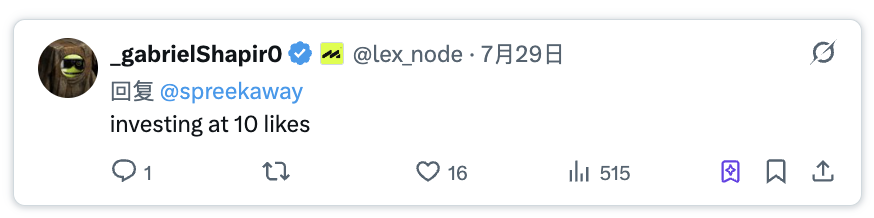
原推文链接:点击此处

Tweem将这种潜在的、非正式的行为转化为一个可玩且具有竞争性的游戏。其机制非常简单,具体操作如下:用户可以通过标记 @tweemdotlol 并设置推文未来表现的具体目标(例如)来押注推文是否会成为爆款:

  • 增幅(如浏览量增长10倍,点赞增长5倍)

  • 特定指标(如1000个点赞)

如果推文达到预测的指标,用户将在 Tweem 平台上赚取积分。

原推文链接:点击此处

其核心价值主张在于,每次正确预测都会添加到用户永久且公开的记录中。这份可验证的记录能够帮助用户建立对好内容和前瞻性的鉴赏力的声誉。通过“搜索”推文,你实际上是在构建一份公开的记录,反映你消费信息的质量和内容类型。
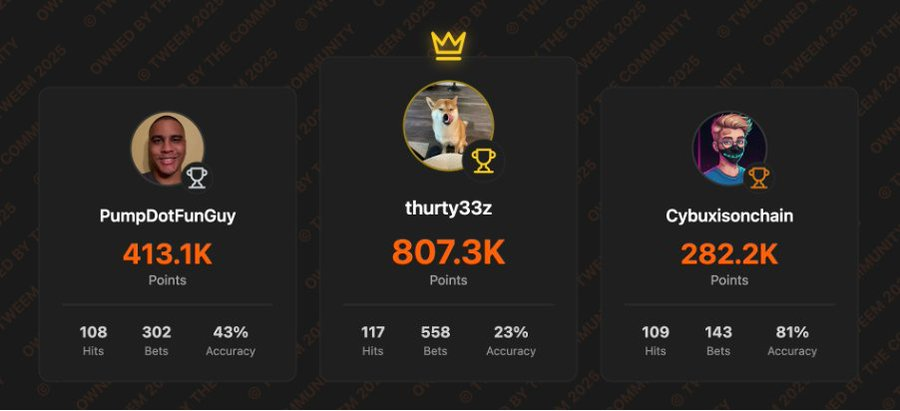
此外,Tweem还提供一个名为“Cult”(团队)的功能,允许用户与其他内容猎手组队寻找优质内容。团队成员可以平均分配积分。这可能形成某种“内容公会”,专注于策划特定主题的专业内容。例如,可以有专注于最佳Meme、最佳宏观分析或最佳预测市场洞察的团队“Cult”。

2.Bangit(@bangitdotxyz

Bangit 是一个基于 X/Twitter 的策展游戏和经济层,其目标是取代 Twitter 原生的点赞和转发系统,构建一个更复杂的市场,用于奖励准确识别“爆款内容”的用户。

其核心理念是“免费游玩,点赞即赚”(Free to Play, Upvote to Earn)

其机制围绕一种稀缺且可再生的资源——“能量”(Power)。每个用户每天都会补充一定的“最大能量”(Max Power),而不是像传统的点赞那样拥有无限次数。

用户可以通过消耗一定比例的能量(1%-10%)来点赞或反对推文。这一设计将点赞行为从一个零成本、随意的点击转变为一种需要慎重分配个人有限资源的行为。
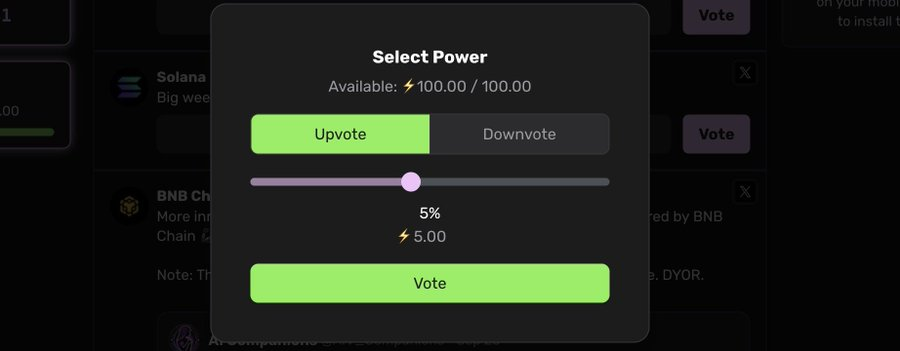
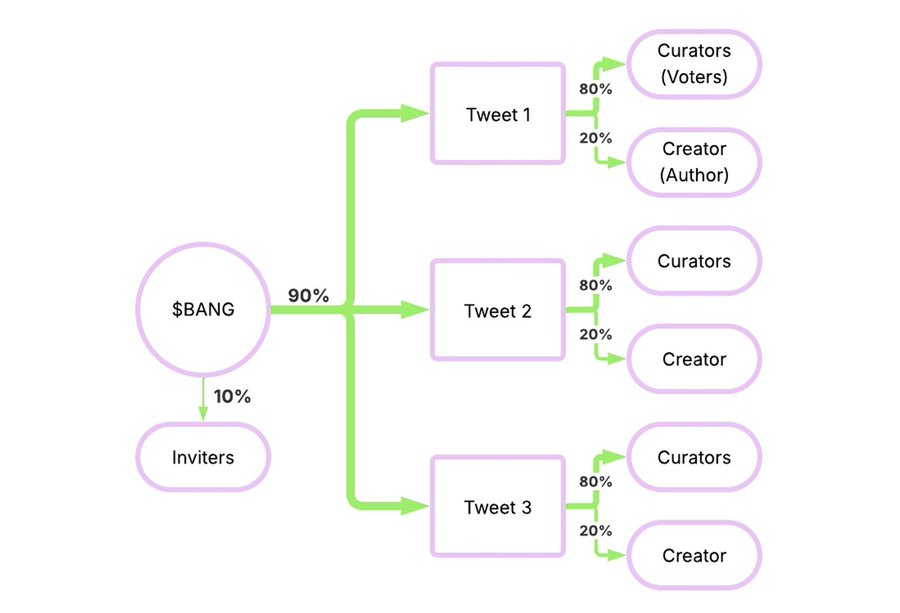
该系统旨在通过飞轮效应奖励技术娴熟的策展者。那些能够持续点赞成功推文的用户(综合考虑点赞的早期程度、使用的能量量级以及整体影响力)可以赚取 $BANG 代币。

这些代币可以用于质押,从而增加用户的“最大能量”,提升未来的奖励潜力。这种循环机制使得拥有“品味证明”(Proof of Taste)的用户能够扩大其影响力和收益能力。

奖励分配方面,大部分(80%)归于成功识别内容的策展者,而一小部分(20%)则归于原创内容创作者,从而明确地资本化了发现的价值。
3.Vimix(@vimixdotfun

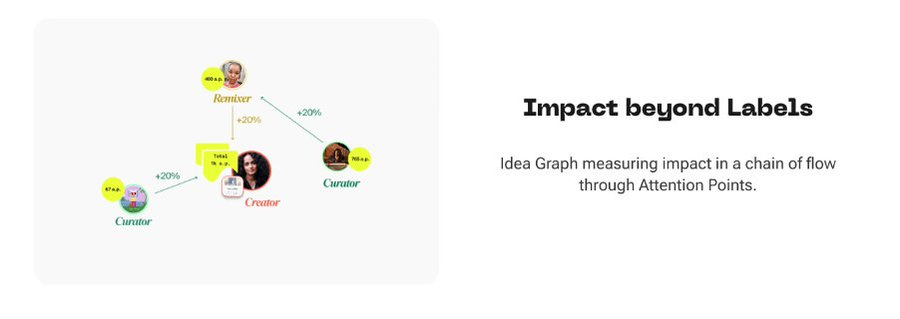
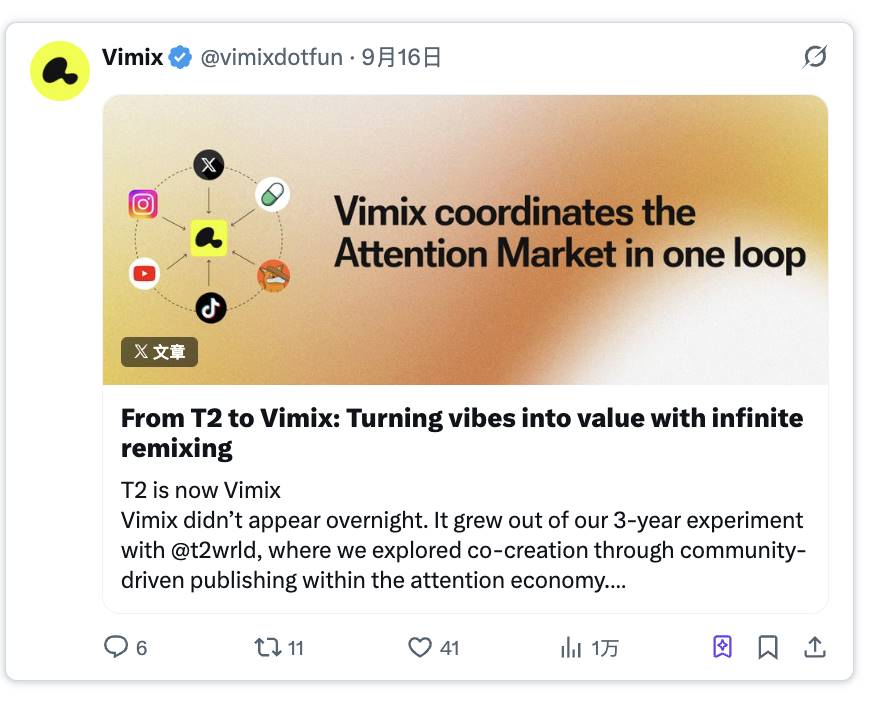
Vimix 是一个希望成为“注意力市场协调层”的协议,其核心理念是为一种特定的、高价值的策展工作——内容二次创作(remixing)构建市场。

Vimix 认识到“文化本质上就是一种二次创作”,而最有力的传播形式来自于社区将核心理念进行衍生创作,如剪辑、表情包、用户生成内容(UGC),通过新的渠道传播。

Vimix 所重视的“高成本信号”是这种二次创作过程中的创意和智力劳动。成本直接体现在

  • 理解内容并以新的、引人注目的方式重新构思所需的时间和技能。

  • 判断哪些瞬间最具共鸣,并如何以最大化影响力的方式呈现。

通过 Vimix,创作者可以建立一个内容社区,设置一小部分奖励池,让二次创作者和策展者传播作品。更多信息可以通过相关项目资料了解。
原推文链接:点击此处

4.Twocents (@twocentinc)

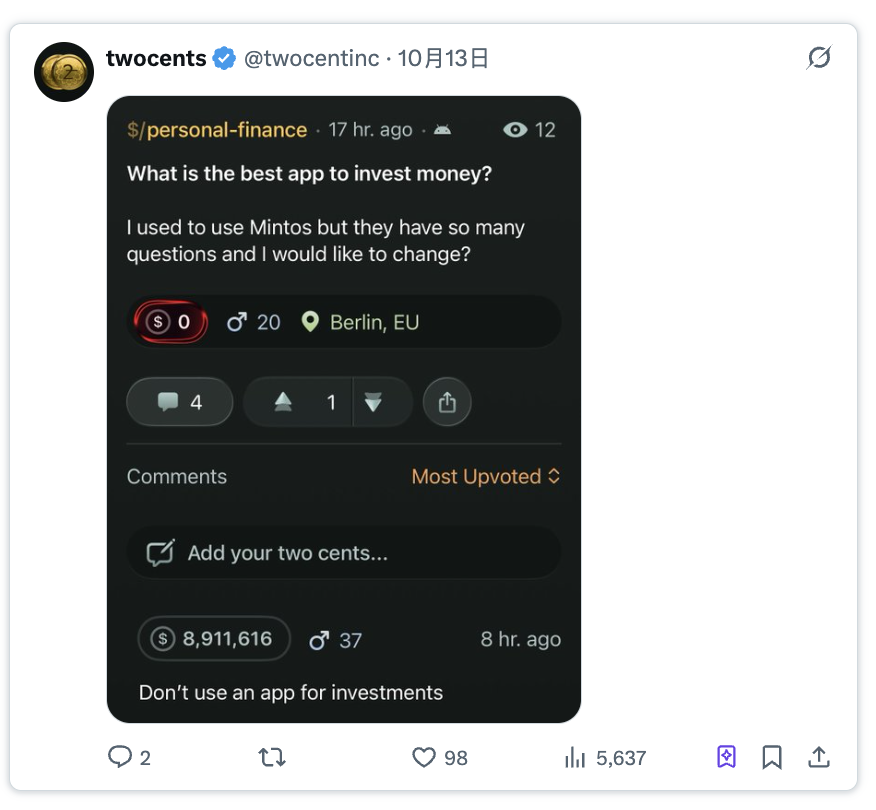
Twocents 是一个社交网络,其用户身份基于经过验证的净资产。虽然它本身不是一个策展市场,但它对解决当前社交媒体中零成本、(大多)匿名身份问题提供了有趣的思路。
原推文链接:点击此处

该平台通过 Plaid 连接到用户的金融账户,将其资本作为用户名的一部分。这创造了一种伪匿名环境,每个帖子和评论都以用户的财富为背景。

平台并未专注于单一话题,用户可以讨论从投资到约会的各种内容,但始终以其经过验证的财务状况为背景。

例如,一个拥有已验证净资产为 2600 万美元的账户所表达的观点,是一种无法伪造的信号,具有其他账户无法复制的分量。这在身份层面上强制实施了“风险共担”(skin in the game)。一个经过验证的、拥有资本的账户的背书因此成为一种更值得信赖的高保真信号,可以更可靠地被其他市场参与者使用。

总结

目前这些项目看起来更像是一些奇特的互联网游戏,而非新经济的基础,但这正是此类创新的起点。

我认为,这些项目的具体特性可能并不重要,重要的是它们共同试图解决的问题:构建一个能够为人类的“选择行为”定价的市场,而不仅仅是为创作行为进行定价的市场。
İlgili Okumalar

IOSG: After the Number of Developers Halved, Crypto Did Not Die

The crypto development community has undergone a significant transformation, with monthly active developers on GitHub halving from 45K in 2022 to approximately 23K by 2026. This decline is largely attributed to the departure of newcomers, whose roles were often tied to market-driven hype cycles like NFTs and forked DeFi protocols, leading to a 52% churn rate among those with less than a year of experience. However, the core of the industry has strengthened. Established developers with over two years of experience have reached a record high, contributing about 70% of the code. They are consolidating around ecosystems with genuine users and revenue, such as Bitcoin and Solana, while moving away from narrative-driven projects. The talent shift represents a "deleveraging" and an increase in core density. This core group has developed a unique skillset by operating in an environment of "code is law," with zero tolerance for error and no external recourse. They have learned to build trust and functional systems from the ground up without central authorities, as demonstrated by protocols like Uniswap and MakerDAO. These capabilities are now being repriced and leveraged in the AI era. The structural challenges of AI scaling—such as trust, coordination, and verification—mirror those long addressed in crypto. Examples include CoreWeave pivoting from GPU mining to AI compute, OpenSea's founder applying NFT market logic to AI model routing with OpenRouter, and projects like NEAR and Catena Labs transitioning crypto-native architectural and financial insights into AI infrastructure and agent banking. Key areas where crypto-bred skills are directly applicable to AI include: 1. **Compute Aggregation & Optimization**: Using token incentives and cryptographic verification (e.g., Proof of Sampling & Privacy) to create trusted, decentralized GPU networks, as seen with Hyperbolic. 2. **AI Governance & Incentive Design**: Applying economic mechanism design from DAOs and tokenomics to align the goals of multiple, fast-acting AI agents, a direction explored by EigenLayer's EigenCloud. 3. **AI Agent Autonomous Payments**: Leveraging stablecoins and programmable, permissionless blockchains to enable the micro-transactions required for AI agent economies, exemplified by protocols like x402. The role of the crypto builder is evolving from writing smart contracts to designing trust mechanisms for autonomous AI systems. This convergence is reflected in hiring trends at major firms and significant capital allocation from funds like Paradigm and a16z crypto, which are investing at the intersection of crypto and AI. Regional differences exist, with the US favoring foundational protocol innovation and Asia focusing on compliant application-layer integration, but the underlying trend is clear. The industry's "deleveraging" has not signaled its demise but rather a maturation, positioning its core builders to solve critical trust and coordination problems in the age of AI.

marsbit25 dk önce

IOSG: After the Number of Developers Halved, Crypto Did Not Die

marsbit25 dk önce

Currency and Stock Market Barometer: Strategy Invested Over $2 Billion to Buy Over 24,800 BTC Last Week; Bitmine's ETH Holdings Increase to 4.37% of Total Supply (May 19)

Crypto & Stock Market Watch: Institutional BTC Buying Surges, ETH Holdings Grow Major listed companies aggressively accumulated Bitcoin last week, with net purchases skyrocketing over 44x to $2.03 billion. Strategy (formerly MicroStrategy) led the charge, spending approximately $2.01 billion to buy 24,869 BTC, bringing its total holdings to 843,738 BTC. Overall, listed firms (excluding miners) now hold 1,113,841 BTC, valued at ~$86.16 billion. On the Ethereum front, Bitmine purchased 71,672 ETH in the past week. It now holds 5,278,462 ETH, worth $11.56 billion and representing 4.37% of ETH's total supply. A significant portion (4,712,917 ETH) is staked, generating an annualized yield of $289 million. Industry leaders note a divergence from the MicroStrategy model, with ETH treasury firms increasingly focusing on staking yields and simpler balance sheets. In traditional markets, Morgan Stanley warns of a potential significant U.S. stock market correction if bond yields and volatility continue rising. Investment giants like Berkshire Hathaway and Bridgewater adjusted portfolios in Q1, with Bridgewater notably increasing its stakes in chipmakers like Nvidia, Broadcom, and Micron while shedding software stocks. Among other crypto-focused public companies, Solana treasury firm Upexi reported a widened net loss of $109 million for its fiscal Q3, driven by a decline in its crypto holdings' value. Meanwhile, Hyperion DeFi, a HYPE token treasury company, reported a Q1 net profit of $8.8 million and increased its HYPE holdings past 2 million tokens.

marsbit26 dk önce

Currency and Stock Market Barometer: Strategy Invested Over $2 Billion to Buy Over 24,800 BTC Last Week; Bitmine's ETH Holdings Increase to 4.37% of Total Supply (May 19)

marsbit26 dk önce

Global Long-Term Bonds Break Down: The Fiscal Illusion of the Low-Interest Era is Collapsing

Global long-term bonds are experiencing a widespread breakdown, as the fiscal illusion of the low-interest-rate era collapses. Sovereign yields are hitting multi-year highs in the US, UK, Japan, and France, signaling a market repricing driven by a common reality: unsustainable debt and deficits outpacing economic growth, compounded by renewed inflationary pressures from energy shocks. The direct trigger is the blockade of the Strait of Hormuz, which has pushed oil prices higher and reignited inflation fears. This squeezes central bank policy space, with expectations shifting from future rate cuts to potential hikes. The core "fiscal Ponzi scheme" is becoming evident—governments rely on new debt to service existing obligations, but as growth lags and borrowing costs rise, investors demand higher yields. Key developments include the US 30-year yield surpassing 5% for the first time since 2007, with tepid auction demand; Japan's 30-year yield reaching 4%, threatening its long-standing low-rate financial system; and political paralysis in the UK and France making meaningful fiscal consolidation unlikely. The marginal buyer for US debt is also shifting from foreign central banks to more price-sensitive private investors. While debt managers may adjust issuance, fundamental drivers—deteriorating fiscal paths, persistent inflation, and constrained central banks—remain. The market is conclusively repricing the end of the low-interest-rate financing model for highly indebted developed economies.

marsbit53 dk önce

Global Long-Term Bonds Break Down: The Fiscal Illusion of the Low-Interest Era is Collapsing

marsbit53 dk önce

Following the KelpDAO Hack: $40 Billion in Assets Flee LayerZero, Chainlink Emerges as the Primary 'Beneficiary'

Following a major security breach in April where KelpDAO's bridge using LayerZero was attacked for approximately $292 million, a significant shift is underway in the cross-chain infrastructure landscape. An estimated $40 billion in assets is in the process of migrating or has already migrated from LayerZero to Chainlink's Cross-Chain Interoperability Protocol (CCIP). The attack exploited a single-point-of-failure vulnerability due to KelpDAO's 1-of-1 validator configuration within the LayerZero network. Attackers corrupted RPC nodes and used DDoS attacks to force the system to rely on compromised nodes, allowing fraudulent messages. While LayerZero acknowledged a serious error in allowing its validator network to service high-value transactions with such a configuration, the incident highlighted critical security risks. This triggered a rapid migration wave. Starting with KelpDAO on May 6th, several major protocols—including Solv Protocol, Re, Tydro, Kraken, and Lombard—announced switching their cross-chain infrastructure exclusively to Chainlink CCIP. The combined value of these migrations is estimated to be around $40 billion. This movement followed earlier major adoptions by Coinbase (in late 2025) and Circle (in early 2024). Market sentiment reflected this shift, with LINK's price showing relative stability while ZRO (LayerZero's token) declined significantly. Data indicates a net outflow of approximately $20.1 billion from the LayerZero network over 30 days. The migration is largely driven by perceived security differences. Chainlink CCIP employs a decentralized oracle network as its default consensus layer, featuring multiple independent node operators, a separate Risk Management Network, and built-in safeguards like rate limits. In contrast, LayerZero's highly modular architecture offers flexibility but places more responsibility on application developers to configure security settings, a risk underscored by the KelpDAO incident. LayerZero has since apologized for its communication handling post-attack and stated the protocol itself was not compromised, but rather its Labs DVN's internal RPC was poisoned. An official post-mortem report with external security partners is forthcoming.

marsbit1 saat önce

Following the KelpDAO Hack: $40 Billion in Assets Flee LayerZero, Chainlink Emerges as the Primary 'Beneficiary'

marsbit1 saat önce

İşlemler

Spot
Futures
活动图片