Аналитики обозначили причины обвала крипторынка

cryptonews.ru2025-10-14 tarihinde yayınlandı2025-10-14 tarihinde güncellendi

Обвал криптовалют 11 сентября не будет иметь долгосрочных фундаментальных последствий, а его причиной стало сочетание ряда технических факторов. Об этом заявили авторы ресурса The Kobeissi Letter.

It's official:

Crypto just saw its LARGEST liquidation event in history with 1.6 MILLION traders liquidated.

Over $19 BILLION worth of leveraged crypto positions were liquidated in 24 hours, 9 TIMES the previous record.

Why did this happen? Let us explain.

(a thread) pic.twitter.com/dHbkfNjrVs

— The Kobeissi Letter (@KobeissiLetter) October 11, 2025

Крах рынка спровоцировал каскад ликвидаций, суточный объем которых достиг рекордных $19,3 млрд. Первая криптовалюта впервые в истории зафиксировала дневную свечу на $20 000.

В числе факторов, вызвавших падение цифровых активов, аналитики назвали «чрезмерное кредитное плечо и риск», а также заявление президента США Дональда Трампа о введении 100% пошлин на импорт из Китая.

Кроме того, глава государства опубликовал свой пост после закрытия традиционных рынков и сокращение ликвидности создало благоприятную почву для повышенной волатильности.

Эксперты также обратили внимание на сильный перекос в сторону длинных позиций в объеме ликвидаций. На большинстве крупных бирж, за исключением Bitfinex, доля лонгов превышала 90%.

При этом, по наблюдению аналитиков, распродажа на рынке началась примерно за час до первых угроз Трампа в адрес Китая. Заявление президента ускорило падение в ходе, вероятно, уже начавшейся коррекции.

«Мы считаем, что этот обвал был вызван сочетанием нескольких внезапных технических факторов. Он не имеет долгосрочных фундаментальных последствий. Техническая коррекция давно назрела. Уверены, торговая сделка будет достигнута, а криптовалюта остается сильной. Мы настроены оптимистично», — заключили они.

«Фактор Трампа» и настроения

Аналитики Santiment также считают, что причины падения рынка кроются не только в заявлении Трампа. По их мнению, розничные трейдеры поспешили найти единичное событие, ставшее фактором краха, что просто является признаком «типичного рационализаторского поведения».

Однако в краткосрочной перспективе торговые отношения между США и Китаем будут играть ключевую роль в настроениях криптотрейдеров, признали эксперты. Позитивные новости могут повысить аппетит к риску, тогда как в случае негативного фона стоит ожидать потока прогнозов о «биткоине ниже $100 000».

Тем временем криптовалютный индекс страха и жадности упал до 24 пунктов, хотя неделю назад достигал 74. Текущее значение сигнализирует об «экстремальном страхе» на рынке.
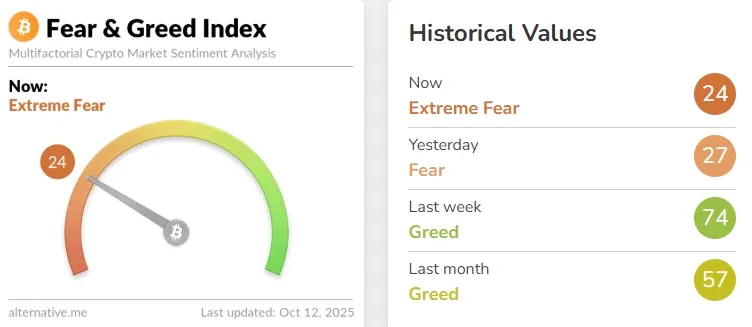
Источник: alternative.me.

В Santiment отметили, что падение первой криптовалюты произошло синхронно с фондовым рынком. В периоды турбулентности трейдеры зачастую обращаются к материальным активам вроде серебра или золота. Драгметаллы продолжили рост.

«Криптовалюты, такие как биткоин, не застрахованы от макрополитических потрясений. Хотя многие рассматривают их как альтернативные или пограничные активы, они по-прежнему крайне чувствительны к склонности к риску. Нравится нам это или нет, биткоин ведет себя скорее как рисковый актив, чем как безопасное убежище в периоды национальной напряженности», — заключили аналитики.

Когда возобновится рост?

Падение крипторынка на самом деле может означать раннюю стадию бычьего тренда, считает криптотрейдер Алекс Беккер.

По его мнению, резкая коррекция была отчасти вызвана «небывалым нетерпением» инвесторов в последние несколько недель.

«Думаю, что продажа сейчас — это, пожалуй, самая глупая вещь, которую можно сделать», — отметил он.

Криптоаналитик Бенджамин Коуэн также с оптимизмом оценил перспективы биткоина, указав, что цифровое золото восстановило доминирование до уровня 60%.

Large liquidation cascade yesterday sent #BTC dominance soaring above 60%.

I still think in the short-term it continues to climb https://t.co/xmxP5ZWEo7 pic.twitter.com/JCZ0O6OztN

— Benjamin Cowen (@intocryptoverse) October 11, 2025

«Пришло время для следующего этапа роста биткоина», — заявил основатель и CEO Jan3 Сэмсон Моу.

Экономист Тимоти Петерсон в комментарии для Cointelegraph осторожно предположил, что криптовалюта, возможно, войдет в «период охлаждения». Цифровое золото продолжит восходящее движение через три-четыре недели.

«Но, возможно, более медленными темпами, чем раньше», — добавил он.

Напомним, в CryptoQuant считают, что биткоин сохраняет потенциал роста. Трейдер Питер Брандт обозначил в качестве перспективы отметку $185 000. Аналитик Фрэнк Феттер полагает, что зона перекупленности в первой криптовалюте наступит около $180 000.


İlgili Okumalar

Tiger Research: Zuckerberg Begins Betting on Prediction Markets, While Asian Nations Still View Them as Gambling

This article examines the rise of prediction markets, contrasting their growing institutional acceptance in the West with their restrictive regulation in Asia. It details how prediction markets, which originated from informal political betting and academic experiments like the Iowa Electronic Market, aggregate crowd wisdom into probabilistic prices through binary contracts. Their growth accelerated around 2020, reaching over $14 billion in monthly volume. A key driver is the "skin in the game" principle, where users risk their own capital, leading to high accuracy in predicting events like Fed rate decisions and elections, as demonstrated by platforms like Polymarket. Meta's entry, with Mark Zuckerberg reportedly leading the development of the Arena app, signals the market's maturation. In the U.S., court rulings have distinguished prediction markets from gambling, facilitating entry by traditional financial institutions. However, most Asian jurisdictions still classify them as gambling, focusing on social control rather than financial innovation. The article argues this stance creates three problems for Asia: 1) regulatory arbitrage pushes users to riskier offshore platforms, 2) loss of sovereign information infrastructure as valuable social sentiment data accumulates abroad, and 3) abandonment of user protection. It concludes that Asia needs a policy shift from prohibition to constructive regulation, integrating these markets into the formal system to harness their data as a national asset, as initiatives like Limitless Research are beginning to do.

marsbit5 dk önce

Tiger Research: Zuckerberg Begins Betting on Prediction Markets, While Asian Nations Still View Them as Gambling

marsbit5 dk önce

Ethereum's Next Decade in the Eyes of Vitalik

"Lean Ethereum" Long-Term Roadmap Unveiled by Vitalik Buterin On July 5, 2026, Vitalik Buterin published the "Lean Ethereum" roadmap, positioning it as Ethereum's third major evolution following the Merge. This multi-year, multi-phase upgrade aims to fundamentally transform Ethereum's core protocol through staged network upgrades extending to 2029. Key goals include achieving 1 gigagas per second L1 throughput (a massive increase from the current ~32 TPS), near-instant finality, and quantum-resistant cryptography. The plan involves transitioning Ethereum's security model from full transaction re-execution by all nodes to native verification via recursive STARK proofs. A major proposed change is replacing the EVM with a proof-friendly architecture like RISC-V or leanISA, though this remains a point of contention, especially with L2s like Arbitrum favoring alternatives like WASM. Other planned upgrades include a restructured state model with a large, cheap "warehouse" storage layer to drastically reduce fees for migrated applications, multi-dimensional gas pricing, and a new focus on making privacy a first-class, native protocol feature. While the roadmap significantly raises Ethereum's long-term technical ceiling, analysts note it does not directly address ETH's mid-term token economics or value capture. The plan's multi-year timeline means near-term price impact will likely depend on observable progress milestones, such as the successful deployment of the upcoming Glamsterdam gas limit increase, growth in L2 activity and blob usage, and trends in L1 fee revenue and ETH burn.

链捕手1 saat önce

Ethereum's Next Decade in the Eyes of Vitalik

链捕手1 saat önce

In Just 11 Days, Claude Rewrote Millions of Lines of Code, an Epic AI Engineering Feat Sparks Fury

In just 11 days, Bun's founder Jarred Sumner used Anthropic's Claude AI models to rewrite its million lines of code from Zig to Rust. This move sparked significant controversy, particularly from Zig's creator, Andrew Kelley, who publicly criticized Sumner's engineering practices and the decision to use AI for such a massive rewrite. Bun, a high-performance JavaScript/TypeScript runtime and rival to Node.js, was originally written in Zig. After Anthropic acquired Bun, the team encountered persistent stability and memory safety bugs in the Zig codebase. These issues, combined with Zig's strict policy against LLM-generated code, led to the decision to rewrite in Rust. The rewrite was executed using Claude AI tools at an estimated API cost of $165,000, dramatically reducing the expected time and financial cost. Andrew Kelley's response was scathing. He blamed the original bugs on poor engineering habits, calling Bun's Zig code a collection of "hacks on top of hacks." He expressed relief that Bun was no longer associated with Zig, fearing it would misrepresent the language and attract low-quality, AI-generated contributions. The tech community is divided; some view Kelley's critique as unprofessional, while others see it as a defense of engineering integrity. A major concern about the AI-driven rewrite is the resulting code quality. The translation from Zig left approximately 27,000 lines of unsafe Rust code, raising fears about long-term maintainability and technical debt. The debate centers on whether this project is a milestone in AI-assisted development or a future maintenance nightmare.

marsbit2 saat önce

In Just 11 Days, Claude Rewrote Millions of Lines of Code, an Epic AI Engineering Feat Sparks Fury

marsbit2 saat önce

From Auto Finance to Bitcoin to AI Engines: An Analysis of Cango's 'What Not to Do' Strategy

From Auto Finance to Bitcoin and Now AI: Cango's "What Not to Do" Strategy Cango, a Chinese auto finance platform that went public on the NYSE in 2018, is undergoing its third major transformation. After selling its entire auto business in 2024, it pivoted to become a large-scale Bitcoin miner, acquiring 50 exahash of mining rigs from Bitmain. However, its true goal was never Bitcoin, but owning and controlling energy infrastructure. Now, Cango is pivoting again. While most listed Bitcoin miners are leasing power to giant hyperscalers for AI training clusters, Cango is taking the opposite path. It has launched an AI inference subsidiary called EcoHash, focusing not on training but on distributed inference. The company's strategy hinges on the insight that over 70% of mining industry power is controlled by small, independent sites (10-50 MW), which are too small for hyperscalers but ideal for low-latency AI inference. Cango aims to partner with these small operators, providing the AI technology, customers, and financing through its EcoLink software layer, which can distribute workloads across sites for reliability. Cango maintains a hybrid model, running roughly 31.7 EH/s of Bitcoin mining for cash flow while aggressively cleaning its balance sheet—slashing long-term debt by 94.5% to $30.6 million and raising $75 million for its AI venture. Its first AI deployment will be at a 50 MW site in Georgia. The strategy faces skepticism, given the high costs of converting mining sites and the potential for an AI bubble. However, Cango's leadership believes discipline around "what not to do"—avoiding direct competition with hyperscalers in training—positions it to capture the long-tail demand for distributed AI inference power.

Foresight News2 saat önce

From Auto Finance to Bitcoin to AI Engines: An Analysis of Cango's 'What Not to Do' Strategy

Foresight News2 saat önce

İşlemler

Spot
活动图片