North Dakota to Launch State-Backed Stablecoin ‘Roughrider’

TheCryptoTimes2025-10-08 tarihinde yayınlandı2025-10-08 tarihinde güncellendi

The State of North Dakota is on the verge of becoming the second U.S. state to issue its own stablecoin. The digital token, called the Roughrider Coin, is expected to launch next year through the Bank of North Dakota in partnership with Fiserv Inc. 

According to a report from Bloomberg, the name “Roughrider Coin” comes from a volunteer army group led by Theodore Roosevelt, the 26th president of the United States during the Spanish-American War. Roosevelt lived in North Dakota in the 1880s, where he raised cattle and hunted. The state is proud of this history and often calls itself the “Rough Rider State.” The coin honors that connection to the past.

How the Coin Will Help Local Banks?

The Bank of North Dakota, which is the only state-owned bank in the country, will create the stablecoin. The bank usually works with more than 80 local banks and credit unions, and helps with loans for farmers and small businesses. 

“We’re leveraging our 106-year history to stand up and be a leader in the banking, fintech space for North Dakota. We see this affecting the industry and continue to affect the industry, and so we’re getting involved.” Don Morgan, the bank’s CEO, said in an interview.

The Roughrider Coin will be fully backed by U.S. dollars. It will be supported by Fiserv’s new digital asset platform—using technology from Paxos Trust Co. and Circle Internet Group Inc.—for the issuance of the token. Initially, the stablecoin will be used for activities like loan advances, overnight lending, as well as construction payments between banks. Morgan said the bank may eventually offer stablecoin deposit accounts to clients. 

State and Industry Support for Digital Money

Unlike Wyoming’s Frontier Stable Token, the Roughrider Coin is not meant for consumer payments in the near future. Governor Kelly Armstrong said, “As one of the first states to issue our own stablecoin backed by real money, North Dakota is taking a cutting-edge approach to creating a secure and efficient financial ecosystem for our citizens.” 

Ever since the U.S President signed the stablecoin bill into law in July 2025, the creation of State-issued stablecoins had increased. Many companies have launched their own tokens, and major payment firms like Stripe, PayPal, Visa, and Mastercard have expanded into digital assets. 
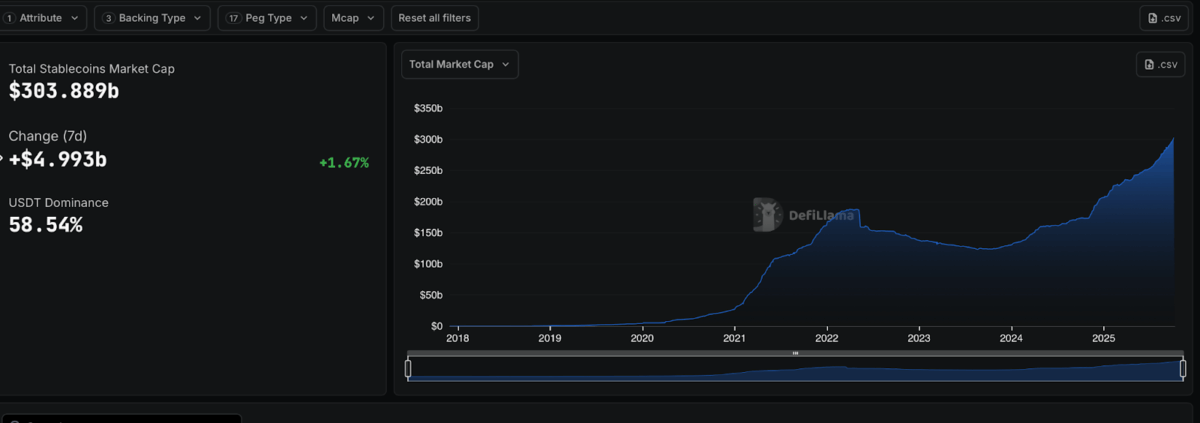
Stablecoin Marketcap
Stablecoin MarketCap | Source: DefiLlama

As of now, the entire stablecoin market sits at $304 billion, according to data from DefiLlama. That is a 1.67% increase in the last 7 days. Tether’s USDT is currently leading the stablecoin market with over 58% dominance, followed by Circle’s USDC and Ethena’s USDe. 

Also Read: Polygon Launches Rio Upgrade To Power 5,000 TPS Payments Network


Mobile Only Image

İlgili Okumalar

The Hottest 00s Generation on Wall Street

"Wall Street's Hottest '00s Phenom: The 25-Year-Old Fund Manager Who Bet on AI's 'Boring' Backbone" At just 25, Leopold Aschenbrenner, once fired by OpenAI, now runs a hedge fund worth $13.7 billion. His strategy? Betting against the consensus. While others chased AI chips, he invested early in the physical infrastructure powering the AI boom: electricity, data centers, and energy. Expelled from OpenAI's safety team in 2024, Aschenbrenner foresaw the coming bottleneck. He argued that AI progress would be limited not by algorithms, but by power, chip capacity, and space. Acting on this, he founded Situational Awareness LP to go long on these "old economy" assets. His bets have paid off spectacularly. His fund's assets soared from $255 million in late 2024 to $13.7 billion by Q1 2026. His portfolio is a direct reflection of his thesis: major long positions in fuel cell company Bloom Energy and data center/bitcoin mining firms like CleanSpark and Riot Platforms, which control critical land and power resources. Conversely, he holds massive put options against overheated semiconductor giants like NVIDIA and AMD. A notable exception was his bullish bet on storage company SanDisk, which surged ~160% in Q2. Aschenbrenner's vision is materializing. Tech giants like Amazon, Alphabet, and Meta are ramping up colossal capital expenditure on data centers. Global data center power consumption is projected to skyrocket, with AI accounting for over half by 2030. The demand for enabling technologies like optical fiber and modules is also exploding. His story underscores a fundamental truth of the AI era: the ethereal intelligence of algorithms rests on a very physical, heavy, and power-hungry foundation. The future is being built not just in code, but in concrete, copper, and kilowatts.

marsbit2 saat önce

The Hottest 00s Generation on Wall Street

marsbit2 saat önce

Review of Cathie Wood's Masterstroke Operation on Circle

A Recap of Cathie Wood's Masterful Trading in Circle's IPO This article analyzes the strategic moves made by ARK Invest's Cathie Wood around the IPO of Circle (CRCL). Despite her typical long-term, narrative-driven investment style, Wood executed a textbook "buy low, sell high" trade. Wood secured a core position of approximately 4.49 million shares at the $31 IPO price. The stock debuted at $69, surged to a high of $299 in June 2025 fueled by stablecoin regulatory news (the GENIUS Act), and then entered a prolonged decline. During this rally, ARK systematically sold around 1.7 million shares at an average price near $210, driven partly by internal fund rebalancing rules triggered by the stock's soaring weight. This move locked in substantial profits. As the stock later fell due to lockup expirations, new share issuance, and interest rate concerns—even dipping below $50—Wood began repurchasing shares. Starting in November 2025 around $86, she continued buying on the way down, eventually rebuilding her position to roughly the original size by Q1 2026. Key takeaways include: 1) Having a strong, independent long-term thesis (viewing Circle as critical digital dollar infrastructure). 2) Trading in tranches instead of trying to time exact tops or bottoms. 3) Maintaining strict position-sizing discipline, using rules to force profit-taking and preserve buying power. For most retail investors, chasing the dramatic "pop" at open is dangerous, as the subsequent 83% drawdown showed. Wood's success hinged on pre-IPO access, a clear investment thesis, and disciplined execution.

marsbit3 saat önce

Review of Cathie Wood's Masterstroke Operation on Circle

marsbit3 saat önce

Sharplink CEO: Ethereum's Future is Unfolding Now

In an article titled "Sharplink CEO: Ethereum's Future is Unfolding," Joseph Chalom, a former BlackRock executive and current Sharplink CEO, argues that the current debates surrounding the Ethereum Foundation (EF) and ETH price miss the bigger picture. He asserts that Ethereum's long-term institutional adoption is secured by its foundational strengths: trust, security, and liquidity. Chalom highlights Ethereum's dominance in settling stablecoin value, tokenizing real-world assets (RWA), and facilitating high-value DeFi transactions as evidence of its winning position. He defends the Ethereum Foundation's focus on rigorous protocol development and a decade-long track record of major upgrades (The Merge, EIP-1559, Dencun, etc.), viewing its upcoming technical roadmap as the most ambitious in the industry. Contrary to critics, Chalom posits that Ethereum's decentralization and reliable neutrality are core strengths for institutional adoption, not weaknesses, as they prevent control by any single entity. Drawing a parallel to Amazon's early days, he suggests that ETH's intrinsic value is tied to the expansion of its network, which is poised for a step-change in transaction volume across stablecoins, RWAs, DeFi, and agentic finance. Chalom advocates for a "be greedy when others are fearful" approach, citing historical examples from Warren Buffett and his own experience at BlackRock during the crypto winter. He concludes that while the EF should remain focused on core protocol attributes (CROPS: Censorship Resistance, Capture Resistance, Open Source, Privacy, Security), there is a leadership gap in market outreach. Chalom calls for ecosystem participants, including Sharplink and other key players, to become more vocal advocates to support the coming institutional adoption supercycle, asserting that "Ethereum's future is unfolding now."

marsbit3 saat önce

Sharplink CEO: Ethereum's Future is Unfolding Now

marsbit3 saat önce

6 Questions to Understand the Business Trends of AI

The AI industry has entered its "summer" phase, according to a six-dimensional scoring framework assessing its development cycle. Each dimension—narrative vs. delivery, system connectivity, delivery capability, ROI rationalization, common industry trends, and capital environment—scores 1 point, totaling 6 points. This places the industry firmly in summer (5-7 points), characterized by a coexistence of grand promises and tangible deliverables, with increasing pressure to demonstrate value and profitability. Key signals mark this shift. ByteDance's Doubao launched paid subscriptions, while OpenAI introduced an advertising platform. These moves are driven by dual forces: immense cost pressures from scaling user bases and massive compute requirements, and the maturation of commercial opportunities. Major players like Anthropic report explosive growth, highlighting AI's transition into core productivity infrastructure. For businesses, the path forward involves three strategic steps. First, identify a small, high-impact use case to quickly demonstrate a closed-loop value proposition, such as automating customer service or content generation. Second, systematically replicate successful pilots across the organization by standardizing processes, building shared AI capabilities, and aligning talent, incentives, and leadership. Finally, move beyond simply adding AI to existing workflows and undertake systemic reconstruction—redesigning processes for parallel AI-human collaboration, implementing real-time dashboards, and establishing automated trigger chains. The era where storytelling alone secured funding is over. The focus has shifted to delivering measurable efficiency gains, cost savings, and new revenue streams, as evidenced by real-world implementations in companies like Semir, Anta, and Midea. Success now depends on starting with a focused proof point, scaling it organization-wide, and ultimately allowing AI to redefine operational paradigms.

marsbit9 saat önce

6 Questions to Understand the Business Trends of AI

marsbit9 saat önce

İşlemler

Spot
Futures
活动图片