Crypto Kings: Singapore And UAE Dominate Global Digital Currency Usage – Study

bitcoinist2025-09-30 tarihinde yayınlandı2025-09-30 tarihinde güncellendi

Özet

Singapore and the United Arab Emirates have climbed to the top of recent crypto adoption lists, with different reports placing...

Trusted Editorial content, reviewed by leading industry experts and seasoned editors. Ad Disclosure

Singapore and the United Arab Emirates have climbed to the top of recent crypto adoption lists, with different reports placing the city-state and the Gulf federation among the most digital currency-friendly places on earth.

According to Henley & Partners and surveys compiled by industry trackers, Singapore holds the number one spot in some indexes, while the UAE posts some of the highest ownership rates recorded.

Based on reports, about 24.4% of Singapore’s population is estimated to own crypto, and the UAE shows about 25.3% ownership — figures that are far above the global average.

Singapore’s Position And Policy Mix

Singapore’s lead is tied to its mix of clear rules and strong finance infrastructure. Regulatory sandboxes, licensing for exchanges, and a banking system that works with digital currency firms are often cited as factors.

Meanwhile, the ApeX Protocol study shows that nearly a quarter of Singaporeans—24.4%—own digital assets, a figure that has more than doubled from 11% the year before.

This surge is also mirrored online, with the country generating about 2,000 crypto searches per 100,000 people, the highest level seen anywhere in the world.
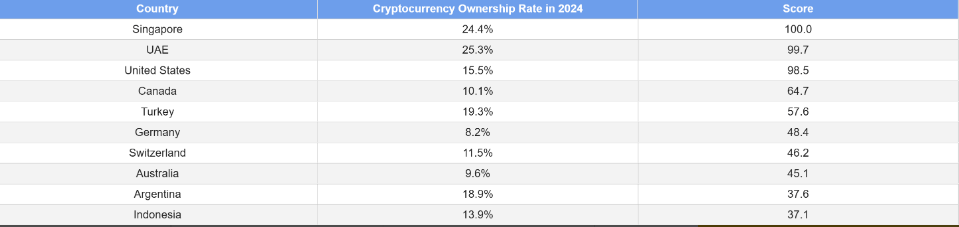
Source: Apex

UAE’s Tax Edge And Rapid Uptake

The UAE is pushing hard to attract users and companies. Based on reports, the country scored a perfect 10/10 on tax-friendliness in one index, and its zero-tax stance on trading, staking, mining, or selling bitcoin across many emirates is a major draw.

Dubai’s Virtual Assets Regulatory Authority (VARA) and other local initiatives have created licensing paths and special zones for digital asset firms.

BTCUSD trading at $113,738 on the 24-hour chart: TradingView

Henley & Partners lists the UAE among the top jurisdictions for crypto wealth, often placing it in the top five for investor-friendly climates. Those policies appear to help explain why roughly a quarter of people in the UAE are reported to hold crypto assets.

Ownership Numbers And What They Mean

Reports place the global number of crypto users in the hundreds of millions — around 562 million by some counts — but that figure hides big differences. Some countries show high ownership because many people treat crypto as an investment.

In others, crypto is used more for payments or savings. Methodologies differ: some studies count any wallet with activity, others rely on surveys asking people if they own crypto.

Featured image from Roslan Rahman/AFP/Getty Images, chart from TradingView

Editorial Process for bitcoinist is centered on delivering thoroughly researched, accurate, and unbiased content. We uphold strict sourcing standards, and each page undergoes diligent review by our team of top technology experts and seasoned editors. This process ensures the integrity, relevance, and value of our content for our readers.

Christian, a journalist and editor with leadership roles in Philippine and Canadian media, is fueled by his love for writing and cryptocurrency. Off-screen, he's a cook and cinephile who's constantly intrigued by the size of the universe.

İlgili Okumalar

Report Interpretation: J.P. Morgan Details Micron's Pre-Earnings Sentiment, Current Hardware Sector Dynamics

Morgan Stanley analyst Joshua Meyers' report (June 21, 2026) highlights key trends in the hardware and semiconductor sector ahead of Micron's earnings. The core takeaways are: 1. **Micron & Memory:** Memory remains a high-conviction long theme, driven by strong AI demand and rising ASPs. However, investor focus is shifting to the sustainability of Micron's >80% gross margins and the specifics of potential new long-term supply agreements (SCAs). 2. **Hardware Supply Chain:** AI-related demand for servers, networking, and storage remains robust, but company performance is diverging. Celestica (CLS) shows improved margin confidence, Western Digital and Seagate benefit from pricing, Fabrinet (FN) sees predictable AI optics growth, and Teradyne (TER) anticipates a new Google customer. 3. **AI Capex & WFE Forecasts:** JPMorgan increased its Wafer Fab Equipment (WFE) market growth forecasts to 28% in 2026 and 29% in 2027. AI infrastructure financing is evolving, with higher project-level debt reducing constraints on capex expansion. The report signals that while the AI-driven hardware cycle is strong, the market is entering a phase focused on execution verification (e.g., Micron's SCA details, Fabrinet's ramp with Amazon) and valuation sustainability. Key near-term signals include Micron's guidance, Arista Networks' outlook, and the pace of demand normalization post potential tariff-related pull-ins.

marsbit6 saat önce

Report Interpretation: J.P. Morgan Details Micron's Pre-Earnings Sentiment, Current Hardware Sector Dynamics

marsbit6 saat önce

Research Report Analysis: The Fed's New Chair's Debut – New Leader, But Same Script?

Report Analysis: Federal Reserve's New Chair Debut – A New Captain, But the Same Script? Morgan Stanley's chief global economist Seth B. Carpenter analyzes the first FOMC meeting under new Fed Chair Kevin Warsh in a June 21 report. Warsh deliberately avoided providing forward guidance on interest rates, aligning with his philosophy. However, market expectations for a rate hike this year were reinforced. Key signals lie elsewhere: inflation may fall more than expected, and quantitative tightening (QT) could be more aggressive than anticipated. The FOMC's "dot plot" suggests only one rate hike in 2026. Carpenter argues that if inflation undershoots forecasts, the logic for even a single hike weakens, especially as projections indicate potential rate cuts in 2027. On QT, Warsh's stance is clear. Carpenter notes that measures like halving the Treasury's account balance could shrink the Fed's balance sheet by around $500 billion with minimal market impact. Combined with adjustments to reserve interest and liquidity rules, the ultimate QT scale may exceed expectations, though its market effect might be less disruptive unless the Fed actively sells Mortgage-Backed Securities (MBS). While Warsh initiated a review of the Fed's policy framework, the 2% inflation target remains intact for now. The report concludes that the market may be overestimating the significance of reduced forward guidance and the near-term rate hike risk, while potentially underestimating the scope and manageable nature of the coming balance sheet reduction. The key debates will hinge on upcoming core PCE data, the specifics of the QT path, and the framework review's findings.

marsbit6 saat önce

Research Report Analysis: The Fed's New Chair's Debut – New Leader, But Same Script?

marsbit6 saat önce

Critical Game Week: BTC Retracement Confirmation vs. HYPE Support Battle | Guest Analysis

This weekly analysis outlines a critical juncture for BTC and HYPE markets, focusing on key price level confirmations. **BTC Analysis:** BTC is at a pivotal point after a five-wave rally from the June 5th low of $59,100. The price has broken below a short-term rising channel's lower boundary, with the current move seen as a pullback to test this breakdown. Failure to reclaim this level could lead to a retest of the $59,000-$60,000 support zone. The core scenario hinges on this channel retest outcome. * **Key Levels:** Resistance at $64,500-$65,000 (channel boundary) and $69,500-$70,500. Support at $59,000-$60,000 and $55,000. * **Strategy:** A core bearish stance is maintained (20% short from last week), with short-term plans for tactical trades. Three detailed contingency plans (A/B/C) are provided for short positions on resistance tests or breakdowns, emphasizing strict stop-loss discipline. **HYPE Analysis:** HYPE shows strong momentum but is currently in a corrective phase after hitting a new high of $76.94. The price is retesting the crucial $64-$66 support area. * **Key Levels:** Resistance near $77 and $80-$82. Support at $64-$66 and $52-$54. * **Strategy:** The short-term approach is "buy on dips, avoid chasing rallies." A long position is considered only if clear stabilization signals appear at the $64-$66 or deeper $52-$54 support zones, with tight risk controls. **General Risk Management:** A standardized trailing stop-loss protocol is emphasized: set initial stop, breakeven at +1% profit, then trail stops upward to lock in gains. *Disclaimer: All analysis is presented as a personal trading framework, not investment advice. Market conditions are complex and require dynamic adjustment.*

marsbit6 saat önce

Critical Game Week: BTC Retracement Confirmation vs. HYPE Support Battle | Guest Analysis

marsbit6 saat önce

İşlemler

Spot
Futures
活动图片